
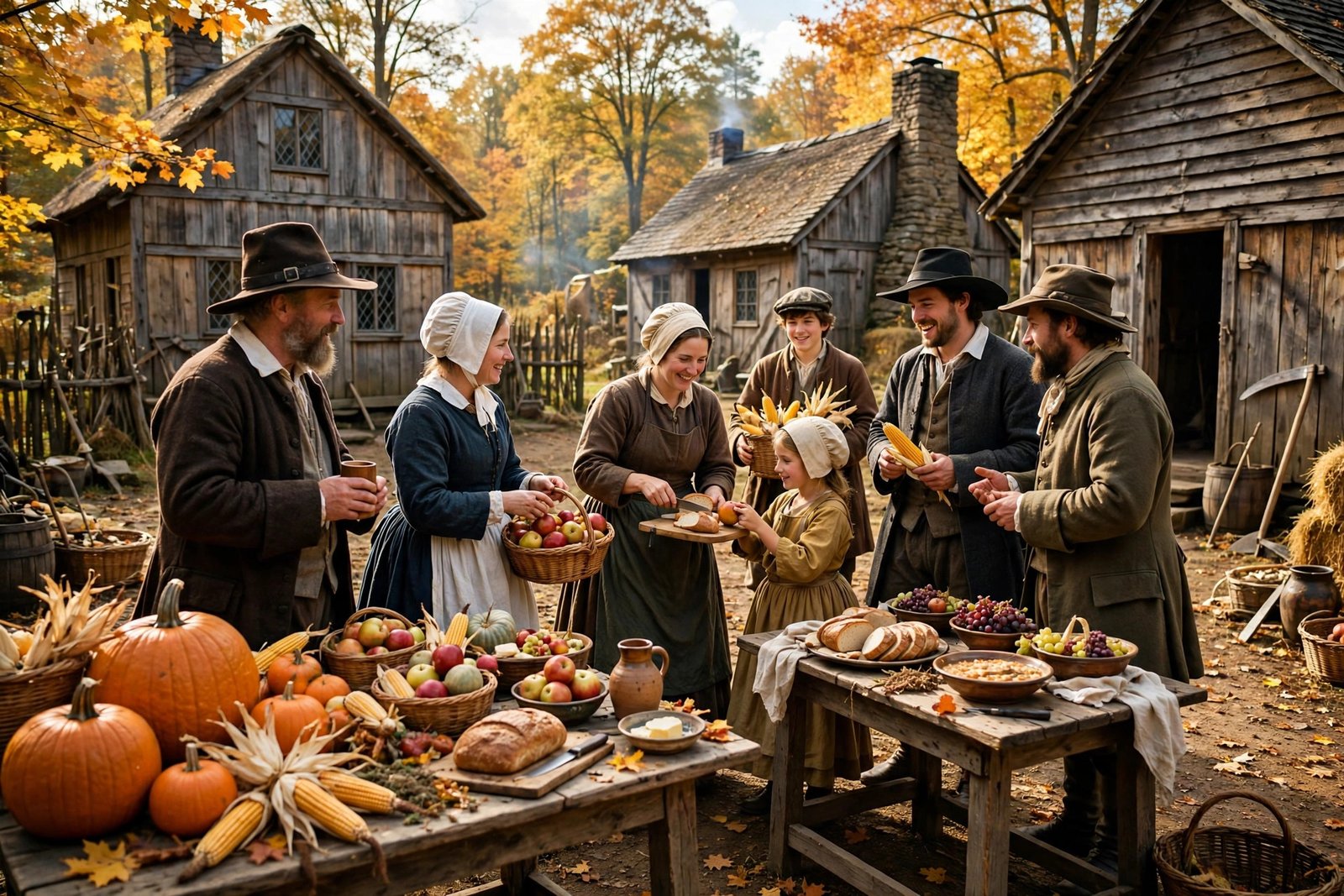
Every November, American families sit down to a meal that most of us picture in the same way: a long table, a roasted turkey, and friendly neighbors sharing food in gratitude. The image is warm, familiar, and mostly invented. The real story of the 1621 harvest gathering at Plymouth is shorter, stranger, and far more interesting than the painting on the greeting card. It involves a harvest, a diplomatic alliance, a people who had already lived in the region for thousands of years, and a celebration that was recorded in only a couple of brief English accounts. Separating what we actually know from what later generations added is the best way to honor the people who were really there.
This is not a story about a single dinner that invented a holiday. The gathering in the autumn of 1621 was a harvest celebration, not a formal Thanksgiving as the English settlers themselves would have understood that term, which for them meant a religious day of prayer. It became known as the First Thanksgiving much later, when a nineteenth-century editor gave it that label. Understanding that distinction does not make the event less meaningful. It makes it more human, because it restores the uncertainty, the diplomacy, and the hard history that surrounded a few days of feasting in a small coastal settlement.
Plymouth Before the Harvest: A Settlement on Hard Ground
The English settlers who arrived on the Mayflower in 1620 settled at a place they called Plymouth, on land the Wampanoag people knew as Patuxet. The site was not empty in any meaningful sense. It was the location of a Wampanoag community that had been devastated by disease in the years before the English arrived, part of a wider epidemic that swept Indigenous homelands in New England from about 1616 to 1619. The cleared fields the settlers found were cleared because people had lived and farmed there, and that history matters to any honest telling of what followed.
The first winter was brutal for the newcomers. They were unfamiliar with the climate, the food sources, and the diseases of a new continent, and many of them died. By the time the harvest of 1621 arrived, the surviving settlers were a small group, and their survival had depended in large part on relationships with their Wampanoag neighbors. They had learned about local crops and foodways, they had negotiated an alliance, and they were still, by any measure, guests in a homeland that was not theirs. The harvest celebration came at the end of that first full growing season, when there was finally enough food to share and a reason to pause.
Tisquantum and Massasoit: The Alliance Behind the Feast
Two figures are central to the story, and both are often flattened into legend. Tisquantum, known in English accounts as Squanto, was a Patuxet man who had been kidnapped by Englishmen years earlier, taken across the Atlantic, and eventually returned to New England, where he found his home village devastated by disease. He spoke English, he understood both worlds, and he served as an interpreter and guide for the Plymouth settlers. His story is one of extraordinary resilience and loss, not simply a helpful footnote to someone else’s holiday.
The other central figure was Ousamequin, the Massasoit, the sachem of the Wampanoag. In the spring of 1621, he entered into an alliance with the Plymouth settlers, a diplomatic agreement forged at a moment when the Wampanoag faced serious pressure from rival peoples, especially the Narragansett, who had been less affected by the epidemic. For Ousamequin, an alliance with the English offered a potential counterweight and access to trade goods. For the settlers, it offered security and a chance to survive. The harvest gathering that autumn should be understood in that diplomatic context, as a moment when an alliance was renewed and displayed, not as a simple act of charity.
What the Primary Sources Actually Say
Here is a fact that surprises many readers: there are only two primary source descriptions of the 1621 harvest event, and both were written by English colonists. The most detailed is a letter by Edward Winslow, written in December 1621 and published in London in 1622 in a pamphlet often called Mourt’s Relation. The second is a brief passage in William Bradford’s history of Plymouth Plantation. Neither account gives us a Wampanoag perspective in the Wampanoag people’s own words, and that gap is itself part of the history. Everything we say about the gathering rests, first, on those two short English texts.
Winslow’s account is worth quoting in modern spelling, because it is short enough to read in full and because it sets the limits of what we know. He wrote that after the harvest was gathered in, the governor sent four men on fowling, so that they might rejoice together in a special manner after gathering the fruits of their labors. Those four men in one day killed as much fowl as, with a little help besides, served the company almost a week. During that time, Winslow wrote, many Native people came among them, including their greatest king, Massasoit, with some ninety men, whom for three days they entertained and feasted. The Wampanoag men went out and killed five deer, which they brought to the plantation and gave to the governor, the captain, and others. That is, in essence, the whole eyewitness record of the feast.
Bradford’s account adds context rather than a menu. He describes the small harvest being gathered in, houses being prepared for winter, and a community recovering in health and strength with food in good plenty. He notes fishing for cod and bass, fowl coming in as winter approached, a great store of wild turkeys, and venison, along with a weekly allowance of meal or Indian corn. Bradford’s passage helps us understand the season and the food landscape of that autumn, but it does not describe the three-day gathering itself in detail.
What Was on the Table, and What Probably Was Not
If you ask what people ate at the 1621 gathering, the honest answer begins with just two foods named in the eyewitness account: wildfowl and venison. Plimoth Patuxet Museums, which studies seventeenth-century foodways in detail, makes exactly this point: the only eyewitness account mentions just venison and wildfowl, and it does not say what else was eaten or how the food was prepared or served. Everything beyond those two foods is an educated guess based on what was seasonally available, what archaeology and period sources suggest, and what each culture commonly ate.
That does not mean the table was bare. It is probable that turkey was present, because Bradford noted a great store of wild turkeys that autumn, even though Winslow does not name turkey specifically for the feast. Corn, beans, and squashes were central to Wampanoag agriculture and to the settlers’ harvest, and foods like pumpkins, nuts, berries, and shellfish were seasonally available in New England in autumn. Historians also note that both cultures enjoyed venison, though in England deer were largely confined to the parks of the landed gentry, so venison carried a different, more celebratory meaning for the English guests than it did for their Wampanoag hosts, for whom hunting was an everyday skill.
Just as important is what almost certainly was not there, at least not in the forms we know today. There is no evidence for sweetened cranberry sauce as we serve it now; cranberries were a seasonal native fruit, but a printed recipe for cranberry sauce sweetened with large amounts of sugar would not appear for about another half century. There is no evidence for mashed potatoes, sweet potato casserole, or pumpkin pie with a wheat-flour crust, because the ingredients and cooking traditions for those dishes were not part of the Plymouth table in 1621. Stuffing a bird with herbs or onions was known in both cultures, but the modern Thanksgiving menu, with its casseroles and pies, is a much later American invention, layered onto a much simpler harvest meal over centuries.
Myth, Memory, and the Wampanoag Perspective
The popular image of the First Thanksgiving took shape long after 1621. In 1841, Alexander Young republished Winslow’s letter in a collection called Chronicles of the Pilgrim Fathers, and in his notes he called the event the first Thanksgiving. From there, the story was retold, illustrated, and eventually taught to generations of schoolchildren as a simple tale of friendship, often without the epidemic, the diplomacy, the land, or the conflicts that followed. The Wampanoag people, in that retelling, often appeared briefly and then vanished from the story, as if their history ended at the feast. It did not, and modern Wampanoag historians and educators have worked to restore a fuller account.
Today, many people approach Thanksgiving with both gratitude and reflection. For Wampanoag people and many other Native Americans, the holiday season is also a time to remember ancestors, to teach accurate history, and to note that the alliance of 1621 did not prevent later dispossession, war, and loss. That is not a reason to stop gathering with family or to stop giving thanks. It is a reason to tell the story more completely, especially to children, by naming the Wampanoag people, by explaining that the feast was also diplomacy, and by acknowledging that we know the English side of the story far better than the Wampanoag side because of whose writings survived.
A good way to talk about this at home is to start with the sources themselves. Read Winslow’s short paragraph together, count what it actually says, and notice what it does not say. Ask who is missing from the account, and why. Visit a museum or a trusted educational resource when you can, and look for Wampanoag voices telling their own history, rather than relying only on retellings from the settler side. The goal is not to spoil a holiday, but to make it richer: a harvest celebration remembered honestly is more worthy of gratitude than a perfect picture that never happened.
From a Harvest Feast to a National Holiday
The road from Plymouth in 1621 to the modern holiday was long and uneven. For generations, days of thanksgiving were proclaimed locally or by individual presidents, on varying dates, rather than observed as a fixed national holiday. George Washington issued a Thanksgiving proclamation in 1789, but the celebration was not yet the annual, nationwide event we know today. The turning point came in the nineteenth century, driven in large part by Sarah Josepha Hale, the editor and writer who campaigned for decades for a national Thanksgiving on a fixed date in November.
President Abraham Lincoln’s proclamation of October 3, 1863, during the Civil War, set aside the last Thursday in November as a day of thanksgiving and praise. It began an unbroken string of annual presidential Thanksgiving proclamations, and it gave the holiday the national shape it retains today. Later, in 1941, Congress passed legislation fixing Thanksgiving as the fourth Thursday in November, resolving a dispute over the date that had flared when President Franklin D. Roosevelt moved the holiday earlier in 1939. The modern holiday, then, is a nineteenth- and twentieth-century creation built around a seventeenth-century memory, not a direct continuation of the Plymouth feast itself.
That history helps explain why Thanksgiving feels both ancient and modern. The foods, the football, the travel, and the family rituals are largely modern American customs. The impulse behind them, to pause after a harvest or at the end of a year and acknowledge what has sustained us, is older and more universal. Knowing the difference lets us enjoy the modern holiday without pretending that a turkey dinner in 2026 recreates a meal in 1621. It also lets us make room, at the same table, for a more honest conversation about whose land we live on, whose history we are retelling, and what gratitude should mean now.
Frequently Asked Questions
Did the Pilgrims and Wampanoag really eat turkey at the first Thanksgiving?
Turkey is not named in Winslow’s eyewitness account of the feast, which mentions only wildfowl and venison. Bradford noted a great store of wild turkeys that autumn, so turkey was probably available and may have been eaten, but we cannot say for certain that it was served at the three-day gathering.
How long did the 1621 gathering last?
Winslow wrote that Massasoit and some ninety men were entertained and feasted for three days. Pilgrim Hall Museum notes that the wider harvest celebration lasted longer, but the Wampanoag delegation’s visit as described by Winslow was three days.
Were the Wampanoag invited to the feast?
The sources do not settle this question in the way a modern invitation would. Winslow describes the English entertaining and feasting their guests, and the Wampanoag contributing five deer. Historians debate whether the visit was planned diplomacy, a response to celebratory gunfire, or a combination of both, and the English accounts alone cannot resolve it.
When did Thanksgiving become a national holiday?
President Abraham Lincoln’s proclamation of October 3, 1863, set aside the last Thursday in November as a national day of thanksgiving. Congress later fixed the date as the fourth Thursday in November in 1941, which is the date observed today.
What is the best way to teach children about the first Thanksgiving?
Start with what the sources actually say, name the Wampanoag people and their homeland, explain the alliance and the diplomacy behind the feast, and be honest about what we do not know. Look for educational resources that include Wampanoag voices, and separate documented facts from later traditions like the modern menu.
Learn more from the sources behind this article: Plimoth Patuxet Museums on what was eaten in 1621, Pilgrim Hall Museum on the First Thanksgiving, and Smithsonian Magazine on Lincoln and Thanksgiving.