
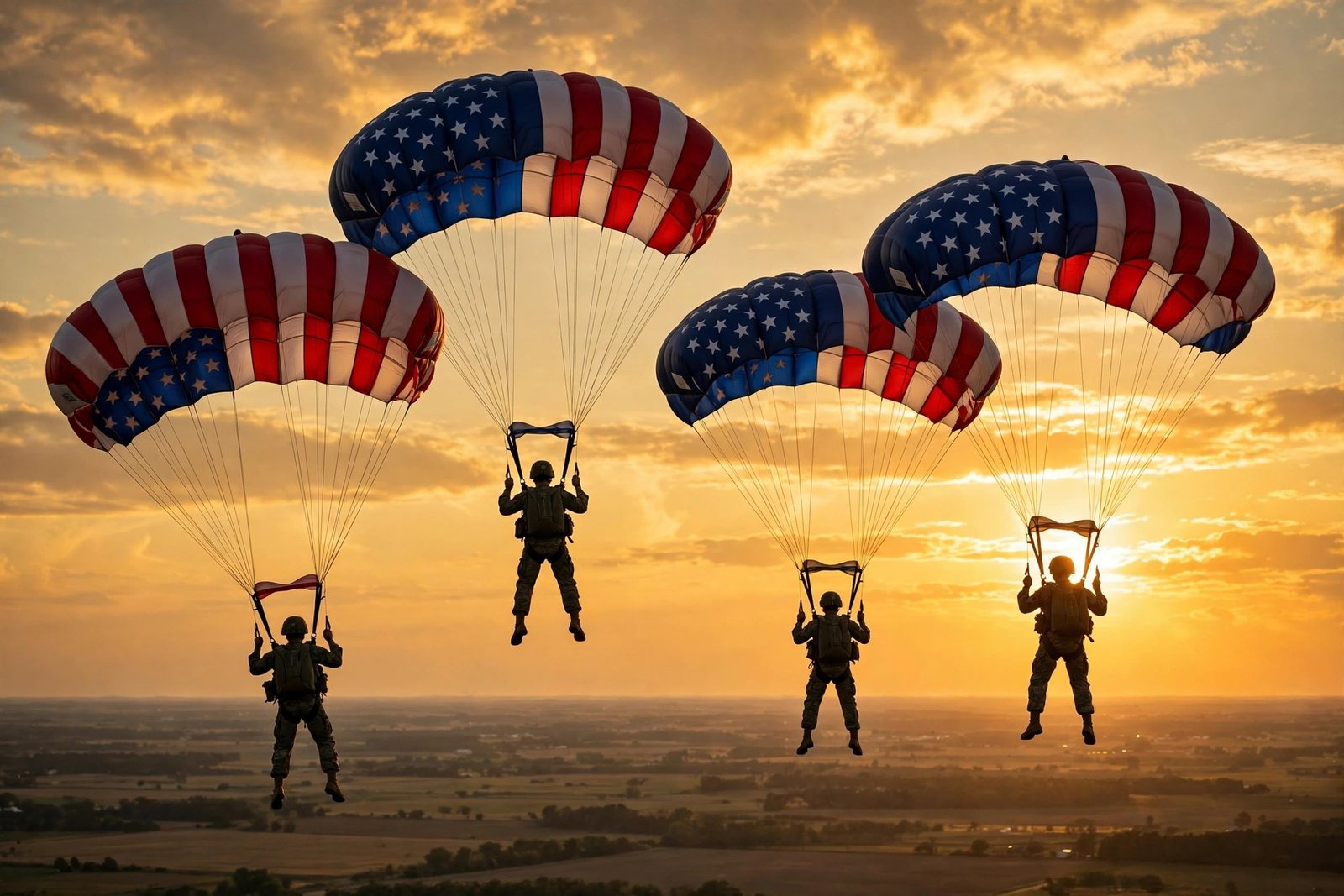
They wear a screaming eagle on their shoulder, and the name fits. The 101st Airborne Division — the Screaming Eagles — is one of the most storied fighting formations in American history. Born in Louisiana in the middle of World War II, the division parachuted into Normandy in the dark hours before D-Day, held the surrounded town of Bastogne against a German onslaught in the dead of winter, and went on to serve in Vietnam, Iraq, and Afghanistan. Its motto, “Rendezvous with Destiny,” was not a boast. It was a promise the division has spent more than eighty years keeping.
This is the story of the Screaming Eagles: where the nickname came from, what they did on the battlefields that made them famous, and what the division does today.
Born at Camp Claiborne: A Division With No History
The 101st Airborne Division was activated on August 16, 1942, at Camp Claiborne, Louisiana. Its first commanding general, Major General William C. Lee, told his new soldiers something remarkable on that first day: the division had no history, but it had a “rendezvous with destiny.” The phrase stuck. It became the division’s motto, and it set the tone for everything that followed — a brand-new unit that would have to earn its reputation from scratch.
The men who volunteered for the airborne were a self-selected breed. Parachuting out of an airplane into enemy territory in 1942 was still a new and dangerous idea, and the training was deliberately brutal. Recruits ran everywhere, marched for miles with full packs, and practiced jumping until it became second nature. The division’s regiments developed fierce identities of their own, including the 506th Parachute Infantry Regiment, whose men — the “Currahees” — trained at Camp Toccoa in Georgia under a regime so demanding it became legendary in its own right.
In September 1943, after more than a year of training, the division shipped out for England, where it prepared for the invasion of occupied Europe. The men did not know when the invasion would come. They only knew that when it did, they would be among the first to go in.
Where the “Screaming Eagles” Name Came From
The division’s famous nickname comes from its shoulder patch: a bald eagle, head thrown back, screaming, set against a black shield. The patch was not invented out of thin air. It reaches back to the division’s roots in the Organized Reserves in Wisconsin, where the eagle recalled “Old Abe,” a real bald eagle who served as the mascot of the 8th Wisconsin Volunteer Infantry Regiment during the Civil War. Old Abe traveled with the regiment through its campaigns and became a beloved symbol of the unit — and, in time, of Wisconsin’s soldiers generally.
The black shield behind the eagle is a second Civil War reference, honoring the Iron Brigade, a hard-fighting formation with Wisconsin ties whose soldiers were known for their distinctive black hats. So when a Screaming Eagle wears the patch today, he or she is carrying two pieces of Civil War heritage onto a modern battlefield. The eagle screams because it is not a passive symbol. It is a bird of prey, mid-cry, and that was exactly the spirit the airborne wanted to project.
D-Day: First Into France
On June 6, 1944 — D-Day — the 101st Airborne Division became one of the first Allied formations to set foot in occupied France. In the hours before dawn, its paratroopers jumped from transport planes into the darkness over Normandy, landing behind Utah Beach. The drops were scattered by flak, weather, and confusion; many men landed miles from their intended drop zones, in flooded fields, hedgerows, and farmyards, often alone or in small groups.
What happened next is part of airborne legend. Instead of waiting to regroup, the scattered paratroopers formed ad hoc bands and went after their objectives anyway. The division’s mission was to seize the causeways leading inland from Utah Beach — the narrow roads across flooded lowlands that the seaborne troops would need to get off the beach — and to disrupt German defenses in the Cotentin Peninsula. By fighting for those exits, the 101st helped make the Utah Beach landings possible, and its men went on to fight through the Norman hedgerows and the town of Carentan in the brutal weeks after the invasion.
The human cost of that kind of fighting is hard to overstate. Paratroopers jumped with little more than what they could carry, far from supply lines, and they fought against an enemy that knew the ground. The division’s performance in Normandy proved that airborne troops could be decisive in a large-scale invasion — not as a gimmick, but as a serious instrument of war. As the U.S. Army itself notes, the 101st’s soldiers were the first Allied troops to set foot in occupied France during the D-Day assault after parachuting in behind enemy lines.
Operation Market Garden: A Bridge Too Far
Three months after D-Day, the 101st jumped again — this time into the Netherlands as part of Operation Market Garden in September 1944, the largest airborne operation ever attempted. The plan was audacious: Allied airborne divisions would seize a chain of bridges across Dutch rivers and canals, opening a corridor for armored forces to drive into Germany.
The 101st fought around Eindhoven and along the corridor to the north, holding roads and bridges against determined German counterattacks. Market Garden ultimately fell short of its boldest goals, and the war would drag on into the winter. But the operation added another chapter to the division’s reputation for holding ground under pressure — a reputation that would be tested to its limit just a few months later.
Bastogne: The Stand That Made the Legend
If Normandy made the 101st famous, Bastogne made it immortal. In December 1944, the division was resting and refitting near Reims, France, after the hard fighting in Holland, when the Germans launched a massive surprise offensive through the Ardennes forest — the Battle of the Bulge. The German goal was to split the Allied armies and seize the vital port of Antwerp. One of the keys to the whole offensive was Bastogne, a small Belgian town where seven roads met. Whoever held Bastogne controlled movement through the Ardennes.
The 101st was rushed to Bastogne in trucks, arriving just ahead of the German encirclement. Within days, the town was surrounded. The division, along with supporting units, held a defensive perimeter around Bastogne while German forces pressed in from every side. The men were short of winter clothing, ammunition, food, and medical supplies. The weather was bitterly cold, the skies were overcast so Allied aircraft could not resupply them, and the fighting was close and constant.
The division’s acting commander during the siege was Brigadier General Anthony C. McAuliffe, who was in charge because the division commander, Major General Maxwell D. Taylor, was away in the United States for a staff conference. When the German commander sent a written demand for the Americans’ surrender, McAuliffe’s reply became one of the most famous single words in military history: “NUTS!” The one-word message, delivered to the German emissaries after a brief deliberation among his officers, told the enemy everything it needed to know about the 101st’s intentions. The division was not surrendering.
The siege continued through Christmas — including a desperate German attack on Christmas Day that briefly broke into American lines — until the 4th Armored Division, part of General George S. Patton’s Third Army, broke through to Bastogne on December 26, 1944, relieving the defenders. The 101st had held the town, and in doing so had wrecked the timetable of the entire German offensive. The division earned the Presidential Unit Citation for its stand at Bastogne, and its men came home with a nickname that captured their defiance: the “Battered Bastards of the Bastion of Bastogne.”
After Bastogne, the division went on the counteroffensive in January 1945, helped liberate the Landsberg concentration camp, and advanced into Germany, seizing Hitler’s mountaintop retreat at Berchtesgaden in the spring of 1945 as the war in Europe drew to a close.
From Parachutes to Helicopters: Vietnam and the Air Assault Era
After World War II, the division was inactivated and reactivated several times, but in 1956 it was reactivated at Fort Campbell, Kentucky, which has been its home ever since. The next great transformation came in Vietnam. In August 1968, the division was redesignated the 101st Airborne Division (Airmobile), trading its parachutes for helicopters. The helicopter changed everything about how infantry moved and fought: troops could be lifted over jungle, mountains, and enemy lines, struck hard, and lifted out again.
The division’s Vietnam service included some of the war’s hardest fighting, including the Battle of Hamburger Hill in 1969, a brutal ten-day assault up a heavily fortified mountain that became one of the most controversial battles of the war. Whatever one thinks of the strategy, the soldiers who fought there embodied the same qualities the division had shown at Bastogne: endurance under fire, and a refusal to quit ground they had been ordered to hold.
In 1974, the division was redesignated once more as the 101st Airborne Division (Air Assault), formalizing the mission it still performs today. The name “Airborne” was kept in honor of the division’s heritage, even though its modern soldiers arrive by helicopter rather than by parachute. The screaming eagle stayed on the shoulder, too — a link between the paratroopers of 1944 and the air assault soldiers of today.
The Screaming Eagles Today
Today the 101st Airborne Division (Air Assault) is based at Fort Campbell, Kentucky, and remains one of the most deployed divisions in the U.S. Army. Its soldiers have served in the Gulf War, in Iraq, and in Afghanistan, and in recent years the division has taken on major roles in Europe and the Middle East, including leading multinational headquarters missions. The Army’s own history of the division describes it as one of the most deployed and recognized divisions in the service, with a combat record stretching from the paratroopers of World War II to the soldiers serving in the Middle East today.
What makes the modern division distinctive is air assault itself: the ability to move an entire infantry force by helicopter, with artillery and supplies slung beneath the aircraft, and to strike deep behind enemy lines or into terrain that wheeled vehicles cannot reach. It is a demanding skill, requiring precise coordination between pilots, infantry, and artillery — and it is the direct descendant of the airborne idea that William C. Lee’s men pioneered in 1942.
The division also maintains a close relationship with the communities and battlefields where it made its name. Every year, veterans, active-duty soldiers, and families gather in Normandy and Bastogne to remember D-Day and the siege. In Bastogne, the people of the town still honor the American soldiers who held their roads in the winter of 1944, and the story of “NUTS!” is told to schoolchildren there as proudly as it is told at Fort Campbell.
Why the Screaming Eagles Endure
Military units come and go, and nicknames fade. The Screaming Eagles have endured for more than eighty years because the name describes something real: a unit that has repeatedly been given the hardest job — jump first, hold the crossroads, refuse to surrender — and has done it.
There is also something deeply American about the division’s story. It began with no history at all, just a general’s promise that it had a rendezvous with destiny. Its symbol came from a Civil War eagle mascot. Its most famous moment was a one-word refusal to quit. And its soldiers have always been ordinary Americans — farm boys from Wisconsin, volunteers from every state — asked to do extraordinary things in the dark, in the cold, and far from home.
That is why the screaming eagle still matters. It is not just a patch. It is a reminder that courage is not the absence of fear or hardship, but the decision, made again and again, to hold the line. From the hedgerows of Normandy to the frozen roads of Bastogne to the mountains of Afghanistan, the 101st Airborne Division has made that decision — and kept its rendezvous with destiny.
Frequently Asked Questions
When was the 101st Airborne Division activated?
The division was activated on August 16, 1942, at Camp Claiborne, Louisiana, under Major General William C. Lee. It is now based at Fort Campbell, Kentucky.
Why are they called the Screaming Eagles?
The nickname comes from the division’s shoulder patch, which shows a screaming bald eagle on a black shield. The eagle recalls Old Abe, the bald eagle mascot of the 8th Wisconsin Volunteer Infantry Regiment in the Civil War, and the black shield honors the Iron Brigade, another formation with Wisconsin ties.
What happened at Bastogne?
During the Battle of the Bulge in December 1944, the 101st held the Belgian town of Bastogne, a vital road junction, while surrounded by German forces. When the Germans demanded surrender, acting commander Brigadier General Anthony C. McAuliffe famously replied “NUTS!” The division held until relieved by the 4th Armored Division on December 26, 1944.
Is the 101st still an airborne division?
The division keeps “Airborne” in its name for heritage, but it is now an air assault division: its soldiers move by helicopter rather than by parachute. It was redesignated the 101st Airborne Division (Air Assault) in 1974, and its official history is documented by the U.S. Army and the Normandy unit history of the 101st. The story of Old Abe, the original Screaming Eagle, is also preserved by Normandy historians.