
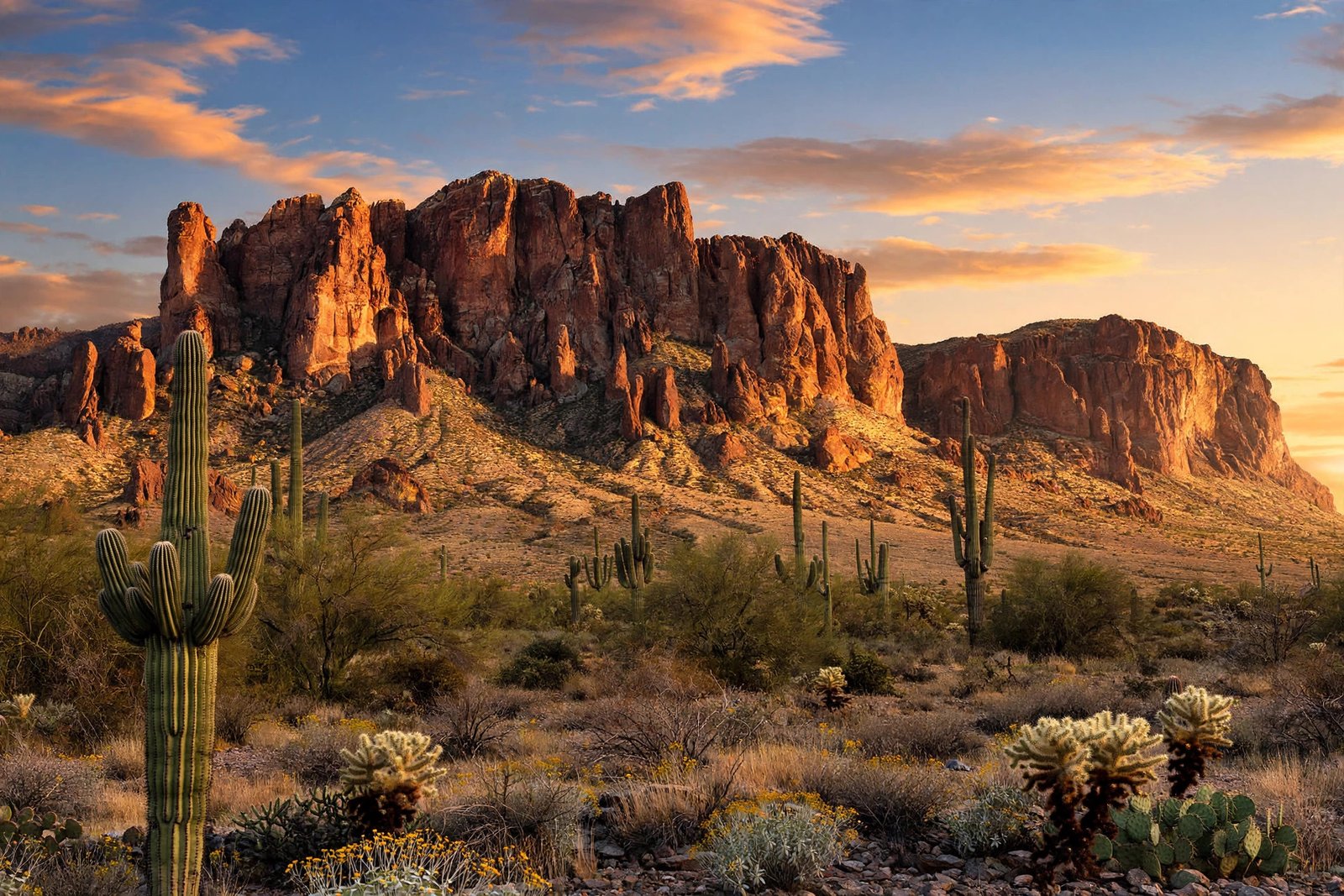
Somewhere in the jagged Superstition Mountains east of Phoenix, Arizona, there is supposed to be a gold mine so rich that it has haunted the American imagination for more than a century. The Lost Dutchman Mine has inspired books, films, songs, and countless expeditions. It has also, by many accounts, cost lives. Every year, people still hike into those dry, sun-baked canyons hoping to be the one who finally finds it. None has ever produced proof.
That is the strange power of this story. It sits exactly on the border between history and folklore. A real man named Jacob Waltz really did live in Arizona in the 1800s, and he really was said to have gold. Beyond that, almost everything depends on which version of the tale you hear. There are dozens of them, and they do not agree.
The Legend in Brief
In the version most people know, the Lost Dutchman Mine is a rich gold deposit hidden in the Superstition Mountains, near Apache Junction, east of Phoenix. It is named after Jacob Waltz, a German immigrant — “Dutchman” was a common, if imprecise, American nickname for a German, from “Deutsch” — who is said to have discovered the mine in the 1800s and kept its location secret until his death in 1891.
According to the legend, Waltz knew where the gold was but refused to tell anyone, except perhaps in a whispered deathbed confession. After he died, treasure hunters picked up the trail. Some claimed to have found old maps, coded clues, or stones engraved with directions. Others simply walked into the mountains with a pick, a canteen, and confidence. The mine became, in the words of Arizona place-name expert Byrd Granger, one of the most retold lost-treasure stories in American history — a tale that, as of the late 1970s, had been printed or cited far more often than the stories of Captain Kidd’s lost treasure or California’s Lost Pegleg mine.
Granger identified 62 variants of the story in 1977, and the number has only grown since. In some versions, Waltz found the mine himself. In others, he learned its location from a member of the Peralta family, a Mexican mining family said to have worked gold in the mountains generations earlier. The details shift, but the core stays the same: fabulous gold, a secret kept too well, and a mountain range that does not give up its secrets easily.
Who Was Jacob Waltz?
Unlike the mine itself, Jacob Waltz was a real person. He was a German immigrant who came to the United States in the 1840s and eventually made his way to Arizona, where he prospected around Prescott before moving closer to Phoenix. Arizona Highways, drawing on the research of longtime Superstition historian Tom Kollenborn, places Waltz’s arrival in Arizona when he was in his fifties, and dates his supposed discovery of a rich gold vein in or near the Superstition Mountains to the spring of 1878.
Waltz lived simply, in a small adobe home near Phoenix, and he was known to his neighbors as a quiet, secretive old man. Witnesses claimed they saw him sell small quantities of gold in Mesa City in 1884, according to Kollenborn’s account. That detail matters, because it is one of the few points where the legend touches something verifiable: people did see Waltz with gold, or at least said they did. What no one could ever establish was where that gold came from.
In February 1891, Waltz fell ill with pneumonia and was taken to the Phoenix home of Julia Thomas, a baker and a close friend. He died there on October 25, 1891, and was buried the next morning in a pauper’s grave in the old Phoenix city cemetery. He left behind no will, no map that anyone could authenticate, and no fortune. That plain, unromantic ending is one of the strongest arguments against the legend — and also, paradoxically, one of the reasons the legend survives.
The Peralta Family Story
Many versions of the legend begin not with Waltz, but with the Peraltas. In these accounts, a Mexican family named Peralta mined gold in the Superstition Mountains in the 1800s, perhaps working a deposit first found by Spanish explorers centuries earlier. The story usually ends in violence: the Peralta party is attacked, most of them are killed, and a survivor — sometimes a dying man — passes the secret of the mine to Waltz and his partner, Jacob Weiser or Wisner, depending on the version.
It is a compelling story, and it has a grain of plausibility. Spanish and Mexican prospectors did work gold deposits across the Southwest, and the Superstitions were known to Indigenous peoples and early settlers long before Waltz arrived. But historians have found no reliable record of a Peralta mining operation in the Superstition Mountains, and the details of the massacre story change so much from telling to telling that it is impossible to treat any single version as history.
Then there are the Peralta Stones: a set of stones engraved with strange symbols and Spanish words, said to be a map to the mine. They surfaced in the 1950s and have been displayed and debated ever since. The problem is that experts who have examined them, including Charles Polzer of the Arizona State Museum, have concluded they are modern fakes, showing evidence of having been cut with modern power tools. A map that was made with a power drill is not a clue from the 1800s, no matter how mysterious it looks.
The Deathbed Confession and Julia Thomas
The most famous scene in the whole legend takes place in Julia Thomas’s house in Phoenix in the autumn of 1891. Waltz, dying of pneumonia, is said to have told Thomas — and sometimes also an old prospector friend named Dick Holmes — where the mine was, or to have drawn or described a crude map. Thomas, in the story, then tried to find the mine herself, and later sold maps and directions to other hopefuls.
Whether Waltz said anything at all on his deathbed is unknowable. He was seriously ill, and the accounts of what he supposedly said were written down later, by people with their own reasons for telling the story. What is known is that the search for the mine began in earnest almost immediately after his death. People have been seeking the Lost Dutchman’s mine since at least 1892, and the search has never really stopped.
The Searchers Who Vanished
The darkest chapter of the Lost Dutchman story is the human cost. The Superstition Mountains are not a theme park. They cover roughly 160,000 acres of rugged volcanic terrain, with summer temperatures that regularly climb past 100 degrees, scarce water, loose rock, and canyons that look confusingly alike. Getting lost there is easy. Getting out again, in July, without enough water, can be impossible.
The legend’s first famous victim was Adolph Ruth, a treasure hunter from Washington, D.C., who went into the mountains in 1931 looking for the mine and never came out. His skull was found months later, and it was matched to his medical records — a grim confirmation that confirmed his identity but not the mine. Ruth’s death made national news and turned the Lost Dutchman from a regional curiosity into a national obsession.
He was not the last. Arizona Highways has noted an estimate of 68 deaths in the Superstition Mountains since the turn of the 20th century, many of them connected to the search for the Dutchman’s gold. In 2010, three hikers from Utah — Curtis Merworth, Ardean Charles, and Malcolm Meeks — went into the mountains looking for the mine and went missing. Their disappearance was widely reported and became a cautionary tale in its own right. More recently, reports of searchers dying in the mountains have continued into the 2020s, a reminder that the legend is not only a story but a real hazard.
It is important to be honest about these numbers. Not every death in the Superstitions is a Dutchman death; hikers die there for ordinary reasons, too — heat, dehydration, falls, and getting lost on trails that are harder than they look. But the mine is the reason many of those hikers were there in the first place, off the marked trails and deep in the backcountry.
What Historians and Geologists Actually Say
Tom Kollenborn, who explored the Superstitions and collected material on the Lost Dutchman for more than seven decades, summed it up bluntly in Arizona Highways: the tale is a mixture of legend, myth, and truth, but “99 percent of it is myth.” That leaves a one percent that keeps people searching — the gold Waltz was said to have sold, the real man behind the story, the genuine Spanish and Mexican mining history of the region. But one percent is not a mine.
Geologists are equally skeptical. The Superstition Mountains are volcanic in origin, formed from ancient lava flows and ash, and they are not the kind of geology that typically hosts large gold deposits. No mining company has ever claimed a major strike there, no geological survey has confirmed mineral deposits matching Waltz’s descriptions, and no one who has claimed to find the mine has ever produced ore that could be verified.
There is also a simpler explanation for Waltz’s gold, if he had any. Some authorities have speculated that the gold he was seen with may have come from an old cache — gold hidden or abandoned by earlier Spanish or Mexican miners — rather than from a mine he worked himself. A cache would explain a small amount of gold in an old man’s hands without requiring a rich, undiscovered deposit.
Visiting the Superstitions Today
For visitors, the good news is that the Superstition Mountains are spectacular even without gold. The range is protected as the Superstition Wilderness inside Tonto National Forest, and it is anchored by Lost Dutchman State Park near Apache Junction, where you can see Weavers Needle — the tall, pointed rock formation that appears in so many versions of the legend as a landmark for finding the mine — rising over the desert.
The Peralta Trail to Fremont Saddle is one of the most popular hikes in the area, a moderately challenging route that offers a fine view of Weavers Needle. The Hieroglyphic Trail leads to rock carvings left by the Hohokam, the Indigenous people who lived in the region centuries before the Spanish arrived. The Superstition Mountain Museum, near the state park, tells the story of the legend with maps, artifacts, and exhibits.
But the mountains demand respect. Hikers should carry far more water than they think they need — a gallon per person per day is the standard advice for desert hiking — start early, stay on marked trails, and tell someone where they are going. Cell coverage is unreliable in the canyons. Summer hiking in the middle of the day is dangerous, and every year, rescue teams are called out for people who underestimated the heat. The legend is fun to read about. The desert is not forgiving.
Why the Legend Endures
Why does a story with so little evidence refuse to die? Part of the answer is the landscape itself. The Superstitions look like a place that would hide a secret: jagged peaks, shadowed canyons, a needle of rock pointing at the sky.
And part of the answer is that the legend is genuinely mysterious. Waltz was real. He did have gold, or people said he did. He did die without telling anyone where it came from. That small, stubborn core of fact is enough to keep the story alive, generation after generation. The mine may be a myth, but the mystery is real — and as long as people love a mystery, the Dutchman will keep drawing them into the mountains.
FAQ
Was Jacob Waltz a real person?
Yes. Jacob Waltz was a real German immigrant who lived in Arizona in the 1800s and died in Phoenix on October 25, 1891. The mine named after him, however, has never been found or verified.
Where is the Lost Dutchman Mine supposed to be?
According to legend, it is hidden in the Superstition Mountains east of Phoenix, Arizona, near Apache Junction, with Weavers Needle often named as a landmark. No location has ever been proven.
Has anyone ever found the Lost Dutchman Mine?
No. Many people have claimed to find it, and books and expeditions have announced discoveries, but no claim has ever been verified by a mining authority, a geological survey, or a government agency, and no verifiable gold ore from the supposed mine has ever been produced.
Is it dangerous to search for the Lost Dutchman Mine?
Yes. The Superstition Mountains are rugged desert wilderness with extreme heat, scarce water, and confusing terrain. Dozens of deaths in the range have been connected to the search, and rescue teams respond to lost and overheated hikers there every year. Visitors should stay on marked trails, carry plenty of water, and hike in the cooler hours.
What are the Peralta Stones?
The Peralta Stones are engraved stones that surfaced in the 1950s and were said to be a map to the mine. Experts, including researchers at the Arizona State Museum, have concluded they are modern fakes, showing signs of being cut with modern power tools.
Related reading
- Skinwalker Ranch: Utah’s Most Mysterious Place
- The Lost Colony of Roanoke: What Really Happened?
- The Bermuda Triangle Mystery Explained
To learn more, see the overview of the Lost Dutchman Mine on Wikipedia and the Arizona Highways account of the legend. The safest way to enjoy the story is from a marked trail, with plenty of water and a healthy respect for the desert.