
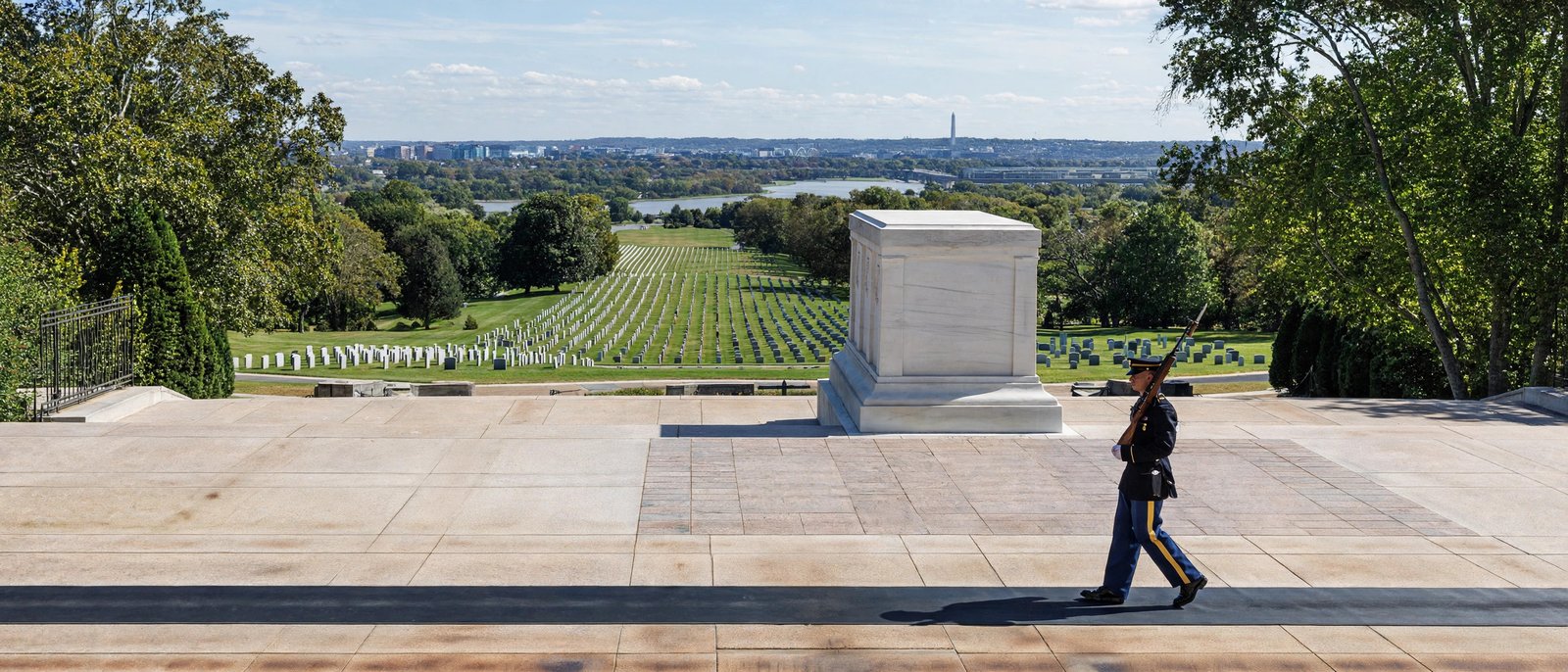
At Arlington National Cemetery, just across the river from Washington, there is a white marble tomb that is never left alone. Day and night, through summer heat, winter snow, hurricanes, and holidays, a single soldier walks a black mat in front of it, rifle on his shoulder, eyes forward. He does not wave. He does not hurry. He counts his steps the same way soldiers have counted them for generations, and when his watch ends, another soldier takes his place without a gap. The tomb has been guarded around the clock since 1937, and the ritual has become one of the most recognizable honors in American military life.
The monument is the Tomb of the Unknown Soldier, and the soldiers who guard it belong to the 3rd U.S. Infantry Regiment, known as The Old Guard. To the crowds who gather to watch the changing of the guard, the ceremony looks like pure precision. To the soldiers themselves, it is something quieter and heavier: a promise to the fallen that no one who died in service to the country will be forgotten, even when their name is lost to history.
This is the story of that promise, how it began, what it takes to keep it, and why a single silent walk still stops visitors in their tracks nearly a century later.
A Tomb Born From Grief
The idea for the tomb grew out of the grief that followed World War I. When the war ended in 1918, the United States, like every nation that fought, faced a painful problem. Thousands of service members had died far from home, and some of their remains could not be identified. Families were left without a grave to visit, and the nation was left without a place to lay its gratitude.
The answer was to bring home one unknown American warrior and bury him with full honors as a representative of all the rest. The chosen soldier was interred at Arlington National Cemetery on Armistice Day in 1921, in a ceremony that drew enormous crowds. The inscription carved on the tomb reads, “Here Rests in Honored Glory an American Soldier Known but to God.” Those words were chosen because they say exactly what the tomb is for: honoring someone whose identity is unknown but whose sacrifice is not.
The original tomb was a simple marble slab. In 1926, Congress authorized a larger, more formal monument, built from Yule marble and designed by sculptor Thomas Hudson Jones and architect Lorimer Rich. The finished structure carries six inverted wreaths representing major World War I battles, along with figures symbolizing peace, victory, and valor. It is a quiet monument, without the scale of a battlefield memorial, and that quiet is part of its power.
The Watch Begins
At first, the tomb was not guarded at all. Visitors could walk right up to it, and some did more than that. According to Arlington National Cemetery, reports of disrespectful behavior, including people climbing on the tomb and leaving trash behind, led to the establishment of a civilian guard in 1925. A military guard followed in 1926, at first only during daylight hours.
In 1937, the guard became a round-the-clock presence, and it has never stopped since. The duty passed to the 3rd U.S. Infantry Regiment, The Old Guard, in 1948, and the regiment has held it ever since. The Old Guard itself dates back to 1784, making it the oldest active-duty infantry unit in the Army, and its soldiers are based at nearby Fort Myer in Virginia, now part of Joint Base Myer-Henderson Hall.
Over time, the tribute grew. After World War II, Americans wanted to add an unknown from that war, but the start of the Korean War in 1950 delayed the plans. In 1956, President Dwight D. Eisenhower approved the selection and interment of Unknowns from both World War II and Korea. The World War II Unknown was selected aboard the USS Canberra, where Navy Hospital Corpsman 1st Class William R. Charette placed a wreath on one of two identical caskets. The Korean War Unknown was selected by Army Master Sergeant Ned Lyle from four candidates. A Vietnam Unknown was interred in 1984, but was later identified through DNA testing as Air Force 1st Lieutenant Michael Joseph Blassie in 1998, and his remains were returned to his family. That crypt was rededicated in 1999 to honor all missing American service members from the Vietnam War.
Twenty-One Steps, Twenty-One Seconds
Every part of the sentinel’s routine carries meaning, and the most famous part is the number 21. The guard marches 21 steps down the black mat behind the tomb, turns and faces east for 21 seconds, turns and faces north for 21 seconds, and then takes 21 steps back down the mat. The number 21 symbolizes the highest symbolic military honor that can be bestowed: the 21-gun salute.
The guard carries an M14 rifle, and the sharp “shoulder-arms” movement places the weapon on the shoulder closest to the visitors. That placement is deliberate. It signifies that the sentinel stands between the tomb and any possible threat. Nothing about the routine is improvised. Every movement has been rehearsed until it is identical from one guard to the next, so that the watch itself never changes even as the soldiers do.
Sentinels are changed every hour in the winter months, from October through March, and every half hour during the warmer months from April through September. The changing of the guard ceremony lasts only a few minutes, but it can take months of preparation to perform it flawlessly. Spectators are asked to stand and remain silent, and most do, because the stillness of the place makes talking feel out of place.
Earning the Badge
Becoming a tomb guard is not an assignment a soldier simply receives. It is a high honor that must be earned through a demanding selection process and intensive training. Each sentinel must study the history of the tomb, master the precise movements of the ritual, and pass a series of challenging examinations before ever taking a watch position alone.
The standards go beyond drill. Sentinels are expected to carry themselves with the same discipline off the mat as on it, because the role is as much about character as it is about marching. The uniform is the Army dress blue uniform, worn to exacting standards, and the guards are known for the extraordinary care they put into every detail, from the shine of their shoes to the crease of their trousers.
The regiment’s own history adds weight to the duty. The Old Guard serves as the Army’s official ceremonial unit, and its soldiers perform honors at the White House, the Pentagon, and state funerals, in addition to their work at the tomb. But the tomb watch is the duty that defines the regiment in the public imagination, and the soldiers who hold it understand that they are standing in for every American who cannot be there.
Storms, Crowds, and Silence
The most famous thing about the guard is that it does not stop for weather. The tomb is guarded around the clock regardless of conditions, and the sentinels have stood their posts through blizzards, heat waves, and hurricanes. That refusal to step away is not stubbornness. It is the point. A promise that pauses for bad weather is not much of a promise, and the guard’s endurance is meant to match the endurance of the sacrifice it honors.
The crowds, too, are part of the story. Millions of visitors come to Arlington every year, and many of them make the walk up the hill to the tomb specifically to watch the changing of the guard. Some arrive carrying private grief, visiting a loved one’s grave elsewhere in the cemetery. Others come simply to pay respects. The guards have pushed back against the idea that they are performers, and the Army emphasizes that the purpose of the ritual is to pay respects, not to put on a show. The stillness is not theatrical. It is disciplined, and the silence is requested because honor requires attention.
There is also a practical side to the watch. The sentinels provide security for the tomb, lead ceremonies, and maintain the sanctity of the space. But their most important job, as Arlington itself describes it, is to honor the Unknowns through the precision and perfection of their rituals. Precision, in this case, is a form of respect. Doing something exactly right, every time, is how the guards say that the people buried here mattered.
What the Tomb Means Today
More than a century after the first Unknown was buried, the tomb still draws people who have no personal connection to any war. Part of the reason is that the Unknowns represent everyone. A visitor does not need to know a name to understand what is being honored, because the tomb stands for all of the service members who never came home, identified or not.
The tomb also reminds Americans that war has a cost that continues long after the fighting ends. The families of the missing live with unanswered questions for decades, and the rededication of the Vietnam crypt to all missing service members from that war was an acknowledgment that some questions never get answered. The tomb does not resolve that grief, but it gives it a place to go.
For the soldiers of The Old Guard, the duty is personal in a different way. They volunteer for it, train for it, and carry it with them long after their watches end. Many former sentinels describe the experience as the defining honor of their military service, not because of the attention, but because of the responsibility. Standing guard over the Unknowns means standing guard over the idea that the nation remembers, and that is a responsibility no soldier takes lightly.
If you visit, the best thing you can do is simple: arrive a little early, stand quietly, and watch. The ceremony lasts only minutes, but the watch it belongs to has lasted for generations, and it will still be going when you leave. That is the whole message. Someone is always there.
Frequently Asked Questions
Who guards the Tomb of the Unknown Soldier? Soldiers from the 3rd U.S. Infantry Regiment, known as The Old Guard, have guarded the tomb since 1948. The regiment is based at Fort Myer in Virginia and is the oldest active-duty infantry unit in the Army.
Why does the guard take 21 steps? The number 21 symbolizes the 21-gun salute, the highest symbolic military honor. The sentinel marches 21 steps down the mat, pauses for 21 seconds facing east, then 21 seconds facing north, before marching 21 steps back.
Is the tomb guarded at night and in bad weather? Yes. The tomb has been guarded around the clock since 1937, regardless of weather conditions, including snowstorms and hurricanes.
How many Unknowns are buried at the tomb? The tomb holds Unknowns from World War I, World War II, and the Korean War. A Vietnam Unknown interred in 1984 was later identified as Air Force 1st Lieutenant Michael Joseph Blassie, and that crypt was rededicated in 1999 to honor all missing service members from the Vietnam War.
Can visitors watch the changing of the guard? Yes. The ceremony is open to the public at Arlington National Cemetery, and visitors are asked to stand and remain silent during it. Guards change every hour in winter and every half hour in summer.
Sources: Arlington National Cemetery: Tomb history fact sheet and Military.com: Tomb of the Unknown Soldier.