
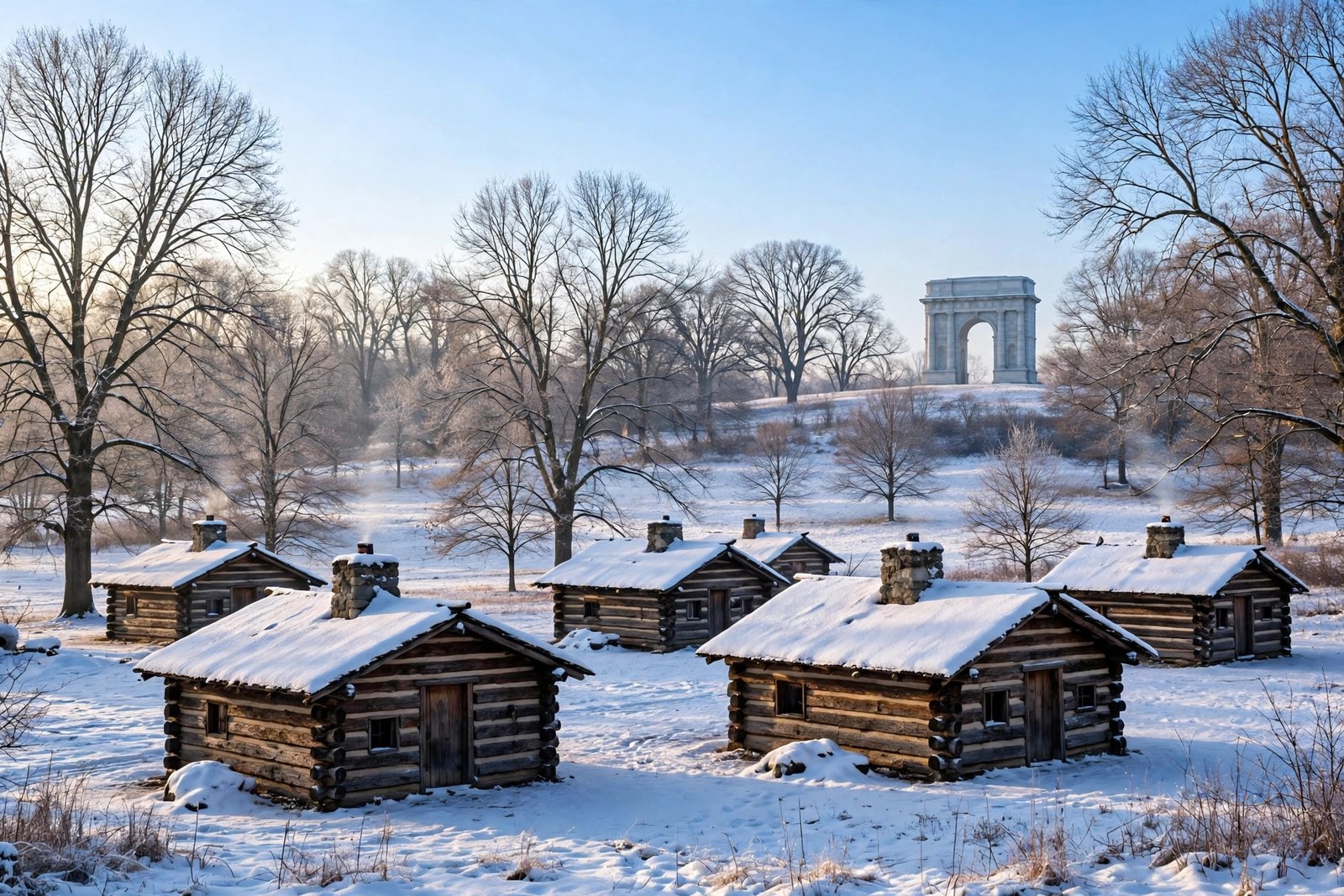
On December 19, 1777, General George Washington led about 12,000 Continental soldiers into a windswept plateau in southeastern Pennsylvania called Valley Forge. They were cold, hungry, and exhausted, and the British army sat just 18 miles away in Philadelphia, the American capital it had captured that fall. No battle was ever fought at Valley Forge. Yet the six months the army spent there, from December 19, 1777, to June 19, 1778, became one of the most famous chapters of the American Revolutionary War.
What happened at Valley Forge was not a victory won with muskets. It was won with endurance, discipline, and training. Roughly 2,000 soldiers died there, most from disease rather than enemy fire. The men who survived marched out in June 1778 as a different army: drilled, organized, and able to stand toe to toe with British regulars.
Why Washington Chose Valley Forge
Washington did not stumble into Valley Forge by accident. After losing the battles of Brandywine and Germantown in the fall of 1777, and after failing to keep the British out of Philadelphia, he needed a place where his army could rest, rebuild, and train through the winter without being surprised by an enemy attack. Valley Forge offered exactly that. The site sat on a defensible plateau above the Schuylkill River, about 18 miles northwest of Philadelphia, close enough to watch the British and block their foraging, but far enough that a surprise attack was unlikely.
It also lay between the British and the Continental Congress in York, and near American supply depots at Reading. The ground was high, wooded, and cut by Valley Creek, which gave the army water and a natural barrier. Washington announced the decision to his generals in early December, and on November 30 he had already decided the army would go into winter quarters rather than risk another battle in its weakened state. His officers, including General Henry Knox, who built fortifications on the surrounding hills, supported the choice. Winter weather and muddy roads also made a major battle unlikely, giving Washington breathing room.
The March In: December 19, 1777
The army that marched into Valley Forge on December 19, 1777, was in rough shape, but the famous image of barefoot soldiers leaving bloody footprints in the snow is only partly true. According to the National Park Service, the soldiers were not downtrodden so much as exhausted and badly supplied. More than 12,000 soldiers, plus about 400 women and children who traveled with the army, arrived that day and immediately set to work building a camp from nothing.
There were no barracks waiting for them. The men had to build their own shelters, and this was the first winter encampment in which thousands of soldiers had to do that. Officers organized construction squads around a standard design: a log hut 14 feet by 16 feet, sealed with clay, with a fireplace at one end, shared by twelve men. By early January the army had raised more than 1,500 huts, two miles of defensive trenches, and five earthen forts called redoubts. From a distance the camp looked like a little city. With its thousands of soldiers and camp followers, Valley Forge became the fourth largest city in America at the time, a diverse community that included free and enslaved African American soldiers, Indigenous people, and European immigrants.
The Supply Crisis: Hunger, Cold, and Bare Feet
The winter at Valley Forge was not the coldest or the snowiest of the war, and historians now know it rained far more than it snowed. The real enemy was logistics. The army’s supply system was collapsing. Congress had no power to tax, the currency was nearly worthless, and the quartermaster and commissary departments were in disarray. Muddy roads meant wagons carrying food and clothing often never arrived.
The crisis peaked in January and February 1778. Army records show that in January the men received an average daily ration of about half a pound of beef per man, and on some days there was no meat at all. Soldiers wrote home about eating fire cake, a tasteless mixture of flour and water baked on a hot stone, and about going days without bread. Clothing was just as scarce. Many men lacked shoes, coats, and blankets, and some wrapped their feet in rags. Washington warned Congress the army might starve or dissolve, and sent foraging parties into the countryside for food, which strained relations with local farmers.
Yet the army did not fall apart. The men improvised, building makeshift clothing and gear, cooking subsistence meals of their own invention, and sharing what little they had. General Nathanael Greene took over as quartermaster general in March 1778 and began untangling the supply system, and by spring the flow of food and clothing was improving. The hunger was real, but it was a failure of organization as much as of plenty, and fixing that system became one of the winter’s quiet achievements.
Disease, the Deadliest Enemy
No British soldier killed the men who died at Valley Forge. Disease did. Historians estimate that between 1,700 and 2,000 soldiers died during the six-month encampment, with some estimates running as high as 2,500. Typhus, typhoid, dysentery, and pneumonia spread quickly through crowded huts where men slept shoulder to shoulder in damp clothing, lice carrying typhus and contaminated water spreading dysentery. About one soldier in six who marched into Valley Forge never marched out.
The toll would have been worse without one of Washington’s most important decisions of the winter. Smallpox was the great killer of eighteenth-century armies, and Washington ordered about 4,000 of his men inoculated against it, using the method of the time, which exposed a healthy person to a mild case to build immunity. It was a bold and risky step, and it worked. Smallpox never swept through the camp the way other diseases did. The army also enforced camp sanitation rules, still new in an era when few understood how disease spread. Even so, burial parties worked through the winter, and the dead were laid in unmarked graves on the hillsides where hundreds of those men still rest.
Baron von Steuben Arrives
The turning point of the winter arrived on February 23, 1778, in the person of a 47-year-old Prussian officer named Friedrich Wilhelm von Steuben. He had served under Frederick the Great, fought in the Seven Years’ War, and come to America after Benjamin Franklin recommended him to Congress. He spoke almost no English, communicating with American officers only in broken French, but Washington gave him a temporary commission as inspector general, with the task of training the army.
Von Steuben started with a model company of about 100 men, drilling them himself on the Grand Parade, the broad open ground at the center of camp. He taught them to march in step, load and fire quickly, fix bayonets and charge, and re-form lines quickly in battle, skills the army had never learned as a single system. Von Steuben swore at the men in German and French while aides translated, and the soldiers loved him for it. Within weeks the model company was teaching the rest of the army, each trained man carrying the lessons back to his regiment.
His training went beyond marching. Von Steuben reorganized the army’s structure, standardized the size of companies and regiments, and introduced a proper system of camp layout, with kitchens, latrines, and parade grounds in set places. Lafayette supported the effort and helped organize the European officers in camp. By spring, visitors to the camp noticed the difference: the ragged crowd of December had become an army that moved as one body.
The Blue Book
Von Steuben wrote down everything he taught, drafting each night’s training plan in French for his aides to translate into English and copy for every regiment. Those notes became a manual called Regulations for the Order and Discipline of the Troops of the United States, published in 1779. Soldiers called it the Blue Book for its blue cover, and it remained the U.S. Army’s basic training guide for more than 50 years.
The Blue Book mattered because it gave the army a single standard. Before Valley Forge, a soldier from Massachusetts and a soldier from Virginia might load a musket differently, march at a different pace, and follow different orders. After Valley Forge, they drilled the same way. That uniformity let Washington maneuver a large army without it falling apart, and it showed within weeks of leaving camp. At the Battle of Monmouth in New Jersey on June 28, 1778, just nine days after marching out, the Continental Army stood its ground against British regulars in a long, hot battle, something it could not have done six months earlier.
Lafayette, Martha Washington, and Life in Camp
Valley Forge was not only soldiers and drills. It was also a community, and two of its most important figures were the Marquis de Lafayette and Martha Washington. Lafayette, just 20, had crossed the Atlantic to volunteer and had been wounded at Brandywine. At Valley Forge he became one of Washington’s closest advisers and commanded a division.
Martha Washington arrived from Mount Vernon in February 1778 and stayed through the spring. She ran the headquarters household, hosted visiting officers and politicians, sewed shirts for soldiers, and organized the officers’ wives into a sewing circle that made clothing for the men. Hundreds of other camp followers cooked, washed, nursed the sick, and carried water, and their labor kept the army functioning. Washington’s headquarters at Valley Forge, a modest stone house near the Schuylkill River, still stands today as one of the most visited historic homes in America.
The French Alliance Changes Everything
In May 1778, news reached Valley Forge that changed the mood of the camp overnight: France had signed a treaty of alliance, recognizing American independence and promising military support. The treaty was the fruit of years of diplomacy by Benjamin Franklin and others in Paris. On May 6, Washington ordered a grand celebration, with the army parading, firing a feu de joie, a rolling volley of musket fire down the line, and cheering for the King of France and American independence.
The alliance did more than lift morale. It meant French money, French ships, and eventually French troops, and it turned a colonial rebellion into an international war that Britain could not win by force alone. Within weeks of the celebration, the British decided to abandon Philadelphia and concentrate their forces in New York. Washington’s army would not have to fight its way out of Valley Forge after all. The road out of camp was open.
Marching Out: June 19, 1778
On June 19, 1778, exactly six months after they had marched in, the Continental Army marched out of Valley Forge. The army that left was smaller, hardened by hunger and disease, but disciplined, organized, and confident, in better uniforms and equipment, drilling to a single standard. Washington led them across New Jersey in pursuit of the British army retreating from Philadelphia, and nine days later at Monmouth they proved what the winter had made of them.
Historians still debate how much of the transformation was Von Steuben’s training, how much was Washington’s leadership, and how much was the simple fact that the men who stayed had chosen to stay. Many soldiers’ enlistments expired that spring, and those who stayed had made a conscious choice to see the war through. That spirit, as much as any drill manual, is what Valley Forge gave the American cause.
Why Valley Forge Still Matters
Valley Forge endures in American memory because it is a story about perseverance rather than victory. No enemy was defeated there, no territory was won, and no famous battle was fought. What happened was quieter and more important: an army learned how to be an army, and a cause that had looked close to collapse found the strength to continue. The name Valley Forge has entered American language as shorthand for enduring hardship for a larger purpose.
Today, Valley Forge National Historical Park preserves about 3,500 acres of the encampment in Pennsylvania, including reconstructed log huts, Washington’s headquarters, miles of trails, and the National Memorial Arch. Nearly two million people visit each year. Walk the ground in winter, when the wind comes off the Schuylkill River and the bare hills look much as they did in 1777. The visitor center and museum explain the encampment with artifacts and exhibits, and rangers lead programs separating myth from fact. The soldiers’ own letters and the army’s records tell of a skilled force that took charge of its own fate and came out stronger.
Related Reading
If you enjoyed this look at Valley Forge, keep exploring American history on Famus News: learn how the Revolution began with the Boston Tea Party of 1773, discover what the flag they fought for means in the stars and stripes of the American flag, and read about the Civil War’s most famous battle in the Battle of Gettysburg 1863.
Frequently Asked Questions
When was the Valley Forge encampment?
The Continental Army camped at Valley Forge from December 19, 1777, to June 19, 1778, a period of six months during the winter of the American Revolutionary War.
How many soldiers died at Valley Forge?
Historians estimate that between 1,700 and 2,000 soldiers died at Valley Forge, some estimates as high as 2,500, almost all from disease, including typhus, typhoid, dysentery, and pneumonia, rather than combat.
Who was Baron von Steuben?
Baron Friedrich Wilhelm von Steuben was a Prussian officer who arrived at Valley Forge on February 23, 1778. As inspector general, he trained the Continental Army in standardized drill, and his manual, the Blue Book, guided the U.S. Army for more than 50 years.
Was there a battle at Valley Forge?
No. No battle was fought at Valley Forge. It was a winter encampment where the Continental Army rested, trained, and reorganized while the British occupied nearby Philadelphia.
Why is Valley Forge considered a turning point?
Valley Forge is considered a turning point because the army that marched out in June 1778 was disciplined, organized, and trained to a single standard, and because the French alliance, announced that spring, brought France into the war on America’s side.
Can you visit Valley Forge today?
Yes. Valley Forge National Historical Park in Pennsylvania preserves about 3,500 acres of the encampment, including Washington’s headquarters, reconstructed log huts, and the National Memorial Arch. The park is open year-round.
Sources: National Park Service, Valley Forge National Historical Park, George Washington’s Mount Vernon, Smithsonian Magazine, World History Encyclopedia, Valley Forge on Wikipedia.