
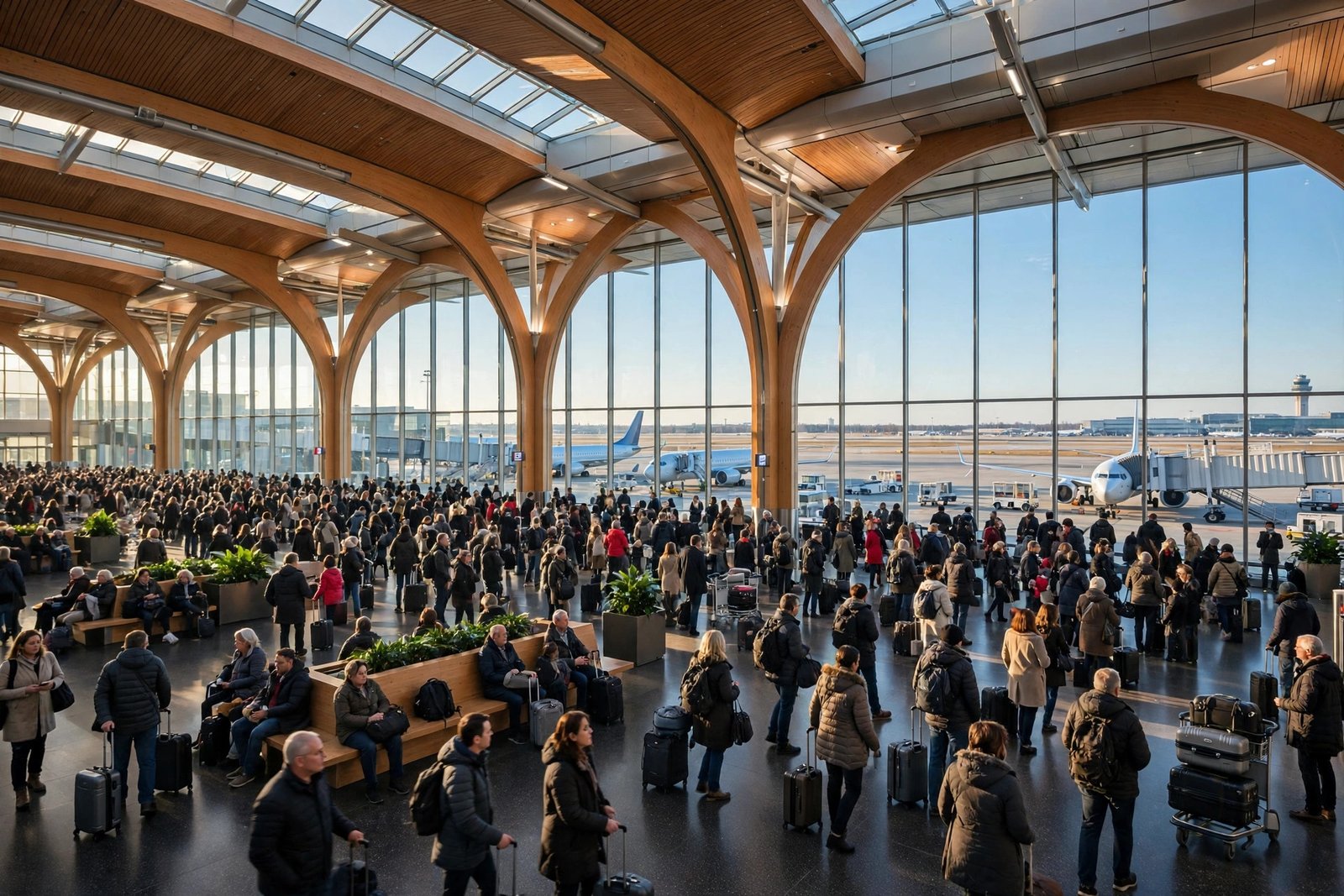
Chicago O’Hare International Airport ground to a brief halt on Monday morning, November 23, 2026, when the Federal Aviation Administration ordered a ground stop on flights bound for one of the busiest airports in the world. The pause lasted about an hour and a half, but it landed at the worst possible moment: the opening days of the Thanksgiving travel rush, with nearly six million Americans expected to fly for the holiday and two powerful storms bearing down on both coasts.
The ground stop began at 10:40 a.m. Central Time, when the FAA told airlines to hold departures bound for O’Hare at their origin airports. By about 12:15 p.m., the restriction had been lifted and operations were returning to normal. For travelers already inside the terminals, the disruption was barely noticeable. For the thousands of passengers booked on flights into Chicago that morning, it was the latest reminder that the American air travel system is running closer to its limits than anyone would like.
“The FAA is briefly pausing flights into Chicago O’Hare International Airport due to staffing constraints at Chicago Terminal Radar Approach Control (TRACON),” the agency said in a statement. The FAA later confirmed that operations were normal at O’Hare after the brief pause, and pointed travelers to real-time airport information on its website.
Thanksgiving falls on Thursday, November 26, this year, and the timing could hardly have been worse. O’Hare is expecting more than one million passengers over the holiday period, and United Airlines alone expected nearly 640,000 passengers to depart from the airport between November 19 and December 1, a 5 percent increase on the previous year. The ground stop was the second major disruption to American air travel in less than two weeks, and it came one day after a technical glitch at Delta Air Lines delayed more than 1,300 flights nationwide.
What Happened at O’Hare on Monday Morning
A ground stop is one of the bluntest tools in the FAA’s kit. When it is issued, aircraft bound for the affected airport are held on the ground at their departure airports rather than being allowed to take off and circle in holding patterns. The idea is simple: if air traffic controllers cannot safely handle the volume of arriving aircraft, it is better to keep planes on the ground than to stack them in the sky.
On Monday, the problem was staffing at Chicago TRACON, the radar facility that manages aircraft arriving and departing in the airspace around O’Hare. The FAA did not immediately explain what caused the specific staffing shortfall on Monday, and further details on what triggered it were not immediately clear. What is clear is that the facility has been running short of controllers for months, and Monday’s stop was the consequence.
The stop initially affected flights departing from several airports across the United States that were bound for Chicago. Departures out of O’Hare itself were delayed by an average of about 15 minutes during the disruption, and the FAA later said departures were facing gate-hold and taxi delays of 15 minutes or less once the stop was lifted. More than 170 flights had been delayed at O’Hare as of 11:55 a.m., though it was unclear how many of those delays were directly attributable to the ground stop itself.
Over a 24-hour period, O’Hare recorded 292 delayed flights and 12 cancellations, according to an airport update. But the numbers tell only part of the story. Every delayed flight into O’Hare ripples outward: crews run out of legal duty hours, aircraft miss their next departures, and passengers miss connections at a hub that serves as a crossroads for the entire country.
Why Staffing Shortages Keep Hitting Chicago TRACON
Monday’s ground stop was not a bolt from the blue. Chicago TRACON has faced staffing shortages in recent months, and the numbers behind the problem are stark. In a letter sent in March to FAA Administrator Bryan Bedford, Illinois Senators Dick Durbin and Tammy Duckworth said the facility had 77 controllers against a staffing target of 102. That is a shortfall of roughly a quarter of the workforce at one of the most demanding radar facilities in the country.
Air traffic controller staffing is a national problem, not a Chicago problem. Training a fully certified controller takes years, and the pipeline of new controllers has struggled to keep pace with retirements and attrition. When a facility is short-staffed, there is less slack in the system. A handful of controllers calling in sick, or a shift that cannot be covered, can be enough to force the FAA to slow or stop traffic.
The consequences are felt most acutely at the biggest hubs. O’Hare is one of the busiest airports in the world, and its TRACON handles an enormous volume of traffic in some of the most complex airspace in the United States. When that facility is short, the FAA’s options narrow quickly: slow arrivals, hold departures, or stop them altogether.
Thanksgiving Travel by the Numbers
The scale of Thanksgiving travel in 2026 is enormous. According to AAA, more than 81 million Americans are expected to travel for the holiday, and 5.96 million of them are expected to fly. That is a slight dip from last year’s figures for air travel, but it still makes Thanksgiving week one of the busiest travel periods of the entire year.
Illinois alone is expected to send more than 350,000 residents into the skies. At O’Hare, the busiest times are expected to be Tuesday night and Wednesday morning, with the Sunday after Thanksgiving also projected to be a heavy travel day. The Transportation Security Administration has warned that the busiest holiday travel day this year will come on the Sunday following Thanksgiving, when millions of Americans fly home at once.
The numbers explain why even a brief disruption matters so much. When nearly six million people are flying in a single week, the system has almost no spare capacity. A 95-minute ground stop at O’Hare does not just delay the flights directly affected. It pushes crews and aircraft out of position, and those knock-on effects can linger for hours after the stop itself has been lifted.
A Week of Airline Chaos
Monday’s ground stop did not happen in isolation. It followed a series of technical problems and operational setbacks, and it came less than two weeks after a nationwide ground stop that briefly halted flights across the entire country.
On Friday, November 13, the FAA imposed a nationwide ground stop in response to a telecommunications failure affecting air traffic control systems across the United States. The stop was the second nationwide ground stop in American history. The FAA issued it out of an abundance of caution while more than 3,500 planes were in the air, and it was lifted at 8:15 p.m. Eastern Time that evening. Transportation Secretary Sean Duffy later confirmed that the outage was caused by a cascading communications issue, triggered by an instability detected within the FAA’s network during routine maintenance at a remote legacy network location. The November 13 disruption affected about 20,000 flights.
Then on Sunday, November 22, a technical issue involving Delta Air Lines’ aircraft weight-and-balance system delayed more than 1,300 flights nationwide. The Delta glitch was an airline problem rather than an FAA problem, but for passengers the distinction hardly mattered. It was the second day in a row of large-scale delays heading into the holiday week.
The pattern is worrying because it suggests a system under strain from multiple directions at once: aging infrastructure at the FAA, staffing shortages at key facilities, and airline systems that can fail without warning. Any one of these problems is manageable on its own. Together, in the busiest travel week of the year, they can compound into real chaos.
Two Storms Threatening Both Coasts
As if staffing shortages and technical glitches were not enough, the weather is about to make things worse. Forecasters are monitoring two major storms that could disrupt flights, close roadways, and create dangerous driving conditions on both American coasts during Thanksgiving week.
On the East Coast, a powerful storm is strengthening off the Southeast coast and could undergo rapid intensification to become a bomb cyclone by the holiday, according to the National Weather Service. The storm is expected to bring soaking rain, potentially damaging winds, and coastal flooding from the mid-Atlantic to the Northeast. The greatest threat of heavy rain falls on Thanksgiving Day along the mid-Atlantic and Northeast coasts, with 1 to 4 inches of rain expected in the Carolinas and the mid-Atlantic and 1 to 2 inches in the Northeast.
The East Coast storm will get its act together on Wednesday, when it forms just off the Southeast. That gives travelers a window early in the week to beat its worst impacts, but anyone flying late Wednesday or on Thanksgiving itself could face serious disruption. Air travel for last-minute passengers could be disrupted late Wednesday or on Thanksgiving anywhere from the Carolinas to the major hubs around New York City, and potentially as far west as Chicago. Powerful winds will accompany the heavy rain through at least Friday night, with gusts of more than 50 miles per hour along the coast and more than 40 miles per hour inland into the I-95 corridor. Power outages and tree damage are possible.
The storm will also coincide with the highest tides of the month, producing serious coastal flooding from the Carolinas northward. Major flooding is possible in Charleston, South Carolina, during Wednesday morning’s high tide, and minor to moderate coastal flooding is also likely as far north as the Chesapeake Bay. A high wind watch is in effect for most of the New Jersey coast, where gusts of up to 60 miles per hour are possible.
On the West Coast, a separate Pacific storm is bringing rain, wind, and mountain snow from Northern California to Washington state, starting later on Monday and continuing into the week. The storm coincides with exceptionally high king tides triggered by Tuesday’s full moon. In San Francisco Bay, high tides could surge more than 8 feet, and dangerously large breaking waves of 20 to 30 feet could slam Pacific Coast beaches on Wednesday. As of Monday morning, the National Weather Service had issued coastal flood warnings from San Francisco to the southern coast of Washington, and forecasters warned that tides could near records and threaten airports in the San Francisco Bay area by midweek.
Taken together, the two storms mean there is almost no corner of the country where Thanksgiving travel is guaranteed smooth. The East Coast gets its worst weather on Wednesday and Thursday. The West Coast gets its storm starting Monday and Tuesday. The middle of the country looks calmer early in the week, but rain spreading across the South on Wednesday could cause delays at the big Atlanta and Charlotte hubs, and those delays would ripple across the country. The storms even threaten the Macy’s Thanksgiving Day Parade, which is marking its 100th parade this year.
What Travelers Should Do Now
If you are flying for Thanksgiving, the most important thing you can do is stay informed and stay flexible. Check your flight status before you leave for the airport, and keep checking it. Airlines will often rebook passengers automatically when a flight is delayed or canceled, but it helps to know your options before you arrive at the terminal.
Fly early in the day if you can. Morning flights are less likely to be affected by delays that build up over the course of the day, and if something does go wrong, there are more later flights available for rebooking. Tuesday is shaping up to be a better travel day than Wednesday across most of the country, so if you have any flexibility, travel before the East Coast storm arrives.
Pack essentials in your carry-on: medication, a phone charger, a change of clothes, and anything you would need if your checked bag is delayed by a day. If you are driving, check road conditions and coastal flood warnings before you set out, and allow extra time. Driving could be dangerous in the Carolinas and parts of the mid-Atlantic on Wednesday night, with pockets of flash flooding possible.
Monday’s ground stop at O’Hare lasted less than two hours, and operations returned to normal the same afternoon. But it was a warning. With record crowds, short-staffed control towers, aging systems, and two major storms converging on the holiday, Thanksgiving 2026 is shaping up to be a test of the American air travel system.
Related Reading
- Thanksgiving Travel Forecast 2026: AAA Expects 81 Million Americans on the Move
- Thanksgiving Travel 2026: Best and Worst Days to Fly and Drive
- Thanksgiving Weather Forecast 2026: What to Expect Across the USA
FAQ
How long did the O’Hare ground stop last?
The ground stop began at 10:40 a.m. Central Time on Monday, November 23, 2026, and was lifted by about 12:15 p.m. Central Time, lasting roughly an hour and a half. The FAA confirmed afterward that operations were normal at Chicago O’Hare International Airport.
Why did the FAA order a ground stop at O’Hare?
The FAA said it was briefly pausing flights into O’Hare due to staffing constraints at Chicago Terminal Radar Approach Control (TRACON), the radar facility that manages arriving aircraft. The FAA did not immediately explain what caused the specific staffing shortfall that day. The facility has been running short of controllers for months, with 77 controllers against a staffing target of 102, according to a March letter from Illinois Senators Dick Durbin and Tammy Duckworth.
How many people are flying for Thanksgiving 2026?
According to AAA, 5.96 million Americans are expected to fly for Thanksgiving 2026, as part of more than 81 million Americans traveling overall. O’Hare is expecting more than one million passengers over the holiday period, and United Airlines alone expected nearly 640,000 passengers to depart from the airport between November 19 and December 1.
Will storms disrupt Thanksgiving travel?
Yes, forecasters expect disruption. A powerful storm off the East Coast could become a bomb cyclone, bringing heavy rain, winds over 50 miles per hour, and coastal flooding to the mid-Atlantic and Northeast on Wednesday and Thanksgiving Day. A separate Pacific storm is bringing rain, wind, and mountain snow to the West Coast, coinciding with record king tides. Air travel could be disrupted from the Carolinas to New York and potentially as far west as Chicago.
What should I do if my Thanksgiving flight is delayed or canceled?
Check your flight status before leaving for the airport, and keep checking it. Airlines will often rebook you automatically, but knowing your options helps. Fly early in the day when possible, pack essentials in your carry-on, and allow extra time for every step of the journey. If you are driving, check road conditions and coastal flood warnings first.