
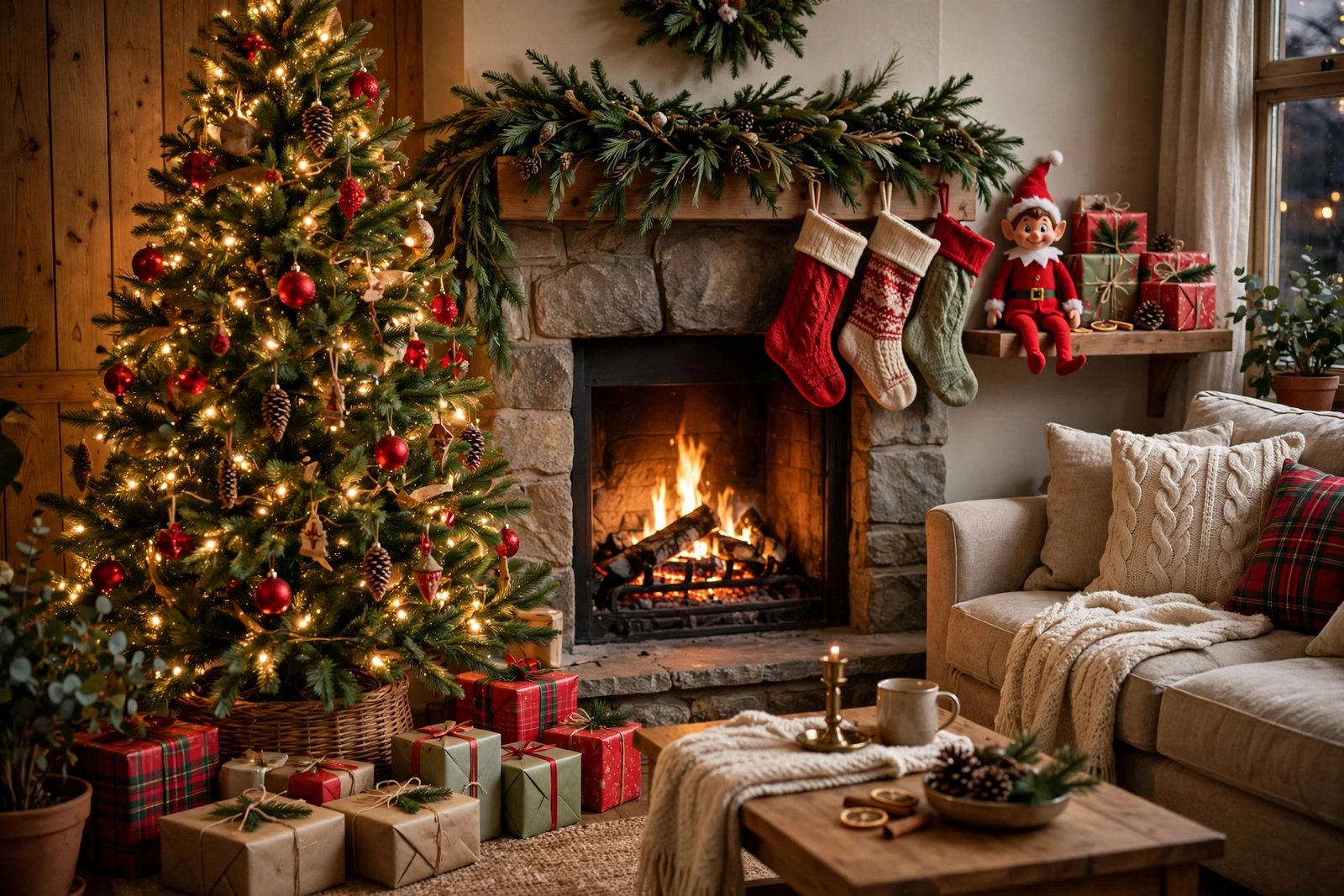
Every December, in millions of American homes, a small elf in a red suit appears in a new hiding spot. One morning he is perched on the mantel. The next, he is hanging from the chandelier, hiding in the cereal box, or taking a marshmallow bath in the kitchen sink. Children race out of bed to find him, parents stay up late moving him, and the whole house plays along with a game that has become one of America’s favorite Christmas traditions.
That elf is the Scout Elf from The Elf on the Shelf, a book and toy that began as one family’s private holiday game and grew into a Christmas phenomenon. This year marks the 20th anniversary of the book, and the tradition is bigger than ever, with new characters, television specials, a stage musical, and even a video game. Here is how it started, how it works, and how to make it your own.
The Family Story Behind the Elf
The story begins in 1974, when a small elf named Fisbee arrived from the North Pole to visit the household of Bob and Carol Aebersold in Georgia. Fisbee watched over their three children, Chanda, Christa, and Brandon, finding new hiding places around the family home after reporting back to Santa each night. Carol told her children that the pixie-looking elf was watching them and would report any bad behavior to Santa in the days leading up to Christmas.
The children grew up, but the memory of Fisbee stayed with them. Years later, when Chanda Bell had her first child, she wanted to continue the tradition in her own home, but she could not find anything on the market like her treasured Fisbee. So in 2004, Bell and her mother, Carol Aebersold, both former schoolteachers, sat around the kitchen table and wrote the story of The Elf on the Shelf, honoring their family and their favorite elf.
In 2005, Carol and Chanda self-published The Elf on the Shelf: A Christmas Tradition. No publisher wanted to take the book, so the family funded it themselves. Bell took on credit card debt, Christa Pitts sold her house in Pennsylvania, and their parents cashed in their retirement savings to fund 5,000 copies of the book, along with the doll that came with it. They held their first book signing at the Marietta Museum of History in Marietta, Georgia, and sold out of the initial 5,000 box sets. Christa, who had experience as an on-air host at QVC, then left her job, and the three women launched the family business that became The Lumistella Company, based in the Atlanta area.
How the Tradition Works
The idea is simple, and that is a big part of its charm. Each adoption kit includes the picture book and a Scout Elf doll. The book suggests starting the tradition the day after Thanksgiving, when the Scout Elf arrives from the North Pole to watch over the family through December.
Every day, the elf quietly observes the children, keeping track of who has been naughty and who has been nice. Each night, after the children have gone to bed, the elf flies back to the North Pole and reports the day’s events to Santa, helping him manage his Nice List. Before the children wake up, the elf returns and takes up a new position somewhere in the house, sometimes in a plain spot on a shelf, sometimes in the middle of a little scene of mischief. The family wakes up to a daily game of hide-and-seek.
Children are encouraged to share their Christmas wishes with their elf, who is a great listener even though it cannot talk back. The elf gets its Christmas magic once it is given a name, which is why the book ends with a page for families to record the elf’s name and adoption date. Names like Buddy, Snowflake, Jack, and Scout are among the most popular.
The Three Rules Every Family Should Know
The official tradition has just three rules, and they are the backbone of the whole game. First, and most important, do not touch your Scout Elf, or the elf will lose its magic. Elves are fragile and sensitive to touch, and if a child touches one, it can no longer fly back to the North Pole to report to Santa. Parents are the one exception: they can touch the elf when they need to help it move to a new hiding place.
Second, Scout Elves cannot talk, but they are great listeners. The elf sits still and silent during the day, watching over the house, and children can whisper secrets and wishes to it as often as they like. Third, Scout Elves must return to the North Pole on Christmas Eve to help Santa prepare for the next Christmas. On Christmas Eve, the elf’s mission is complete, and it stays at the North Pole until the next season.
Families have also worked out what to do when the rules get broken. If someone accidentally touches the elf, the official guidance offers three ways to restore its magic: write Santa an apology note, sprinkle cinnamon next to the elf, since the spice acts like a vitamin for elves, or sing the elf a Christmas carol. Parents also use tongs or a potholder to rescue a fallen elf rather than grabbing it with bare hands.
When Does the Elf Arrive, and When Does It Leave?
There is no single set date for an elf to appear, and that flexibility is part of the fun. The book suggests starting the day after Thanksgiving, and the official website says Elf Return Week falls between November 24 and December 1, so most families can expect their elf to arrive around then. Some elves show up with the Thanksgiving leftovers still in the fridge. Others make a grand entrance in the first week of December, sometimes arriving with a little note, a tiny suitcase, or a trail of glitter.
The elf stays through the whole season, moving to a new spot every night until Christmas Eve. That final night is the finish line: the elf flies home with Santa, or stays behind at the North Pole to help prepare for next Christmas. Many families make the farewell special, leaving a goodbye note from the elf or a small gift behind.
That month-long rhythm is what makes the tradition feel like a real countdown. Unlike an advent calendar, which simply marks the days, the elf gives children something to look for every morning, and gives parents a reason to be a little bit creative every night.
Why Families Love It
Ask parents why they keep the tradition going, and the answers are remarkably consistent. First, it builds anticipation: December can feel endless to a child, and the elf turns the wait for Christmas into a daily treasure hunt.
Second, it gives families a shared ritual. In a month crowded with shopping lists, school concerts, and holiday parties, the elf is a small, daily moment that belongs to the household alone. Many parents say the nightly move is their favorite part of the day, a quiet, silly ritual after the kids are asleep.
Third, it encourages good behavior in a way that feels like play rather than punishment. The elf is not a threat; it is a witness. Children know the elf is watching and reporting to Santa, and for many of them, that is enough to think twice before grabbing a sibling’s toy or leaving the dishes in the sink.
And finally, it is a tradition families make their own. Some elves are elaborate pranksters, zip-lining across the living room on candy canes. Others are quiet observers who simply move from shelf to shelf. There is no wrong way to do it, and that freedom is why the tradition has survived and spread.
Creative Elf Ideas for Every Night
The hardest part of the tradition is not the rules. It is coming up with a new spot every single night for a month. Parents who have done it for years swear by a few strategies, and the ideas below work for beginners and veterans alike.
Start simple. The elf does not need a production every night. Some of the best-loved spots are the easiest: peeking out of a stocking, sitting in the Christmas tree, reading a book in the bookshelf, or hiding behind the cereal boxes at breakfast. Simple nights keep the tradition sustainable, and they make the big nights feel special.
Use what is already in the house. A roll of toilet paper becomes a snowman outfit, a handful of marshmallows becomes a bubble bath, and a candy cane becomes a fishing pole over a sink of blue tissue paper. The kitchen is the elf’s favorite playground, and most classic scenes need nothing more than pantry items.
Let the elf get into a little mischief. The most photographed elf moments are the naughty ones: the elf drawing a mustache on a family photo, wrapping the toilet in streamers, making snow angels out of flour on the counter, or eating the cookies meant for Santa. Mischief is the elf’s personality, and children love finding evidence of it in the morning.
Write little notes. A short message from the elf, praising a kind act or reminding the family about a holiday event, makes the tradition feel personal. Some families leave a note every night. Others save them for the first night, the night before a school concert, or the farewell on Christmas Eve.
Plan ahead, just a little. Parents who keep a short list of ideas on their phone, or set a nightly reminder after bedtime, say it takes the stress out of December. A few minutes of planning saves a frantic search for inspiration at midnight.
Elf Pets, Movies, and a Growing Christmas Universe
The Scout Elf is no longer alone. Since the book’s release, The Lumistella Company has grown into a publishing house, toy company, and licensing business, with 24 books based on the elf and a partnership with HarperCollins to publish more. The company has added Elf Pets, including a Saint Bernard, a reindeer, and an Arctic fox named Noorah, who arrived in 2023. There is an animated television special, a stage musical, and an official Elf on the Shelf Snowball Fight game on Roblox.
The elf has also become a pop culture fixture. In 2007, paparazzi photos of Jennifer Garner carrying the book and doll, followed by a segment on NBC’s Today show, helped launch the company into the national spotlight. The elf made its debut as a balloon in the Macy’s Thanksgiving Day Parade in 2012, and it has appeared in McDonald’s Happy Meals in Europe, as a cereal, and in four Netflix specials.
For the 20th anniversary in 2025, the company introduced new characters like Razzle the Snowman and a range of limited-edition collectibles. The Lumistella Company has also launched an inbound licensing program, partnering with Disney and Warner Bros. to bring familiar characters into Scout Elf traditions. What began as a single elf on a shelf in one Georgia family home is now an entire Christmas universe.
Making the Tradition Your Own
The best advice for families starting the tradition this year is to keep it joyful and low-pressure. You do not need the most elaborate elf on the block. The magic is not in the staging; it is in the morning moment when a child finds the elf and lights up.
Some families adapt the rules to fit their household. Younger children may be allowed to hold the elf gently on Christmas Eve, or to give it a goodbye hug before it flies home. Some families use the elf to celebrate kindness, leaving notes that praise sharing, helping, and patience rather than focusing on the naughty list. Others pair the elf with a giving tradition, like donating a toy for every day the elf visits.
It is also worth remembering where the tradition came from. Carol Aebersold and her daughters built it out of a childhood memory, funded it with their own savings, and were turned away by publishers before they decided to publish it themselves. The elf survived because families loved it enough to pass it on, one kitchen table at a time. Twenty years later, that is still how it spreads: a parent remembers Fisbee, or a friend’s elf, and decides to bring one home.
So this December, when the elf arrives, give it a name, find it a good shelf, and enjoy the hunt. The mornings will go fast, the elf will be back at the North Pole before you know it, and the memories will last a lot longer than the season.
Learn more from the official Elf on the Shelf guide, the Lumistella Company story, the Mental Floss history of the 20th anniversary, the Story Exchange profile of the women behind the elf, the Romper guide to the elf rules, the Parade list of elf rules every parent should know, and the Wikipedia overview of The Elf on the Shelf.
Related Reading
If you enjoyed this story, you may also like these articles from Famus News:
- The American Christmas Tree Tradition: A Complete Guide
- Christmas Cookie Exchange: An American Tradition
- National Christmas Tree Lighting 2026: What to Know
FAQ
What is The Elf on the Shelf?
The Elf on the Shelf is a Christmas tradition based on a 2005 children’s book by Carol Aebersold and her daughter Chanda Bell. A Scout Elf doll arrives from the North Pole, watches the children during the day, flies back to report to Santa each night, and returns to a new hiding spot every morning until Christmas Eve.
When did The Elf on the Shelf start?
The tradition began as a family game in the Aebersold household in 1974, when an elf named Fisbee watched over the children. Carol Aebersold and Chanda Bell wrote the book in 2004 and self-published it in 2005, funding the first 5,000 copies themselves.
What are the rules of Elf on the Shelf?
There are three official rules: do not touch the Scout Elf, or it will lose its magic; Scout Elves cannot talk, but they are great listeners; and the elf must return to the North Pole on Christmas Eve. Parents may touch the elf to help it move.
When does the elf arrive and leave?
The book suggests starting the day after Thanksgiving, and the official website says Elf Return Week falls between November 24 and December 1. The elf leaves for good on Christmas Eve, when it returns to the North Pole to help Santa prepare for next Christmas.
What happens if a child touches the elf?
According to the tradition, the elf loses its magic and cannot fly back to the North Pole. The official guidance offers three ways to restore it: write Santa an apology note, sprinkle cinnamon next to the elf, or sing the elf a Christmas carol.