
On a dark autumn night in a quiet valley in New York, a lanky schoolteacher rides home alone after a harvest party, his head full of ghost stories. Behind him, a rider on a great black horse draws closer, and when the stranger turns in the moonlight, the schoolteacher sees the impossible: the rider has no head. It is one of the most famous scenes in American literature, and more than two hundred years after Washington Irving first wrote it down, the Legend of Sleepy Hollow still sends a shiver down the spine of everyone who hears it. The Headless Horseman has become the unofficial mascot of Halloween in America, and the real village of Sleepy Hollow, New York, has built a whole season of festivals around him. But how much of the tale is true, and how much did Irving invent? The legend sits right on the line between history and imagination, and that is what makes it so enduring.
The Story Washington Irving Told
The Legend of Sleepy Hollow was first published in 1820 as part of Washington Irving’s collection The Sketch Book of Geoffrey Crayon, Gent. Set around 1790 in a secluded valley near Tarrytown, New York, it tells of Ichabod Crane, a tall, thin, deeply superstitious schoolteacher from Connecticut who has come to teach the local children and, if he can manage it, marry his way into money. Ichabod sets his sights on Katrina Van Tassel, the beautiful only daughter of Baltus Van Tassel, one of the richest farmers in the area. Katrina is also courted by Abraham Van Brunt, known as Brom Bones, a big, brawny local hero who has no patience for a rival schoolteacher.
The contest comes to a head one autumn evening at a harvest party at the Van Tassel farm. Ichabod rides there on a borrowed old plow horse named Gunpowder, eats heartily, dances, and listens as the older men trade ghost stories, above all the tale of the Headless Horseman. According to the local legend, the Horseman is the ghost of a Hessian soldier, a German trooper fighting for the British, who had his head shot off by a cannonball during the Revolutionary War. He is said to be buried in the churchyard of the Old Dutch Church, and every night he rides out in search of his missing head. The stories say he cannot cross the wooden bridge over the Pocantico River near the church. After the party, Ichabod lingers to make his proposal to Katrina, but she turns him down, and he rides home crestfallen and alone in the dark.
On the lonely road, his imagination runs wild. Then a huge rider on a powerful black horse falls in beside him, matching his pace no matter how fast he rides. When Ichabod looks across, he sees that the rider carries his head under his arm. Terrified, Ichabod spurs Gunpowder into a gallop and races for the church bridge, believing that crossing it will save him. He almost makes it. At the bridge, the rider rears up and hurls his head straight at Ichabod, knocking him to the ground. In the morning, Gunpowder is found grazing peacefully by his master’s gate, but Ichabod Crane has vanished. All that is found near the bridge is his hat and a smashed pumpkin.
Who Was Washington Irving?
Washington Irving was born in New York City on April 3, 1783, and died in Tarrytown, New York, on November 28, 1859. He is often described as the first American man of letters, and his two most famous stories, The Legend of Sleepy Hollow and Rip Van Winkle, are frequently called the first American short stories. Both appeared in The Sketch Book, published in installments in 1819 and 1820, and both were Americanized versions of older German folktales. Irving wrote the collection while living in England, where he had gone in 1815 to look after his brothers’ business, and its success allowed him to make his living as a writer, something almost no American author had managed before.
Irving knew the Hudson Valley well. He had made trips up the river as a young man, and he later settled at Sunnyside, his home in Tarrytown, where he spent most of the rest of his life except for four years as the American minister to Spain. He is buried in Sleepy Hollow Cemetery, a short walk from the Old Dutch Church. He did not invent Sleepy Hollow out of thin air. He took a real place, with real Dutch families, a real church, and real Revolutionary War history, and wove a ghost story through it so skillfully that visitors have been coming to check the facts ever since.
The Headless Horseman: Ghost or Trick?
Here is the question that has kept readers arguing for two centuries: was the rider a ghost, or was it Brom Bones in disguise? Irving never answers it, and that is the genius of the story. Irving leaves the Horseman’s nature open to interpretation, and the clues point in both directions. Ichabod’s superstitious mind is primed to believe in ghosts after a whole evening of ghost stories. On the other hand, Brom Bones, who had every reason to want his rival gone, knew the local legends well enough to stage the perfect scare.
Consider the evidence. The rider appears just after Ichabod has been rejected by Katrina, when Brom’s path to marrying her is suddenly clear. The rider’s horse is big and black and powerful, much like the horses Brom and his gang rode. The “head” that is thrown turns out, in the morning light, to be a smashed pumpkin, exactly the kind of prop a prankster would use. And shortly after Ichabod disappears, Brom Bones marries Katrina, a suspiciously convenient ending for the man who had the most to gain. Most readers today believe Irving intended us to suspect Brom, while leaving just enough doubt to keep the ghost story alive. Headless horsemen were not Irving’s invention; the German folktales he drew on included headless riders. What Irving did was give the figure an American home, an American war, and an American landscape, and that is why the Horseman feels so much like ours.
Fact vs. Legend: What Is Real in Sleepy Hollow?
Separating fact from legend is the most fun part of visiting Sleepy Hollow, because so much of the setting is real. Sleepy Hollow is a real village on the east bank of the Hudson River in Westchester County, about 28 miles north of Midtown Manhattan. The Old Dutch Church of Sleepy Hollow is real, a stone church dating to about 1685, financed by the trader Frederick Philipse, who built the pulpit with his own hands according to local tradition. The Pocantico River is real, and the church bridge over it is the bridge of the story’s climax. The Sleepy Hollow Cemetery is real, and Washington Irving is buried there.
The Dutch families are real too. The area was settled by Dutch colonists, and family names like Van Tassel and Van Brunt belonged to real Hudson Valley families, though the characters themselves are Irving’s creations. The Hessian soldier is the part that belongs to legend. Hessian troops, German soldiers hired by the British, did fight in the Revolutionary War in the Hudson Valley, and Westchester County saw real fighting and hardship during the war. But there is no historical record of a headless Hessian trooper buried in the churchyard who rides out at night, and Irving never claimed there was. He presented the Horseman as a local legend told by the villagers, not as a documented fact.
Ichabod Crane, Katrina Van Tassel, and Brom Bones are all fictional, as are the harvest party, the midnight ride, and the smashed pumpkin. What is true is the atmosphere: a quiet Dutch farming community, haunted by war memories, where ghost stories were a normal part of winter evenings. Irving understood that the best ghost stories grow out of real places, and he chose his place perfectly.
The Real Village: From North Tarrytown to Sleepy Hollow
The village’s own history is almost as good as the story. According to the history of Sleepy Hollow, New York, the land that became the village once belonged to the Wecquaesgeek, a Munsee-speaking band of the Wappinger people, before Henry Hudson claimed the Hudson Valley for the Netherlands in 1609. Dutch settlers followed, and Frederick Philipse built his manor, mills, and the Old Dutch Church in the late 1600s. For centuries the area was a farming and milling community, and in the late 19th century it was incorporated as North Tarrytown, a factory town built around a General Motors assembly plant on the riverfront.
Everything changed in 1996. General Motors closed the North Tarrytown plant that June, taking the town’s largest employer and a huge share of its tax base with it. Facing an uncertain future, residents looked to the one thing that had made their home world famous: Washington Irving’s ghost story. On December 10, 1996, villagers voted 1,304 to 710 to rename North Tarrytown as Sleepy Hollow, embracing the legend as the town’s identity. The Headless Horseman now appears on police cars, street signs, fire department crests, and the local high school’s sports jerseys. The gamble worked. The village of under 10,000 people now draws tens of thousands of visitors every October.
The Old Dutch Church and Sleepy Hollow Cemetery
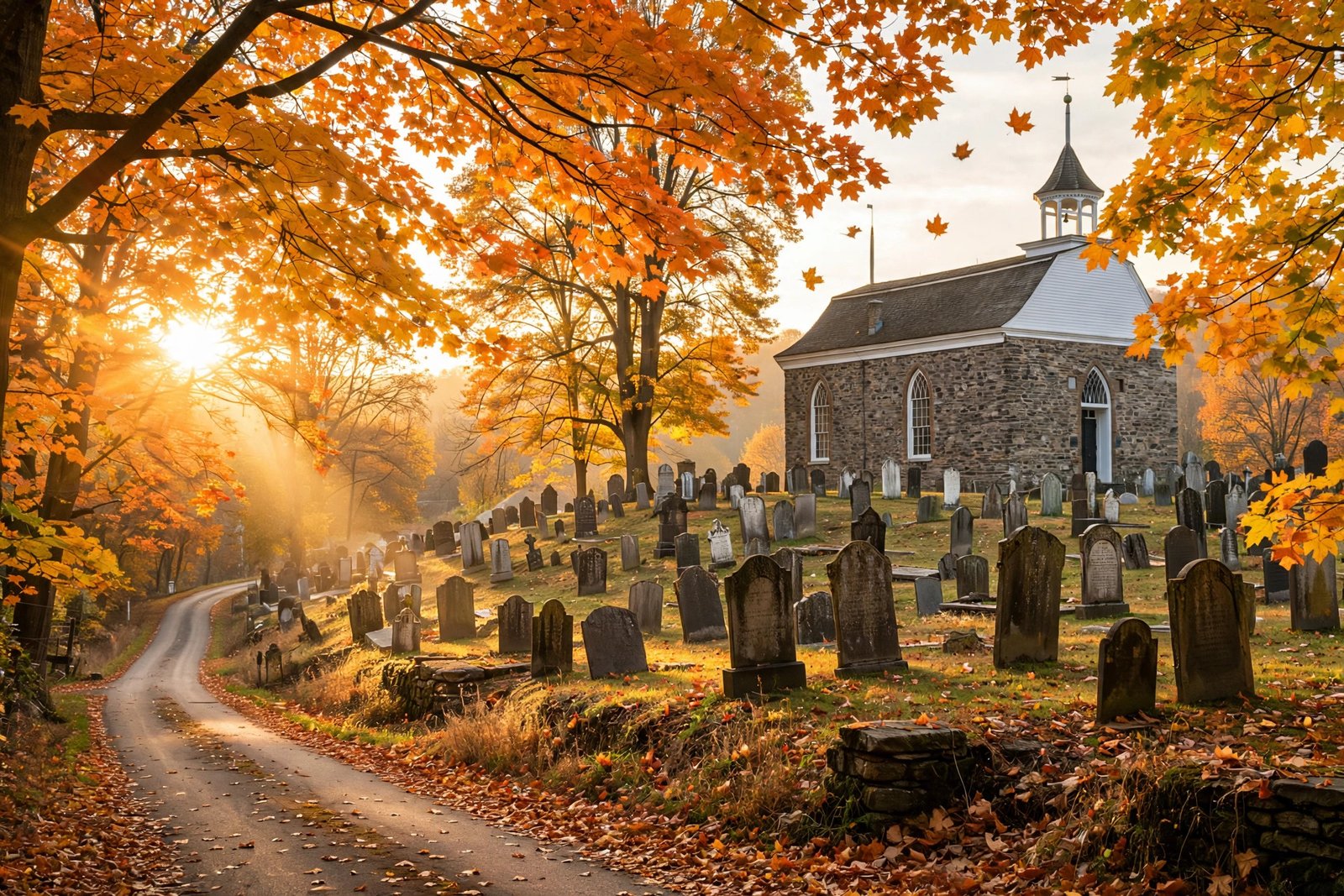
No visit to Sleepy Hollow is complete without the Old Dutch Church and the cemetery beside it. The church, consecrated in the late 1600s, still holds services today, and its churchyard is the burying ground where the Horseman is said to be buried in the story. The adjacent Sleepy Hollow Cemetery, founded in 1849 and listed on the National Register of Historic Places in 2009, spreads across roughly 90 acres of ridge above the church. Washington Irving’s grave is there, a modest stone that draws visitors from around the world.
The cemetery leans into its literary fame without losing its dignity. It remains an active burial ground, and its popular lantern-lit evening tours are led with respect for the people buried there. Walking its winding paths at dusk, past marble angels and moss-tipped headstones under old oak trees, it is easy to understand why Irving set his climax here. The place feels haunted even in daylight, not by ghosts but by history.
How the Legend Lives On Today
The legend now powers an entire autumn season. The centerpiece is The Great Jack O’Lantern Blaze, presented by Historic Hudson Valley at Van Cortlandt Manor in nearby Croton-on-Hudson, where more than 7,000 hand-carved, illuminated jack o’lanterns are arranged into glowing displays, synchronized to music and light. The event runs from mid-September into November and draws more than 100,000 visitors a year, with tickets regularly selling out weeks in advance.
At Washington Irving’s Sunnyside in Tarrytown, Historic Hudson Valley stages daytime tours called Home of the Legend, with a shadow puppet film and an exhibit about the story, and evening performances of Irving’s Legend, a dramatic outdoor retelling by master storyteller Jonathan Kruk with live music. At Philipsburg Manor in Sleepy Hollow, illusionists and performers conjure the supernatural in evening shows, and the village itself hosts cemetery tours, haunted hayrides, and street festivals. As local coverage of the Blaze notes, the events have limited capacity and regularly sell out, so advance tickets are essential.
Beyond the Hudson Valley, the Horseman has never left American screens, from Disney’s 1949 animated version to Tim Burton’s 1999 film Sleepy Hollow and the Fox television series that ran for four seasons starting in 2013. Every Halloween, he shows up in costumes, yard displays, and pumpkin carvings across the country.
Why the Legend Still Haunts America
The Legend of Sleepy Hollow endures because it is many stories at once. It is a ghost story, a comedy about a foolish schoolteacher, a love triangle, a mystery with no solution, and a portrait of a young America still figuring out who it was. Irving took a Dutch valley, a Revolutionary War memory, and a German folktale, and made something entirely American out of them. The story has stayed in print continuously since 1820 and has been retold in every medium from silent film to streaming television.
It also endures because the place is real and the legend is honest about what it is. Irving never pretended the Horseman was history. He presented him as a story the villagers told each other, and then he let the reader decide what to believe. That invitation, to stand on a real bridge over a real river and wonder what you would have seen on a dark night in 1790, is the reason people still make the trip. The Headless Horseman may never have ridden, but the story he rides through has never stopped moving, and every October, in a small village on the Hudson, it rides again.
Related reading
If you enjoyed this look at an American legend, keep exploring the strange and storied corners of the country with these stories from Famus News:
FAQ
Is the Headless Horseman based on a real person?
No. The Horseman is a fictional character from Washington Irving’s 1820 story, adapted from German folktales about headless riders. Hessian soldiers did fight in the Revolutionary War in the Hudson Valley, but no headless trooper is recorded in the churchyard.
When was The Legend of Sleepy Hollow published?
The story was first published in 1820 as part of Washington Irving’s collection The Sketch Book of Geoffrey Crayon, Gent. Written while Irving lived in England, it has remained continuously in print ever since.
Is Sleepy Hollow a real place?
Yes. Sleepy Hollow is a real village in Westchester County, New York, on the east bank of the Hudson River about 28 miles north of Manhattan. The Old Dutch Church, the Pocantico River, and Sleepy Hollow Cemetery are all real places you can visit.
Why did North Tarrytown change its name to Sleepy Hollow?
After the General Motors plant closed in 1996, residents voted 1,304 to 710 on December 10, 1996, to rename the village Sleepy Hollow, embracing Irving’s story and building a tourism economy around the legend.
What is The Great Jack O’Lantern Blaze?
The Blaze is Historic Hudson Valley’s annual autumn event at Van Cortlandt Manor in Croton-on-Hudson, featuring more than 7,000 hand-carved, illuminated jack o’lanterns. It runs from mid-September into November and regularly sells out, so advance tickets are required.