
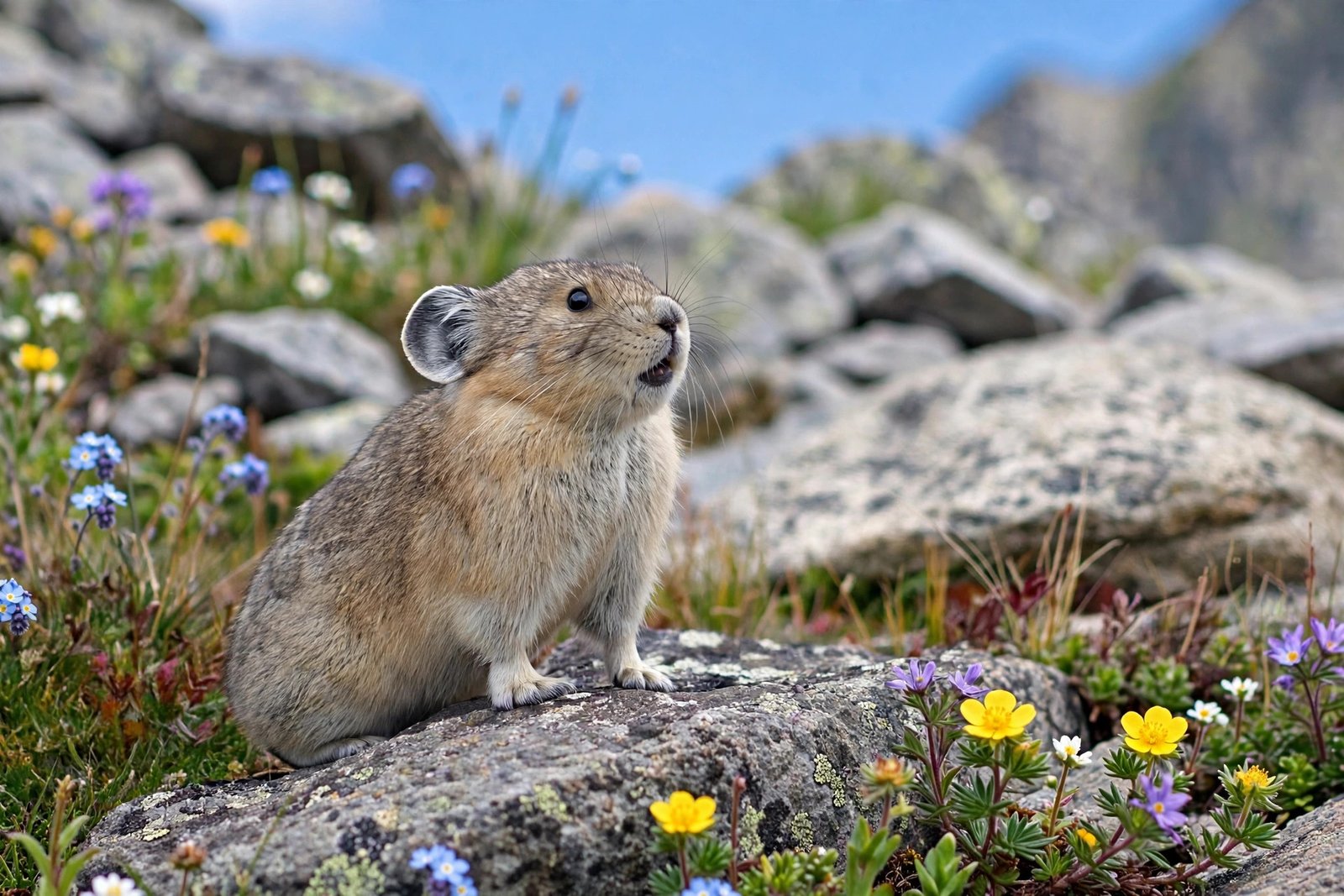
High in the mountains of the American West, above the treeline where the air is thin and the wind never really stops, a small, round, russet-colored animal darts between the rocks and lets out a sharp, high-pitched cry: eep! If you have ever hiked a rocky alpine slope in the Rockies, the Cascades, or the Sierra Nevada and heard that sound, you have met the American pika. About the size of a hamster, with round ears, no visible tail, and a thick coat of fur, the pika looks like a stuffed toy that learned to survive in one of the harshest environments in North America. Scientists call the American pika a living thermometer for the high country, because its survival depends on cold, and as the mountains warm, the pika is telling us something important.
The pika’s story is one of hard work and stubborn endurance. Unlike most mountain animals, pikas do not hibernate. They stay active all winter beneath the snow, living off food they spent the summer gathering and drying in the sun. They defend tiny territories among the boulders, and they fill the thin mountain air with calls that warn their neighbors of danger. In this guide, we will meet the American pika up close, learn how it lives, why it matters, and what scientists and volunteers are doing to protect it.
Meet the American Pika
The American pika, known to science as Ochotona princeps, is a small mammal in the order Lagomorpha, which makes it a relative of rabbits and hares rather than a rodent, even though it looks a bit like a mouse at first glance. According to the National Wildlife Federation, American pikas are about six to eight inches long and weigh four to six ounces, roughly the size of your hand, with thick light-brown fur, rounded ears, short legs, and no visible tail. Their egg-shaped bodies and dense coats are built for cold, and their small ears lose less heat than the long ears of their rabbit cousins.
Pikas are diurnal, meaning they are active during the day, and they do not hibernate. That combination is unusual for a small mountain mammal, and it shapes everything about how they live. They spend the short alpine summer in a constant rush, eating and gathering, and they spend the long winter tucked into the gaps between rocks, sheltered by snow, eating the food they stored. A pika can live six or seven years, although many die after three or four. They are solitary and fiercely territorial, each animal defending its own patch of rocks and the meadow plants around it.
Where Pikas Live: Mountains of the West
American pikas live on high, cool mountains across western North America, from central British Columbia in Canada south through the Rocky Mountains, the Sierra Nevada, the Cascades, and the Great Basin. In the United States they are found in ten states: Montana, Wyoming, Colorado, Idaho, Washington, Oregon, California, Nevada, Utah, and New Mexico. They live above the treeline in alpine terrain, on rock faces, talus slopes, and cliffs near mountain meadows. Talus is the jumble of broken rock that piles up at the base of cliffs and steep slopes, and it is the pika’s whole world.
The rocks matter more than the view. Pikas do not dig burrows. They make their dens in the existing gaps between boulders, where the temperature stays cool and steady even on a hot summer day. The spaces between the rocks act like natural air conditioning, and on a warm afternoon a pika can duck underground into the cool dark while the sun bakes the surface. In the northern part of their range, pikas can live near sea level where the climate stays cool, but in the southern part of their range they are rare below about 8,200 feet, because the valleys below are simply too warm. That dependence on cool, rocky high ground is the key to everything that follows in the pika’s story.
The Famous “Eep” and the Haypile Habit
Ask any hiker how they found their first pika, and the answer is almost always the same: they heard it before they saw it. Pikas are famous for their high-pitched calls, a sharp “eep” or “eeee” that carries across the talus. According to the National Park Service, piles of drying vegetation called haystacks, along with that distinctive high-pitched call, are the most recognizable signs of active pika habitat. The calls serve as alarms, warning neighboring pikas when a weasel, hawk, or coyote is near, and as territorial announcements telling other pikas to keep their distance.
The haypiles are even more remarkable. Because pikas do not hibernate, they must gather enough plant food during the short growing season to survive the winter. Through late summer, a pika will dash out from the rocks, snip grasses, sedges, and wildflowers with its teeth, and carry mouthful after mouthful back to its den. It lays the plants out in the sun to dry, so they do not get moldy, and then stacks them into a haypile tucked under an overhanging rock. Volunteers with the National Park Service’s Pika Project in North Cascades National Park survey haypiles, since fresh haypiles confirm pikas live on a slope.
Pikas are generalist herbivores, eating grasses, sedges, thistles, and fireweed, choosing plants with higher calories, protein, and water content. Like other members of the rabbit family, pikas also reingest special soft droppings to extract extra nutrients from their food. It is not glamorous, but where the growing season lasts only a few months, no nutrition can be wasted.
Surviving Winter Without Hibernating
Winter above the treeline is brutal, with deep snow, high winds, and temperatures far below freezing. Most small mountain mammals escape it by hibernating, but the pika has chosen a different strategy: it stays awake and stays put. The talus slopes that look so barren in summer become a refuge in winter, because the gaps between the rocks stay close to freezing even when the air above is bitterly cold, and a thick blanket of snow insulates the rocks like a roof. Under that snow, in the dark tunnels between boulders, pikas live on their haypiles, venturing out to forage on mild days and retreating underground when storms hit.
Snowpack is therefore just as important to the pika as cold summers. A deep, lasting snowpack keeps the den stable and insulated, while a thin snowpack leaves the pika exposed to killing cold snaps. This is one reason scientists watch snowpack so closely in pika country. A warming climate threatens pikas from both directions: hotter summers that push them past their heat tolerance, and thinner winter snowpacks that strip away their insulation. The pika’s whole year is a balancing act between those two pressures, and it has very little room for error.
Why Scientists Call the Pika a Climate Indicator
Here is the fact that made the pika famous in climate science: pikas are extremely sensitive to heat. The National Park Service notes that pikas are sensitive to temperatures above 77.9 degrees Fahrenheit, about 25.5 degrees Celsius, and studies have shown that exposure to temperatures above 78 degrees for extended periods can be lethal. Their thick fur coats, which keep them alive through alpine winters, become a liability on a hot summer afternoon. A pika cannot sweat. Its options are to hide in the rocks, stay quiet during the heat of the day, or move higher.
That is exactly what researchers have documented. In the 2000s, scientists began noticing declines in pika populations at lower elevations, especially in Nevada and the surrounding Great Basin, the driest part of the western United States. In some places, pikas have moved to higher elevations to escape warming temperatures; in others, local populations have vanished entirely. Researchers at the University of Connecticut have documented pika habitat in the southern Rockies contracting around 1,000 feet further up the slopes, driven by high summer temperatures and low snowpacks. Pikas are now extinct in Zion National Park, and numerous populations have disappeared in Nevada and California.
Because pikas are so finely tuned to their environment, and relatively easy to find and study, scientists call them an indicator species, or sentinel species, for climate change. When pikas disappear from a mountain, it is a warning that the mountain itself is changing. The University of Connecticut describes them as mountain-dwelling canaries in the coalmine for climate change, and the National Park Service has run a collaborative research program called Pikas in Peril, funded in 2010, bringing together scientists from the Park Service, Oregon State University, the University of Idaho, and the University of Colorado Boulder to understand how vulnerable pikas are to a warming world.
Life, Family, and Predators on the Talus
Pika family life is short, busy, and centered on the territory. Breeding begins in early to mid-spring, before the snow has fully melted. Females usually produce two litters a year, one in spring and one in summer, with a pregnancy lasting about a month and litters of two to six young. The pups are born blind and helpless and depend entirely on their mother, opening their eyes at about nine days old and heading out on their own at about four weeks. Young pikas take about three months to reach adult size and become breeding adults after a year.
Life on the talus is dangerous as well as cold. Weasels can slip into the rock gaps after pikas, hawks strike from above, and coyotes patrol the meadow edges. The pika’s alarm call is its first defense, sending neighbors diving for cover at the first sign of trouble, and its camouflage is its second, since its brown fur blends into the rocks so well that even experienced hikers can stare at a slope for minutes before spotting one. Pikas also help protect themselves by living in colonies, with neighbors close enough to hear each other’s warnings, even though each animal jealously defends its own den and haypile.
Conservation: What Is Being Done
The good news is that the American pika is not currently listed as threatened or endangered. In 2010, pikas were considered for federal endangered species protection, but the U.S. Fish and Wildlife Service declined to list them, in part because researchers did not yet have enough data about pikas across their full range. The species is assessed as Least Concern by the International Union for Conservation of Nature, and it remains common in the northwestern United States and Canada. But that overall picture hides real trouble in the south, where populations are declining and local extinctions have already happened.
The response has been a wave of research and citizen science. The National Park Service stewards pika populations in more than a dozen parks, and the Pika Project in North Cascades National Park uses trained volunteers to survey talus slopes, record haypiles and calls, and place temperature loggers above and below the rock surface. In Colorado, the Colorado Pika Project, a partnership between the Denver Zoo and the nonprofit Rocky Mountain Wild, runs a volunteer Pika Patrol that surveys habitat statewide and feeds the data to researchers. A study in Glacier National Park surveyed hundreds of habitat patches across the park to learn which features predict pika abundance, giving land managers the information they need to protect the best remaining habitat.
What pikas need most is cooler summers, deeper snowpacks, and connected high-elevation habitat that lets populations move upslope as conditions change. Protecting alpine areas from development, keeping human disturbance away from sensitive talus slopes, and supporting the monitoring programs that track pika populations all help. The pika cannot adapt by changing its fur or learning to sweat. Its survival depends on the mountains staying cold.
How to Spot a Pika (Responsibly)
If you want to see a pika for yourself, pick a high trail in summer, hike to a talus slope near an alpine meadow, and then stop, sit down, and listen. Early morning and late afternoon are the best times, because pikas are most active during the cooler parts of the day and tend to shelter in the rocks during midday heat. Listen for the eep, watch for movement at the edge of the rocks, and look for fresh haypiles tucked under overhangs, bright green against the gray stone. Bring binoculars, because pikas are small and skittish, and give them space. Never chase a pika, never feed one, and never move rocks on a talus slope, since the gaps between the stones are the animal’s home and its shelter from heat and predators.
If you do spot one, consider reporting it. Apps and volunteer programs like the Pika Patrol in Colorado let hikers record where they saw or heard pikas, and that data goes directly to researchers tracking how populations are shifting. You do not need a biology degree to help, just a pair of ears, a phone, and a willingness to sit quietly on a rock for a while.
Related reading
Love American wildlife? Keep exploring with these stories from Famus News:
- American Bison Comeback: Return of the Herds
- Bald Eagle Comeback: Conservation Success
- Gray Wolf Comeback in Yellowstone
FAQ
What is an American pika?
The American pika is a small alpine mammal, Ochotona princeps, about six to eight inches long and weighing four to six ounces. Despite looking like a mouse, it is a relative of rabbits and hares, with round ears, no visible tail, and thick fur built for cold mountain life.
Where do American pikas live?
Pikas live on high, rocky mountains across western North America, above the treeline on talus slopes near alpine meadows. In the United States they are found in ten states: Montana, Wyoming, Colorado, Idaho, Washington, Oregon, California, Nevada, Utah, and New Mexico.
Why do pikas make haypiles?
Pikas do not hibernate, so they must store food for winter. In late summer they gather grasses and wildflowers, dry them in the sun, and stack them into haypiles under rocks, eating from these piles all winter.
Why are pikas called climate change indicators?
Pikas are highly sensitive to heat, with temperatures above about 78 degrees Fahrenheit potentially lethal over extended exposure. As summers warm and snowpacks thin, pika populations have declined at lower elevations and moved upslope, an early warning sign of climate change.
Are American pikas endangered?
No. The American pika is not listed as threatened or endangered under the Endangered Species Act, and the IUCN assesses it as Least Concern. But populations are declining in parts of the southern range, and pikas have already disappeared from places like Zion National Park.