
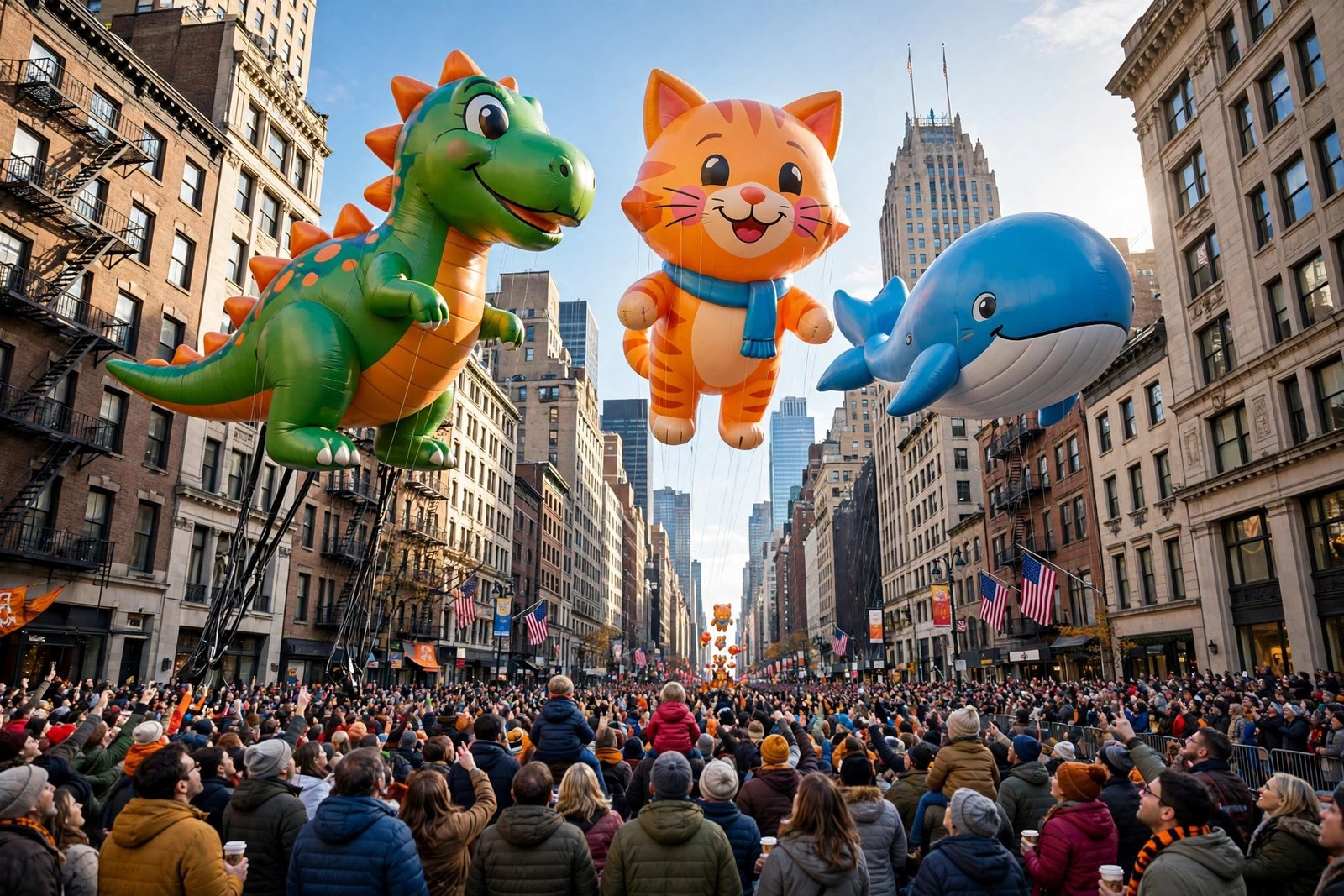
On Thursday, November 26, 2026, the Macy’s Thanksgiving Day Parade will mark its 100th edition — a milestone a century in the making. Millions of Americans will gather along the streets of Manhattan or tune in from their living rooms to watch the giant balloons drift past, just as their grandparents did. But behind the spectacle lies a wilder history than most viewers realize. Over the decades, the parade’s beloved balloons have slammed into lampposts, lost their heads, been stabbed by police officers, and sent spectators to the hospital.
These are the moments that turned a holiday tradition into viral legend long before the internet existed. The most famous of them — the 1997 Cat in the Hat disaster — nearly ended the parade itself and changed the rules forever. The 2005 M&M’s balloon crash proved that even after reforms, the wind still rules the day. And the earlier incidents, from Sonic the Hedgehog in 1993 to the balloon races of the 1920s, show that the parade has been wrestling with its own balloons since the very beginning.
This is the story of the Macy’s Thanksgiving Day Parade’s most famous balloon mishaps — what happened, why giant balloons are so hard to control, and how each accident made the parade safer.
How the Parade’s Balloons Were Born
The first Macy’s parade took place on November 27, 1924, and it looked nothing like the event we know today. There were no balloons at all. Instead, Macy’s employees marched from Harlem to the Herald Square flagship store alongside floats, professional bands, clowns, and live animals borrowed from the Central Park Zoo — including lions, camels, and elephants.
The balloons arrived three years later, thanks to the puppeteer and illustrator Tony Sarg. Macy’s had hired Sarg to design its famous animated holiday window displays, and he believed the parade needed something tall that everyone in the crowd could see. Working with the Goodyear Tire and Rubber Company in Akron, Ohio, Sarg created the first giant balloons, which debuted in 1927. The first character balloon was Felix the Cat, joined by a toy soldier and a dragon. These early balloons were not filled with helium at all — they were filled with ordinary air and held aloft by handlers carrying long poles.
Helium came in 1928, and with it came a tradition that sounds unbelievable today. At the end of the parade, the balloons were released into the sky to float away. They were expected to rise a few thousand feet and slowly leak gas over seven to ten days before settling somewhere across the country. Anyone who found one and returned it could collect a $100 reward, according to The New York Times.
The parade was suspended from 1942 to 1944 during World War II, when rubber and helium were diverted to the war effort. That pause is why the 100th edition falls in 2026 rather than 2024.
Why Giant Balloons Are So Hard to Control
To understand the mishaps, you have to understand what a parade balloon actually is. A full-size character balloon can stand six stories tall, stretch 70 feet high and 78 feet long, and hold an enormous volume of helium. It is, in effect, a giant sail. Every gust of wind pushes against thousands of square feet of nylon, and the only thing holding it in place is a team of handlers on the ground pulling on ropes.
Modern full-size balloons are handled by as many as 90 people, each weighing at least 125 pounds, and even that much human ballast is not always enough. When a gust hits, the balloon can surge sideways, dip toward the rooftops, or swing like a pendulum. The handlers can only pull down and sideways — they cannot push the balloon back up.
The parade route makes it harder. The balloons travel about two and a half miles through Manhattan, down Central Park West and into Times Square, where the tall buildings create wind tunnels. A gust that is barely noticeable on an open street can double in force between two skyscrapers. And the route is lined with the balloons’ natural enemies: lampposts, traffic lights, and trees, all waiting at exactly the wrong height.
Weather is the deciding factor, and the parade has learned to respect it. The balloons are built in pieces in Macy’s parade studio in New Jersey, and each one must be small enough when deflated to fit through the Lincoln Tunnel — no more than 12.5 feet high and 8 feet wide when packed. Building a single balloon takes about five months. All of that care and craftsmanship can be undone in seconds by a single gust of wind.
1993: Sonic the Hedgehog’s First Warning
The modern era of balloon accidents began in 1993, when a Sonic the Hedgehog balloon lost control in high winds and crashed into a lamppost. According to the Associated Press, falling debris injured an off-duty police officer and a 10-year-old girl. It was a frightening moment, but the injuries were minor, and the parade carried on with only modest changes.
1997: The Cat in the Hat Disaster
November 27, 1997, was the 71st Macy’s Thanksgiving Day Parade, and it was held under high winds that should have kept the balloons on the ground. Forecasters had predicted gale-force winds, and gusts along the parade route reached 40 to 43 miles per hour. The parade went ahead anyway, and what followed became known in parade lore as the Great Balloon Massacre.
The trouble started early. The Cat in the Hat balloon, a six-story-tall giant, struck a tree at 81st Street, damaging its head. Then the other balloons began falling one by one. The Pink Panther balloon was torn open by a streetlight, and the Barney the Dinosaur balloon was battered so badly that police officers had to stab it with knives to deflate it before it could hurt anyone. The New York Times reported that perhaps a dozen balloons were damaged overall, several losing limbs to wind-related problems.
The worst moment came at 72nd Street and Central Park West. The Cat in the Hat balloon, already damaged, was blown twice into a lamppost. The second impact snapped off the lamppost’s horizontal arm, which fell into the crowd below. Four people were injured. Two suffered serious head wounds, and one of them — Kathleen Caronna, a 33-year-old spectator — suffered a nearly fatal skull fracture and spent 24 days in a coma. The two other injuries were facial bruising.
The aftermath was swift and severe. The Cat in the Hat balloon was pulled from the parade at 36th Street, along with the Quik Bunny balloon, while Barney was removed at 51st Street and the Pink Panther at 42nd. Mayor Rudy Giuliani launched a task force to investigate, and the city imposed new rules: balloons were limited to 70 feet high, 78 feet long, and 40 feet wide — dimensions that permanently retired the Cat in the Hat, Pink Panther, and Woody Woodpecker balloons. More importantly, the city set a wind rule: the giant balloons would not fly if sustained winds exceeded 23 miles per hour or gusts exceeded 34 miles per hour.
Kathleen Caronna later filed a $395 million lawsuit against Macy’s, New York City, and the lamppost’s manufacturer, saying she had suffered permanent brain damage. The case was settled out of court for an undisclosed sum in 2001. For the parade, the lesson was seared into its history: a beloved tradition had come within inches of a fatality, and the rules would never be the same.
2005: The M&M’s Balloon Strikes Again
Eight years after the Cat in the Hat disaster, the new safety rules were put to their first serious test — and the wind won again. On November 24, 2005, a sudden gust in Times Square pushed the 50-foot-tall M&M’s balloon off course. A handling line snagged on a lamppost, the balloon spiraled, and it struck a streetlight at West 43rd Street and Seventh Avenue. As the balloon collapsed, it pulled a light fixture off the pole, which crashed to the ground among the spectators, showering broken glass onto the crowd.
Two sisters from Albany, New York, were hurt: Mary Chamberlain, 26, who uses a wheelchair, and her 11-year-old sister Sarah. Mary suffered a bruised forehead and was given a CAT scan. Sarah suffered a chipped tooth and a cut on the back of her head that required nine stitches. Both were treated at the hospital and released the same day, without serious injuries. Their father told The New York Times that the family planned to return to the parade the next year, and the family did not sue — the case was settled amicably with Macy’s, reportedly including a lifetime supply of M&M’s.
The 2005 accident proved an uncomfortable truth: the wind rule and the size limits had reduced the danger, but they had not eliminated it. Organizers had been uncertain until an hour before the parade whether the balloons would be allowed to fly at all that morning. The incident reinforced the existing wind regulations and led Macy’s to temporarily remove some lampposts along the route, and in 2006 the parade added new safety measures, including wind measurement devices along the route and a policy of flying the balloons lower to the ground in windy conditions.
How Safety Changed After the Accidents
Each disaster left a permanent mark on how the parade runs. The 1997 accident produced the two rules that still govern the parade today: the size limits and the wind thresholds. If sustained winds exceed 23 miles per hour or gusts exceed 34 miles per hour, the giant balloons stay on the ground. Macy’s employs a licensed meteorologist and operates several weather monitoring stations along the route, and on the morning of the parade, Macy’s and the New York Police Department make the final call on which balloons can fly.
The 2006 measures added another layer: wind measurement devices that alert organizers to unsafe conditions in real time, and a rule that balloons fly lower during windy conditions, keeping them further from lampposts and closer to their handlers. The parade also began removing or padding obstacles along the route and training handlers more rigorously.
The rules have worked, at least so far. Since 2005, there has not been another serious balloon injury at the parade, and the wind rule has never been fully triggered — although bad weather did keep the balloons grounded once, in 1971, before the modern rules existed. In 2013, the parade formalized two balloon classes: the full-size character balloons, each handled by exactly 90 people, and the smaller novelty balloons, handled by anywhere from one to thirty people.
Why the Mishaps Went Viral — Before Viral Was a Word
The balloon mishaps live on because they are the perfect viral story: a beloved childhood icon, a spectacular public failure, and a crowd of witnesses with cameras. The 1997 parade was broadcast live on NBC, and millions of viewers watched the Cat in the Hat disaster unfold in real time. The footage of police officers stabbing the Barney balloon — a children’s television character being deflated by knives in front of a crowd of kids — became one of the most replayed clips in parade history.
Today, the clips circulate every November on social media, shared by people who were not even alive in 1997. The incidents have become part of the parade’s mythology, retold in listicles, documentaries, and trivia quizzes. They are also a reminder of something the parade’s organizers understood long ago: the balloons are the stars of the show precisely because they are barely under control. The tension between the spectacle and the danger is what makes people watch.
That tension will be on full display at the 100th parade on November 26, 2026, when Felix the Cat — the very first character balloon from 1927 — returns to the route. A century after the first parade, the balloons are bigger, safer, and more closely watched than ever. But they are still giant sails full of helium, floating through the wind tunnels of Manhattan, held down by 90 people and a prayer. And that is exactly why America keeps watching.
Related reading
Planning your Thanksgiving? Read Macy’s Thanksgiving Day Parade History, The First Thanksgiving at Plymouth in 1621, and Thanksgiving Dinner Cost 2026.
FAQ
What happened at the 1997 Macy’s Thanksgiving Day Parade?
High winds with gusts of 40 to 43 miles per hour battered the balloons on November 27, 1997. The six-story Cat in the Hat balloon struck a lamppost at 72nd Street and Central Park West, knocking off the lamppost’s arm, which fell into the crowd and injured four people. One spectator, Kathleen Caronna, suffered a skull fracture and spent 24 days in a coma. The Barney and Pink Panther balloons were also destroyed and had to be deflated by police.
What happened to the M&M’s balloon in 2005?
On November 24, 2005, a gust of wind in Times Square pushed the 50-foot M&M’s balloon into a lamppost at West 43rd Street and Seventh Avenue. A light fixture fell into the crowd, injuring two sisters, Mary and Sarah Chamberlain. Sarah needed nine stitches for a cut on the back of her head, and Mary suffered a bruised forehead. Both were released from the hospital the same day.
When are the Macy’s parade balloons grounded for wind?
Under city rules set after the 1997 accident, the giant balloons do not fly if sustained winds exceed 23 miles per hour or gusts exceed 34 miles per hour. Macy’s employs a licensed meteorologist and weather stations along the route, and the final decision is made on the morning of the parade with the New York Police Department.
When was the first Macy’s Thanksgiving Day Parade?
The first parade was held on November 27, 1924, and featured live animals from the Central Park Zoo instead of balloons. The first balloons appeared in 1927, when Felix the Cat debuted as the first character balloon. The parade was suspended from 1942 to 1944 during World War II, which is why the 100th edition falls on November 26, 2026.
How many people does it take to handle a parade balloon?
A full-size character balloon is handled by as many as 90 people, each weighing at least 125 pounds. Smaller novelty balloons need anywhere from one to thirty handlers. Building a single giant balloon takes about five months in Macy’s parade studio in New Jersey.