
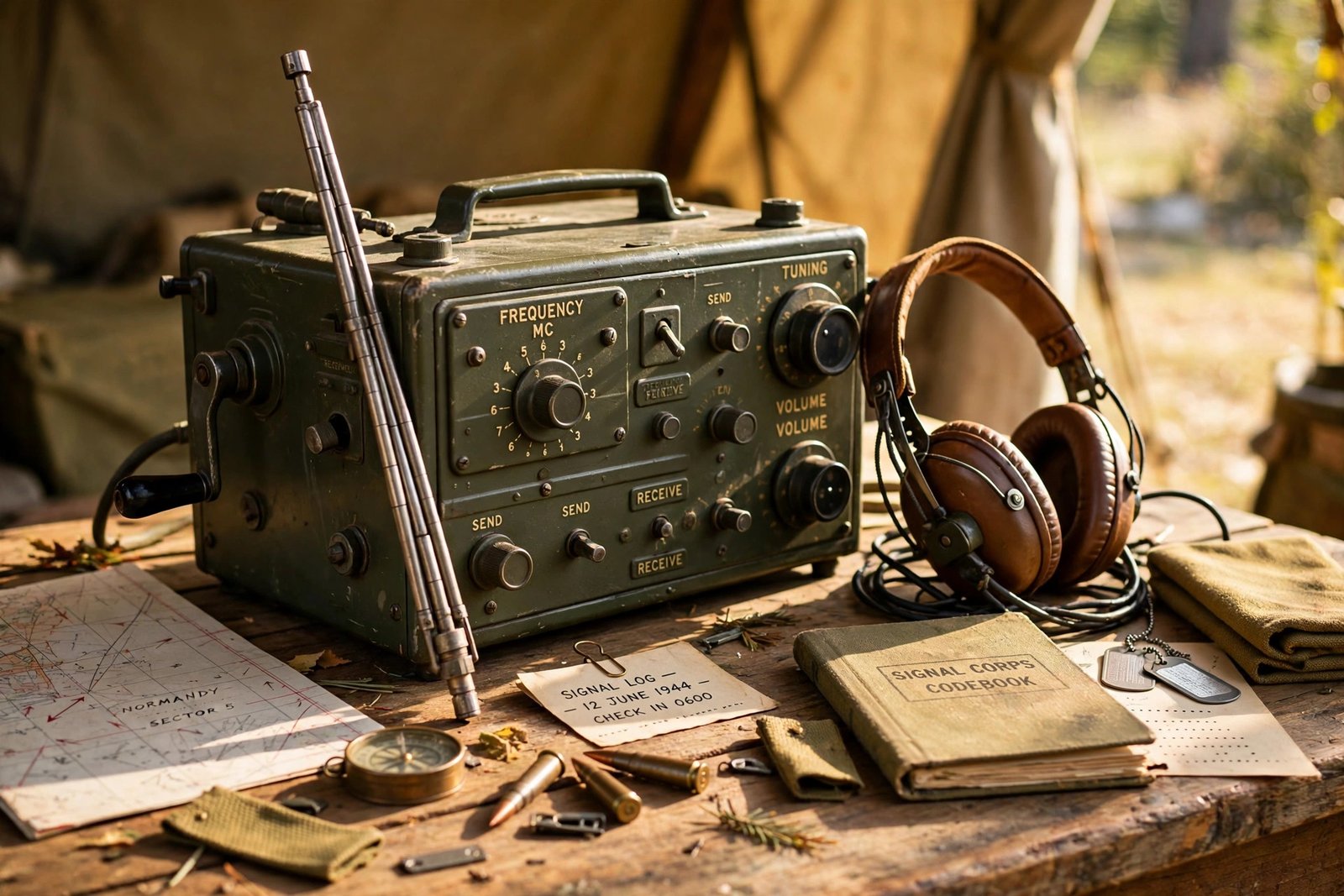
In the Pacific Theater of World War II, American commanders had a problem that was getting men killed. Radio messages could be intercepted, and Japanese codebreakers were skilled at cracking American military codes. The solution came from an unlikely place: the language of the Navajo people, a complex, unwritten tongue spoken by almost no one outside the Navajo Nation. The Marines who spoke it became the Navajo Code Talkers, and the code they built was never broken by the enemy.
The story begins in 1942, when Philip Johnston, a civilian who had grown up on the Navajo reservation as the son of a missionary and was one of the few non-Navajos fluent in the language, proposed the idea to the Marine Corps. The Corps recruited 29 Navajo men — the Original 29 — to develop a code based on their language. By the end of the war, more than 400 Navajo Marines had served as Code Talkers, transmitting orders, coordinates and battle plans in the thick of combat, from Guadalcanal to Iwo Jima.
A language made for secrets
Navajo was an ideal code language for several reasons. It was unwritten at the time, with no alphabet until the mid-twentieth century, so there were no books or dictionaries an enemy could study. It was grammatically complex and tonal, meaning that the same sounds could carry different meanings depending on pitch. And it was spoken by a small community in the American Southwest, so the pool of potential enemy speakers was effectively zero.
But the Code Talkers did more than simply speak Navajo on the radio. They built a code on top of the language. The Original 29 started with about 200 terms and expanded the dictionary to more than 400 by war’s end. Military concepts with no Navajo equivalent got code names drawn from nature: a tank became a tortoise, a fighter plane became a hummingbird, a battleship became a whale, a submarine became an iron fish. Place names and letters were spelled out using Navajo words for animals and objects. The result was a two-layer system — a code inside a language — that could be spoken, transmitted and decoded far faster than any machine cipher of the era.
Speed mattered as much as secrecy. A message that took a code machine 30 minutes to encrypt, transmit and decrypt could be sent by Code Talkers in about 20 seconds. In combat, where artillery coordinates and troop movements change by the minute, that difference saved lives. The Library of Congress’s Veterans History Project documents their service here, and the National Archives tells the broader Code Talker story here.
From training to the front lines
The Original 29 trained in specially designed courses, memorizing the code — no part of it was ever allowed to be written down — and learning to transmit under fire. They were then assigned to Marine divisions in the Pacific, where they served as radio operators, often working in pairs: one to send, one to receive and verify. Their job put them in the most dangerous places on the battlefield, carrying radios and speaking into handsets while bullets flew.
They served in every major Marine campaign in the Pacific: Guadalcanal, Tarawa, Saipan, Tinian, Peleliu and Iwo Jima, among others. At Iwo Jima, six Navajo Code Talkers worked around the clock during the first two days of the battle, sending and receiving more than 800 messages without error. Major Howard Connor, the signal officer for the 5th Marine Division, later said that were it not for the Navajo, the Marines would never have taken Iwo Jima. It is one of the most quoted assessments of any unit in the war, and it came from a man who watched them work.
The irony at the heart of the story
The Code Talkers’ story carries a painful irony that makes it more than a military tale. Many of the men had attended Native American boarding schools as children, where speaking Navajo was forbidden and punished. The United States government had spent decades trying to suppress Native languages through those schools. Then, in its hour of greatest need, it turned to one of those languages to help win a war.
The men understood the irony, and they served anyway. They served a country that had not always served them — Native Americans were not universally recognized as U.S. citizens until the Indian Citizenship Act of 1924, and even then many states restricted their voting rights for decades. The Code Talkers’ patriotism was not naive; it was a choice made in full knowledge of that history. That is part of why their story resonates so deeply today.
Other tribes, other codes
The Navajo were the most famous Code Talkers, but they were not the only ones. The idea predated World War II: in World War I, Choctaw soldiers had used their language to encrypt messages, and the Army remembered that success when the next war came. During World War II, the Army enlisted Code Talkers from the Comanche, Hopi, Cherokee, Osage, Kiowa, Creek, Seminole, Cheyenne, Yankton Sioux and other tribes, generally serving in Europe and North Africa while the Navajo served in the Pacific.
Each group’s code worked on the same principle — a language the enemy could not speak, turned into a military tool — and each group’s service remained classified long after the war. The Code Talkers Recognition Act of 2002 eventually honored Native Code Talkers from both world wars, and in 2001 the original Navajo Code Talkers received the Congressional Gold Medal, one of Congress’s highest expressions of appreciation. A broader Congressional Gold Medal ceremony for Code Talkers of all tribes followed in 2013.
Decades of silence
Perhaps the most remarkable part of the story is how long it stayed secret. The Navajo code was classified until 1968, more than two decades after the war ended. The men came home as unsung heroes, forbidden to speak about what they had done, and returned to lives on the reservation that offered little recognition and few opportunities. Many never told their own families the details of their service.
When the story was finally declassified, it spread quickly — through books, films, museum exhibits and the veterans’ own belated honors. Chester Nez, the last surviving member of the Original 29, lived until 2014, long enough to see his story become part of the national memory. Today the Navajo Code Talkers are remembered in the Navajo Nation capital of Window Rock, in museums across the country, and in the classrooms where students learn that a language once punished in school helped save a nation at war.
Remembering the Code Talkers today
Today the Code Talkers are honored in places that would have been unimaginable to the young men who shipped out in 1942. The Navajo Code Talkers Memorial stands in Window Rock, Arizona, the capital of the Navajo Nation, and exhibits at the National Museum of the American Indian, the National WWII Museum in New Orleans, and the Arizona State Capitol tell their story to new generations. School curricula now include the Code Talkers alongside other World War II units, and the Navajo language itself — once punished in boarding schools — is taught, celebrated and studied as a living language with its own literature and media. That revival is, in its own way, part of the Code Talkers’ legacy: a language that was once treated as a liability proved to be a national asset, and the recognition that followed helped affirm its value at home as well as at war. Every November, on Native American Heritage Month, their story is retold — not just as military history, but as a reminder of what a community’s language and loyalty can mean to a country.
Why the code was never broken
Military historians sometimes ask whether the code was truly unbreakable or simply never given the chance to be broken. The honest answer is both. The Japanese never captured a Code Talker alive and never obtained the codebook — because there was no codebook to capture. The code lived only in the memories of the men who used it. Combined with the structural complexity of Navajo itself, that made the system effectively unbreakable under wartime conditions.
That design — no written key, human memory as the only storage — is also a lesson that modern cryptography has taken to heart in a different form: the most secure system is often the one with the fewest copies of the key. The Code Talkers achieved that with nothing more than their voices, their language and their training.
Related reading
For more stories of American service, read The 442nd: The Unit That Went For Broke, The Old Guard: Inside the Tomb of the Unknown Soldier, and American Flag Facts: Stars, Stripes, and the Real History.
Frequently asked questions
Who were the Navajo Code Talkers? Navajo Marines recruited in World War II who built and used a code based on the Navajo language to transmit secure battlefield messages in the Pacific Theater.
How many Navajo Code Talkers were there? The program began with 29 men, the Original 29, and grew to more than 400 Navajo Code Talkers by the end of the war.
Was the Navajo code ever broken? No. The code was never deciphered by enemy forces, partly because no part of it was ever written down.
Why was the Code Talkers’ work kept secret? The code remained classified until 1968, so the men could not speak publicly about their service for more than two decades after the war.
When were the Code Talkers honored? The original Navajo Code Talkers received the Congressional Gold Medal in 2001, and the Code Talkers Recognition Act of 2002 honored Native Code Talkers from both world wars.