
On a dark and stormy night in 1735, according to the legend, something terrible was born in the Pine Barrens of southern New Jersey. A woman known as Mother Leeds, already the mother of twelve children and pregnant with a thirteenth, is said to have cried out in frustration, “Let this one be the devil!” When the baby was born, the story goes, it transformed into a winged, hoofed creature with a horse-like head, bat wings and a forked tail, and escaped up the chimney into the pines. It has been haunting New Jersey ever since.
The Jersey Devil is one of America’s oldest and most durable legends — older than the United States itself, if you count from 1735. It has survived for nearly three centuries, through newspaper frenzies, a famous hoax, a professional hockey team and a roller coaster. And like all great legends, it tells us as much about the people who told it as about the creature it describes.
The birth of the legend
The traditional story is set at Leeds Point, in what is now Galloway Township, Atlantic County. Mother Leeds — in some versions named Deborah Leeds — was pregnant with her thirteenth child and, exhausted by poverty and hardship, cursed the unborn baby. Versions differ on the details: in some, the baby was born normal and then changed; in others, it was born already transformed. In nearly all, it killed the midwife, attacked its family, and flew up the chimney into the Pine Barrens.
Other versions add different curses. One says a clergyman, angry that Mother Leeds refused to convert from the Quaker faith, told her that her next child would be an offspring of Satan. Another says a young woman cursed by a town for falling in love with a British soldier gave birth to the Devil. Another blames a gypsy’s curse. The New Jersey Historical Society collects several of these variants here, and the state of New Jersey itself retells the classic version here.
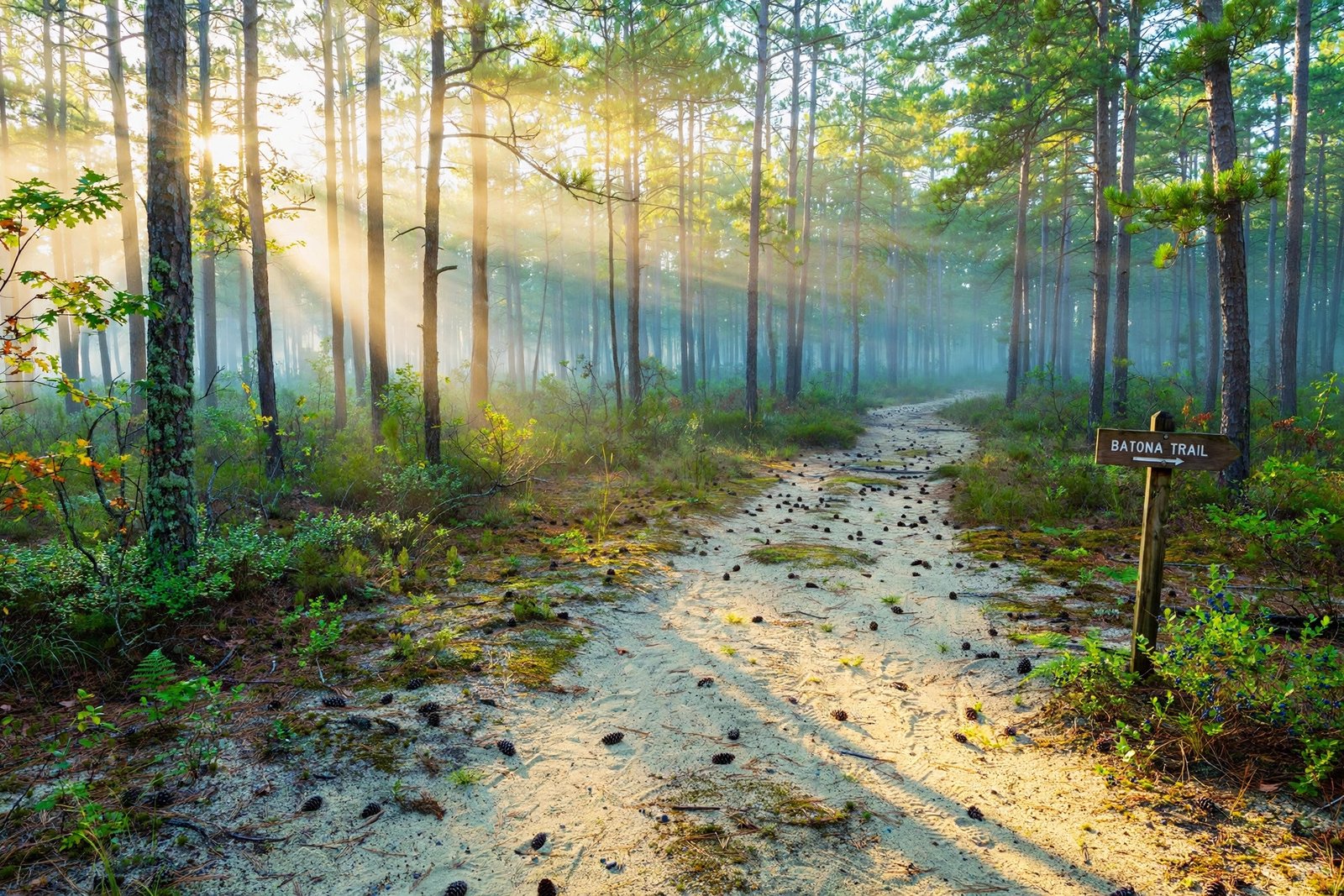
What most versions agree on is the creature’s appearance: a bipedal figure with a horse’s or goat’s head, long legs with hooves, short front legs or clawed hands, leathery bat wings, a forked tail and glowing red eyes, with a blood-curdling scream. Locals in the Pine Barrens traditionally call it the Leeds Devil. Its home is the vast, sandy, pine-forested region of southern New Jersey — a landscape that even today feels remote and a little eerie, crisscrossed by sandy roads and dotted with ghost towns, cranberry bogs and abandoned ironworks.
A colonial feud that grew wings
Historians have found a more grounded explanation for the legend, and it is arguably more interesting than the monster itself. The Leeds family of colonial New Jersey — Daniel Leeds and his son Titan — were almanac publishers whose astrological and political views put them at odds with the Quaker establishment. Benjamin Franklin, a rival almanac-maker, mockingly predicted the death of the Leeds almanac’s author. Quaker opponents cast Daniel Leeds as Satan’s harbinger, and the family crest, which featured a wyvern — a winged, dragon-like figure — helped fuse the family name with a literal devil.
Over generations, the “Leeds Devil” became the “Jersey Devil” and acquired the cursed-birth story. The legend, in this reading, began as a colonial smear campaign — a political insult that grew wings, quite literally, as it passed from pamphlet to fireside tale to newspaper sensation. It is a reminder that folklore is often history in disguise: a feud, a family crest and a region’s superstitions, blended over centuries into a monster.
There is also a more human possibility that historians note. In the 1700s, many people still believed in witchcraft, and a child born with a visible birth defect was sometimes feared as a child of the devil or a sign of a curse. It may be that Mother Leeds did give birth to a child with a defect, and that the superstitions of the period did the rest. Either way, there are no credible reports of the Jersey Devil actually harming anyone — a notable exception among monster legends, and one that makes the creature more mischievous than malevolent in most tellings.
The great panic of 1909
The legend’s most spectacular moment came in January 1909, when a week of reported sightings, strange tracks in the snow and newspaper sensation swept the Delaware Valley. Reports flooded in from across New Jersey and Pennsylvania: hoof-like tracks appeared in snow-covered fields and on rooftops, livestock was found disturbed, and witnesses claimed to have seen a winged figure. Schools and businesses closed. Posses formed. Newspapers, competing for readers, printed sighting after sighting, each more dramatic than the last.
The frenzy was capped by a documented hoax: a kangaroo fitted with fake wings was exhibited as the captured Devil, drawing paying crowds before the trick was exposed. The 1909 panic is now understood as a case study in how media, suggestion and a good story can feed each other — a pattern that feels strikingly modern. The tracks, the sightings and the panic were real as social events, even if the creature was not real as a biological one.
The Devil in modern New Jersey
Today the Jersey Devil is less a terror than a mascot — and a beloved one. The New Jersey Devils of the National Hockey League carry its name. Six Flags Great Adventure in Jackson Township, on the edge of the Pine Barrens, built the Jersey Devil Coaster, a single-rail roller coaster whose first drop hits 87 degrees and rises 130 feet, explicitly themed to the legend. The Pine Barrens themselves are now a National Reserve, protecting more than a million acres of forest, wetlands and rivers — and the Devil, in its way, helped protect them, by giving the region a story that made people care about it.
The legend also lives on in books, films, podcasts and local tours, and in the small museums and roadside attractions of southern New Jersey. Leeds Point still draws the curious. And every Halloween season, the story gets retold, polished and passed on — which is, after all, how a legend stays alive.
The forest behind the legend
It is worth pausing on the Pine Barrens themselves, because the forest is stranger than the monster. The region covers more than a million acres across seven counties in southern New Jersey, sitting atop the Kirkwood-Cohansey aquifer, one of the largest freshwater aquifers in the eastern United States. The sandy, acidic soil supports pitch pines, scrub oaks and rare plants like the Pine Barrens gentian, while the tea-colored rivers and cedar swamps shelter species found almost nowhere else in the state. The Barrens were once an industrial landscape of iron furnaces, glassworks and charcoal pits, and the ruins of those enterprises — Batsto Village, Atsion, and dozens of forgotten hamlets — give the forest its haunted atmosphere. A walk through the Barrens at dusk, with the wind in the pines and no town in sight, makes it easy to understand why generations of travelers came home with stories of something winged moving between the trees.
Why the legend endures
Why has the Jersey Devil lasted nearly 300 years while countless other local monsters faded? Part of the answer is place. The Pine Barrens are genuinely strange: a vast wilderness in the middle of the most densely populated state in America, where the sand is sugar-white, the water runs tea-colored from cedar roots, and the silence at night is profound. A monster belongs there in a way it would not belong in a suburb.
Part of the answer is timing. The legend was born in a colonial world of religious conflict, matured in a newspaper age hungry for sensation, and survived into an era that loves cryptids, podcasts and roadside mystery. Each generation found a new use for the Devil. And part of the answer is the story itself: a cursed thirteenth child, a stormy night, a creature that escapes up a chimney. It is a story built to be told around a fire, and it has been told around fires for centuries.
Whether you believe in the Jersey Devil or not — and no physical evidence of such a creature has ever been found — the legend is worth knowing, because it is a piece of American folklore with a traceable history. It began with a family, a feud and a forest. It became a monster. And in becoming a monster, it became something larger: a story New Jersey tells about itself, dark and funny and strange, and still very much alive.
Related reading
For more American mysteries, read The Mothman of Point Pleasant: America’s Winged Mystery, The Lost Colony of Roanoke: What Really Happened, and The Lost Sea: America’s Largest Underground Lake.
Frequently asked questions
What is the Jersey Devil? A legendary winged creature of the New Jersey Pine Barrens, usually described as having a horse-like or goat-like head, bat wings, hooves and a forked tail.
When did the Jersey Devil legend begin? The traditional origin story dates to 1735, when Mother Leeds’s thirteenth child was said to have transformed into the creature at Leeds Point, New Jersey.
What happened in the 1909 Jersey Devil panic? For about a week in January 1909, newspapers across the Delaware Valley reported sightings and strange tracks, closing schools and businesses, before a hoax involving a winged kangaroo was exposed.
Is there any evidence the Jersey Devil exists? No physical evidence of such a creature has ever been found. Historians trace the legend to a colonial family feud and centuries of storytelling.
Where are the Pine Barrens? The Pine Barrens are a vast forested region across southern New Jersey, now protected as a National Reserve of more than a million acres.