
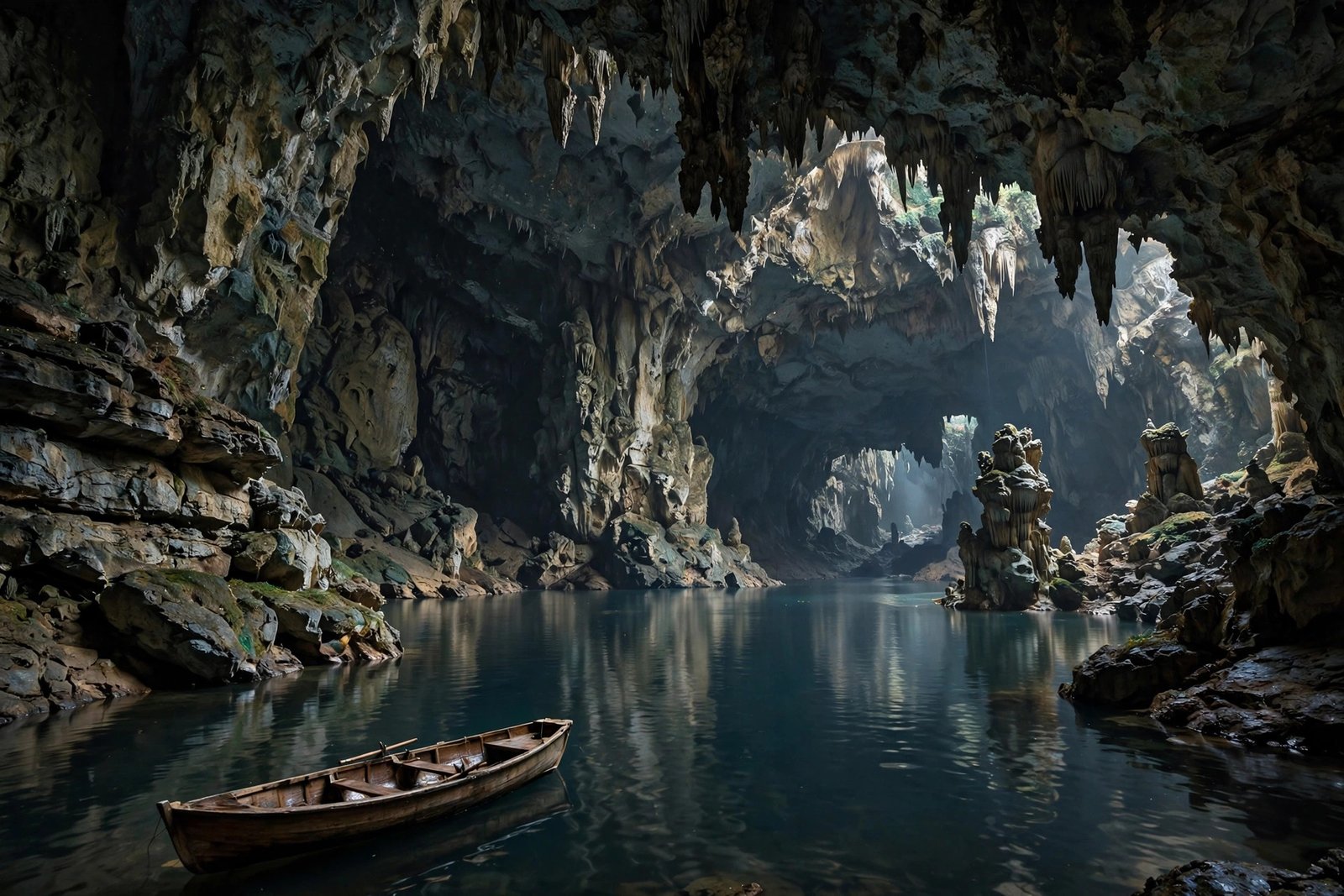
One hundred and forty feet beneath the rolling hills of Sweetwater, Tennessee, there is a lake that sunlight has never touched. It sits in still, dark water inside Craighead Caverns, and for most of human history, no one knew it was there. Today you can ride a boat across it, gliding over water so clear that enormous rainbow trout drift below like shadows.
This is the Lost Sea, widely recognized as the largest underground lake in the United States, and it is one of the most extraordinary hidden gems in the country. It is not on most travelers’ bucket lists. It does not have the fame of a national park or the crowds of a big-city attraction. That is exactly what makes it special.
A Lake Found by a Teenager
The Lost Sea’s discovery story sounds like something from an adventure novel, except that it happened. In 1905, a 13-year-old boy named Ben Sands was exploring Craighead Caverns when he squeezed through a small, difficult opening and found himself facing an underground chamber and a body of water. He had no modern mapping equipment, no powerful lights, and no idea what he had found.
What he had found was the visible portion of a lake that measures roughly 800 feet long and 220 feet wide. Divers have since mapped more than 13 acres of submerged passages and chambers beneath it, and the full extent of the lake is still unknown. The end of the lake has never been found. Every survey pushes the boundary a little further, and the water keeps going.
The lake’s obscurity is part of its charm. It lay hidden for generations beneath farmland and small-town Tennessee, in a cave system that had been used, ignored, and rediscovered by different people for centuries. A teenager with curiosity did what centuries of adults had not: he looked through the small opening.
What the Cave Has Seen
Craighead Caverns holds far more history than the lake alone. Archaeologists have found bones of a Pleistocene-era jaguar that roamed the caves tens of thousands of years ago, a reminder that this underground world predates humans entirely. There is evidence that Cherokee people used the caverns centuries ago, and markings in the cave include a date from 1863, believed to have been written during the Civil War era.
During the Civil War, Confederate soldiers mined the caves for saltpeter, a crucial ingredient in gunpowder, and many of their signatures and markings can still be seen etched into the walls and ceilings today. The cave has also served more peaceful purposes. In the 1920s and 1930s, visitors attended concerts and dances in the caverns, traveling across the underground lake by boat to reach the festivities. During the Cold War, a large room in the cave system was even converted into a fallout shelter, stocked with supplies as a potential refuge.
That layered history is what separates a genuine hidden gem from a pretty view. The Lost Sea is not just a geological wonder. It is a place where deep time, Native American history, Civil War industry, jazz-age parties, and Cold War anxiety all share the same stone walls.
What a Visit Actually Looks Like
Visiting the Lost Sea starts above ground, in the foothills of the Smoky Mountains near Sweetwater, a small town in East Tennessee. The attraction, called The Lost Sea Adventure, runs guided tours that descend into the caverns on foot before reaching the lake itself.
The walk down is part of the experience. The path winds through chambers shaped over millions of years, past stalactites and stalagmites and other formations that drip slowly into the dark. The cave holds a steady, cool temperature year-round, so a light layer is worth bringing even on a hot Tennessee summer day. Comfortable, closed-toe shoes with good grip matter too, because the stone underfoot can be damp.
Then comes the part everyone remembers. Visitors board a glass-bottomed electric boat and glide across the lake’s surface, looking down into water of remarkable clarity. Some of the largest rainbow trout in the country swim in these waters, visible in the boat’s lights. Fishing is not permitted, which is probably for the best, since the fish have become part of the show.
One of the cave’s most famous features is its anthodites, extremely rare flower-like crystal formations that appear in only a small number of caves worldwide. They look like delicate stone flowers blooming out of the rock, and guides point them out as the boat drifts past. It is the kind of detail that makes visitors whisper, even though there is no one to disturb.
How an Underground Lake Forms
The Lost Sea exists because of limestone, water, and an enormous amount of time. The region around Sweetwater was once covered by a shallow sea, and the remains of marine life settled into thick layers of limestone. Over millions of years, slightly acidic groundwater seeped through cracks in that limestone, dissolving the rock grain by grain and carving out chambers, passages, and eventually a cavern large enough to hold a lake.
That slow process is still going on. The same dripping water that built the cave continues to shape it, depositing minerals that grow into stalactites hanging from the ceiling and stalagmites rising from the floor. The anthodites, the rare flower-like crystals that visitors admire from the boat, are among the most delicate products of this process, forming only where water chemistry and airflow meet in exactly the right conditions. It is a reminder that the cave is not a finished monument. It is a living geological system, changing on a timescale far longer than a human lifetime, but changing nonetheless.
Why It Counts as a Hidden Gem
America has no shortage of famous natural wonders, and most of them are famous for good reason. But fame brings crowds, reservations, traffic, and the strange feeling of experiencing something through a phone screen held up by the person in front of you. The Lost Sea offers the opposite. It is a major natural wonder that still feels undiscovered, even though it welcomes visitors every day.
Part of that is geography. Sweetwater is not on the way to anywhere famous, and the attraction does not advertise itself with the volume of a theme park. Part of it is the nature of the experience itself. You cannot rush a cave tour. You cannot skim an underground lake. The darkness and the quiet force a slower pace, and slower travel tends to be more memorable travel.
There is also something deeply American about the place. It is a wonder found by a kid, in a cave, in a small town, that turned out to be the largest of its kind in the country. The story rewards curiosity, and the place rewards the people curious enough to go.
Planning Your Trip
A few practical notes will make the visit smoother.
- Wear sturdy, closed-toe shoes. Cave floors are damp and uneven in places, and good grip matters more than style.
- Bring a light layer. The cave stays cool all year, and the temperature difference from a Tennessee summer day is noticeable.
- Book ahead when you can. Tours run daily, but space on the boats is limited, and weekends fill up.
- Give yourself time in Sweetwater. The town sits in a pretty stretch of East Tennessee, and the drive through the Smoky Mountain foothills is part of the trip.
- Leave the fishing rod at home. Fishing is not allowed in the lake, and the trout are there to be admired, not caught.
- Bring a camera, but expect low light. The cave is dim by design, and the best photos come from the boat, where the lights illuminate the water.
Families with children tend to love the Lost Sea, because it combines the two things kids care about most: a real adventure and a good story. The tale of a 13-year-old discovering a hidden lake is the kind of story that makes a child look at every small opening in a rock with new interest, which is exactly the right reaction.
The Lake That Is Still Growing
Perhaps the most remarkable thing about the Lost Sea is that it is unfinished. Divers keep mapping new passages. The full extent of the water remains unknown. In an age when satellite maps have charted nearly every square mile of the surface, there is still a lake in Tennessee whose end has never been found.
That unfinished quality is what makes it worth the trip. You are not just visiting a landmark. You are visiting a mystery that is still being solved, one dive at a time, beneath a small town in the Smoky Mountain foothills. And the next time someone asks you for a hidden gem in America, you will have an answer that most people have never heard of, about a lake that spent most of history waiting in the dark for a curious teenager to find it.
For more on the Lost Sea, see Southern Living’s guide to the Lost Sea, Clio’s history of the Lost Sea in Sweetwater, and a look inside America’s largest underground lake.
Frequently Asked Questions
Where is the Lost Sea? The Lost Sea is inside Craighead Caverns near Sweetwater, Tennessee, in the foothills of the Smoky Mountains in East Tennessee.
Is it really America’s largest underground lake? Yes. It is widely recognized as the largest underground lake in the United States, and its full extent has never been mapped.
Who discovered the Lost Sea? It was discovered in 1905 by 13-year-old Ben Sands, who squeezed through a small opening in Craighead Caverns and found the underground lake.
Can you ride a boat on the lake? Yes. Guided tours include a ride on an electric boat across the lake, where visitors can see rainbow trout and rare crystal formations in the clear water.
What should I wear for the tour? Comfortable closed-toe shoes with good grip and a light layer, since the cave stays cool year-round and the stone floors can be damp.