
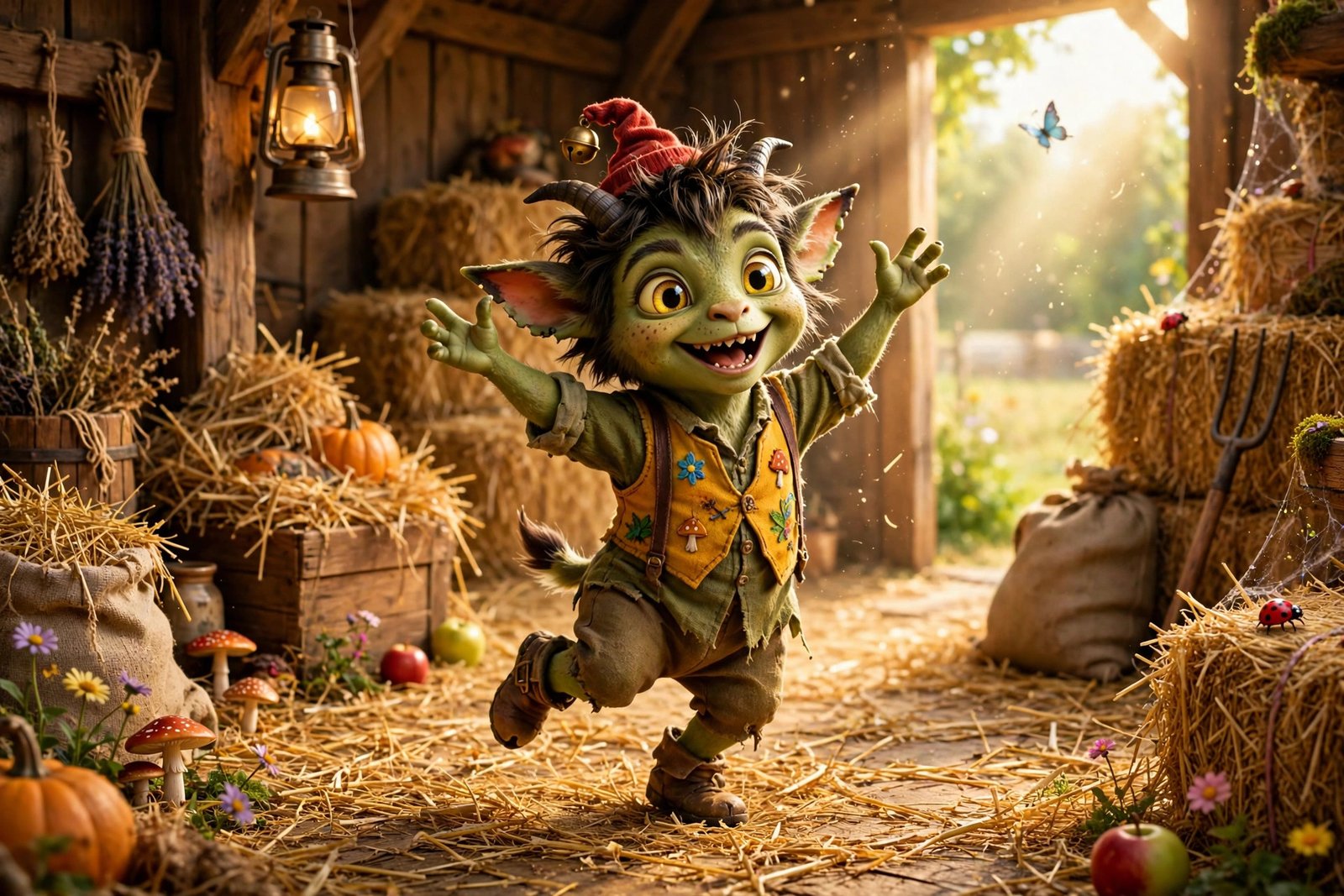
You have probably seen him, even if you did not know what you were looking at: a small man in a sequined jacket and bow tie, tiptoeing through a barn full of straw, grinning at a young woman, dancing to a song about Jordans. The clip looks like a scene from an old fantasy movie — many posts label it “Rumpelstiltskin (1987)” — and millions of people went looking for that movie. There is no such scene in any movie. The dancing imp is AI-generated, and his rise through TikTok and X in the fall of 2026 is one of the strangest viral stories of the year.
The meme is called the AI Rumpelstiltskin, or “Tip Toein’ in My Jordans,” and it captures almost everything about how virality works in 2026: an AI-made clip, a nostalgic style, a catchy song, a mystery about its origin, and a format so easy to copy that thousands of people remade it with themselves, their pets and their favorite characters in the starring role.
Where the clip actually came from
The original video was posted to Instagram on August 27, 2026, by the accounts Stroinaya, Neuroferma and Anna Glinskaya. It is a 33-second fake 1987 fantasy scene: a small man with wispy blond hair, a black sequined jacket and a bow tie crouches and tiptoes through a room piled with straw, grins at a young woman with long hair, and dances. The colors are washed out and the picture is soft, like an old television recording. A title card in Russian reads “RUMPEL,” which may be why some viewers decided the clip came from an old Russian film.
A real Rumpelstiltskin movie did come out in 1987 — a Cannon fairy-tale musical starring Billy Barty in the title role — but the dancing man is not from it. The confusion is understandable: the AI clip was deliberately styled to look like a 1980s film, and the internet loves a lost-media mystery. For days, viewers searched for a film that did not exist, debated whether the clip was real, and argued in comments about its origin. By the time the AI origin was confirmed, the meme had already taken off. Know Your Meme documents the full origin and spread here.
How it became a meme
The clip took about a month to cross from Instagram to TikTok. In late September 2026, editors paired the dance with Riff Raff’s song “Tip Toe Wing in My Jawwdinz,” looping the tiptoe steps to the beat. One early TikTok edit, posted September 27, had gathered about 6.5 million plays by late October. Another, posted September 29 by a user often credited with starting the trend, passed 850,000 views within a week. On October 1, a post on X reached 9.8 million views in five days.
From there, the format exploded. Creators used AI video tools to replace Rumpelstiltskin with other people and characters: streamers, superheroes, pets, friends in wigs on playgrounds. Every remake copies the same nine seconds — the creep, the shush, the maiden’s gasp, the grin, the dance, the arms-out pose and the close-up on the pointed shoes. Trend trackers estimated the meme at roughly 58 million views across TikTok, Reels, Shorts and X by late October 2026, and it ranked among the top trending memes in the United States in the final week of October. A detailed timeline of the trend is here.
Why this meme, why now
The Rumpelstiltskin meme works for several reasons that, taken together, explain a lot about the current internet. First, it is instantly readable: you do not need context to enjoy a tiny man dancing in a barn. Second, it is remixable: the format survives almost any substitution, which is the defining trait of a durable meme. Put anyone in the imp’s place and the joke still lands, because the joke is partly the absurdity of the scene itself.
Third, it carries a mystery. The “is this real?” question drove engagement in a way that a clearly labeled AI clip would not have. People shared it to ask, to debunk, to argue — and every share, whatever its intent, spread the clip further. Fourth, it is nostalgic without being tied to any actual nostalgia: the fake-1980s look triggers a warm, vague familiarity even in viewers too young to remember the 1980s. And fifth, it arrived at the perfect moment, just before Halloween, when a grinning imp in a barn feels seasonally appropriate.
There is also a broader point. AI-generated video has moved, in a single year, from a novelty to a raw material of meme culture. Earlier viral AI clips were curiosities. The Rumpelstiltskin clip is something else: a fully AI-made scene that most viewers initially assumed was real footage, remixed thousands of times by people using AI tools of their own. The meme is not just about an imp. It is about an internet in which the line between found footage and generated footage has become genuinely hard to see.
The misinformation problem, in miniature
The Rumpelstiltskin story is funny, but it is also a small case study in how misinformation spreads. The false claim — that the clip came from a 1987 film or an old Russian movie — traveled faster than the correction, because the false claim was more interesting. People wanted there to be a lost film. A debunk, however accurate, is rarely as shareable as a mystery.
That pattern matters beyond one meme. As AI video improves, more clips will arrive with plausible-but-false backstories, and more of them will be about consequential things rather than fairy-tale imps. The Rumpelstiltskin case shows both sides of the dynamic: the internet eventually figured it out, with Know Your Meme, news outlets and the original creators’ own posts establishing the AI origin — but only after millions of views, and only because people cared enough to investigate. For less charming subjects, the correction may never catch up.
How to spot an AI clip like this one
A few tells can help. Look for the too-perfect softness of old-film styling combined with movement that feels slightly off — hands, feet and faces are still where AI video struggles most. Check whether the supposed source film actually exists: a quick search for the film’s title, cast and year will usually settle it. Look for the original poster and the earliest upload, rather than trusting a repost’s caption. And treat any clip labeled with a suspiciously specific year and no other provenance as a claim, not a fact, until you have checked it.
None of this means AI memes are bad. The Rumpelstiltskin remakes are, by most accounts, delightful — creative, funny and harmless. The point is not to spoil the fun. It is to keep the fun honest: enjoy the imp, remake the imp, but know that the imp is AI, and that the 1987 film in the caption does not exist.
What comes next for the imp
Memes have short lives, and the Rumpelstiltskin dance is already past its search peak, which came around October 5, 2026. But the format has staying power for Halloween season, and its real legacy may be as a template: a proof that an AI-generated character can become a folk figure, passed from creator to creator like a story, each version slightly different and none of them quite real.
Years from now, people may remember the fall of 2026 as the season a tiny AI imp danced through everyone’s feed. They may not remember whether they believed he was real. That ambiguity — between real and generated, found and made — is the meme’s true subject, and it is not going away. The imp tiptoed out of a barn that never existed and into a culture that is still learning how to tell the difference.
Related reading
For more viral trends and internet culture, read Maxxing Explained: Dictionary.com’s Word of the Year 2026, Silent Walking: America’s Quietest Viral Trend Explained, and Grandma Hobbies Are Booming: Why Gen Z Picked Up Knitting.
Frequently asked questions
Is the Rumpelstiltskin dancing clip from a real 1987 movie? No. The clip is AI-generated and was first posted to Instagram on August 27, 2026. A real 1987 Rumpelstiltskin musical exists, but the dancing scene is not from it.
Who created the AI Rumpelstiltskin video? The original was collaboratively posted by the Instagram accounts Stroinaya, Neuroferma and Anna Glinskaya in late August 2026.
What song is used in the Rumpelstiltskin meme? Riff Raff’s “Tip Toe Wing in My Jawwdinz,” which TikTok editors paired with the dance in late September 2026.
How big did the meme get? Trend trackers estimated roughly 58 million views across TikTok, Reels, Shorts and X by late October 2026, with the earliest TikTok edit alone reaching about 6.5 million plays.
Why did people think it was a real film? The clip was styled to look like a 1980s film, with washed-out colors and a soft picture, and early posts labeled it “Rumpelstiltskin (1987),” which sent viewers searching for a movie that did not exist.