
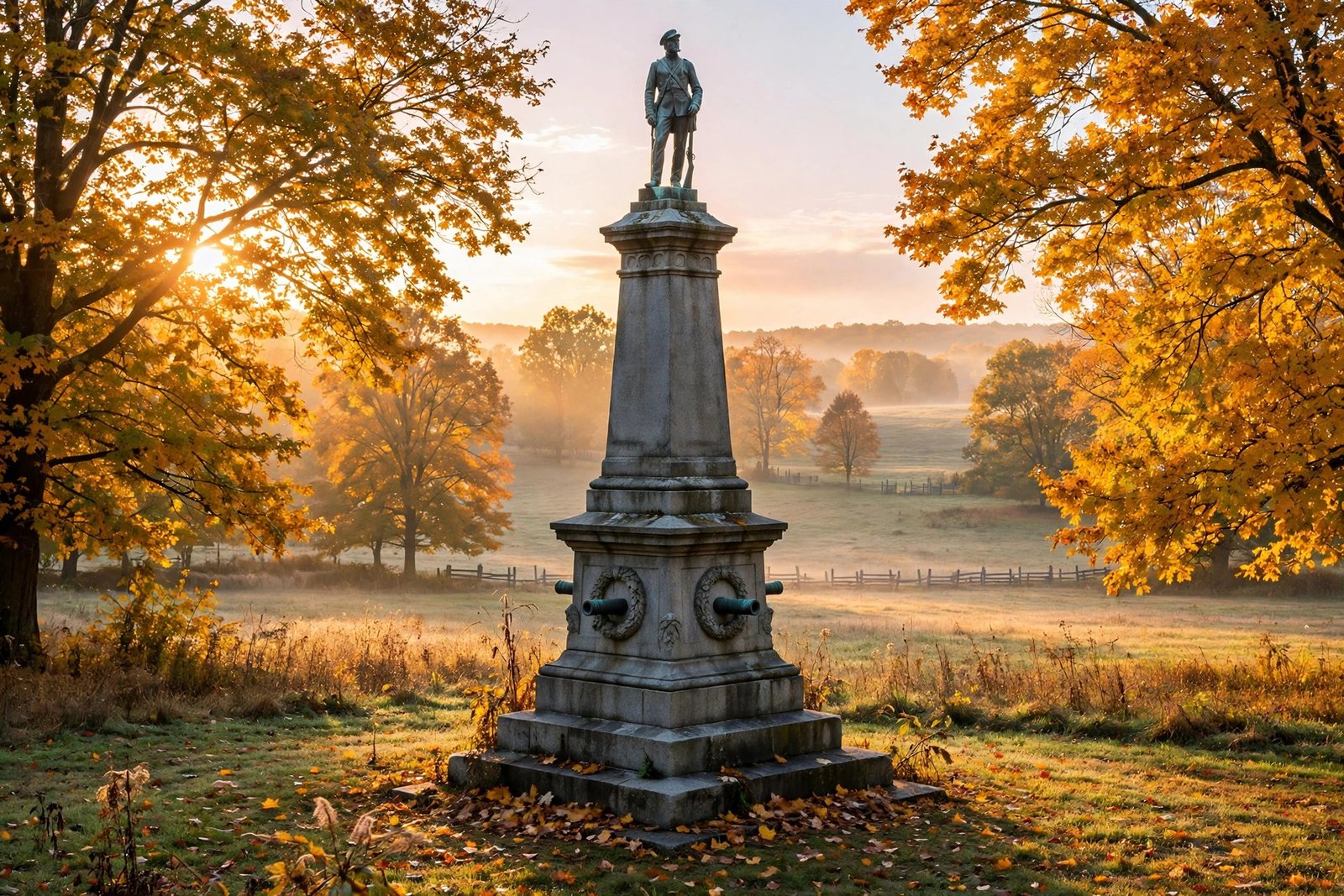
On a cold November afternoon in 1863, Abraham Lincoln stood before a crowd in a small Pennsylvania town and spoke for barely two minutes. He had not come to deliver a grand oration. He had come, in his own words, to offer only “a few appropriate remarks” at the dedication of a cemetery. Yet those remarks — just 272 words — became the most famous speech in American history, and they changed the way Americans understood their own country.
The Gettysburg Address is quoted on monuments, memorized by schoolchildren, and carved into the wall of the Lincoln Memorial in Washington. But its power does not come from its length. It comes from what Lincoln did in those few sentences: he took a war that many Americans understood as a fight over states and sovereignty, and he reframed it as a test of a single idea — that all people are created equal, and that a government built on that idea could survive.
This is the story of that speech: the terrible battle that made it necessary, the quiet ceremony where it was delivered, the words themselves, and why they still matter more than a century and a half later.
The Battle That Made the Speech Necessary
To understand the Gettysburg Address, you first have to understand what happened at Gettysburg in the summer of 1863. The American Civil War was in its third year, and the Confederacy, under General Robert E. Lee, had pushed north into Pennsylvania in a bold invasion. Union forces under General George G. Meade met Lee’s army near the town of Gettysburg, and from July 1 to July 3, 1863, the two armies fought one of the largest and most decisive battles of the war.
The fighting was ferocious. It rolled across farms, ridges, and rocky hills with names that are now burned into American memory: Little Round Top, Cemetery Ridge, Devil’s Den. On the third day, Lee ordered a massive frontal assault against the center of the Union line — the attack now remembered as Pickett’s Charge — and it was repulsed with devastating losses. Lee’s army withdrew south, and the invasion of the North was over.
But victory came at a staggering human cost. The fields around Gettysburg were covered with the dead and wounded, and the town itself — a community of ordinary farmers, shopkeepers, and families — was overwhelmed by the aftermath. Thousands of bodies lay in shallow, hastily dug graves, and as the summer wore on, the need for a proper resting place became urgent.
That need led to the creation of the Soldiers’ National Cemetery at Gettysburg, a burial ground for the Union soldiers who had died in the battle. Pennsylvania’s governor and local leaders organized the effort, and a dedication ceremony was planned for the autumn. The date was set for November 19, 1863, roughly four and a half months after the guns had fallen silent.
A Cemetery Dedication, Not a Headline Event
It is one of history’s great ironies that Lincoln was not the star of the day. The featured speaker was Edward Everett, a former governor of Massachusetts, a former secretary of state, and widely regarded as the finest orator in America. Everett had been given weeks to prepare, and he delivered a formal, classical oration that ran for about two hours, delivered entirely from memory.
Lincoln, by contrast, was invited almost as an afterthought to offer brief remarks after Everett’s speech. He arrived in Gettysburg the day before the ceremony and stayed overnight at the home of David Wills, a local attorney who had helped organize the cemetery. The next day, Lincoln joined a procession through town to the cemetery grounds, where a large crowd had gathered on a hillside.
When Everett finished, Lincoln rose and spoke. Accounts differ slightly on the crowd’s immediate reaction — some people later said the applause was scattered, as if the audience was not quite sure the speech was over — but Everett himself understood what had happened. In a letter to Lincoln afterward, he wrote that he wished he could flatter himself that he had come as near to the central idea of the occasion in two hours as Lincoln had in two minutes. It was a generous admission from a proud man, and it was entirely accurate.
The Words Themselves
Lincoln’s genius was compression. In ten sentences, he moved from the founding of the nation to the crisis of the present to a call for the future. Here is the full text of the address, in the version most commonly reprinted, as preserved by the National Archives:
“Four score and seven years ago our fathers brought forth on this continent, a new nation, conceived in Liberty, and dedicated to the proposition that all men are created equal.
Now we are engaged in a great civil war, testing whether that nation, or any nation so conceived and so dedicated, can long endure. We are met on a great battle-field of that war. We have come to dedicate a portion of that field, as a final resting place for those who here gave their lives that that nation might live. It is altogether fitting and proper that we should do this.
But, in a larger sense, we can not dedicate — we can not consecrate — we can not hallow — this ground. The brave men, living and dead, who struggled here, have consecrated it, far above our poor power to add or detract. The world will little note, nor long remember what we say here, but it can never forget what they did here. It is for us the living, rather, to be dedicated here to the unfinished work which they who fought here have thus far so nobly advanced. It is rather for us to be here dedicated to the great task remaining before us — that from these honored dead we take increased devotion to that cause for which they gave the last full measure of devotion — that we here highly resolve that these dead shall not have died in vain — that this nation, under God, shall have a new birth of freedom — and that government of the people, by the people, for the people, shall not perish from the earth.”
Read it slowly and you can feel the architecture of it. The opening reaches back to 1776 — “four score and seven years” is 87 years, a poetic way of counting back from 1863 to the Declaration of Independence. The middle turns to the present, to the war and the field itself. And the closing turns to the future, to the living, and to the work that remains unfinished.
What Lincoln Was Really Saying
The Gettysburg Address is often described as beautiful, and it is. But it was also a political argument, and a daring one. Lincoln was making three claims that were not universally accepted in 1863, even in the North.
First, he was saying that the nation was founded on a proposition — human equality — and not merely on a set of legal arrangements. The Declaration of Independence, not the Constitution alone, was the moral foundation of the country. That mattered because it meant the war was not just about preserving a government; it was about whether a nation dedicated to equality could survive at all.
Second, he was saying that the soldiers buried at Gettysburg had died for that proposition, and that their sacrifice gave the war its meaning. This was a deliberate act of interpretation. By dedicating the cemetery in these terms, Lincoln was telling a grieving nation that its losses were not senseless, and that the dead had purchased something precious with their lives.
Third, and most radically, he was pointing toward a “new birth of freedom.” In 1863, the Emancipation Proclamation had already declared enslaved people in Confederate-held territory to be free, but slavery still existed, and the war’s ultimate outcome was far from certain. Lincoln’s phrase suggested that the war would not simply restore the old Union, but create something better — a nation that lived up to its founding promise more fully than it had before.
That is why the speech still resonates. Lincoln was not just eulogizing soldiers. He was redefining what America was for.
Why It Endured When Longer Speeches Were Forgotten
Edward Everett’s two-hour oration was learned, eloquent, and thoroughly researched. Almost nobody quotes it today. Lincoln’s 272 words are quoted everywhere. Why?
Part of the answer is craft. Lincoln’s sentences are built on rhythm and repetition — “we can not dedicate, we can not consecrate, we can not hallow” — and on a plain, biblical cadence that feels both ancient and immediate. He used almost no jargon and no technical language. A child can follow the argument, and a scholar can spend a lifetime unpacking it.
Part of the answer is timing. Lincoln spoke at the moment when the nation most needed a way to make sense of its suffering. Gettysburg had been a Union victory, but the war ground on for nearly two more years, and the casualty lists kept growing. The Address gave Americans language for grief that was neither bitter nor empty — language that honored the dead by demanding something of the living.
And part of the answer is that the speech’s promise was left deliberately unfinished. Lincoln did not declare the work complete. He said the work remained, and that it belonged to “us the living.” Every generation since has been able to hear in those words a challenge addressed to itself — during the civil rights movement, in debates over voting rights and equality, and in moments of national crisis when Americans have asked what their country is actually for.
There are five known copies of the Address in Lincoln’s handwriting, made for different recipients in the months after the speech. The version most often reprinted, known as the Bliss copy, was written for Colonel Alexander Bliss and is now kept in the Lincoln Bedroom of the White House. The existence of several slightly different copies is itself a reminder that the speech was a living document to Lincoln, not a monument — he continued to polish its wording even after delivering it.
Visiting Gettysburg Today
If you want to understand the Gettysburg Address, there is no substitute for standing where it was given. Gettysburg National Military Park preserves the battlefield, and the Soldiers’ National Cemetery — now Gettysburg National Cemetery — remains the final resting place of over 3,500 Union soldiers who died at Gettysburg, along with veterans of later wars. The National Park Service offers a virtual tour of the National Cemetery for those planning a visit, and the park itself is free to enter.
Begin at the Museum and Visitor Center on Baltimore Pike, where the film and museum exhibits set the stage for the battle. Then walk the battlefield itself — the rolling ground of Cemetery Ridge, the rocky slopes of Little Round Top — and you will quickly grasp what the soldiers faced. Finally, go to the cemetery. Stand near the Lincoln Speech Memorial, look out over the rows of headstones arranged in a great arc, and read the Address aloud, quietly, to yourself. It takes about two minutes. That is the whole point.
The town of Gettysburg itself is worth a slow wander, too. The David Wills House in the center of town, where Lincoln spent the night before the speech, is part of the park. The streets still follow the same grid that soldiers marched through in 1863, and the surrounding Adams County farmland still looks, in places, much as it did then. It is a place where history does not feel distant. It feels close enough to touch.
Lincoln once said, in the Address itself, that the world would little note nor long remember what was said at Gettysburg. He was wrong about that, in the best possible way. The world has never forgotten. And the reason it hasn’t is that his 272 words were not really about Gettysburg at all. They were about whether a nation built on the idea of equality could endure — and whether the living would finish the work the dead had started. That question is still open. That is why the speech still matters.
Frequently Asked Questions
When was the Gettysburg Address delivered?
President Abraham Lincoln delivered the Gettysburg Address on November 19, 1863, at the dedication of the Soldiers’ National Cemetery in Gettysburg, Pennsylvania, about four and a half months after the Battle of Gettysburg.
How long is the Gettysburg Address?
The address is 272 words long and takes roughly two minutes to deliver. It is one of the shortest major speeches in American history, especially compared with Edward Everett’s two-hour oration that preceded it on the same day.
What does “four score and seven years ago” mean?
A “score” is twenty years, so four score and seven is 87 years. Counting back 87 years from 1863 gives 1776, the year of the Declaration of Independence. Lincoln was deliberately tying the Civil War to the founding ideals of the nation.
Where can I read the full text of the Gettysburg Address?
The full text is available from the National Archives and is also discussed with historical context by Encyclopaedia Britannica. The address is in the public domain, so it can be freely read, quoted, and shared.