
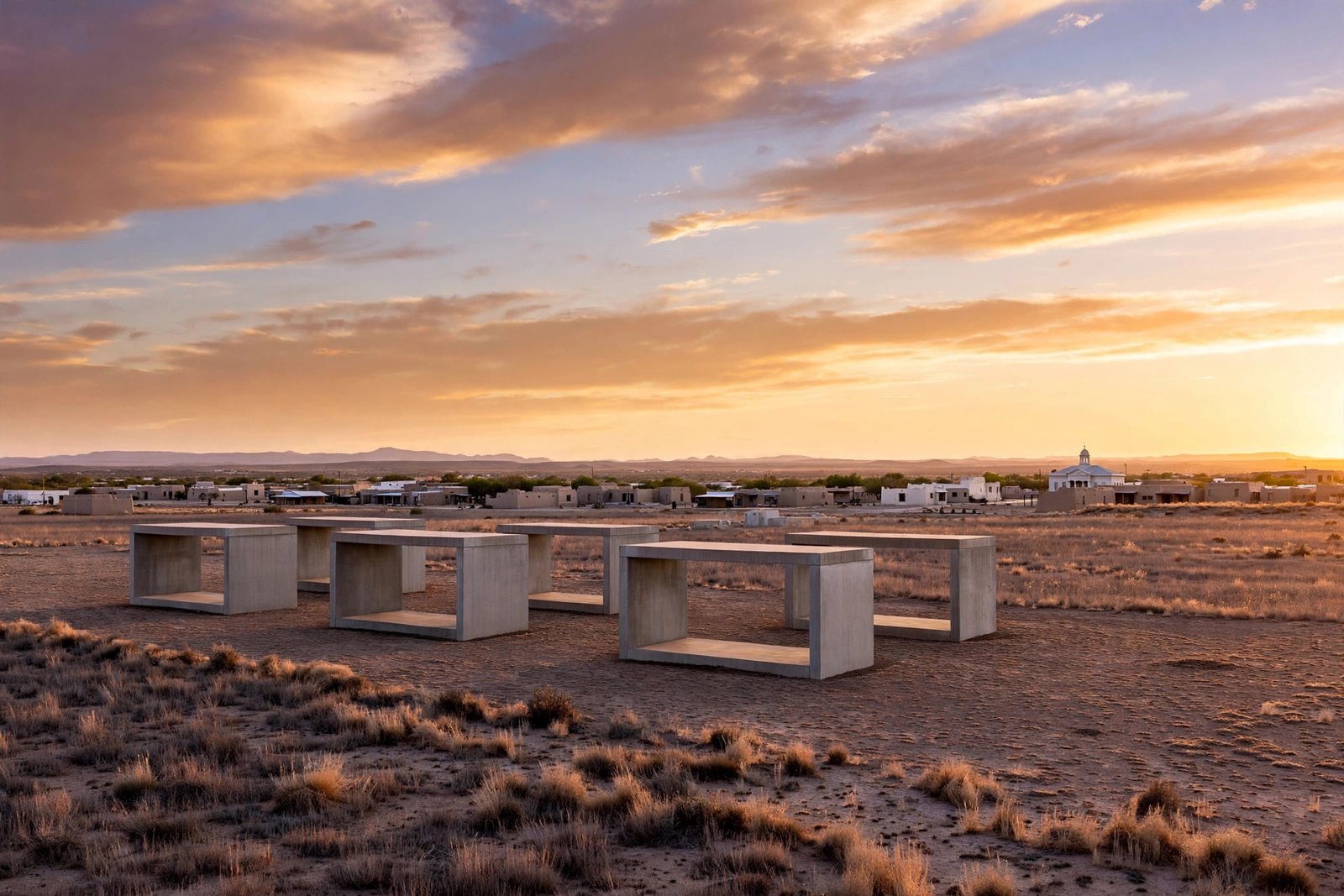
Drive west from San Antonio, keep going past the edge of what feels like the middle of nowhere, and eventually the desert opens up into a small town that does not look like anywhere else in Texas. Marfa is a high-desert town of wide skies, low adobe buildings, and art installations so large they need former military buildings to hold them. It is famous for two things that should not exist side by side: world-class minimalist art and a mysterious light phenomenon that has puzzled visitors for well over a century. That unlikely combination is exactly why Marfa has become one of the most beloved hidden gems in America, a place where a weekend trip feels like stepping into a different version of the country.
Marfa sits in Presidio County in the Big Bend region of far West Texas, in the Chihuahuan Desert, and it rewards travelers who are willing to make the journey. There is no quick way to get here, and that is part of the point. The town moves slowly, the horizon stretches forever, and the light at sunset turns the desert gold, then pink, then deep blue. This guide covers what makes Marfa special: the Marfa Lights, the Chinati Foundation and the art scene Donald Judd built, the town itself, and the practical tips that will help you plan a trip that lives up to the legend.
First, the Marfa Lights: A Mystery Older Than the Automobile
The Marfa Lights are the town’s oldest mystery and its most famous attraction. They are unexplained lights that appear over the desert southeast of town, usually described as glowing orbs that hover, split apart, merge, change color, and drift across the horizon. Some nights they are bright and active; other nights there is nothing at all. That unpredictability is part of the experience, and it is why the town built a place specifically for watching them.
The first historical record of the lights dates to 1883, when a young cowhand named Robert Reed Ellison reported seeing a flickering light while driving cattle through Paisano Pass. He first thought it might be an Apache campfire, but when he and others investigated, they found no ashes and no evidence of a campsite. Other settlers told him they had seen the lights too, and a few years later, in 1885, Joe and Anne Humphreys reported their own sighting. The story matters because 1883 predates the automobile by decades, which rules out the simplest modern explanation for those earliest accounts.
Over the years, the lights have inspired many theories: campfires, phosphorescent minerals, swamp gas, static electricity, and St. Elmo’s fire among them. Modern scientific studies have concluded that most lights seen from the official viewing area today are automobile headlights on distant highways, distorted by warm desert air. That finding has not dimmed the town’s enthusiasm for the lights, and a small number of observations have resisted easy explanation.
The official place to watch is the Marfa Lights Viewing Area, about nine miles east of town on US Highway 90 toward Alpine. It is a roadside viewing platform maintained by the Texas Department of Transportation, with informational plaques and an open view toward the Chinati Mountains. Go after dark, bring a layer for the desert chill, and give your eyes time to adjust. There is no schedule and no guarantee on any given night, so the best approach is to treat the viewing as an evening outing in itself: arrive before sunset, watch the sky change color, and stay for a while. If the lights appear, you will know it. If they do not, you will still have watched one of the best sunsets in Texas.
Donald Judd and the Art Town That Should Not Exist
If the lights put Marfa on the map, Donald Judd made it an art destination. Judd was a minimalist artist who settled in Marfa in the 1970s, drawn to the high desert’s raw beauty and open space. He bought a decommissioned Army fort, Fort D. A. Russell, and turned its buildings into his home and studio. In 1986, he established the Chinati Foundation there, with the goal of permanently displaying large-scale works in a setting where the art, the architecture, and the landscape are inseparable. The foundation is named for the Chinati Mountains southwest of town.
Chinati is not a museum you wander through on your own. Most of the collection is seen on guided tours, which must be reserved in advance and are the only way into many of the buildings. The centerpiece is Judd’s 100 untitled works in mill aluminum, a series of identical-form boxes arranged in two former artillery sheds, where enormous windows frame the desert beyond. The effect is hard to describe and easy to feel: identical objects that look different in every light, in a room that seems to dissolve into the landscape. The guided tour also typically includes Judd’s works in plywood and concrete, along with installations by other artists he admired, and a self-guided walk lets visitors see his concrete works on a trail through the grounds.
One important planning note for 2026: Chinati has announced that restoration of the Artillery Sheds begins in October 2026, and Judd’s 100 aluminum works will be closed to the public during construction. The concrete works remain available for free viewing by trail during museum hours. If the aluminum works are the reason for your trip, check Chinati’s current visiting notice and tour calendar before booking, and consider whether a later visit suits you better. The foundation’s schedule and tour offerings change seasonally, so the official site is the place to confirm what is open.
The Judd Foundation is a separate organization, and it is worth understanding the difference. Where Chinati shows large-scale installations on the former fort grounds, the Judd Foundation maintains Judd’s living and working spaces downtown, including La Mansana de Chinati, known as the Block, and selected studios. Its guided visits are also by reservation, run on set days, and offer a more intimate look at how Judd lived and worked: rooms full of books, furniture he designed, and art arranged exactly as he left it. Visiting both foundations gives you the full picture, one monumental and one domestic, and both reward booking well ahead of time.
Beyond Chinati: Galleries, Ballroom Marfa, and the Downtown Scene
Marfa’s art scene extends well beyond its two foundations. The town holds nearly two dozen galleries, many of them small, independent spaces along Highland Avenue and San Antonio Street, the town’s main drag. Gallery hopping here is a pleasure because the scale is human: you can walk the whole downtown in an afternoon, ducking into spaces that range from polished white cubes to converted storefronts, and you will often find the artist or gallerist behind the desk, happy to talk.
Ballroom Marfa, at 108 East San Antonio Street, is another anchor of the scene. It offers free admission and a changing program of exhibitions, music, film, and performances. Check its calendar before your visit, since an opening or a concert can turn an ordinary evening into the highlight of your trip.
Then there is Prada Marfa, which is not in Marfa at all, and that is part of the joke. The installation, a sealed, never-open storefront in the desert northwest of town along US Highway 90 toward Valentine, has become one of the most photographed roadside sights in Texas. It is a work of art posing as a luxury boutique, and it captures something essential about Marfa: this is a town that takes art seriously and does not take itself too seriously. A drive out to see it pairs naturally with a day trip into the wider desert, and it makes for a photo that instantly tells friends where you have been.
The Town Itself: Slow Days, Big Skies, and West Texas Character
What surprises many first-time visitors is how much of Marfa’s charm has nothing to do with art or lights. The town began as a railroad water stop and a ranching center, and it still carries that history in its bones. The Presidio County Courthouse, an 1886 Second Empire-style building with Italianate details, anchors downtown and is worth a slow walk around. The Marfa and Presidio County Museum, housed in an 1880s-era home, tells the town’s story through nine galleries covering the railroad, the military years, ranching, filmmaking, and the art transformation.
Daily life in Marfa runs at desert pace. Mornings are quiet, afternoons are for galleries and coffee, and evenings belong to the sunset and the lights. The food scene is small but serious, with restaurants and food trucks that punch above their weight for a town this size, and the hotel scene ranges from the historic Hotel Paisano, a restored 1930s hotel downtown, to stylish small inns and desert retreats. Whatever you choose, book early: Marfa’s lodging is limited, and weekends, festival dates, and art openings can sell out weeks ahead.
The town is also a basecamp for the wider Big Bend region. Big Bend National Park, one of the least visited and most spectacular national parks in the country, is a drive to the south, and the Davis Mountains, McDonald Observatory, and the arts community of Alpine are all within reach for day trips. Many visitors pair Marfa with a night at the observatory’s star parties, where the same dark skies that make the Marfa Lights visible also make the Milky Way look close enough to touch.
Practical Tips for Visiting Marfa
Getting to Marfa is part of the adventure. The town is remote by design: it is a long drive from any major city, and the nearest commercial airports are hours away. Most visitors drive, and the drive itself, across the high desert plains, is one of the best parts of the trip. Fill up when you can, since services thin out in West Texas, and plan your arrival for daylight if it is your first time on these roads.
Book art tours before you book anything else. Chinati and Judd Foundation visits require advance reservations, and popular slots sell out, especially on weekends. Decide which experience matters most to you, check the current tour calendar, and build the rest of your weekend around those times. If you are traveling with children, note that Judd Foundation visits generally require visitors to be at least 12, with carried infants as an exception, and photography is not permitted on guided visits.
Pack for the desert. Days can be warm and bright even in cooler months, and nights cool off fast. Closed-toe shoes are a good idea for Chinati’s grounds, where you will walk on uneven ground, and a hat, sunscreen, and water are essential year-round. Marfa is in the Central Time Zone, which matters if you are driving in from El Paso, which is on Mountain Time: it is easy to lose an hour to the time change if you are not watching for it.
For the lights, keep expectations honest. The viewing area is free and open, and it is a wonderful place to spend an evening, but no one can promise a sighting. Go for the sunset, stay for the stars, and treat any lights as a bonus. Bring a light for navigating the viewing area safely after dark, dress warmly, and be patient. The desert rewards patience more than almost any other place in America.
Frequently Asked Questions
Where is Marfa, Texas?
Marfa is a small city in Presidio County in the Big Bend region of far West Texas, in the Chihuahuan Desert. It is a long drive from major cities, which is part of its remote, hidden-gem character.
What are the Marfa Lights?
The Marfa Lights are unexplained lights seen over the desert southeast of town, first recorded in 1883 when cowhand Robert Reed Ellison reported a flickering light in Paisano Pass. Modern studies have found that most lights seen from the official viewing area are distant automobile headlights distorted by warm desert air, though the phenomenon’s history predates cars by decades.
Where is the best place to see the Marfa Lights?
The official Marfa Lights Viewing Area is about nine miles east of town on US Highway 90 toward Alpine. It is a roadside platform with an open view toward the Chinati Mountains. There is no guaranteed schedule, so go after dark and allow plenty of time.
What is the Chinati Foundation?
The Chinati Foundation is a contemporary art museum founded in 1986 by artist Donald Judd on the site of the former Fort D. A. Russell. It presents large-scale, permanent installations, including Judd’s 100 untitled works in mill aluminum, and most visits are by guided tour booked in advance.
Do I need reservations to visit Marfa’s art sites?
Yes. Both the Chinati Foundation and the Judd Foundation require advance reservations for guided visits, and popular slots sell out. Check their official tour calendars before your trip, and note that Chinati’s Artillery Sheds restoration beginning in October 2026 temporarily closes the aluminum works.
Plan your visit with the Chinati Foundation’s official site, the Lonely Planet guide to the Chinati Foundation, the Texas View visitor guide to Marfa, the history of the Marfa Lights, and the Tour Texas guide to Marfa attractions.
Related reading
If you enjoyed this article, you may also like: Bisti Badlands: New Mexico’s Hidden Gem Great Sand Dunes National Park, Colorado America’s 63 National Parks: A Complete Guide.