
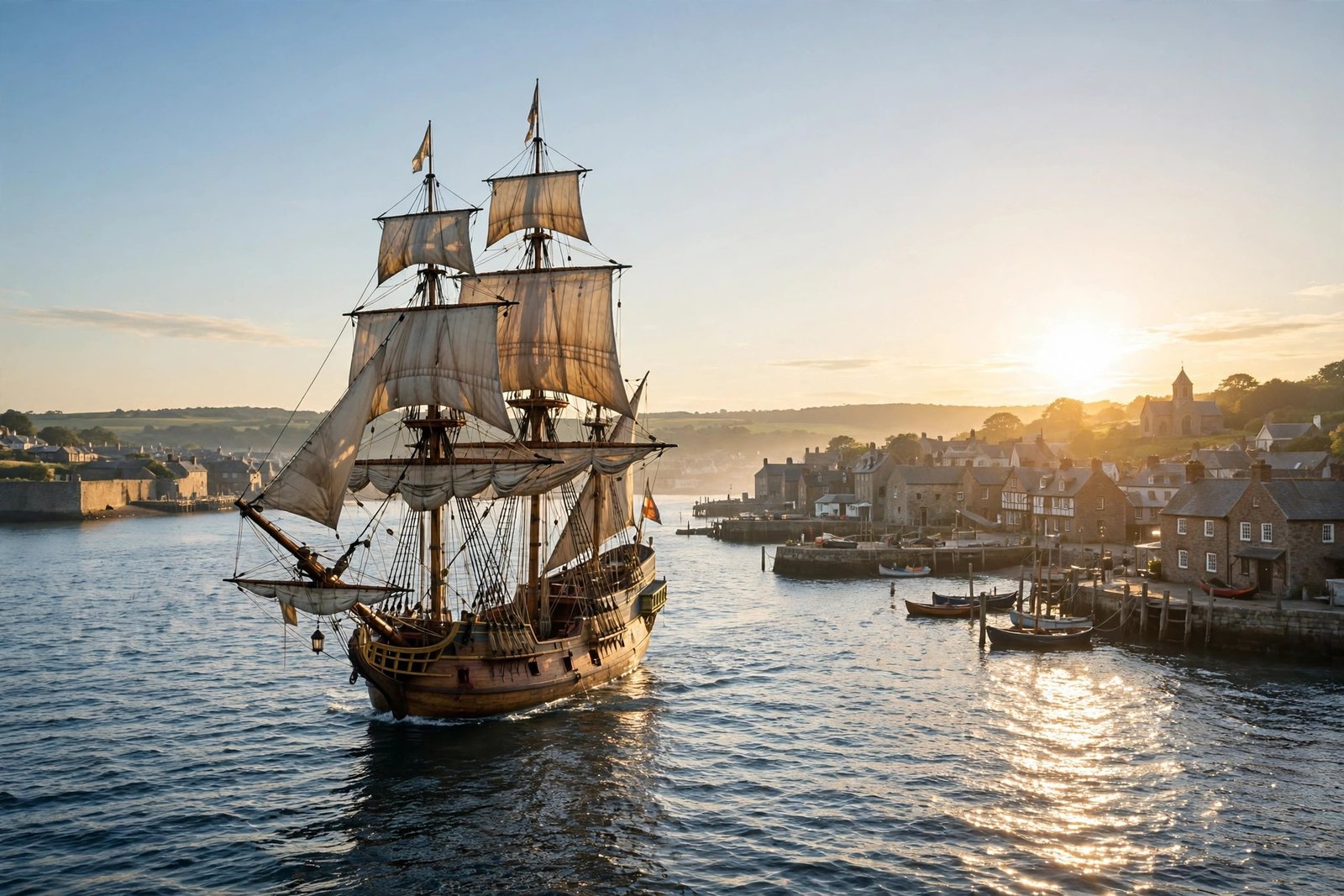
On a cold November day in 1620, a group of English settlers anchored off a windswept hook of land they had never intended to reach, far from the place where they were legally supposed to settle. Before anyone went ashore to build, they did something extraordinary: they wrote down, and signed, an agreement to govern themselves. That short document, the Mayflower Compact, became one of the most famous pieces of paper in American history. It was not a declaration of independence, and it did not create a democracy as we know it today. But it planted an idea that would grow for more than a century and a half: that legitimate government comes from the consent of the governed, not only from a distant king.
Who Were the Pilgrims, and Why Did They Leave?
The people we call the Pilgrims were English Separatists, Protestants who believed the Church of England was beyond reform and that true believers should form their own independent congregations. That belief was dangerous in early seventeenth-century England, where the king headed the church and dissent could bring fines, imprisonment, and worse. A congregation from Scrooby in Nottinghamshire fled first to the Netherlands, settling in Leiden, where they could worship freely. But life in exile was hard. Their children were growing up Dutch, their trades were poorly paid, and they worried their community would simply dissolve into a foreign land.
So they made a bold plan: cross the Atlantic and build a colony in the New World where they could worship as they pleased and keep their English identity. They were not the only passengers. The voyage was financed by a group of London merchants called the Merchant Adventurers, who recruited additional settlers, craftsmen, and servants to make the colony economically viable. Historians call the religious Separatists the “Saints” and the others the “Strangers,” a useful shorthand for a ship full of people who did not all share the same faith or the same reasons for leaving home.
That mix mattered. The Saints wanted a godly community. The Strangers wanted land, wages, and opportunity. Keeping such a mixed company together through a dangerous ocean crossing and a hard first winter would require more than shared religion. It would require a shared agreement about who was in charge and why anyone should obey.
The Voyage: Two Ships, One Leaky Problem
The plan began with two ships. The Separatists sailed from the Netherlands aboard the Speedwell, a smaller vessel, and met the larger Mayflower at Southampton, England. The two ships set out together on August 15, 1620, according to Britannica, but the Speedwell proved unseaworthy and was twice forced to turn back. After the second failure, the voyagers made a hard choice: abandon the Speedwell, crowd as many of its passengers and supplies as possible onto the Mayflower, and sail alone.
The Mayflower finally set out from Plymouth, England, on September 16, 1620, under Captain Christopher Jones, carrying 102 passengers. Britannica estimates the square-rigged merchant ship at about 180 tons and roughly 90 feet long, a working cargo vessel, not a passenger liner. For 66 days, more than a hundred men, women, and children lived crammed below decks in damp, dark, miserable conditions. Storms battered the ship so violently that a main beam cracked and had to be held in place with a great iron screw the passengers happened to have brought along. Seasickness was nearly universal, food was salted and stale, and tempers frayed.
Yet the passengers endured, and the voyage itself became part of the legend. A child was even born at sea during the crossing. When land finally appeared, it was not the Virginia coast the settlers had aimed for. It was Cape Cod, in what is now Massachusetts, hundreds of miles north of their intended destination.
Off Course: The Problem That Created the Compact
Missing Virginia was not just a navigational embarrassment. It was a legal crisis. The settlers held a patent, a grant of land, for territory in northern Virginia. Outside that territory, their patent arguably did not apply, and with it, the authority of their leaders was thrown into question. Some of the Strangers reportedly said that once they landed outside Virginia’s bounds, they would be free of all authority and could do as they pleased.
Whether that threat was real or exaggerated, the leaders took it seriously. Before anyone set foot ashore to stay, the adult male passengers gathered, probably aboard the ship anchored in what is now Provincetown Harbor, and signed an agreement. It was dated November 11, 1620, under the Old Style Julian calendar then in use in England, which corresponds to November 21 on the modern Gregorian calendar. Forty-one men signed it.
The genius of the Compact was its simplicity. Rather than waiting for a new patent from London, the signers created their own authority on the spot, from below, by mutual agreement. They did not claim to be independent of the king. They called themselves his loyal subjects. But they agreed among themselves to form a government and obey its laws. In a world where authority almost always flowed downward from a monarch, that sideways agreement, among equals, was quietly radical.
What the Compact Actually Said
The whole document is short, only a few hundred words, and it repays reading closely. It opens “In the Name of God, Amen,” and describes the signers as loyal subjects of King James who have undertaken a voyage to plant the first colony in the northern parts of Virginia, for the glory of God, the advancement of the Christian faith, and the honor of king and country.
Then comes the decisive passage: the signers “solemnly and mutually, in the Presence of God and one another, covenant and combine ourselves together into a civil Body Politick.” In plain language, they agreed to become a political community. And by virtue of that agreement, they would “enact, constitute, and frame, such just and equal Laws, Ordinances, Acts, Constitutions, and Officers, from time to time, as shall be thought most meet and convenient for the general Good of the Colony,” promising “all due Submission and Obedience” to those laws.
Notice what the Compact does and does not do. It does not list rights. It does not describe a system of voting or representation in detail. It does not mention religious freedom for others, and it certainly does not extend political power to women, servants, or the Indigenous peoples already living on the land. What it does do is establish a principle: that the colonists themselves, acting together, could create a government and bind themselves to obey it. That principle, that government rests on agreement, would echo through American history.
One more honest note: the original signed document has been lost. What survives are three seventeenth-century versions, including one handwritten by William Bradford in his history Of Plimoth Plantation and one printed in Mourt’s Relation in 1622. Scholars note that the versions agree in substance, differing mainly in spelling and punctuation, so we can be confident about what the Compact said even though the original sheet of paper is gone.
Who Signed It?
Forty-one men signed the Mayflower Compact, out of 102 passengers aboard the ship. The list, preserved by Bradford’s nephew Nathaniel Morton in his 1669 history, reads like a roll call of Plymouth’s founding generation. First came John Carver, who would become the colony’s first governor, followed by William Bradford, who would lead Plymouth for decades after Carver’s death. Edward Winslow, William Brewster, Isaac Allerton, and Myles Standish, the colony’s military leader, were among the other prominent names.
The list also includes men whose names are less famous but whose presence tells us something important. Servants signed alongside gentlemen. John Alden, a cooper hired as a crew member, signed and stayed. John Howland, a servant, signed too. The signers were not a council of aristocrats. They were the adult men of the company, Saints and Strangers together, putting their names to the same agreement. That breadth was the point: the Compact worked only if nearly everyone in the colony accepted it.
It is equally important to say who did not sign. No women signed, though women made up a large share of the passengers and would endure the same brutal first winter. Children, servants under age, and the ship’s crew were not signers either. The Compact was a step toward self-government, not a finished democracy, and its limits remind us how much further the American experiment had to go before government by consent included everyone.
The First Winter and Self-Government in Practice
The Compact was tested almost immediately. After exploring the coast, the settlers chose a site across the bay, at a place the Wampanoag people called Patuxet, and began building Plymouth in late December 1620. The winter that followed was devastating. About half of the passengers died in the first winter, according to Britannica’s passenger account and other histories, from disease, exposure, and malnutrition. The dead included John Carver, the first governor, and many of the colony’s strongest members.
Yet the government the Compact created held. When Carver died, the colonists chose Bradford as governor. They held meetings, made laws, divided land, and negotiated with their Wampanoag neighbors, most famously through the treaty with Massasoit and the harvest gathering remembered as the first Thanksgiving. None of this was smooth or easy, and the colony’s relations with Indigenous peoples would darken badly in later decades. But the basic machinery of self-rule, leaders chosen by the community, laws made for the general good, survived its hardest test.
Over the following years, Plymouth grew from a fragile outpost into a functioning colony, eventually merging with the Massachusetts Bay Colony in 1691. Its town-meeting tradition, in which freemen gathered to discuss and decide local matters, became a hallmark of New England political life and a training ground for the kind of participatory government that would later shape the American republic.
Why the Mayflower Compact Still Matters
Historians argue about how much direct influence the Mayflower Compact had on later American documents. It was not a constitution, and the men who wrote the Declaration of Independence and the Constitution drew on many sources, from English common law to Enlightenment philosophy to their own colonial charters. But the Compact matters for a simpler reason: it is the earliest clear American example of a government created by written agreement among the governed themselves.
That idea, that people can sit down together and write the rules they will live by, became the through-line of American political life. It appears in the town covenants of New England, in the colonial assemblies that insisted on a say in taxation, and finally in the founding documents of the United States, which open by invoking “We the People.” The Mayflower Compact did not invent that idea out of nothing, but it gave America its first vivid, local example of it in action.
There is also a cautionary side to the story that deserves telling. The Compact’s promise of self-government applied to the signers, not to the Wampanoag people whose land the colonists occupied, and not to the women and servants who shared their hardships. American self-government began as a partial promise, and much of the nation’s history since has been the struggle to extend that promise to everyone. Remembering the Compact honestly means remembering both halves: the boldness of the idea and the narrowness of who first got to share in it.
Four centuries later, the Mayflower Compact still rewards a visit, not as a relic to worship but as a reminder. A small group of cold, frightened, seasick people, far from home and off course, chose agreement over anarchy. They wrote it down, signed their names, and lived by it. That choice, made aboard a cramped ship in November 1620, is still the foundation stone of how Americans think government should work.
Frequently Asked Questions
When was the Mayflower Compact signed?
It was signed on November 11, 1620, under the Old Style Julian calendar used in England at the time, which corresponds to November 21, 1620, on the modern Gregorian calendar.
How many people signed the Mayflower Compact?
Forty-one adult male passengers signed it, out of 102 passengers aboard the Mayflower. The signers included both Separatists and Strangers, and the list was preserved by Nathaniel Morton in 1669.
Why did the Pilgrims write the Compact?
The Mayflower landed at Cape Cod, outside the Virginia territory covered by the settlers’ land patent, so their legal authority was in doubt. The Compact created a government by mutual agreement so the colony could maintain order and make laws for the general good.
Does the original Mayflower Compact still exist?
No, the original signed document has been lost. Three seventeenth-century versions survive, including William Bradford’s handwritten copy in Of Plimoth Plantation and the version printed in Mourt’s Relation in 1622, and they agree in substance.
Was the Mayflower Compact a constitution?
Not in the modern sense. It was a brief agreement to form a political community and obey its laws. It did not list rights or describe a detailed system of government, but it established the principle that government could rest on the consent of the governed.
For further reading, see Britannica’s history of the Mayflower voyage, the full text and signer list at American History Central, the Compact’s text at Encyclopedia.com, and the passenger list at Wikipedia’s list of Mayflower passengers.
Related reading
If you enjoyed this article, you may also like: The First Thanksgiving at Plymouth in 1621 Ellis Island: America’s Immigration Gateway The Louisiana Purchase of 1803: How America Doubled.