
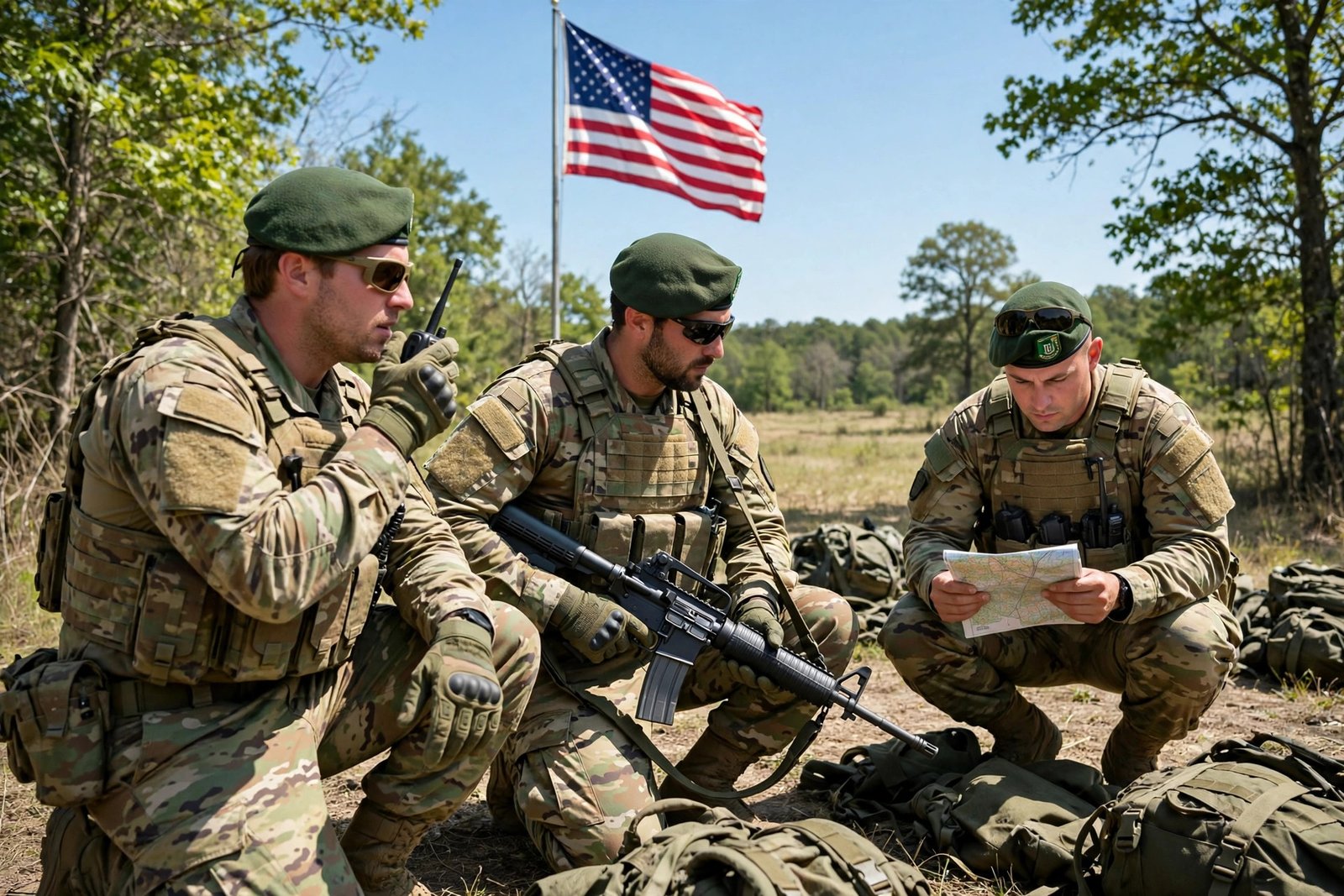
Few pieces of headgear in American military history carry as much meaning as the rifle-green beret worn by the U.S. Army Special Forces. To most Americans, the soldiers who wear it are simply the Green Berets. To the men and women who earn it, the beret is the visible end of a long road of selection, language training, and small-team soldiering, and a symbol of a mission that sets Special Forces apart from every other unit in the Army: working through and with other people, often far from home, to help free societies defend themselves. This is the story of how that force was born, how a president made its beret official, and what Green Berets actually do.
Roots in the Shadows of World War II
Army Special Forces trace their lineage to the purpose-built units of World War II that operated behind enemy lines. The Office of Strategic Services, America’s wartime intelligence and unconventional warfare organization, fielded Operational Groups that parachuted into occupied territory, linked up with resistance fighters, and organized sabotage and guerrilla operations. The Alamo Scouts ran dangerous reconnaissance missions in the Pacific, the First Special Service Force fought as an elite combined American-Canadian unit, and Filipino guerrillas kept resistance alive under Japanese occupation. These experiences taught the Army a lasting lesson: a small team of well-trained soldiers, working alongside local fighters who know the terrain and the people, can achieve results far out of proportion to its size. When the Cold War began, that lesson became the foundation of a permanent force.
That force took formal shape in June 1952, when the 10th Special Forces Group (Airborne) was activated at Fort Bragg, North Carolina, under Colonel Aaron Bank. Bank himself was a veteran of the OSS Operational Groups, and he built the new unit around the unconventional warfare mission. The early Green Berets were not designed to fight set-piece battles. They were designed to infiltrate denied territory, organize and train resistance movements, and conduct guerrilla warfare. The Psychological Warfare School established alongside the new group eventually grew into today’s U.S. Army John F. Kennedy Special Warfare Center and School, the institution that still trains Special Forces soldiers.
The Beret That Was Not Yet Official
The green beret itself appeared long before it was authorized. In the mid-1950s, soldiers of the 10th Special Forces Group in Bad Tolz, Germany, began wearing a green beret as a mark of their distinct identity. Their commander authorized it locally in November 1955, but the Department of the Army did not recognize the headgear as official. That left Special Forces soldiers in an awkward position. They wore the beret where they could, and tucked it away when conventional commanders objected. As one veteran of the era later recalled, it became a sort of cat-and-mouse game, with soldiers scrambling to find berets that were actually green, some brought down from Canada, some handmade, with dye that ran in the rain. The beret mattered to these soldiers because it said something about who they were, and they were determined to keep it.
President Kennedy and the Green Beret
The turning point came in October 1961, when President John F. Kennedy visited Fort Bragg and watched a demonstration of Special Forces capabilities at McKellar’s Lodge. Brigadier General William Yarborough, commander of the Special Warfare Center, instructed his soldiers to take their unauthorized green berets out of hiding and wear them proudly before the president. Kennedy, who had studied unconventional warfare and communist insurgencies closely, was impressed. He had already concluded that the United States needed a dedicated counter-insurgency capability for the Cold War, and the demonstration convinced him that Special Forces were the force to build.
Following that visit, Kennedy authorized the green beret as the official headgear of Army Special Forces. On April 11, 1962, he put it in writing in an official White House memorandum, declaring that the green beret was “a symbol of excellence, a badge of courage, a mark of distinction in the fight for freedom.” That sentence permanently joined Kennedy’s legacy to the regiment. The bond deepened tragically after his assassination in November 1963, when Green Berets stood guard over his coffin and took part in the honor guard at his funeral. Command Sergeant Major Francis J. Ruddy laid his own beret at Kennedy’s grave in a gesture of gratitude and respect, and that beret is now on display at the John F. Kennedy Presidential Library. Every year since, Green Berets have laid a wreath in the shape of a green beret at the Kennedy Eternal Flame at Arlington National Cemetery. In April 2025, the Army formally inducted Kennedy as a Distinguished Member of the Special Forces Regiment, on the 63rd anniversary of the 1962 memorandum, with his grandson accepting the honor.
What Green Berets Actually Do
Special Forces soldiers are organized into 12-man Operational Detachments-Alpha, known as ODAs, the basic building block of the force. Each detachment is a self-contained team of specialists: a detachment commander and warrant officer, an operations and intelligence sergeant, and pairs of weapons, engineering, medical, and communications sergeants. The medical sergeants, in particular, are trained to a level far beyond ordinary combat medics, able to deliver advanced trauma care and even basic dentistry and veterinary care in places where no doctor exists. That breadth is deliberate. An ODA may have to fight, teach, heal, build, and negotiate, sometimes all in the same week.
The regiment’s missions reflect that versatility. Unconventional warfare, the original and most important mission, means working through indigenous forces and resistance movements. Foreign internal defense means training and advising a partner nation’s own military so it can defend itself. Special reconnaissance means gathering information deep in hostile or denied territory. Direct action means short, precise strikes against high-value targets. Counterterrorism rounds out the core set, and Green Berets also support counterinsurgency, stability operations, and humanitarian missions. The common thread is that Special Forces work by, with, and through others. Their greatest weapon is often not a rifle but a relationship, built on language skill, cultural understanding, and trust earned over months of living and working alongside partner forces.
Earning the Beret: Selection and the Q-Course
Nobody is simply assigned to Special Forces. Every candidate must first pass Special Forces Assessment and Selection, a grueling evaluation held at Camp Mackall near Fort Bragg that tests physical fitness, mental toughness, teamwork, and leadership under stress. Those who are selected move on to the Special Forces Qualification Course, universally known as the Q-Course, which runs roughly a year and is divided into phases covering small-unit tactics, specialty training in one of the detachment skills, language and culture training, and a final unconventional warfare exercise called Robin Sage, conducted in the forests of North Carolina with civilian role-players. Candidates must also complete Army Airborne School. Only on graduation does a soldier earn the green beret and the Special Forces tab, and assignment to an Operational Detachment-Alpha.
The language requirement is one of the clearest signs of what makes Green Berets different. A Special Forces soldier is expected to speak the language of the region where his group operates, whether that is Spanish, French, Arabic, Russian, Chinese, or another language. Language training lasts many months, and it is paired with study of the region’s history, politics, and culture. The Army calls Green Berets “soldier-diplomats” and “quiet professionals” for a reason. Much of their work is never publicized, and they prefer it that way. The nickname “quiet professionals” captures a culture that values results over recognition.
The Motto: De Oppresso Liber
The regiment’s motto, “De Oppresso Liber,” is Latin for “to free the oppressed,” and it appears on the Special Forces crest beneath a crossed-arrows-and-dagger emblem. The Army itself describes the motto as a reference to one of the force’s primary missions: training and combat-advising foreign indigenous forces. It is a mission statement as much as a motto. Wherever Green Berets deploy, from the mountains of Afghanistan to the jungles of Colombia to villages in Africa, the idea is the same: help local people gain the skills and confidence to defend their own freedom, so that American soldiers do not have to fight their battles for them. That philosophy, born in the resistance movements of World War II, remains the heart of the Green Berets more than seventy years after the first group was activated.
Today, Special Forces groups are stationed at Fort Bragg, Fort Carson, Fort Campbell, Joint Base Lewis-McChord, and elsewhere, each aligned to a region of the world, and the force continues to deploy on missions that range from training partner armies to counterterrorism operations. The green beret that was once worn in defiance of regulations is now one of the most recognized symbols in the American military, and it is still earned, never given. For the soldiers who wear it, and for the president who made it official, it remains what Kennedy called it in 1962: a symbol of excellence, a badge of courage, and a mark of distinction in the fight for freedom.
Vietnam: The War That Made the Green Berets Famous
Vietnam became the defining chapter in Green Beret history, and it began the way Special Forces missions are supposed to begin: with advisers, not armies. In 1961, President Kennedy sent the first A-Teams to South Vietnam to train South Vietnamese soldiers and loyal Montagnard tribespeople in unconventional warfare tactics to counter the Viet Cong. In 1964, when most Americans were barely aware of the war, the U.S. force in Vietnam consisted primarily of military advisers, mostly Army Special Forces. Green Beret advisers organized local fighters from backcountry minorities, including Montagnards, Hoa Hao, Nung, and Cambodians, building militias for village defense, running patrols along the Cambodian border, and setting up camps in remote areas where conventional forces rarely went.
The work was as much civic as military. A detachment might build a school, run a medical clinic, and recruit a village militia in the same month, and its medical sergeants treated civilians who had never seen a doctor. That combination of fighting and nation-building at village level was the unconventional warfare doctrine in action, and it made the Green Berets famous at home. Author Robin Moore embedded with Special Forces in Vietnam in 1964 and published The Green Berets in 1965, a book based on real battles at places like Tinh Bien and Nam Dong. The book spent more than a year on the bestseller list, and Staff Sergeant Barry Sadler, a Special Forces medic, recorded “The Ballad of the Green Berets,” which became the best-selling single of 1966. John Wayne turned Moore’s book into a 1968 film of the same name, one of the first films about the Vietnam War made while the fighting was still going on. The film was panned by critics, but it cemented the Green Berets in American popular culture, and the beret has never left it since.
Frequently Asked Questions
When were the U.S. Army Green Berets founded?
The 10th Special Forces Group (Airborne), the first Special Forces unit, was activated in June 1952 at Fort Bragg, North Carolina, under Colonel Aaron Bank, a veteran of the OSS Operational Groups of World War II.
Why are they called Green Berets?
They are named for their distinctive rifle-green beret, which became their official headgear after President John F. Kennedy authorized it in 1961 and confirmed it in a White House memorandum on April 11, 1962.
What does “De Oppresso Liber” mean?
It is Latin for “to free the oppressed,” and it reflects the Special Forces mission of training and advising indigenous forces so local people can defend their own freedom.
How long does it take to become a Green Beret?
Candidates must pass Special Forces Assessment and Selection at Camp Mackall, then complete the Special Forces Qualification Course, which runs roughly a year including language training, plus Army Airborne School.
What is an ODA?
An Operational Detachment-Alpha is the 12-man team at the heart of Special Forces, made up of specialists in weapons, engineering, medicine, communications, intelligence, and leadership.
Sources: U.S. Army articles on the history of the green beret, including Special Forces Regimental Day marks 50 years of history with the green beret, The Green Berets and Kennedy: Two legacies forever united, JFK’s legacy endures with induction as Distinguished Member of the Special Forces Regiment, and Special Forces: Shooters and thinkers.
Related reading
If you enjoyed this article, you may also like: The 101st Airborne: The Screaming Eagles Army Rangers at Pointe du Hoc on D-Day Navajo Code Talkers: WWII’s Secret Language.