
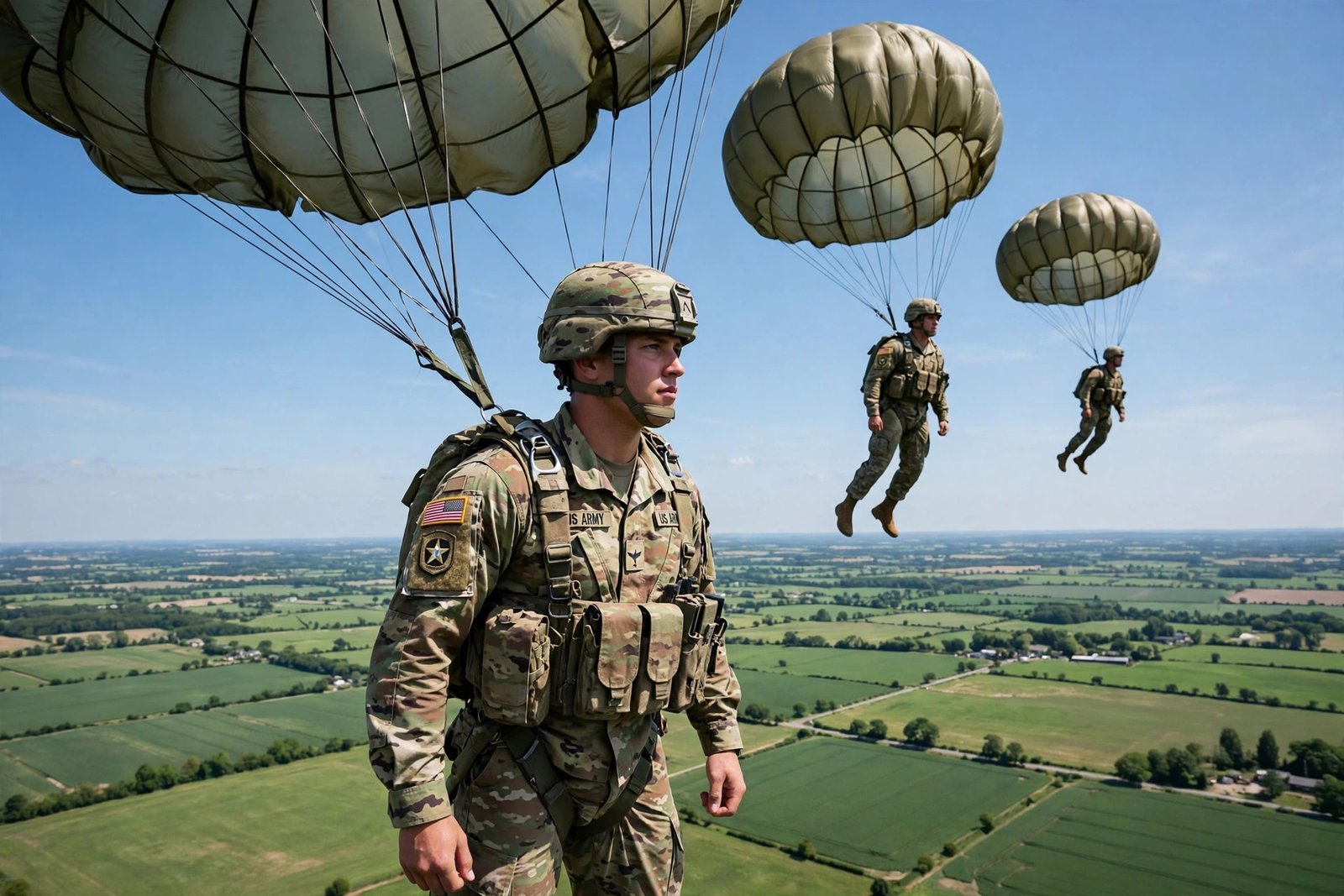
Few units in American military history carry a nickname as fitting as the one worn by the 82nd Airborne Division. Known as the All American Division, it earned that name because its first soldiers came from every state in the Union at the time, all 48 of them. More than a century later, the red, white and blue double-A patch is still one of the most recognized symbols in the United States Army. The division has fought in two world wars and in conflicts from Grenada and Panama to Iraq and Afghanistan, and it remains the Army’s rapid-deployment airborne force, based at Fort Bragg in North Carolina. Its story is not just a list of battles. It is a story about how a new kind of warfare was invented, tested under fire, and carried forward by generations of paratroopers who volunteered to jump out of airplanes into enemy territory.
Born in 1917: The All American Division
The 82nd Division was constituted in the National Army on August 5, 1917, and organized on August 25, 1917, at Camp Gordon, Georgia, as the United States prepared to enter the fighting in Europe during World War I. The Army’s official division page records those dates and explains the origin of the All American nickname: because its initial members came from all 48 states, the unit acquired a name that captured the whole country, and that name became the basis for its famed AA shoulder patch. At a time when most divisions were drawn from a single region, the 82nd was deliberately national in character, and that identity stuck.
The division sailed to France in 1918 to join the American Expeditionary Forces, and it fought on the Western Front in the final months of the war, including the campaigns of St. Mihiel and the Meuse-Argonne Offensive. The fighting was brutal, close and costly, and it tested a young division that had only just been formed. Among its soldiers was Sergeant Alvin C. York, whose actions in the Argonne Forest earned him the Medal of Honor and made him one of the most famous American soldiers of the war. York’s story became part of the division’s founding legend, but the wider achievement belonged to thousands of ordinary soldiers who had never seen combat before and learned it under fire.
When the war ended, the division was demobilized in May 1919. It was reconstituted in the Organized Reserve in 1921, and for two decades it existed largely on paper and in training, far from the battlefield. That quiet period mattered, though, because it kept the division’s name, lineage and traditions alive. When the United States was drawn into another world war, the Army did not have to invent a new division from nothing. It could call back a formation that already had a history, and that is exactly what happened in the spring of 1942.
Becoming Airborne: A New Kind of Warfare
After the attack on Pearl Harbor in December 1941, the 82nd was recalled to active duty in March 1942. At first it was still an infantry division, but the Army was experimenting with a radical idea: soldiers who could be delivered by parachute behind enemy lines, seize key ground, and hold it until heavier forces arrived. In August 1942, the 82nd became the Army’s first airborne division, redesignated as the 82nd Airborne Division on August 15, 1942. Under Major General Matthew B. Ridgway, it became the proving ground for large-scale American airborne warfare.
The change was far more than a new name. Paratroopers had to learn to jump, to fight lightly equipped, and to operate in small groups that might be scattered across miles of countryside on landing. Training was hard by design, and the division’s culture began to take shape around that hardship: physical fitness, initiative, and a willingness to fight surrounded and outnumbered. The Army’s own account of the division’s centenary notes that with just 18 hours of notice, the 82nd can deploy and conduct a forcible-entry operation, a standard that traces directly back to the urgency of those early airborne experiments. The paratrooper was not just an infantryman with a parachute. He was a different kind of soldier, built for speed and surprise.
Sicily and Italy: The First Combat Jumps
The division’s first combat parachute assaults came in the Mediterranean. In July 1943, elements of the 82nd dropped into Sicily as part of the Allied invasion, and in September 1943 paratroopers jumped at Salerno on the Italian mainland. These were the first regimental-sized combat parachute assaults conducted by the United States Army, and they were messy in the way that first attempts often are. Aircraft were scattered, drops went wide, and small groups of paratroopers found themselves fighting far from their planned landing zones.
Yet the Sicily and Italy campaigns taught lessons that would save lives later. Commanders learned how much night navigation, timing and coordination mattered when hundreds of aircraft were flying in darkness over enemy ground. Soldiers learned that a scattered drop did not mean a failed mission, because small, aggressive groups could still cut roads, seize bridges and confuse the enemy. By the time the division left Italy for England in late 1943, it was no longer an experiment. It was a battle-tested airborne force, and its next mission would be the largest amphibious and airborne operation in history.
D-Day: Into Normandy Before Dawn
On the night of June 5 to 6, 1944, paratroopers of the 82nd Airborne Division boarded transport aircraft in England and flew toward Normandy as part of Operation Overlord, the Allied invasion of Nazi-occupied France. Their mission, known as Mission Boston, was to land behind Utah Beach, seize causeways and crossings over flooded ground, and secure the town of Sainte-Mere-Eglise, so that troops coming ashore from the sea could move inland. The division dropped hours before the beach landings, in darkness, under fire, and across drop zones that were often flooded, hedged and heavily defended.
Sainte-Mere-Eglise became one of the most famous place names of D-Day. It was among the first French towns liberated during the invasion, and its church square, where paratrooper John Steele’s parachute famously snagged on the steeple, remains a symbol of that night. The Airborne Museum in Sainte-Mere-Eglise today tells the story of the American paratroopers who dropped into Normandy, and it stands across from the church itself. For visitors, the museum is a reminder that D-Day did not begin on the beaches. It began in the air, in the dark, with men jumping into the unknown.
The Normandy fighting was fierce and sustained. The division fought for more than a month in the hedgerows and marshes of the Cotentin Peninsula, holding ground against counterattacks and pushing toward Cherbourg. By the time it was withdrawn to England, it had suffered heavy casualties, but it had accomplished its core task: the airborne landings had helped the seaborne invasion succeed. D-Day fixed the 82nd in the public imagination as the division that jumped first, and that reputation has never really faded.
Market Garden, the Bulge and the Drive Into Germany
The division returned to combat in September 1944 in Operation Market Garden, the ambitious Allied attempt to seize bridges across the Netherlands and open a route into Germany. Dropped near Nijmegen, the 82nd fought to capture and hold the Nijmegen bridge, a mission that involved a famous daylight crossing of the Waal River under fire. The wider operation did not achieve its goals, and the division was withdrawn after hard fighting, but the Nijmegen battle remains one of its proudest chapters.
In December 1944, when German forces launched a surprise offensive through the Ardennes, the 82nd was rushed back into the line to help blunt the northern shoulder of the Bulge. Fighting in bitter winter weather, paratroopers held key ground and helped stop the German advance. In early 1945 the division pushed through the Siegfried Line, crossed the Roer River, and advanced across Germany, ending the war in the Mecklenburg Plain, where German forces surrendered to it in May 1945. From Normandy to the Elbe, the 82nd had fought across the whole breadth of the Western Front, and it had done so as the Army’s airborne spearhead.
From the Cold War to Iraq and Afghanistan
Unlike many wartime divisions, the 82nd was not disbanded after World War II. It found a permanent home at Fort Bragg, and it became the Army’s ready force for crises around the world. During the Cold War it deployed to the Dominican Republic, and elements served in Vietnam. In 1983 it took part in the invasion of Grenada, and in 1989 it played a leading role in the invasion of Panama, where its paratroopers conducted a combat jump and seized key objectives including airfields and dams. In 1990 and 1991 it deployed to Saudi Arabia and took part in the liberation of Kuwait during the Gulf War.
After the attacks of September 11, 2001, the division deployed repeatedly to Afghanistan and Iraq. Its brigades fought in some of the hardest campaigns of those wars, and its soldiers also took on missions that went beyond conventional combat, including training partner forces, securing populations, and supporting humanitarian efforts. The division also took part in the 2021 Kabul airlift, helping to evacuate civilians during the final days of the American presence in Afghanistan. That mission, conducted under chaotic and dangerous conditions, was a reminder that airborne forces are called on not only to fight, but to respond quickly when events move faster than plans.
What the 82nd Airborne Does Today
Today the division describes its mission in clear terms on its official Army page: on order, it rapidly deploys within 18 hours of notification, conducts forcible-entry parachute assaults, and secures key objectives for follow-on forces in support of American national interests. It is the primary fighting arm of the XVIII Airborne Corps, and it maintains a brigade ready to deploy on short notice at all times. That readiness is not an abstract slogan. It means paratroopers train constantly, jump regularly, and keep their equipment packed for a call that could come at any hour.
The division also keeps its history alive in a deliberate way. Its centenary in 2017 was marked with a podcast series tracing its story from 1917 onward, as described in the Army’s own account of the All American Legacy Podcast, and its annual All American Week brings together paratroopers, veterans and families to celebrate that legacy. A recent Army article honoring the division notes that it was the second of eight divisions to deploy and fight in France in World War I, a detail that ties its modern identity back to its origins. For many Americans, the 82nd is simply the division they picture when they think of paratroopers. That picture was earned over more than a century, one jump at a time.
The full chronology, including its campaigns and commanders, is summarized in the 82nd Airborne Division overview, which is a useful starting point for readers who want to follow each campaign in more detail. What stands out across that long record is continuity. The weapons, aircraft and uniforms have changed completely since 1917, but the core idea has not: a force that can arrive fast, fight hard, and hold ground until help arrives. That is why the All American Division still matters, and why its history continues to be written by each new generation of paratroopers.
Frequently Asked Questions
When was the 82nd Airborne Division founded?
The 82nd Division was constituted on August 5, 1917, and organized on August 25, 1917, at Camp Gordon, Georgia. It became the 82nd Airborne Division on August 15, 1942, when it was redesignated as the Army’s first airborne division.
Why is it called the All American Division?
Its first soldiers came from all 48 states in the Union at the time, rather than from a single region. That national character gave it the nickname All American, which is the basis for its AA shoulder patch.
What did the 82nd do on D-Day?
On the night of June 5 to 6, 1944, its paratroopers dropped into Normandy ahead of the beach landings, with orders to seize causeways behind Utah Beach and secure Sainte-Mere-Eglise. They fought in Normandy for more than a month.
Where is the 82nd Airborne Division based?
The division is based at Fort Bragg, North Carolina, where it serves as the primary fighting arm of the XVIII Airborne Corps and maintains a brigade ready to deploy on short notice.
How quickly can the 82nd Airborne deploy?
According to the Army, the division can rapidly deploy within 18 hours of notification and conduct a forcible-entry parachute assault to secure key objectives for follow-on forces.