
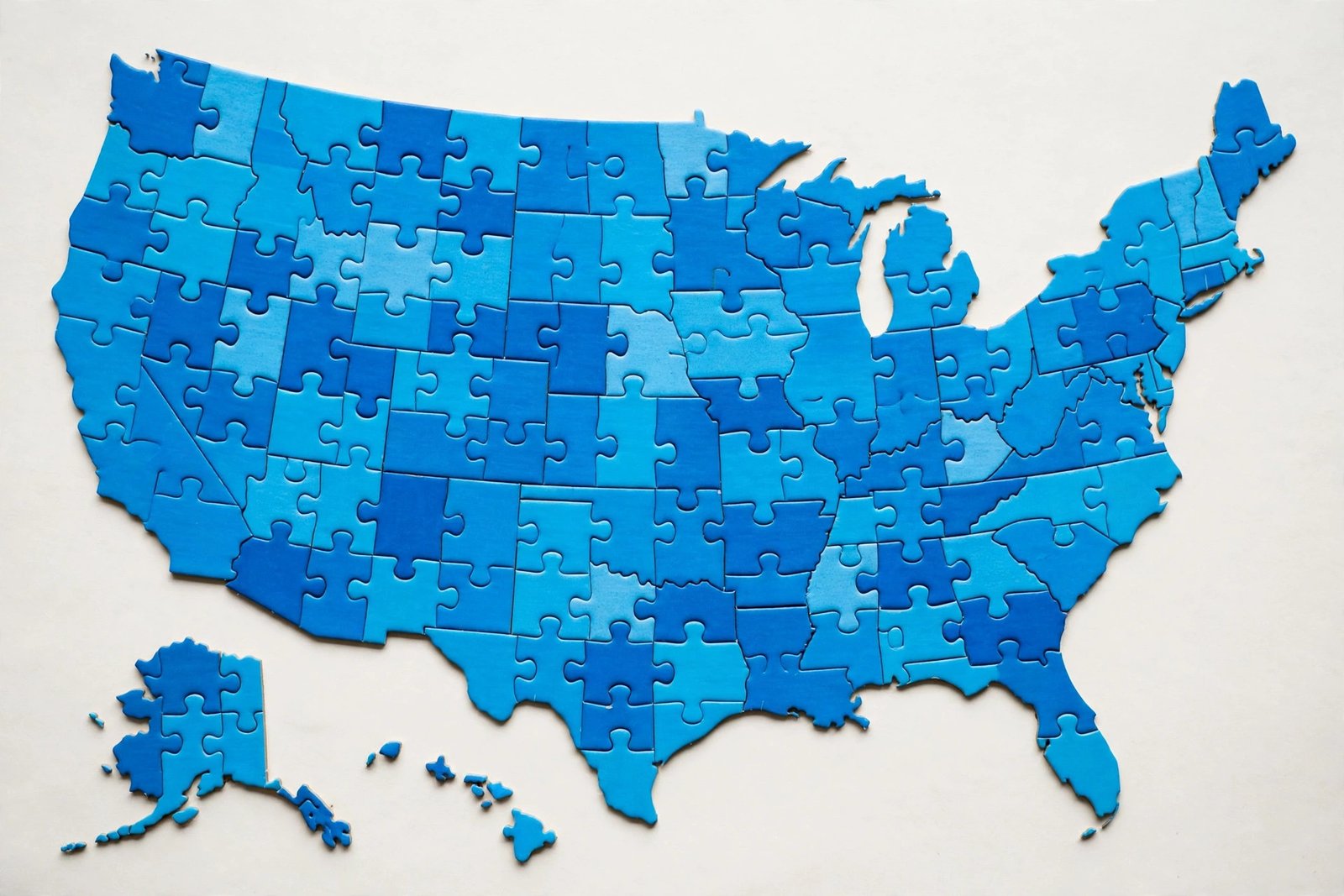
Texas is now Blexas. Michigan is Blichigan. Iowa is Bliowa, Maine is Blaine, and North Carolina is Blorth Carolina. If you opened TikTok in the days after the November 3, 2026, midterm elections, you probably saw the joke spreading faster than the results themselves. Young people across the country were renaming American states by swapping in the letters “Bl” — the color blue, the color of the Democratic Party — to celebrate a Democratic wave that flipped the House and Senate. The internet is calling it the “blueification” of state names.
The trend is funny on the surface, and deliberately silly. But it is also a window into how a generation experiences politics now: on their phones, through memes, in group chats and watch parties, with a soundtrack. This article explains what blueification is, where the names came from, what happened on election night, why the Halsey song “Colors” became the trend’s anthem, and what researchers say about how young adults get their news. The names are a joke. The politics behind them are real.
What Is Blueification?
Blueification is the viral renaming of U.S. states with “Bl” — a nod to the color blue — after Democrats won big in the November 3, 2026, midterms. The idea is simple: take a state name, replace its opening sound with “Bl,” and you get a new, bluer version of the map. Texas becomes Blexas, Michigan becomes Blichigan, Iowa becomes Bliowa, Maine becomes Blaine — and the list goes on.
The joke works because it is visual as well as verbal. Election maps color Democratic wins blue and Republican wins red, so a state that flips literally turns blue on the map. Renaming the state is a way of claiming the flip in meme language. As USA Today reported on November 5, the election flipped the House and Senate, and Democrats also pulled off several down-ballot races.
The format is easy to copy, which is why it spread so fast. You do not need editing skills, a big following, or a political argument — just a state and a sense of humor. TikTokers posted lists of renamed states, filmed themselves reacting to results at watch parties, and stitched each other’s videos with new additions. Hashtags like #Blexas and #bluewave gathered the posts into a shared feed anyone could join.
The Names That Took Over TikTok
The most famous blueified name is Blexas. Texas has long been the biggest prize in American politics for Democrats — a huge, Republican-leaning state they have dreamed of flipping for years. On election night, the Associated Press projected Texas Democratic Senate candidate James Talarico as the winner, the first Democrat to win a Texas Senate seat since 1988, and Gina Hinojosa defeated three-term governor Greg Abbott to become the state’s first Latina governor, according to election-night reporting.
But the list did not stop at Texas. TikToker Cassie Willson joked in a video, “Blexas, Blichigan, Bliowa, Blaine, Blorth Carolina, Blouth Caroline, Blansas… Blhat’s going on?” — a video that drew more than 109,000 likes, according to USA Today. Other creators added their own entries, including Blississippi for Mississippi, where a race was still too close to call on Thursday morning.
The joke also traveled beyond state names, with creators blueifying foods, celebrities, and song titles. The pattern is the same one that powers most TikTok trends — a simple, repeatable format anyone can remix. The state names were the starting point, but the format is the real meme.
It is worth noting what the names do not mean. Nobody is seriously proposing to rename Texas, and no state is changing its name, flag, or government because of a TikTok trend. Blueification is a celebration, not a policy proposal — a way for young people to say they are excited about a result, in the language their friends actually speak.
What Happened on November 3, 2026
Americans went to the polls on Tuesday, November 3, 2026, for the midterm elections. All 435 seats in the House of Representatives were on the ballot, along with 35 of the 100 Senate seats and 36 governorships. By Wednesday morning, the picture was clear: the Democratic Party had won both chambers of Congress.
Associated Press results showed Democrats winning 249 House seats to 156 for Republicans — a clear flip of the chamber, which Republicans had held by a narrow margin. In the Senate, where 35 seats were contested, Democrats won enough to take control of that chamber as well. The wins were not confined to states Democrats usually carry: they flipped districts and won races in Pennsylvania, New Jersey, Kentucky, Arizona, North Carolina, and Texas.
The down-ballot results mattered too. Governors’ races, state legislative contests, and ballot measures broke toward Democrats in several states. When a party wins the House, the Senate, and a string of state races on the same night, the night feels like a wave — and that is the word that took hold. Coverage described a “blue wave,” and the blueification meme is that wave, translated into TikTok.
About half of voters under 30 said they were angry about the direction of the country, according to the AP Voter Poll cited by USA Today. Young voters had spent years hearing that their generation was disengaged or checked out. On November 3, many of them turned out, and the results gave them something to celebrate. The memes were the celebration.
The Halsey “Colors” Edits and the Watch Parties
Every viral moment needs a soundtrack, and blueification found one in Halsey’s 2015 song “Colors,” built around the lyric “Everything is blue.” Creators paired election results with cinematic edits set to the song — slow-motion clips of watch parties, maps turning blue, crowds cheering as results came in.
Videos from Tuesday night watch parties and bar celebrations showed young people cheering, hugging, and filming each other as results came in, with hashtags like #Blexas and #bluewave marking the posts. Some creators used Lana Del Rey’s 2012 song “National Anthem” as well — another favorite from the Tumblr era — giving the moment a nostalgic, early-2010s feel.
The nostalgia is part of the appeal: many of the young people celebrating grew up on Tumblr, where Halsey and Lana Del Rey were defining artists.
Some creators took the mood further and declared a new era. One viral post called the moment “WhimZ” — whimsy plus Gen Z — with flashing images of glitter, rainbows, and the blue wave on the electoral map. “Gen Z optimism era is now,” one caption read. Another creator, Cassidy Clarke, posted a video of herself laughing with the text, “Can we have Gen Z optimism now too?” Underneath the jokes, the message is earnest: after years of feeling the future was bleak, young people were allowing themselves to feel hopeful, at least for a night.
Why Gen Z Memes Politics Instead of Just Watching It
To older observers, renaming states on TikTok can look like a strange way to respond to an election. To the people doing it, it is the most natural thing in the world: memes are how this generation talks about everything — sports, school, relationships, work — so of course they are how it talks about politics too. The joke is the conversation.
Mike Wagner, director of the University of Wisconsin-Madison’s School of Journalism and Mass Communication, told USA Today that posts like these are a way for young people to politically participate and signal being part of a movement. Posting a meme is not the same as voting, and nobody in the trend claims it is. But it is a form of participation: it says which side you are on, connects you to people who feel the same way, and keeps the conversation going after the polls close.
Wagner also made a sharper observation about the names themselves. “When you see Blexas or Blississippi, these are places that were not on the electoral college map for Democrats, and now they are, and so part of it is also an expression of what’s possible in the political future,” he said. The joke carries an argument inside it: if Texas can flip, the map is not fixed, and places that seemed permanently out of reach are suddenly in play.
This is part of a longer pattern. Over the past decade, politicians and their supporters have increasingly used internet culture to support their cause. Campaigns hire meme creators, candidates post on TikTok, and supporters make their own content without waiting for permission. The line between the campaign and the audience has blurred: on social media, the audience is the campaign now.
What Pew Research Says About Young Adults and the News
The trend makes more sense once you understand where young adults get their news. According to Pew Research Center, 76% of Americans ages 18 to 29 say they get news from social media at least sometimes, while only 28% of those age 65 and older do. For many young adults, social media is the main way the news arrives.
When it comes to political news, 70% of young adults say they get it because they happen to come across it, compared with 30% who seek it out. They are scrolling TikTok or Instagram for entertainment, and the news finds them there — in a video, a meme, a friend’s post. A blueified state name is exactly the kind of thing that reaches someone that way: entertaining first, informative second, and nothing like homework.
TikTok and Instagram are the platforms where young adults are most likely to get news, far ahead of older age groups. About 43% of adults ages 18 to 29 say they regularly get news on TikTok, and 40% say the same about Instagram, according to Pew’s 2025 survey data. That is why a political meme lives on TikTok rather than on television: the audience is already there, and the format fits the feed.
There is a flip side. Young adults follow the news less closely than any other age group — only about 15% say they follow the news all or most of the time. They are more likely than older Americans to trust the news they get on social media, and to get news from “news influencers” with large followings who post about news or politics: about 38% regularly do, according to Pew. That mix — heavy social media use, incidental exposure, and trust in familiar online voices — is the environment that produces a trend like blueification.
None of this means young people are uninformed — the information simply reaches them differently. The Pew Research Center’s report on young adults and the future of news describes a generation less interested in legacy news formats but deeply engaged with news where they already spend their time. Blueification is a case study in that shift.
Will Blueification Last?
Probably not as a daily habit — memes move fast, and the internet will have a new joke by next week. But the trend has already done something lasting: it gave a name to a political moment and showed how a generation processes a win. The names will fade. The feeling behind them — that the map can change, that young voters matter, that politics can be fun as well as serious — is likely to stick around longer.
There are limits to what the meme can tell us. A viral trend is not a poll: the people posting blueified names are, by definition, the people happy about the results. The millions of Americans who voted the other way are not posting “Blexas,” and their views did not disappear because a meme went viral. Election results are decided by votes, not by likes, and governing — the bills, the budgets, the compromises — does not happen on TikTok.
Still, dismissing the trend as trivial would miss the point. Blueification is a small, funny artifact of a big night. It captured the mood of a generation that experiences politics through its phone, turns a map into a joke and a joke into a shared identity, and found, for one week in November 2026, a reason to be optimistic. For now, the map is blue, the song is playing, and Texas — at least on TikTok — is Blexas.
Frequently Asked Questions
What does “blueification” mean?
Blueification is the viral TikTok trend of renaming U.S. states with “Bl” — for the color blue, associated with the Democratic Party — after Democrats won the November 3, 2026, midterms. Examples include Blexas for Texas, Blichigan for Michigan, and Bliowa for Iowa.
What is Blexas?
Blexas is the blueified name for Texas. It became the most popular name in the trend after Democrats won high-profile races there on November 3, 2026, including the Senate race and the governor’s race.
Why are Gen Z TikTokers renaming states after the midterms?
They are celebrating Democratic wins in the November 3, 2026, midterms, which flipped the House and Senate. Renaming states turns the blue wave on the election map into a joke anyone can copy and share.
What is the Halsey “Colors” trend?
Creators paired election results and watch-party clips with Halsey’s 2015 song “Colors,” built around the lyric “Everything is blue.” It became an unofficial anthem for the trend, along with Lana Del Rey’s “National Anthem.”
What does Pew Research say about young adults and social media news?
Pew Research Center finds that 76% of Americans ages 18 to 29 say they get news from social media at least sometimes. Pew also finds that 70% of young adults get political news because they happen to come across it, rather than seeking it out.
Did the Democrats really flip the House and Senate in 2026?
Yes. In the November 3, 2026, midterms, Democrats won control of both chambers, including 249 House seats to 156 for Republicans in the Associated Press results, along with several down-ballot races.
Are states actually being renamed?
No. Blueification is a meme, not a real renaming. No state has changed its name. The new names exist only on TikTok and other social media platforms.