
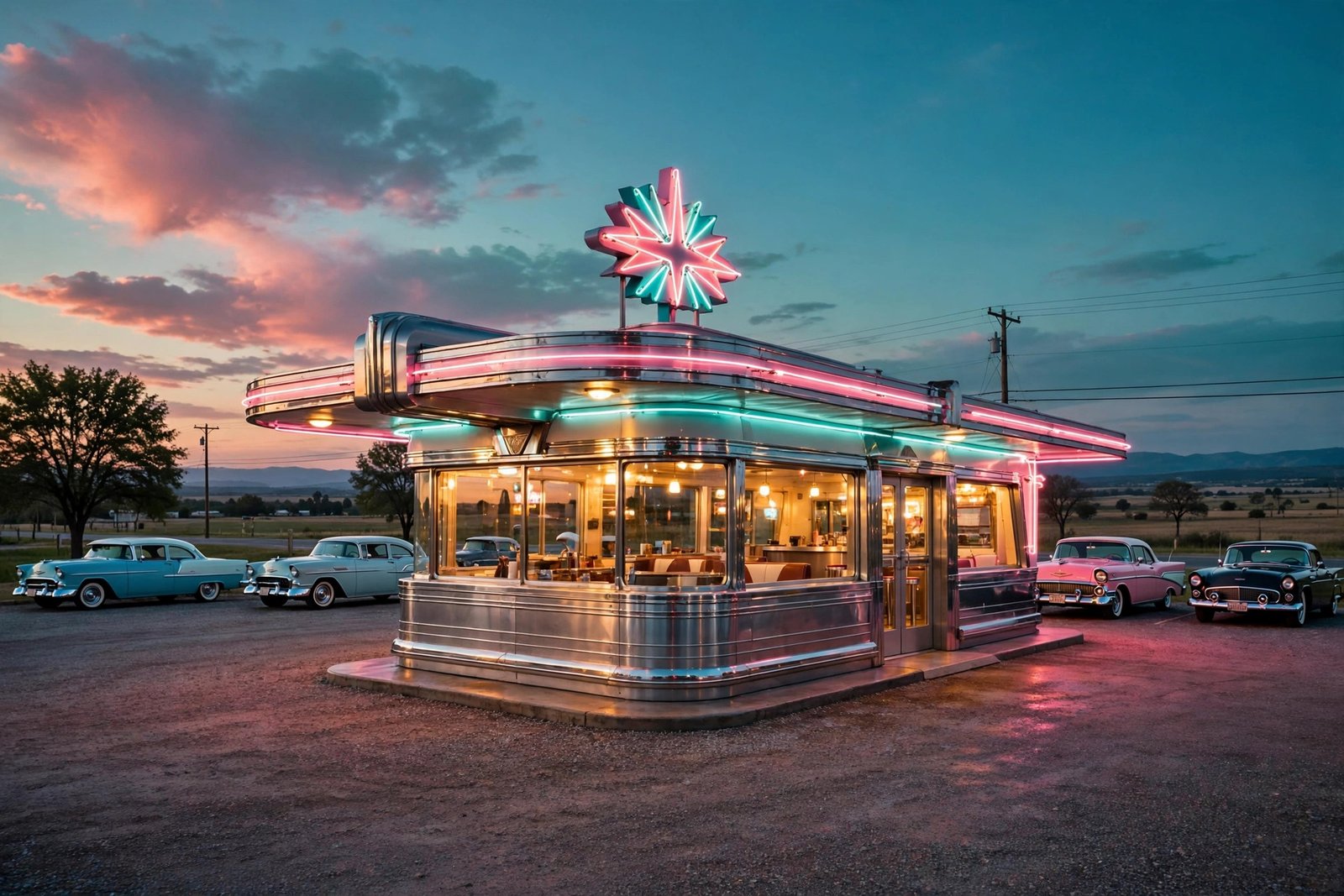
There is a particular kind of comfort that only an American diner can deliver. It starts before you even sit down: the glow of the neon sign in the window, the smell of coffee and bacon drifting out the door, the soft clatter of plates and the low murmur of conversation. Inside, the counter stretches out in front of you, the stools spin just a little too easily, and the menu is long enough to feel like a small book. Breakfast is served all day, and nobody hurries you along.
The diner is one of the most recognizable symbols of American life, right up there with the pickup truck and the front porch. It has starred in movies, inspired songs, and hosted everything from first dates to late-night study sessions to campaign stops by presidential candidates. Yet the diner began as something far humbler: a single horse-drawn wagon selling sandwiches to night-shift workers in Rhode Island. This is the story of how that wagon became an icon, what makes a diner a diner, and why these chrome-and-Formica landmarks still matter today.
The Night Lunch Wagon That Started It All
The history of the American diner begins in Providence, Rhode Island, in 1872, with a pressman named Walter Scott. Scott worked at a local newspaper, and he noticed a problem that nobody else was solving: the people who worked through the night — pressmen, factory workers, theatergoers heading home late — had nowhere to get a hot meal once the restaurants closed. So Scott gave up his newspaper job, used his savings to buy a small horse-drawn freight wagon, stocked it with sandwiches, coffee, and pies, and parked it outside the newspaper office after dark.
It worked. Hungry workers lined up at the wagon’s window, took their food, and ate sitting on the curb. Scott’s little business was so successful that it became his full-time living, and before long, other entrepreneurs across New England were copying the idea. These mobile food wagons became known as “lunch wagons” or “night lunch wagons,” and they were, in effect, the food trucks of the nineteenth century. As Smithsonian Magazine notes in its profile of diner historian Richard Gutman, the whole history of the diner began right there in Providence — “with a horse-drawn wagon, a menu and, as they say, a dream.”
The wagons kept evolving. In 1887, an entrepreneur named Samuel Jones added seats inside his wagon, turning it from a takeout window into a tiny rolling restaurant. Builders began fitting wagons with small kitchens, counters, and room for a handful of customers to sit down and eat. The vehicles grew longer and boxier, and people started calling them “lunch cars,” then “dining cars” — a nod to the dining cars on passenger trains. Around 1924, the name was shortened to the word we still use today: diner.
From Wagons to Dining Cars: The Factories That Built Diners
By the early 1900s, the lunch wagon had mostly stopped moving. Cities were cracking down on wagons clogging busy streets, so owners parked their cars on private lots and stayed put. Around 1913, Jerry O’Mahony of New Jersey built one of the first stationary lunch cars, and a new industry was born: companies that manufactured entire diners in factories and shipped them to their sites by rail or truck.
Purpose-built diners were manufactured by companies such as the Worcester Lunch Car Company and the Kullman Dining Car Company in the 1920s and 1930s, along with O’Mahony and several other builders concentrated in New Jersey, New York, and Massachusetts. A buyer could order a diner the way you might order a car. The factory-built diner arrived more or less complete, was set down on its lot, hooked up to utilities, and opened for business. That is the technical difference between a true diner and an ordinary coffee shop: a classic diner was built in a factory and transported to its location, rather than constructed on-site.
The Golden Age: Chrome, Neon, and the Streamline Look
Diners boomed in the 1940s and 1950s, with thousands operating across the country. The postwar years were the diner’s golden age. Americans were moving to the suburbs and eating out more than ever, and diners followed them onto the highways. At their peak in the 1950s, there were about 6,000 diners across the country, according to Smithsonian Magazine, with the highest concentration in the Northeast. New Jersey earned its lasting nickname as the Diner Capital of the World, with hundreds of diners still operating in the state today.
This was also when the classic look we picture today took shape. In the 1940s, manufacturers such as Sterling Diners of Massachusetts introduced the streamline style: shiny stainless-steel exteriors with smooth, rounded edges, neon signs, and interiors of Formica countertops, porcelain tile, leather booths, and terrazzo floors. The look borrowed from the era’s futuristic trains and airplanes. As History.com explains, the classic boxcar shape evolved from those horse-drawn wagons, not from actual train cars. The stainless-steel streamline diner became the building’s signature style, and it is still the image most Americans carry in their heads when they hear the word “diner.”
Diners were also among the first American eateries to serve customers around the clock, a habit they inherited from the night lunch wagons. In many places, the diner’s low prices and open door made it one of the few public places where factory workers, office staff, families, and solo travelers all ate side by side. That democratic spirit was real, but it had limits: many diners were shaped by segregation, and the lunch-counter sit-ins of the civil rights movement were a reminder that the promise of a seat for everyone had not yet been kept everywhere.
What’s on the Menu: Classic Diner Food
A diner menu is a beautiful thing: long, laminated, and gloriously unpretentious. The staples have barely changed in a century. Breakfast is the star, and it never stops being served. Pancakes, eggs any style, bacon, sausage, hash browns, and toast make up the backbone of the menu. The all-day breakfast is one of the diner’s great gifts to American eating.
Beyond breakfast, the classics stack up fast: the cheeseburger and fries, the club sandwich, the tuna melt, meatloaf with mashed potatoes, chicken pot pie, and the hot open-faced turkey sandwich drowned in gravy. Regional flavors show up, too. New England diners serve scrod and baked beans, Maryland diners lean on crab cakes, and Southern diners bring grits and biscuits and gravy to the table. And then there is dessert. The pie case is sacred ground in a real diner — apple, cherry, lemon meringue, and Boston cream, served by the slice with coffee that never seems to run out.
What makes diner food special is not fancy technique. It is consistency, generosity, and value. The portions are big, the prices are fair, and the food tastes like someone’s home cooking rather than a chain restaurant’s formula. The cook works in plain sight, and your order arrives hot a few minutes after you place it.
The Counter, the Jukebox, and Diner Culture
If the food is the diner’s body, the counter is its soul. The long counter with its spinning stools is where the diner’s social life happens. Regulars claim their favorite stool, and strangers strike up conversations over coffee refills. The counter is deliberately democratic: everyone sits in a row, at the same level, eating the same food.
The booths play their own role. Tucked along the windows, they are the diner’s living rooms — the place for family breakfasts, first dates, homework sessions, and long talks that stretch past midnight. Teenagers adopted diners as their gathering place in the 1950s, and the booth became a fixture of American youth culture.
And then there is the jukebox. The tabletop jukebox, with its little flip-through song list, is one of the diner’s most beloved details. Drop in a coin, pick a song, and the whole room shares it. The jukebox turned the diner into a soundtrack — doo-wop, rock and roll, country, and soul all drifting over the clink of coffee cups.
Famous Historic Diners Worth a Visit
Some diners have earned a place in history all their own. Casey’s Diner in Natick, Massachusetts, is the country’s oldest continually operating diner. It began as a lunch wagon in the 1890s, and its current building was constructed in 1922 by the Worcester Lunch Car Company. Five generations of the same family have run it, serving breakfast, lunch, and dinner from a tiny ten-stool counter. It is living proof that a diner does not need to be big to be beloved.
The Modern Diner in Pawtucket, Rhode Island, opened in 1941 and holds a special distinction: it was the first diner in America to be named to the National Register of Historic Places. Built by the Kullman Dining Car Company, it is a gleaming example of the streamline style, and it still serves breakfast and lunch to a loyal crowd. Its place on the Register helped establish that diners are historic buildings worth preserving, a point Back Then History makes in its account of the diner’s rise.
In New York City, Tom’s Restaurant in Morningside Heights became famous around the world as the exterior used for the diner in the television show Seinfeld. Inside, it is a real working diner, and fans still make the trip to sit in a booth beneath the show’s glow. Other historic diners dot the Northeast, and preservationists have worked for decades to save them from demolition.
Diners in Movies, TV, and Pop Culture
Few American settings have appeared on screen as often as the diner. Edward Hopper’s painting Nighthawks fixed the diner in the national imagination as a place of quiet, late-night honesty. Barry Levinson’s 1982 film Diner turned a Baltimore diner into the center of a group of friends’ whole world. Seinfeld made a diner booth the place where four friends worked out the meaning of everyday life, week after week.
The diner has also become a ritual stop in American politics. Candidates for president make a point of visiting diners in early primary states, ordering pie and coffee, and shaking hands at the counter. The message is unmistakable: a candidate who can sit comfortably in a diner can connect with ordinary people.
Why Diners Still Matter Today
The diner has never really gone away, but it has had to fight for its place. Chain restaurants, rising rents, and changing tastes have closed many classic diners, especially in big cities. New York City has lost many of them to development. Yet the diner keeps hanging on, and in some places it is thriving again.
Part of the reason is nostalgia, but only part. The diner offers something that is genuinely hard to find elsewhere: a locally owned, affordable place that is open late, welcomes everyone, and serves real food made to order. In an era of delivery apps and drive-through windows, the diner is a place where you sit down, slow down, and eat with other people.
New generations of owners are keeping the tradition alive, sometimes with a twist. Some restored diners serve Thai food or vegetarian menus alongside the pancakes and meatloaf. Others have been rescued from demolition and rebuilt stool by stool by preservationists. As Mental Floss notes, the basic characteristics live on: a friendly place to get an inexpensive, hot meal, run by people who know your name.
So the next time you pass a chrome diner glowing on a dark road, pull in. You are sitting inside more than 150 years of American history — a history that started with one man, one horse, and one wagon full of sandwiches in Providence, Rhode Island.
Frequently Asked Questions
Who invented the American diner?
The first diner is generally traced to Walter Scott, who began selling sandwiches, coffee, and pies from a horse-drawn wagon in Providence, Rhode Island, in 1872. His “night lunch wagon” served night-shift workers, and the idea spread across New England.
Why do diners look like train cars?
Diners evolved from horse-drawn lunch wagons that grew longer and boxier as builders added kitchens and seating. Factory-built diners were shipped by rail, which encouraged the long, narrow shape, and “dining car” was shortened to “diner” around 1924.
What is the oldest diner still operating in America?
Casey’s Diner in Natick, Massachusetts, is widely regarded as the country’s oldest continually operating diner. It started as a lunch wagon in the 1890s, and its current building was built by the Worcester Lunch Car Company in 1922.
Which state has the most diners?
New Jersey is known as the Diner Capital of the World, with hundreds of diners still operating. It was also the center of diner manufacturing.
Are diners open 24 hours?
Many classic diners are open around the clock, a tradition inherited from the original night lunch wagons. Hours vary by location, though, and some diners now close overnight, so it is worth checking before a late-night visit.
What should I order at a diner for the first time?
You cannot go wrong with breakfast at any hour: pancakes or eggs with bacon and hash browns, plus coffee. For lunch or dinner, try a cheeseburger, a club sandwich, or the meatloaf, and save room for a slice of pie.
Related reading
If you enjoyed this look at a classic piece of Americana, you may also like Route 66: Facts About America’s Mother Road, The American Front Porch Is Making a Comeback, and Farmers Markets: America’s Saturday Morning Ritual.
Sources: Smithsonian Magazine, the Rhode Island Heritage Hall of Fame, History.com, Mental Floss, and Back Then History.