
Every airport has its quirks. Denver International Airport has a 32-foot blue horse with glowing red eyes that killed its own sculptor, two giant murals of gas-masked soldiers and weeping mothers, bronze gargoyles peering out of suitcases, and a granite capstone inscribed with the words “New World Airport Commission” beside a Freemason symbol. It is the strangest major airport in America — and the center of some of the wildest conspiracy theories on the internet.
According to the theories, Denver International Airport — known as DEN or DIA — is not really an airport at all. It is said to be a secret headquarters for a shadowy New World Order, a bunker city for a global elite, its runways laid out as a giant swastika and its artwork encoding the plan in plain sight. Here is what is really behind the murals, the horse, and the legends of America’s most mysterious airport.
The Airport That Started a Thousand Theories
Denver International Airport opened on February 28, 1995, replacing the city’s old Stapleton Airport. The new airport sits on open prairie 25 miles northeast of downtown Denver. At 33,531 acres, it is the largest airport by land area in the United States — more than twice the size of Manhattan.
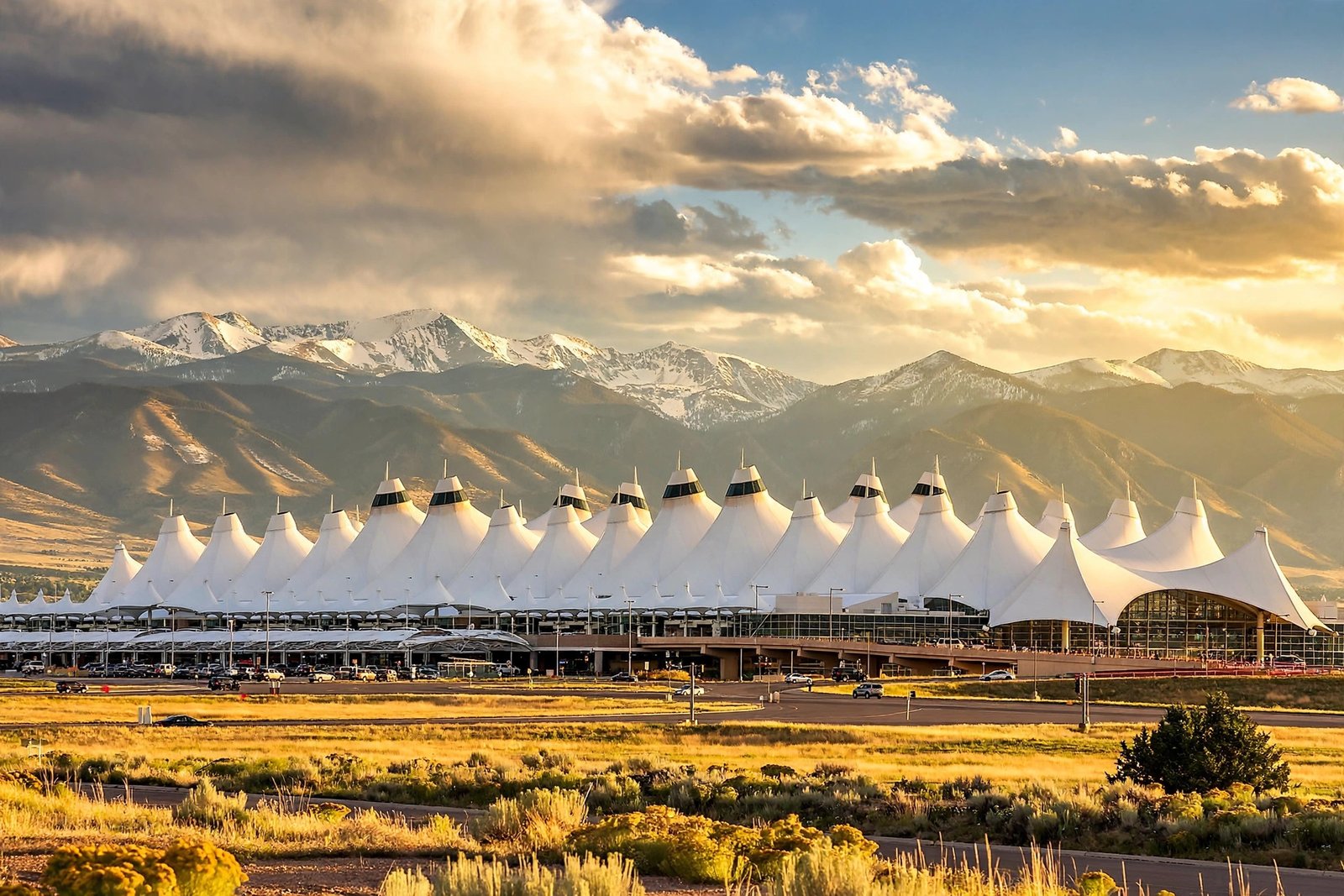
The airport’s signature feature is its white peaked tent roof, a sweeping fabric canopy over the Jeppesen Terminal that was designed to echo the snow-capped Rocky Mountains and the teepees that once stood on the plains. From the highway, the roofline looks like a range of white tents pitched in the middle of nowhere.
Then there were the problems. The airport opened 16 months late, and its automated baggage-handling system — an ambitious network of underground tracks meant to move luggage without human hands — was a famous failure. It malfunctioned in a live demonstration and helped push the final bill to about $4.8 billion, nearly $2 billion over projections. The system was abandoned in 2005 in favor of ordinary conveyor belts and human handlers.
The Facts First: Why the Airport Is So Big
Before the theories, the real explanation for the airport’s size is worth knowing. Denver’s old airport, Stapleton, had a specific technical problem: its parallel runways sat too close together to be used independently in bad weather. When cloud or snow arrived, controllers had to land aircraft one behind another, and the airport’s landing rate collapsed — a problem that rippled across the national air network, since Denver is a connecting hub in the middle of the country.
The new airport solved the problem with space. Its six runways are laid out in a pinwheel pattern around the terminal, spread far enough apart for controllers to run independent approaches to three runways at once, even in a snowstorm. The land also solved an altitude problem: at 5,431 feet above sea level, thin air means aircraft need a longer run to get airborne. That is why one of the runways, opened in 2003, stretches 16,000 feet — the longest public-use runway in North America. As AeroCorner explains, Denver was not buying land for the sake of it. It was buying distance: room to space runways miles apart and keep adding more for decades.
Blucifer: The Blue Mustang With a Real Body Count
The single most famous object at the airport is not inside the terminal at all. It stands in the median of Peña Boulevard, the road into the airport, where every arriving traveler sees it: a 32-foot-tall, 9,000-pound cast-fiberglass mustang, rearing up on its hind legs, painted electric blue, with glowing red eyes. Its official name is “Blue Mustang.” Almost nobody calls it that. Locals call it Blucifer — a mash-up of “blue” and “Lucifer.”
The sculptor was Luis Jiménez, a Chicano artist from El Paso, Texas, known for monumental fiberglass sculptures celebrating the American Southwest. Denver commissioned the piece in the early 1990s for $300,000 under the city’s one-percent-for-art ordinance, and Jiménez modeled the horse on his own blue roan Appaloosa stallion, Black Jack. The glowing red eyes were a tribute to his father, who ran a neon sign shop in El Paso.
Then came the tragedy that made the statue a legend. On June 13, 2006, while Jiménez was still working on the sculpture in his studio in Hondo, New Mexico, a section of it came loose from a hoist, pinned him against a steel support beam, and severed an artery in his leg. He bled to death. He was 65. His family completed the piece, and Blue Mustang was finally unveiled at the airport on February 11, 2008 — nearly fifteen years after it was commissioned. As Only In Your State puts it, this is the one Denver airport legend that does not need a theory: the statue really did kill the man who built it.
That single fact does more for the conspiracy theories than any symbol in the terminal. A demonic-looking horse that killed its creator is the kind of detail that makes a rumor immortal. The airport’s own art page treats Mustang simply as one of Denver’s most iconic landmarks. The statue’s menace is real, but it is a story about a workplace accident, not a curse.
The Murals: What Leo Tanguma Actually Painted
The second pillar of the Denver airport legend is the pair of large murals in the Jeppesen Terminal, painted by Chicano artist Leo Tanguma with his daughter Leticia in 1993–95. The two murals are titled “Children of the World Dream of Peace” and “In Peace and Harmony with Nature,” and they are genuinely unsettling at first glance — which is exactly why they have fueled decades of speculation.
“Children of the World Dream of Peace” shows a war-versus-peace story in two panels. On one side, a gas-masked soldier wields a gun and a sword, refugees trudge through ruins, and mothers weep over their children. On the other side, children hand over weapons wrapped in their countries’ flags, doves rest on the fallen soldier, and a child dismantles his sword with a hammer. “In Peace and Harmony with Nature” tells a similar story about the environment: one panel shows burning forests and animals trapped in glass cages, while the other shows children and animals gathering around a new plant in a healed world.
Tanguma has explained the work himself, repeatedly and on the record. The imagery, he says, comes from the prophets Isaiah and Micah: the idea that one day nations will stop making war and “beat their swords into plowshares.” The dark panels show the world that must be left behind; the bright panels show the world that could replace it. “The conspiracy theorists have interpreted it in the most naive way,” he said in one interview, “like they think I advocate war and all these horrible stories.” As Uncover Colorado notes, the themes are clear once you look at both halves of each mural together.
Both murals spent several years in storage during construction on the terminal’s Great Hall. According to the airport’s own art page, “In Peace and Harmony with Nature” returned to display in fall 2026, while “Children of the World Dream of Peace” is expected back in the Great Hall in early 2028. The airport has also said misreadings of Tanguma’s work have led to occasional threats against the artist and his family.
The Theories, One by One
With the facts established, here is what the theories actually claim — and where each one stands. Every claim below is presented as an unproven theory with no supporting evidence.
The underground bunker city. The most sweeping theory holds that beneath the airport lies a vast underground complex built to shelter a global elite through a manufactured apocalypse. There really are tunnels under the airport, but the documented ones carry the underground train and once housed the failed baggage system. The Denver Public Library’s archivists call the idea of an underground city fanciful at best. No evidence of a bunker complex has ever been produced.
The runways form a swastika. Viewed from above, the pinwheel runway layout is said to resemble a swastika. The Denver Public Library publishes the actual layout diagram next to the claim, and the resemblance only holds if you selectively ignore parts of the design. The pinwheel lets several runways be used at once and keeps the field open in strong winds. As a design claim, the swastika theory is false.
The New World Airport Commission. At the airport’s south entrance sits a granite capstone dated March 19, 1994, covering a time capsule inscribed to “the people of Colorado in 2094.” It carries the Square and Compasses of Freemasonry and the name “New World Airport Commission,” which theorists read as the New World Order under an alias. The commission was real, but it was a temporary body of local boosters formed to organize the opening celebrations, and it disbanded soon after the airport opened. The Denver Public Library holds eleven boxes of its records. Its name was a nod to Dvořák’s Symphony No. 9, “From the New World,” and the Masonic lodges only helped fund the time capsule and perform the dedication ceremony. There is no evidence connecting it to any secret organization, as The People Argue documents.
The Illuminati symbols and the gargoyles. The terminal also holds two bronze gargoyles, “Notre Denver” by artist Terry Allen, sitting inside open suitcases in the baggage claim areas. The suitcases nod to the Samsonite factory that operated in Denver for decades, and the artist’s stated purpose is that the creatures watch over travelers’ luggage. Other supposed clues have ordinary explanations: the mine cart nods to Colorado mining history, the floor inscriptions are Navajo with published translations, and the Anubis figure was an ad for a King Tut exhibition removed years ago. None of these is evidence of a secret society.
Why the Airport Leaned Into the Joke
Here is the twist that keeps the legend alive: Denver International Airport eventually stopped fighting the theories and started having fun with them. In October 2016, the airport ran a month-long program called “Conspiracy Theories Uncovered,” with a temporary gallery, conspiracy art tours, and a screening of Close Encounters of the Third Kind. The program won an award for best social media campaign. More recently, the airport has fenced construction zones with signs joking about the secret tunnels.
Airport spokespeople have always been clear that the theories are not true. One spokesperson told Fox Nation in 2022: “This is headquarters for a lot of strange and evil things that are supposed to happen” — followed immediately by “It’s a fun story, but there’s no truth to it.” As the airport’s own art guide puts it, the artwork is part of what makes DEN unique.
What to Look For on Your Next Trip
If you are passing through Denver International Airport, the legends are easy to see for yourself. Watch for Blue Mustang in the median of Peña Boulevard on the drive in — best seen from the passenger seat. Inside the Jeppesen Terminal, look for “In Peace and Harmony with Nature” on Level 5. In the baggage claim areas, look for the two bronze “Notre Denver” gargoyles keeping watch from inside their open suitcases.
And if you find yourself at the south entrance, look for the granite dedication capstone with its Masonic symbol and its “New World Airport Commission” inscription. It is a time capsule from 1994 and a civic celebration. Then look up at the white tent roof, and remember what you are actually standing under — one of the largest, strangest, and most oddly charming airports in the world.
Frequently Asked Questions
When did Denver International Airport open?
It opened on February 28, 1995, replacing Stapleton Airport — 16 months behind schedule, largely because of problems with its automated baggage-handling system.
How big is Denver International Airport?
At 33,531 acres, it is the largest airport by land area in the United States. Its six runways are laid out in a pinwheel pattern so several can be used at once, even in bad weather.
Did the Blue Mustang statue really kill its sculptor?
Yes. Sculptor Luis Jiménez died on June 13, 2006, when a section of the 32-foot Blue Mustang sculpture came loose from a hoist in his studio and severed an artery in his leg. His family completed it, and it was unveiled at the airport on February 11, 2008.
What do the Denver airport murals actually mean?
According to artist Leo Tanguma, the murals depict war giving way to peace and environmental destruction giving way to healing, inspired by the prophets Isaiah and Micah. The dark imagery shows what humanity must leave behind, not a prophecy.
Is there really an underground bunker under Denver airport?
There is no evidence of one. The airport does have miles of documented tunnels, but they carry the underground train and once housed the baggage system. The Denver Public Library describes the idea of an underground city as fanciful.
Why does the airport joke about the conspiracy theories?
The airport has leaned into the legend with its 2016 “Conspiracy Theories Uncovered” program and signs joking about secret tunnels. Spokespeople have repeatedly said the theories are not true.
Related reading
If you enjoyed this dive into an American mystery, you may also like Area 51: The Mystery Explained, Skinwalker Ranch: Utah’s Strangest Mystery, and The Mothman Legend of Point Pleasant.
Sources: Denver International Airport’s official art guide (flydenver.com), Uncover Colorado, The People Argue, AeroCorner, and Only In Your State.