
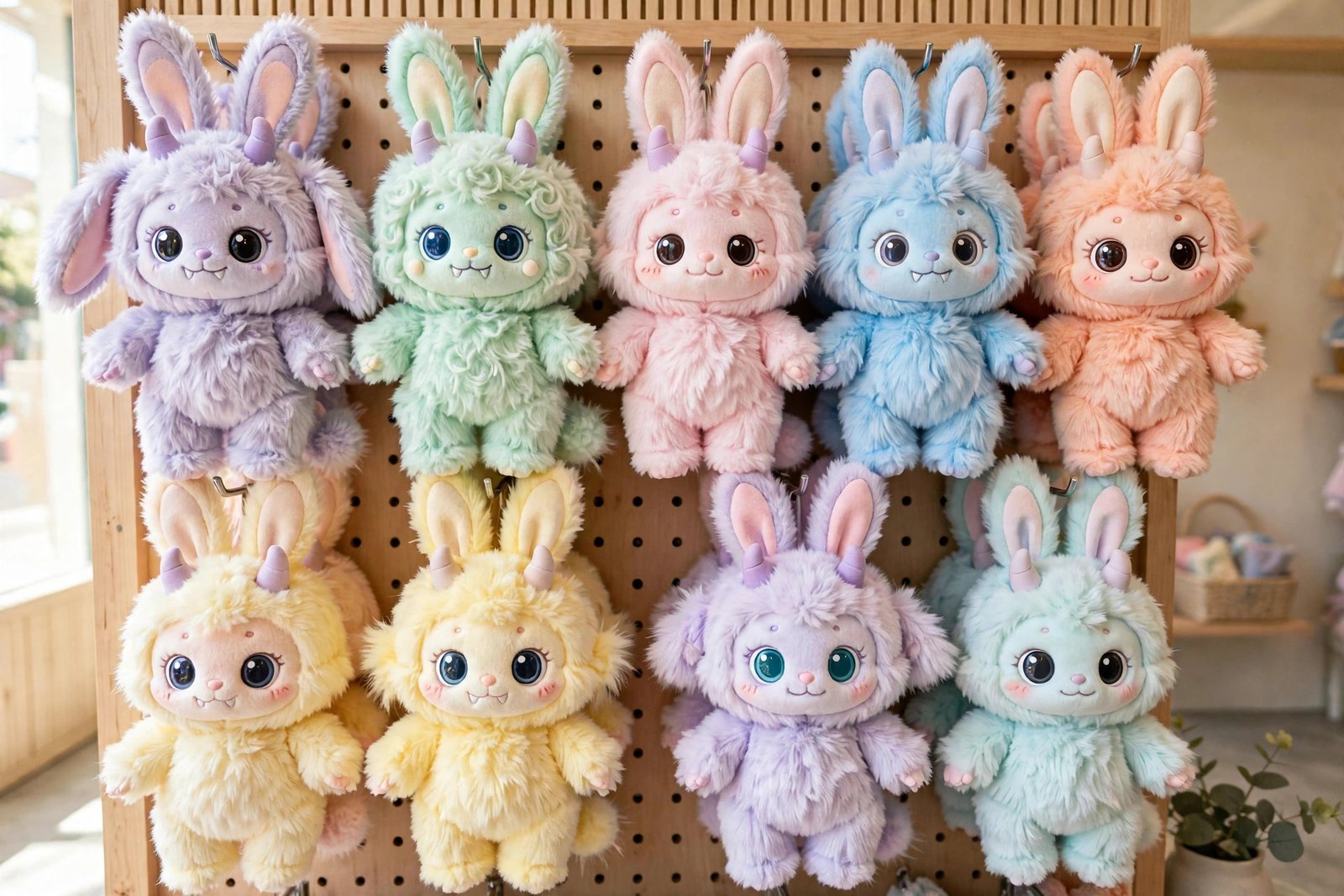
It started as a toy for collectors. Then it showed up on a pop star’s handbag, then on a reality star’s, then on millions of them. By the summer of 2025, the Labubu — a small, furry monster with a toothy grin and tall rabbit ears — was the most talked-about toy in America. People lined up outside stores before dawn, paid many times the retail price on resale sites, and clipped the little creatures to designer bags like jewelry.
What Is a Labubu?
Labubu is a character from The Monsters, a storybook series created by Hong Kong-born artist Kasing Lung, who was raised in the Netherlands and is based in Belgium. Lung first drew Labubu in 2015 as one of a cast of forest monsters inspired by Nordic folklore — a mischievous little creature with pointed ears, big eyes, and a wide grin full of sharp little teeth. It is, by design, a little bit creepy and a little bit cute, and that odd combination is a large part of its charm.
Pop Mart, the Chinese designer-toy company, began working with Lung in 2019 and turned Labubu into a collectible figure. Most Labubus are sold as vinyl plush pendants — soft, furry bodies with vinyl faces, a little loop for clipping onto a bag, and a size of about seven inches — in sealed “blind boxes,” which means the buyer does not know which design is inside until the box is opened. Each series contains a set of regular designs plus one rare “secret” figure, and the surprise is the point.
The character comes in many forms, from small vinyl figures to large plush dolls and keychains. The most popular lines in the United States have been the plush pendant series with names like Exciting Macaron, Have a Seat, and Big into Energy.
How a Little Monster Took Over America
For years Labubu was a niche collector’s item, popular in Asia and among designer-toy fans but barely known in the United States. That changed in April 2024, when Lisa of the K-pop group BLACKPINK was photographed with a Labubu keychain clipped to her bag. The photo spread across social media, and the doll’s popularity surged through Thailand, China, and South Korea before reaching the West.
By 2025 the wave had hit America. Celebrities including Kim Kardashian and Rihanna were spotted with Labubus on their bags, and the doll became a fashion accessory as much as a toy — a status symbol that happened to cost less than thirty dollars at retail. TikTok did the rest. Unboxing videos racked up enormous audiences, and each new series launch became an event, with store lines wrapping around the block and online drops selling out in minutes.
The numbers behind the boom were extraordinary. Pop Mart reported 2025 revenue of 37.12 billion yuan, up 184.7 percent from the year before, and The Monsters brought in 14.16 billion yuan, up 365.7 percent. Overseas revenue reached 16.27 billion yuan, with sales in the Americas up 748.4 percent. At the peak, Pop Mart was one of the most valuable toy companies in the world, with around 500 stores in more than 30 countries.
The auction market told the same story. On June 10, 2025, at the Yongle Spring Auction in Beijing, a 131-centimeter mint-green first-generation Labubu sold for a hammer price of 1.08 million yuan, realizing about $171,000 including the buyer’s premium. A toy that had started life as a sketch in a picture book was now selling for the price of a house.
The Celebrity Effect
It is impossible to explain Labubu without the celebrities. The doll’s rise followed the classic pattern of a fashion trend: a star is seen with it, fans copy the star, and the copy becomes the trend. Lisa’s 2024 sighting was the spark. Kim Kardashian, Rihanna, and other stars with enormous followings were soon photographed with Labubus clipped to expensive handbags, and the tiny monster became visual shorthand for being in the know.
The appeal crossed the usual boundaries of toy collecting. Labubu was not marketed to children — Pop Mart lists many of its products for ages 15 and up — and its buyers were largely adults, many of them women in their twenties and thirties who treated the dolls the way an earlier generation treated charm bracelets. The bag charm was the key insight: a Labubu was not something you kept on a shelf at home, but something you wore in public, where other people could see it and want one too.
Pop Mart leaned into the fashion angle with collaborations. In 2026 alone the company released Labubu collections with Sanrio’s Hello Kitty, Coca-Cola, and Vans, plus a FIFA World Cup series in April and an original “Cat Mode On” series in October. Each collaboration brought a new audience to the character and a new reason for existing collectors to buy another box.
How Much Does a Labubu Cost?
The honest answer is that it depends enormously on which Labubu, where you buy it, and when. At retail, a standard Labubu plush pendant blind box costs about $27 to $30 in the United States. Pop Mart’s US site lists a Big into Energy blind box at $26.99, and the newer Cat Mode On series, which launched in the United States on October 15, 2026, is priced at $29.99 per blind box. Smaller items in that series start at $12.99, and across the full range of sizes prices run from about $15 to $960 at retail.
The resale market is where the numbers get wild — and where they have changed the most. At the height of the craze in 2025, some blind boxes traded for many times their retail price, and rare secret figures sold for hundreds of dollars. That market has cooled sharply. Recent data from the resale platform StockX showed a Big into Energy blind box averaging just $6 across 36 sales in the preceding three months — below its retail price — while the secret figure from the same series, known as ID, averaged $70 across 95 sales. Common figures have lost their resale premium, while genuinely rare ones still hold value.
The secret editions are the engine of the whole system. In the Cat Mode On series, the secret Maine Coon Kitty figure has an estimated pull rate of one in 72 boxes, which means a collector would need to buy, on average, 72 blind boxes — more than $2,100 at retail — to find one by chance. That math is why collectors trade and why the rare figures command the prices they do.
Blind Boxes: The Gamble Built Into Every Purchase
The blind box is the most important thing to understand about Labubu. When you buy one, you are not choosing a character. You are buying a sealed box that contains one figure chosen at random from a series, and you do not find out which one until you open it. Pop Mart publishes the odds for each design, and the rarest figure is always the hardest to get.
That randomness is not an accident. It is the business model. A collector who wants a complete set of nine figures cannot simply buy nine boxes and expect nine different designs — duplicates are common, and the hunt for the missing figure is what keeps people buying. It is also what makes unboxing videos so watchable: every opening is a small lottery draw.
The model has drawn criticism as well as fans. Consumer advocates have compared blind boxes to gambling, and regulators in several countries have looked at whether the odds should be disclosed more clearly. Pop Mart does publish pull rates, and its US listings state that buyers cannot choose a particular figure. For a casual buyer, the practical advice is simple: treat a blind box as a surprise gift to yourself, not as a way to obtain one specific design.
The Fake Problem
Wherever a popular product sells out, counterfeits follow, and Labubu has been one of the most counterfeited toys of the past two years. Fake Labubus — nicknamed “Lafufus” by collectors — flooded online marketplaces and street stalls during the 2025 peak, often sold at a fraction of the real price.
The fakes matter for more than the money. Counterfeit plush toys are not subject to the safety testing that genuine products go through, and there have been reports of poorly made copies with loose parts and low-quality materials. For a toy that is often clipped to a bag or given to a teenager, that is a real concern, not just a collector’s complaint.
Spotting a fake takes care. The safest rule is the simplest one: buy from Pop Mart’s own stores, its official website, or its app. Collectors also check the QR code on the box and the tag, which can be verified through Pop Mart’s system. Other warning signs include prices far below retail, sloppy stitching, uneven fur, and packaging with blurry printing or spelling errors. If a deal looks too good to be true, it almost always is.
The Cool-Down: Is the Craze Over?
The numbers say the fever has broken. On October 27, 2026, Pop Mart told the Hong Kong stock exchange that its third-quarter revenue had fallen 45 to 50 percent from a year earlier. The decline was steepest in the Americas, where revenue fell 70 to 75 percent, and severe in Asia-Pacific too, down 65 to 70 percent. Mainland China fell 25 to 30 percent. Pop Mart’s shares have lost more than half their value since their 2025 peak.
There are two reasons for the fall. The first is the comparison: the third quarter of 2025 was an extraordinary period, with revenue up 245 to 250 percent, so almost any normal quarter would look weak against it. The second is that Pop Mart removed the scarcity that made Labubu desirable in the first place. The company increased production sharply — by August 2025 its plush capacity had grown more than tenfold, to about 30 million units a month — and the shelves filled up. Collectors who once queued for hours now see entire series sitting in Pop Mart shops.
The company’s own accounts confirm the shift. In the first half of 2026, revenue from The Monsters fell 7.5 percent to 4.45 billion yuan, down from 4.81 billion yuan a year earlier, and the line’s share of Pop Mart’s total revenue dropped from 34.7 percent to 26 percent. Pop Mart kept expanding its American footprint — its store count in the Americas rose from 41 to 86 — but offline revenue growth of 19.5 percent could not offset a 45.6 percent fall in online revenue.
That does not mean Labubu is finished. The third quarter of 2026 was still far above the same quarter of 2024, and new series like Cat Mode On continue to sell through. What has ended is the mania — the phase in which every box was an investment and every launch a stampede. What remains is a popular character with a large fan base and a resale market that now rewards rarity.
Should You Buy One in 2026?
For most people, the answer is yes — with a different mindset than in 2025. A Labubu bought today is a fun collectible, not a financial investment. The days when a common blind box could be flipped for several times its price are over. Buy the design you like, from an official seller, at retail price, and enjoy the surprise.
A few practical tips will help. Start with one box rather than a full set, and see whether the character appeals to you in person. If you want a specific figure, check the resale price first; for common designs it is now often below retail. Keep the box and the tag if you think you might resell or trade later. And if you are buying for a child, check the age guidance on the listing and inspect the toy for loose parts, especially with counterfeits in circulation.
Labubu’s story is a familiar American one: a small, strange, charming thing catches the eye of the right person at the right moment, the internet does the rest, and a toy becomes a phenomenon. The phenomenon has cooled, the prices have come back to earth, and the little monster with the toothy grin is still here. The craze may be over. Labubu is not.
FAQ
What is a Labubu?
Labubu is a character from The Monsters, a storybook series by artist Kasing Lung. Pop Mart sells it mainly as a vinyl plush pendant in sealed blind boxes, so buyers do not know which design is inside until they open it.
How much does a Labubu cost in the US?
A standard plush pendant blind box costs about $27 to $30 at retail in the United States — for example, $26.99 for a Big into Energy box and $29.99 for the Cat Mode On series. Prices range from about $15 to $960 across sizes. On the resale market, common figures now often sell below retail, while rare secret figures can sell for much more.
Why did Labubu become so popular?
The craze took off after BLACKPINK’s Lisa was photographed with a Labubu keychain in April 2024, and it grew as celebrities including Kim Kardashian and Rihanna were seen with the dolls on their bags. TikTok unboxing videos and Pop Mart’s blind-box model turned the toy into a viral fashion accessory.
How can I tell a real Labubu from a fake?
Buy from Pop Mart’s own stores, website, or app. Check the QR code on the box and tag through Pop Mart’s verification system, and watch for prices far below retail, sloppy stitching, uneven fur, or blurry packaging. If a deal looks too good to be true, it probably is.
Is the Labubu craze over?
The mania has cooled. Pop Mart reported third-quarter 2026 revenue down 45 to 50 percent, with Americas sales down 70 to 75 percent, and common figures now sell below retail on resale sites. But new series still launch, stores still stock the character, and rare editions still hold value.
Related Reading
Love viral trends? Read our explainer on the bicep heart trend taking over TikTok, our look at the Gen Z grandma hobbies trend, and our Black Friday 2026 shopping guide.
Sources: The Shitbot — Labubu Collectibles: The Ultimate Guide to Pop Mart’s Star; Kursiv — From must-have to has-been: Is the Labubu craze finally over?; Open Magazine — Can Pop Mart Sustain Labubu’s Hype Amid Falling Sales?; Bastille Post — Fetching 1.08 Million at Auction: How China’s Designer Toys Conquered the World; FinPrism — Pop Mart revenue falls up to 50% as Labubu demand fades; EvoRetro — Pop Mart Labubu Cat Mode On Guide; Medium — Pop Mart Opened Stores for a Labubu Crowd That Shopped Online.