
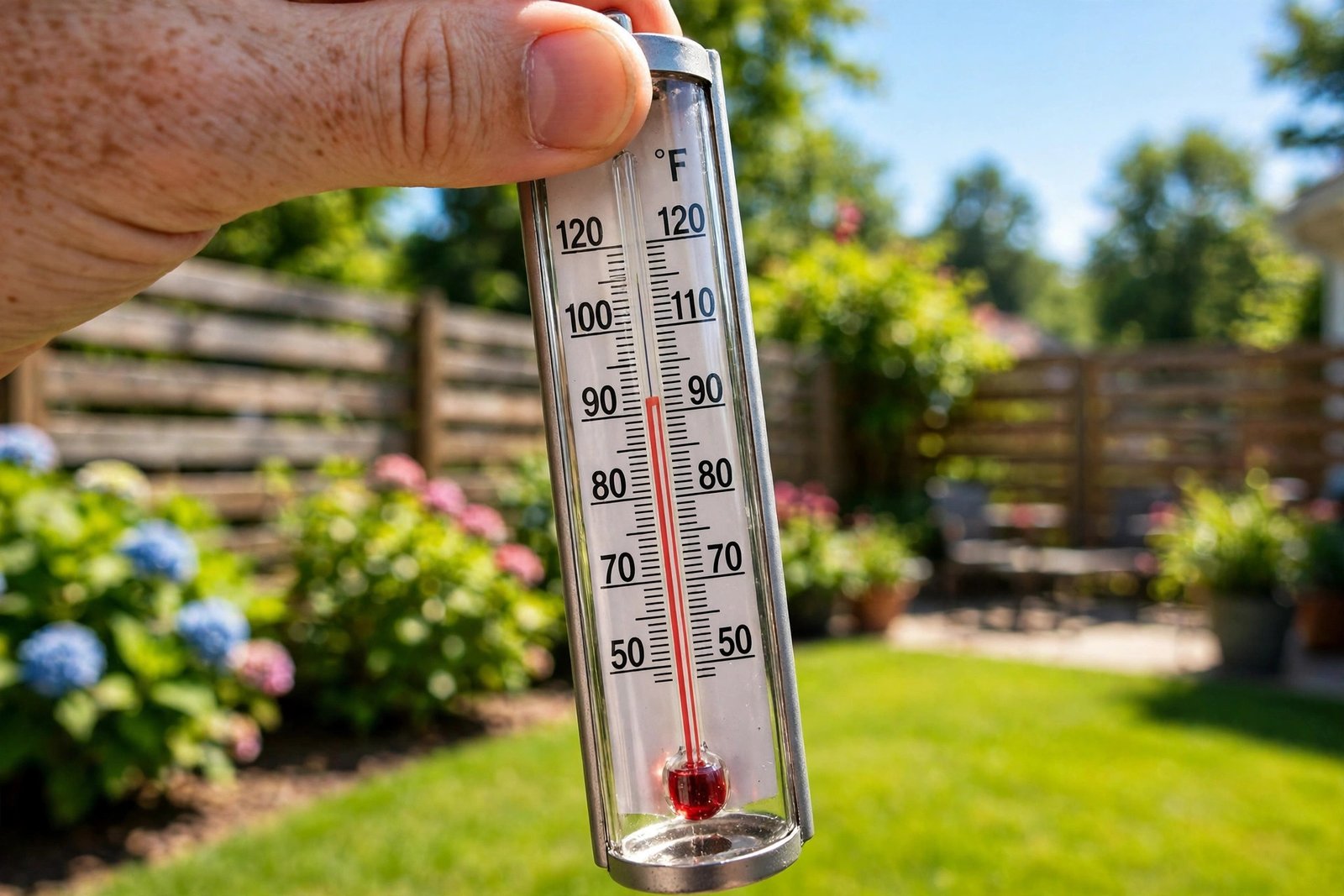
Ask an American how hot it is outside and you will hear a number that sounds strange to most of the world. Seventy-two degrees is a pleasant day. Ninety-eight point six is a normal body temperature. Thirty-two is freezing. To visitors from almost any other country, those numbers feel upside down, because almost everywhere else, water freezes at zero, boils at 100, and a pleasant day is about 22 degrees. The United States is one of only a handful of countries that still uses Fahrenheit for everyday temperature, and the question of why has puzzled travelers, students, and scientists for generations.
The answer is not that Americans never heard of Celsius, or that Fahrenheit is somehow more scientific. American scientists, doctors, and weather forecasters use Celsius every day, and American schoolchildren learn both scales. The real story is older and more human than a simple choice between two systems. It is a story about a German glassblower in the early 1700s, a British Empire that carried his scale around the world, an American republic that inherited it, and a country that tried once to change, found the change voluntary, and then quietly decided to live with both systems at once.
The Man Behind the Scale: Daniel Gabriel Fahrenheit
Daniel Gabriel Fahrenheit was born in 1686 in Gdansk, then part of Poland, and he grew up in a family of merchants before turning to science and instrument-making. He became a physicist and a skilled glassblower, and that combination mattered. In the early 1700s, thermometers existed, but they were unreliable. Two instruments made in the same workshop could give different readings in the same room, which made it hard to compare temperatures from one place or one day to another.
Fahrenheit set out to fix that problem. In 1709, he built an alcohol thermometer, and in 1714, he built the first practical mercury thermometer, using mercury sealed inside a glass tube. Mercury expands and contracts evenly as temperature changes, and it works over a wider range than alcohol, so his instruments were far more accurate and consistent than what had come before. For the first time, a thermometer could be trusted to give the same reading in the same conditions, no matter which of his instruments you used.
A reliable thermometer still needs a scale, and in 1724 Fahrenheit presented his temperature scale to the Royal Society of London. His choices for the fixed points look odd today, but they made sense in his laboratory. He set zero at the coldest temperature he could reliably produce in his workshop, using a mixture of ice, water, and salt. He set the freezing point of water at 32 degrees, and the boiling point of water at 212 degrees, which meant there were 180 degrees between freezing and boiling. His original upper reference was human body temperature, which he placed at 96 degrees, a number that could be divided neatly in halves again and again.
Later refinements set body temperature at 98.6 degrees Fahrenheit, the figure most Americans still learn in school. Fahrenheit died in 1736, only a dozen years after he introduced his scale, but his thermometers had already spread widely.
How Fahrenheit Actually Works
Once you know the fixed points, Fahrenheit is not hard to use. Water freezes at 32 degrees Fahrenheit and boils at 212 degrees at standard atmospheric pressure. A comfortable room is often described as being in the high 60s or low 70s. A hot summer day might reach the 90s, while a cold winter night can fall into the teens or below zero. For weather, cooking, and home heating, Americans think in those ranges without doing any math at all.
The scale is finer than Celsius, and that is one argument its defenders still make. Because there are 180 Fahrenheit degrees between freezing and boiling, compared with 100 Celsius degrees, each Fahrenheit degree is smaller. One Celsius degree equals 1.8 Fahrenheit degrees, according to the National Institute of Standards and Technology (NIST), so Fahrenheit can describe small weather changes without decimals.
To convert Celsius to Fahrenheit, multiply by 1.8 and add 32. To convert Fahrenheit to Celsius, subtract 32 and divide by 1.8. That is how zero degrees Celsius becomes 32 degrees Fahrenheit, and 37 degrees Celsius becomes 98.6 degrees Fahrenheit. At minus 40 degrees, the two scales meet.
The Rival Scale: Anders Celsius and the Metric Idea
Fahrenheit’s scale was only 18 years old when a rival appeared. In 1742, Swedish astronomer Anders Celsius proposed a scale based on the freezing and boiling points of water, with 100 degrees between them. Water froze at zero and boiled at 100, a clean, decimal-friendly system that matched the way scientists were beginning to think about measurement. Celsius, who was born in 1701 and worked as a professor of astronomy at Uppsala University in Sweden, had built his country’s first observatory, and his scale reflected the same desire for order and simplicity.
Celsius fit naturally with the metric system, formally developed in France in the late 1700s and built on tens. A scale that ran from zero to 100 for water fit that decimal logic perfectly. As countries adopted the metric system, most adopted Celsius with it. Britain switched its weather forecasts to Celsius in 1961, and most of the English-speaking world followed.
The United States did not follow. By the time Celsius and the metric system were spreading, America had already built much of its life around Fahrenheit, and the cost and disruption of changing looked larger than the benefit. That timing, more than any single decision, is at the heart of why Fahrenheit survived in America while it faded almost everywhere else.
How Fahrenheit Reached America
Fahrenheit came to America the same way many British customs did: through colonization. The British Empire adopted Fahrenheit as its standard temperature scale, and the American colonies adopted the British system along with miles, pounds, inches, and gallons. When the United States became independent, it kept the measurement system it already knew. There was no moment when Americans sat down and chose Fahrenheit over Celsius, because Celsius had barely been invented when the colonies were founded, and Fahrenheit was already the familiar standard.
The United States legalized metric measurements in 1866, and in 1875 it became one of the original signatories to the Treaty of the Meter. In 1893, under the Mendenhall Order, American customary units were defined in metric terms, so an inch is now legally defined as exactly 25.4 millimeters.
None of that changed everyday life. Legalizing the metric system is not the same as requiring it, and Americans continued to measure distance in miles, weight in pounds, and temperature in Fahrenheit. By the time the metric system was spreading internationally in the 19th century, the Industrial Revolution had already shaped American factories, railroads, and construction around customary units. Machines were built to inch-based measurements, railroads measured distances in miles, and workers were trained in the existing system. Changing all of that would have been enormously expensive and disruptive, and there was no crisis forcing the change.
The 1975 Attempt That Changed Almost Nothing
The closest America ever came to switching was in the 1970s. In 1975, Congress passed the Metric Conversion Act, and President Gerald Ford signed it into law. The act declared the metric system the preferred system of weights and measures for United States trade and commerce, and it created a United States Metric Board to encourage and coordinate the transition. For a time, it looked as if America might finally join the rest of the world.
The problem was a single word in the law: voluntary. The act did not require anyone to switch, set no firm deadline, and gave the Metric Board no power to enforce a change. Without a mandate, most people and most industries simply kept doing what they already did.
By 1982, President Ronald Reagan had dismantled the Metric Board, and the government’s push for metrication effectively ended. Congress returned to the issue in 1988, amending the 1975 act to declare the metric system the preferred system for trade and commerce and directing federal agencies to use it where practical, but everyday life was untouched. The result was the hybrid system Americans live with today: metric in science, medicine, international trade, and many industries, and customary units in daily life, on road signs, in kitchens, and on weather reports.
A 2015 poll found that only 21 percent of Americans favored switching to metric measurements, while 64 percent were opposed. Most Americans saw no reason to change a system that already worked for them.
Why Fahrenheit Has Survived: Habit, Cost, and Identity
The simplest explanation for why America still uses Fahrenheit is habit. People learn temperature in Fahrenheit as children. They know what 70 degrees feels like, what 90 degrees means for a summer afternoon, and what 32 degrees means for an icy road. Those numbers are tied to memories, routines, and instincts. Asking a whole country to relearn those associations is asking for a kind of mental rewiring that most people will resist unless they have a strong reason to do it.
Cost is the second reason. Every thermostat, oven, refrigerator, car dashboard, weather broadcast, cookbook, and school textbook in America is built around Fahrenheit. Replacing or re-labeling all of them would cost an enormous amount of money, and the benefit would be hard to measure. A business that exports goods already uses metric where it needs to, and a family that cooks at home has no need to convert its recipes. The system works well enough that the cost of changing it looks like a cost with no clear payoff.
There is also a cultural element. For some Americans, customary units have become a small symbol of independence, a way of saying that America does things its own way. That feeling was already present in debates about metric conversion in the 1970s, and it helps explain why a voluntary change never gathered momentum.
Fahrenheit and Celsius Side by Side
Water freezes at 32 degrees Fahrenheit and zero degrees Celsius. Water boils at 212 degrees Fahrenheit and 100 degrees Celsius. Normal body temperature is 98.6 degrees Fahrenheit and 37 degrees Celsius. A comfortable room is about 68 to 72 degrees Fahrenheit, or 20 to 22 degrees Celsius.
Scientists and doctors in the United States already use Celsius, and so do many American industries that trade internationally. The National Weather Service still reports temperatures in Fahrenheit to the public, even though its forecast models and many of its instruments work in Celsius. That split is a good summary of the whole American arrangement. The country is not ignorant of Celsius. It is bilingual in temperature, using Celsius where precision and international coordination matter, and Fahrenheit where habit and public communication matter.
The United States is not entirely alone. A small number of other countries still use Fahrenheit as their primary everyday scale, including the Bahamas, Belize, the Cayman Islands, and Palau. That short list is one reason the question keeps coming up.
Will America Ever Switch?
A full national switch to Celsius looks unlikely in the near future, and the reasons are the same ones that stopped the 1975 effort. There is no political movement demanding it, no business case that depends on it, and no public demand strong enough to overcome the habit and cost of changing. Most Americans already understand the current mixed system well enough to function day to day, and the industries that truly need metric measurement already use it.
What is more likely is a slow expansion of Celsius where it already lives: science, medicine, and international trade. Younger Americans learn both scales in school, and weather apps often let users choose either scale.
America still uses Fahrenheit because it inherited the scale, because it tried once to change and made the change voluntary, because the cost of a forced switch looks larger than the benefit, and because most Americans like the numbers they grew up with. The scale Fahrenheit built three centuries ago endured not because it was perfect, but because it arrived first and became part of everyday American life.
Frequently Asked Questions
Why does the United States use Fahrenheit instead of Celsius? The United States inherited Fahrenheit from Britain during the colonial period, long before Celsius became the world standard. When Congress tried to encourage a switch with the Metric Conversion Act of 1975, the change was voluntary, not mandatory, and most Americans, businesses, and schools did not switch. Habit, cost, and a lack of political pressure have kept Fahrenheit in everyday use ever since.
Who invented Fahrenheit, and when? German physicist Daniel Gabriel Fahrenheit invented the alcohol thermometer in 1709 and the mercury thermometer in 1714. He introduced the temperature scale named after him in 1724, when he presented his work to the Royal Society of London. He set water’s freezing point at 32 degrees and its boiling point at 212 degrees.
What is the difference between Fahrenheit and Celsius? Water freezes at 32 degrees Fahrenheit and zero degrees Celsius, and it boils at 212 degrees Fahrenheit and 100 degrees Celsius. One Celsius degree equals 1.8 Fahrenheit degrees. To convert Celsius to Fahrenheit, multiply by 1.8 and add 32. To convert Fahrenheit to Celsius, subtract 32 and divide by 1.8.
Do American scientists use Fahrenheit? Mostly, no. American scientists, doctors, and many industries use Celsius, and the National Weather Service uses Celsius in its forecast models, even though it reports temperatures to the public in Fahrenheit. Everyday life in the United States, including weather reports, cooking, and home thermostats, still runs on Fahrenheit.
Will the United States ever switch to Celsius? A full, forced switch looks unlikely in the near future. There is no strong political or public demand for it, and the cost of replacing thermostats, appliances, road signs, and textbooks would be very high. Celsius is likely to keep expanding in science, medicine, and trade, while Fahrenheit remains the everyday scale for most Americans.
Related reading
Keep exploring how America works with these stories from Famus News: USA Facts by the Numbers, Zip Codes in the USA: How They Work and Their History, and Route 66 Facts: The Mother Road of the USA.
Sources: NIST: SI Units, Temperature; Scilumen: Why Do Americans Use Fahrenheit Instead of Celsius?; Heater Guides: What Temperature Measurement Does the USA Use?; History Facts: Why Doesn’t America Use the Metric System?; White Units: Why Does the US Still Use the Imperial System?; The Inventors: Who Invented the Thermometer.