
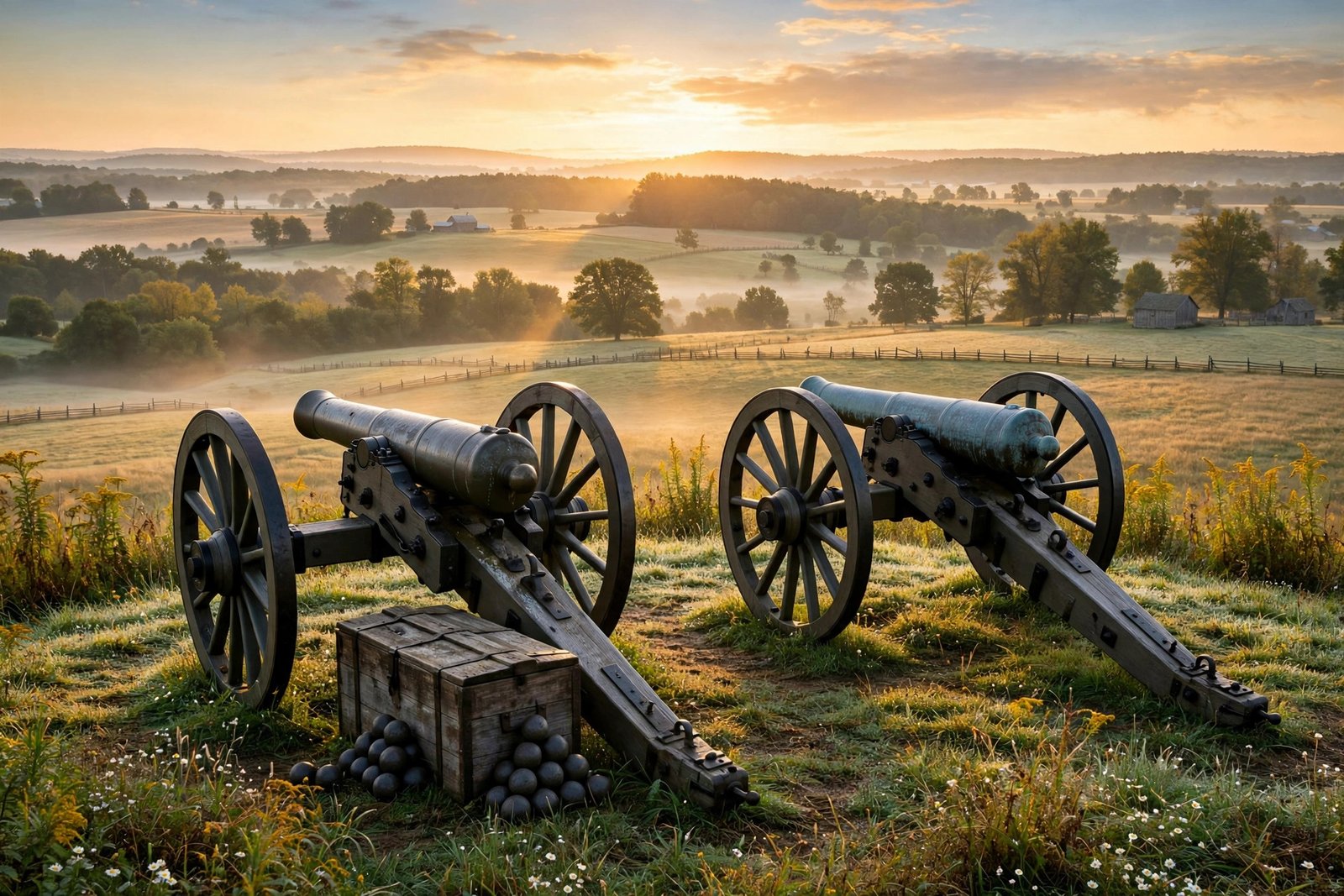
On a cold November afternoon in 1863, Abraham Lincoln stood on a Pennsylvania hillside and spoke for about two minutes. He was not even the main speaker that day. Yet the few words he delivered at Gettysburg became the most famous speech in American history. As the 163rd anniversary of the address approaches on November 19, 2026, it is worth asking how 272 words changed a nation.
A Battlefield That Needed a Cemetery
The Battle of Gettysburg was fought from July 1 to July 3, 1863, in and around the small town of Gettysburg, Pennsylvania. Union Major General George G. Meade’s Army of the Potomac met Confederate General Robert E. Lee’s Army of Northern Virginia in what became the bloodiest battle of the Civil War. When the fighting ended, Lee’s army retreated toward Virginia and the Union held the field — but the field itself was a scene of devastation.
Between 46,000 and 51,000 soldiers from both armies were casualties in the three days of fighting, according to the figures most commonly cited today. Union casualties numbered about 23,000, while Confederate losses are generally put at roughly 23,000 to 28,000. More than 3,000 Union soldiers had been killed in the battle alone.
The scale of the loss created an urgent problem: bodies had to be gathered, identified where possible, and buried with dignity. Gettysburg attorney David Wills, whose home became the center of the enormous cleanup effort after the battle, worked with local leaders to establish a proper burial ground on Cemetery Hill. The result was the Soldiers’ National Cemetery, the final resting place for more than 3,500 United States soldiers killed at Gettysburg, according to the National Park Service. The organizers invited Edward Everett of Massachusetts, one of the most celebrated orators in America, to deliver the main speech. President Abraham Lincoln was invited to offer only, in Wills’s words, “a few appropriate remarks” afterward. Lincoln accepted, and he arrived in Gettysburg on the night of November 18, staying at Wills’s home, where he put the finishing touches on his short speech.
November 19, 1863: The Day Lincoln Spoke
The morning of November 19 dawned bright and clear, broken only by the booming of signal cannon from Cemetery Hill. A procession formed at about 10 a.m. and made its way to the cemetery grounds, where a crowd of about 15,000 people had gathered
Edward Everett spoke first, and he spoke at length. His oration lasted about two hours, delivered without notes, and ran to more than 13,000 words. Steeped in classical oratory, it drew comparisons with the Battle of Marathon, gave a detailed account of the events leading up to the battle, and argued against the idea that the United States was merely a compact of sovereign states.
Then Lincoln rose. He spoke for only about two minutes. His remarks were so brief that some in the crowd were unsure the speech had ended when he sat down. Yet within days, newspapers across the North were printing Lincoln’s words, and within a generation, Everett’s two-hour oration was largely forgotten while Lincoln’s two minutes were memorized by schoolchildren. Everett gave the audience history, argument, and detail. Lincoln gave them something else: a meaning. Instead, he told the crowd what the dead had done, what the living could not do, and what the living still had to do.
The Gettysburg Address in Full
The version most often reproduced today is the Bliss copy, the last one Lincoln wrote, in early 1864, and the only copy he signed and dated. Its text is carved on the south wall of the Lincoln Memorial. Here it is in full:
Four score and seven years ago our fathers brought forth on this continent, a new nation, conceived in Liberty, and dedicated to the proposition that all men are created equal.
Now we are engaged in a great civil war, testing whether that nation, or any nation so conceived and so dedicated, can long endure. We are met on a great battle-field of that war. We have come to dedicate a portion of that field, as a final resting place for those who here gave their lives that that nation might live. It is altogether fitting and proper that we should do this.
But, in a larger sense, we can not dedicate — we can not consecrate — we can not hallow — this ground. The brave men, living and dead, who struggled here, have consecrated it, far above our poor power to add or detract. The world will little note, nor long remember what we say here, but it can never forget what they did here. It is for us the living, rather, to be dedicated here to the unfinished work which they who fought here have thus far so nobly advanced. It is rather for us to be here dedicated to the great task remaining before us — that from these honored dead we take increased devotion to that cause for which they gave the last full measure of devotion — that we here highly resolve that these dead shall not have died in vain — that this nation, under God, shall have a new birth of freedom — and that government of the people, by the people, for the people, shall not perish from the earth.
Abraham Lincoln
November 19, 1863
Read slowly, the speech is only ten sentences long. Lincoln begins in the past, moves to the present, and ends in the future — a simple structure that gives the short text its feeling of completeness.
What Lincoln Actually Said — and What It Meant
The opening line is the most famous sentence in American public life: “Four score and seven years ago our fathers brought forth on this continent, a new nation, conceived in Liberty, and dedicated to the proposition that all men are created equal.” A “score” is twenty years, so four score and seven is eighty-seven years — counting back from 1863 to 1776, the year of the Declaration of Independence. Lincoln deliberately started the nation’s story with the Declaration, not with the Constitution of 1787. The Declaration declared that all men are created equal; the Constitution, as written, had compromised with slavery. By rooting the nation in the Declaration’s promise of equality, Lincoln was quietly reframing the Civil War: it was not only a war to preserve the Union, but a test of whether a nation founded on equality could survive.
Then comes the turn that makes the speech unforgettable. Lincoln tells the crowd that they cannot, in any real sense, dedicate this ground at all. The brave men who struggled there have already consecrated it, “far above our poor power to add or detract.” “The world will little note, nor long remember what we say here, but it can never forget what they did here.” Lincoln was wrong about the first half of that sentence — the world has remembered what he said for more than a century and a half — but he was right about the deeper point. Ceremony cannot substitute for sacrifice.
The final paragraph turns from the dead to the living. “It is for us the living, rather, to be dedicated here to the unfinished work which they who fought here have thus far so nobly advanced.” The dedication, he argues, is not something done to a cemetery; it is something the living do with their own lives. The dead gave “the last full measure of devotion” — a phrase that has entered the language as the classic description of dying for a cause. The living must answer that devotion with their own: a resolve that “these dead shall not have died in vain,” that the nation “shall have a new birth of freedom,” and that “government of the people, by the people, for the people, shall not perish from the earth.” That closing phrase is the speech’s most quoted line — a promise and a warning at once.
Why Two Minutes Changed America
The Gettysburg Address mattered for three reasons, and together they explain why a two-minute speech outlasted a two-hour oration. First, it redefined the war. When the Civil War began in 1861, the Union’s stated purpose was to preserve the United States as one nation. By November 1863, Lincoln had already issued the Emancipation Proclamation, but the war’s meaning was still contested, and many in the North were weary of it. The Gettysburg Address tied the preservation of the Union to the Declaration’s promise of equality, and to a “new birth of freedom.”
Second, it gave the nation a language for grief. The Civil War killed more Americans than any other conflict in the country’s history, and families across the North and South were living with losses that had no satisfying explanation. Lincoln did not offer comfort in the usual sense. He offered meaning: the dead had given the last full measure of devotion, and the living owed them a finished task.
Third, it was short enough to be remembered. A speech of 272 words can be carried in the mind whole, quoted in full, printed on a single page, and carved into stone. Everett’s 13,000 words could not be. Within a day, newspapers were reprinting Lincoln’s text. Within sixty years, it was on the wall of the Lincoln Memorial, dedicated in 1922, where visitors read it every year. Lincoln himself was unsure how the speech had landed; the day after the ceremony, Everett wrote to him that he wished he had come as near to the central idea of the occasion in two hours as Lincoln had in two minutes.
The Five Copies and the Words That Differ
One detail surprises many first-time readers: there is no single, settled text of the Gettysburg Address. Lincoln wrote out five copies of the speech by hand, and each one differs slightly. The other three were written months later, for charitable purposes: the Everett copy, the Bancroft copy, and the Bliss copy.
The differences are small but real. The phrase “under God” appears in the later copies but not in the earliest drafts, and the Bliss copy — written in early 1864 for Colonel Alexander Bliss — is the only version Lincoln signed and dated. It has become the standard text, reproduced on the Lincoln Memorial and in most schoolbooks. The speech is usually described as 272 words long, though some counts of the Bliss text come to 271, depending on how hyphenated words such as “battle-field” are counted.
How America Received It — Then and Now
Reception of the address in 1863 was mixed, and it is worth saying so honestly. Many Northern newspapers praised it But some partisan papers mocked its brevity, and Lincoln’s political opponents found little to praise in anything he said. The speech did not instantly become sacred. It became sacred gradually, as the Union won the war, as emancipation was written into the Constitution with the Thirteenth Amendment, and as later generations found in Lincoln’s words a definition of American purpose that fit their own moments.
Visiting Gettysburg Today
For travelers, the address is still best encountered where it was given. Gettysburg National Military Park preserves the battlefield and the cemetery, and the park’s museum and visitor center are the natural starting point for a visit. The Soldiers’ National Cemetery, now part of Gettysburg National Cemetery, remains an active place of remembrance; the original Civil War section holds the graves Lincoln came to dedicate. It officially closed to new interments in 1972, though family plots remain for dependents of veterans already buried there.
One hundred and sixty-three years after Lincoln spoke, the questions he raised have not gone away. Can a nation founded on equality endure? Does self-government survive its hardest tests? What do the living owe the dead? The Gettysburg Address does not answer those questions with policy or detail. It answers them with a resolve: that the dead shall not have died in vain, that freedom shall have a new birth, and that government of the people, by the people, for the people shall not perish from the earth. Two minutes, 272 words — and a task that is still unfinished.
Frequently Asked Questions
When was the Gettysburg Address delivered?
President Abraham Lincoln delivered the Gettysburg Address on November 19, 1863, at the dedication ceremony for the Soldiers’ National Cemetery in Gettysburg, Pennsylvania, four and a half months after the Battle of Gettysburg. Its 163rd anniversary falls on November 19, 2026.
How long is the Gettysburg Address?
The address is usually described as 272 words long and about ten sentences, delivered in roughly two minutes. Some counts of the standard Bliss text come to 271 words, depending on how hyphenated words are counted.
What does “Four score and seven years ago” mean?
A “score” is twenty years, so “four score and seven” is eighty-seven years. Counting back eighty-seven years from 1863 gives 1776, the year of the Declaration of Independence. Lincoln was deliberately dating the nation’s birth to the Declaration and its promise that all men are created equal.
Where can I read the original Gettysburg Address?
The standard text is the Bliss copy, the last version Lincoln wrote, which is displayed in the Lincoln Room of the White House and carved on the south wall of the Lincoln Memorial in Washington, D.C. The Library of Congress holds two of the five handwritten copies — the Nicolay copy and the Hay copy
Why is the Gettysburg Address so important?
It redefined the Civil War as a test of whether a nation founded on liberty and equality could endure, gave the nation a language for honoring its war dead, and set out an ideal of self-government — “government of the people, by the people, for the people” — that Americans have quoted and debated ever since. Its brevity helped it travel: a speech of 272 words could be memorized, reprinted, and carved in stone.
Related reading
- Boston Tea Party 1773: The Night America Found Its Voice
- The Star-Spangled Banner: Facts Behind America’s National Anthem
- Pearl Harbor, December 7, 1941: The Day That Changed America
Sources: National Park Service — Gettysburg National Cemetery Virtual Tour; Library of Congress — Gettysburg Address Exhibition; Library of Congress — Gettysburg Address: Primary Documents in American History; Gettysburg Address; History.com — Battle of Gettysburg; Abraham Lincoln Online — The Gettysburg Address.