
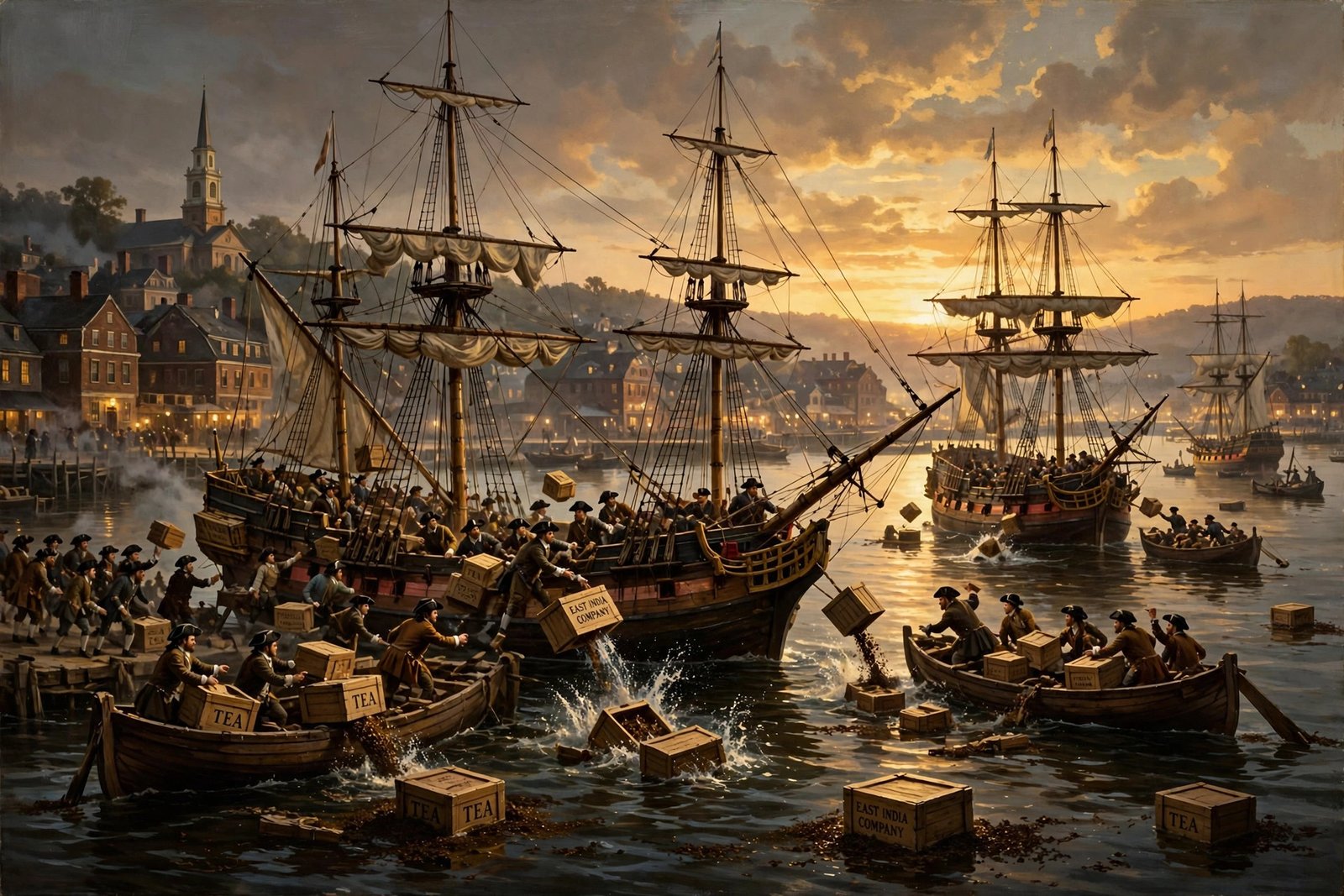
On a cold December night in 1773, Boston Harbor became the stage for one of the most famous protests in American history. A group of colonists, their faces darkened and their identities hidden, slipped aboard three British ships, pried open hundreds of wooden chests, and dumped an entire cargo of tea into the dark water below. By morning, the harbor was covered in floating tea leaves, and nothing in the relationship between Britain and its American colonies would ever be the same.
The Boston Tea Party was not a random act of vandalism. It was the climax of a decade of growing anger over taxes imposed by a Parliament in which the colonists had no voice. The men who boarded those ships knew they could be hanged for treason, yet they went ahead anyway, convinced that the principle at stake was worth the risk. Within sixteen months, their defiance would help push thirteen colonies toward open war and, eventually, independence.
Boston on the Brink: Why Tea Became the Flashpoint
To understand why tea mattered so much, you have to understand what tea meant in the 1770s. Tea was not a luxury for the wealthy. It was the everyday drink of colonial America, poured at breakfast tables from Boston to Charleston and served to guests as a matter of course. When Parliament taxed it, the tax touched nearly every household in the colonies.
The trouble had been building for years. After the French and Indian War ended in 1763, Britain was deep in debt and determined that the American colonies should help pay for their own defense. Parliament passed the Stamp Act in 1765 and the Townshend Acts in 1767, taxing paper, glass, paint, lead, and tea. Colonists answered with boycotts and a powerful argument: they could not be taxed by a Parliament in which they had no elected representatives. The slogan that captured it, taxation without representation, became the rallying cry of a generation.
Most of the Townshend duties were repealed in 1770 after colonial boycotts hurt British merchants, but Parliament deliberately kept the tax on tea. Keeping it was a point of principle. By holding on to the tea tax, Parliament was insisting that it still had the right to tax the colonies, even if it chose not to exercise that right on other goods. For many colonists, that was the whole argument in miniature, and it kept the wound open for three more years.
The Tea Act of 1773: A Bailout That Backfired
The Tea Act, passed by Parliament on May 10, 1773, was designed to save the East India Company from financial ruin. The company was allowed to sell its tea directly to the colonies, cutting out the London middlemen who had previously bought it at auction. That change made the company’s tea cheaper than the tea sold by colonial merchants, and even cheaper than much of the smuggled Dutch tea that many Americans drank.
On paper, it looked like a good deal for consumers. In practice, colonists saw something very different. The tax on tea remained in place, so buying the cheaper East India tea still meant accepting Parliament’s right to tax them. Worse, the arrangement gave one giant company a government-backed monopoly over the colonial tea trade, threatening to ruin independent American merchants. To the Sons of Liberty, the Tea Act was not a bargain. It was a trap, a sweetener designed to make an unjust tax palatable.
The standoff turned on a deadline. Under customs law, once a ship had been in port for twenty days, its cargo had to be landed and the duty paid. The Dartmouth, the first of the tea ships, arrived in Boston in late November 1773, and its deadline fell on December 17. Thousands of colonists packed into the Old South Meeting House day after day, demanding that the ship’s captain return to England with the tea still aboard.
December 16, 1773: The Night of the Tea Party
The Old South Meeting House was packed with thousands of people on the evening of December 16, 1773. When word arrived that Governor Hutchinson had again refused to let the ships sail, Samuel Adams is said to have declared that the meeting could do nothing more to save the country. Whether he used those exact words is still debated by historians, but the crowd understood the signal.
Estimates of how many men took part range from about 30 to 130, and most were members of the Sons of Liberty. Many disguised themselves as Mohawk warriors, smearing their faces with soot and wrapping themselves in blankets. The disguise served two purposes: it hid their identities from the authorities, and it made a symbolic point. By dressing as Native Americans, the protesters were casting themselves as true Americans, distinct from the British, and claiming the continent as their own.
What happened next was remarkably disciplined. Over about three hours, the men worked in near silence, broken only by the sound of axes splitting open chests. They hauled 342 chests of tea on deck, smashed them open, and dumped the contents into the harbor. Contemporary accounts note that the work was done carefully. No other cargo was damaged, nothing was stolen, and when one participant was caught trying to pocket some tea for himself, his companions reportedly stopped him.
By the time they finished, more than 90,000 pounds of tea, worth roughly ten thousand pounds sterling at the time, had been destroyed. When the sun rose on December 17, the harbor was covered in a thick layer of floating tea leaves, and Governor Hutchinson denounced the act as treason. The fourth tea ship bound for Boston, the William, had run aground near Cape Cod earlier in the month, so it escaped the night’s work.
The Morning After: Reaction in Boston and London
Reaction in the colonies was sharply divided. In Boston and throughout Massachusetts, many Patriots celebrated the Tea Party as a bold defense of liberty. Elsewhere, even some who opposed British taxation were uneasy. Figures such as Benjamin Franklin, then in London, worried that destroying private property would damage the colonial cause and hand Britain a justification for harsh punishment.
In London, the news arrived in January 1774 and landed like a thunderclap. King George III and his prime minister, Lord North, saw the Tea Party not as a protest but as an act of rebellion that had to be answered. Parliament moved quickly to punish Boston, and the punishment was designed to be unmistakable. If Massachusetts would not obey, Massachusetts would be made an example to every other colony.
The Coercive Acts: Britain’s Punishment
The Coercive Acts of 1774 were four laws aimed squarely at Massachusetts, and they struck at the heart of colonial self-government. The Boston Port Act closed Boston Harbor to all trade until the destroyed tea was paid for, a blockade enforced by the Royal Navy that began in June 1774. For a port city that lived by trade, it was an economic blow that threw sailors, dockworkers, merchants, and craftsmen out of work almost overnight.
The Massachusetts Government Act went further, curtailing free elections in the colony and giving the royally appointed governor far greater power over local government. Town meetings, the beating heart of New England self-rule, were sharply restricted. The Administration of Justice Act allowed British officials accused of crimes while enforcing the law to be tried in Britain rather than in Massachusetts, and a new Quartering Act required colonial governments to house and feed British troops stationed in their towns.
In September 1774, delegates from twelve colonies met in Philadelphia for the First Continental Congress, the first coordinated political gathering of its kind. They drew up a list of grievances, agreed to a colony-wide boycott of British goods, and pledged to meet again the following year if their demands were not met. The Congress was a direct answer to the Coercive Acts, and it would not have happened without the Tea Party that provoked them.
From Protest to Revolution
The road from the Boston Tea Party to open war was short. Through the winter and spring of 1775, tensions kept rising as Britain sent more troops to Boston and colonial militias began drilling and stockpiling arms. On April 19, 1775, British soldiers marched out of Boston to seize a colonial arms store at Concord, and they were met by armed minutemen at Lexington and Concord. The shots fired that morning, the first shots of the American Revolutionary War, came just sixteen months after the tea went into the harbor.
It would be too simple to say the Tea Party caused the Revolution on its own. The grievances ran deeper, the arguments about taxation and representation had been building for a decade, and war might have come anyway. But the Tea Party changed the character of the conflict. Before December 1773, the dispute was still, in large part, an argument about taxes and trade. After the Tea Party and the Coercive Acts, it became a struggle over self-government itself, and that was a fight far more colonists were willing to join.
Why the Boston Tea Party Still Matters
More than two and a half centuries later, the Boston Tea Party still matters because the questions it raised have never really gone away. Who gets to tax a people, and who gets to decide? When does protest become justified, and where is the line between defiance and destruction? The men who dumped the tea into Boston Harbor did not have neat answers, and historians still argue about their motives and their methods.
What is not in doubt is the scale of what they set in motion. A single night of determined, disciplined protest forced a crisis that neither side could walk away from. Britain’s answer, the Coercive Acts, united the colonies in a way that years of argument never had. The First Continental Congress, the boycotts, the militias, and finally the war all trace back, in part, to those three hours at Griffin’s Wharf.
For more on the people and places behind the Revolution, see the HISTORY overview of the Boston Tea Party, the American Battlefield Trust account of the event, and the U.S. Census Bureau history of December 1773. The Britannica entry on the Boston Tea Party offers a concise summary of causes and consequences, and the Boston Tea Party Ships and Museum preserves the story where it happened.
FAQ
When was the Boston Tea Party?
The Boston Tea Party took place on the night of December 16, 1773, in Boston, Massachusetts. The protesters boarded three ships at Griffin’s Wharf and worked for about three hours, finishing in the early hours of December 17.
How much tea was destroyed in the Boston Tea Party?
The protesters dumped 342 chests of British East India Company tea into Boston Harbor, weighing more than 90,000 pounds. At the time, the tea was valued at roughly ten thousand pounds sterling.
Who organized the Boston Tea Party?
The protest was led by Samuel Adams and the Sons of Liberty, though many of the participants remain unknown. Estimates of the number of men who boarded the ships range from about 30 to 130, and many disguised themselves as Mohawk warriors.
What were the Intolerable Acts?
The Intolerable Acts, known in Britain as the Coercive Acts, were four laws passed by Parliament in 1774 to punish Massachusetts for the Tea Party. They closed Boston Harbor, restricted Massachusetts self-government, shielded British officials from colonial trials, and required colonists to house British troops.
Did the Boston Tea Party directly cause the American Revolution?
It was a major step on the road to war, but not the only cause. The Tea Party provoked the Coercive Acts, which united the colonies and led to the First Continental Congress in 1774. Open fighting began at Lexington and Concord in April 1775, about sixteen months later.