
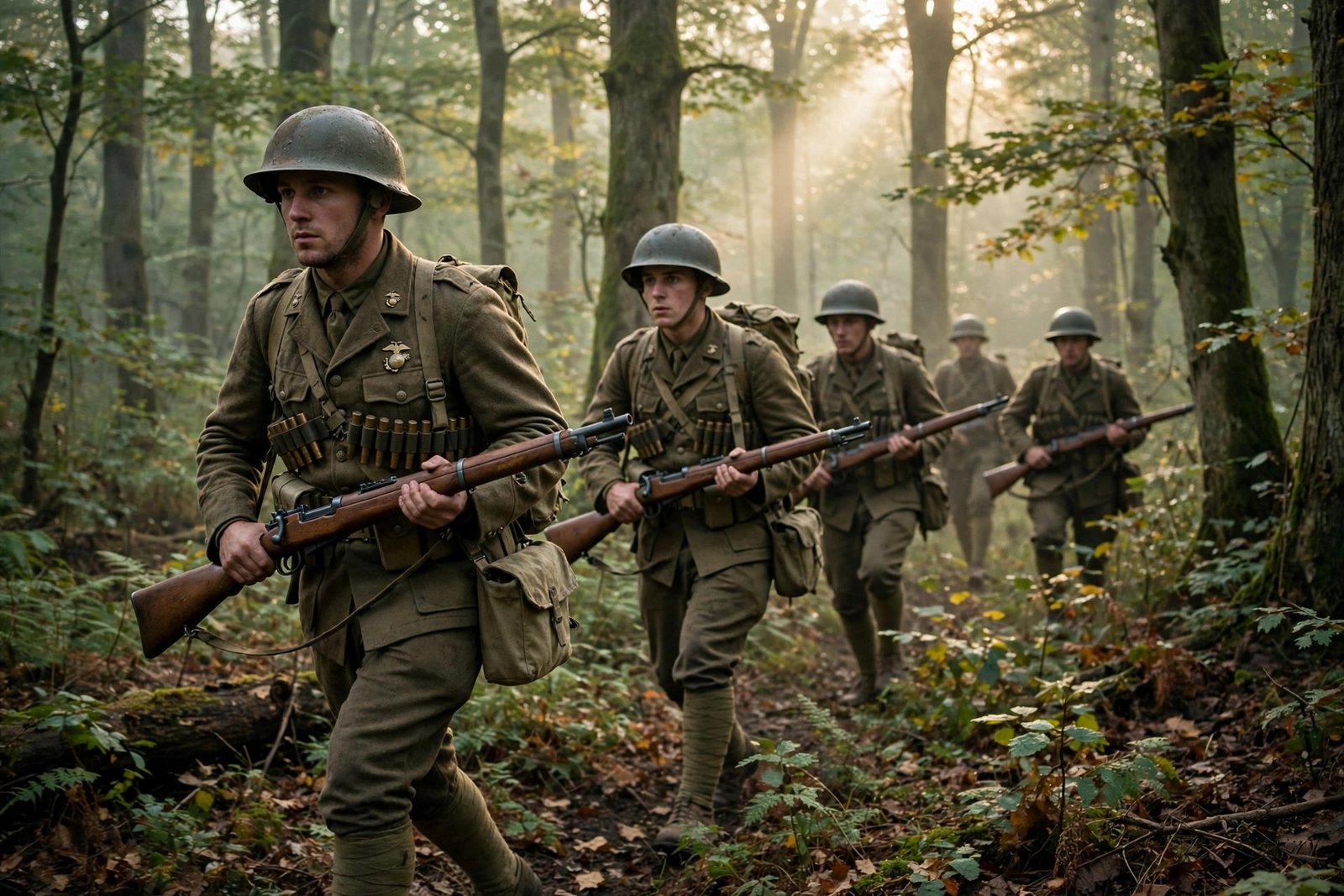
Every November, as Veterans Day approaches and the Marine Corps marks another birthday, one battle from more than a century ago comes back into focus: Belleau Wood. In June 1918, in a small forest about 50 miles northeast of Paris, a brigade of United States Marines stood in the path of the German army and refused to move. The fighting lasted less than a month, but it changed the Marine Corps forever. This week, as the Corps celebrates its 251st birthday on November 10, 2026, and the nation honors its veterans on November 11, the story of Belleau Wood is worth telling again — not as a dusty chapter in a history book, but as the moment the Marines became the Marines.
The Spring of 1918: Germany’s Last Big Push
By the spring of 1918, the First World War had ground on for almost four years, and the German high command knew time was running out. American troops were arriving in France in ever-larger numbers, and Germany’s leaders believed they had one last chance to win the war before the United States could bring its full strength to bear. In March 1918, they launched a series of massive spring offensives, breaking through Allied lines and driving deep into French territory.
The situation was desperate. British forces had been pushed back, and French units were staggering under the weight of the attack. In late May, German troops reached the Marne River near Château-Thierry, less than 60 miles from Paris. The French capital, which had not been seriously threatened since the opening weeks of the war in 1914, was suddenly in danger again. Roads out of Paris filled with refugees, and the Allied high command scrambled to plug the gap.
The Americans had only entered the war in April 1917, and by the spring of 1918 their forces in France were still building up. General John J. Pershing, commander of the American Expeditionary Forces, had resisted pressure to feed his troops piecemeal into French and British units. But the emergency of late May changed everything. Pershing agreed to send American divisions to the front where they were needed most, and among the first to go was the U.S. Army’s 2nd Division — which included a brigade of Marines.
The Marines Arrive at the Marne
The 4th Marine Brigade, made up of the 5th and 6th Marine Regiments and the 6th Machine Gun Battalion, was part of the 2nd Division under Major General Omar Bundy. On May 30, 1918, the division was ordered into the Marne sector. The Marines moved up in trucks through countryside crowded with retreating French soldiers and fleeing civilians, a scene that told them everything they needed to know about how bad things were.
They took up positions along a defensive line north of the village of Lucy-le-Bocage, facing a forest the French called the Bois de Belleau — Belleau Wood. It was not a large place, barely more than a mile long and half a mile wide, a former hunting preserve of tangled trees, rocky outcrops, and ravines. But the Germans had fortified it thoroughly, with machine-gun nests, artillery, and barbed wire, and they held the nearby village of Bouresches and the high ground at Hill 142. Taking the wood would mean attacking uphill, across open wheat fields, into the teeth of prepared defenses.
The Marines were told to dig in and hold the line. The French officers they met had a different message: keep falling back. The French army had been retreating for days, and its officers assumed the newly arrived Americans would do the same. They were wrong, and the moment that proved it has become one of the most famous exchanges in Marine Corps history.
“Retreat, Hell! We Just Got Here”
On June 2, 1918, as the Marines were moving into position, Captain Lloyd W. Williams of the 2nd Battalion, 5th Marines, was approached by a French officer who advised him to withdraw. According to the account that has come down through Marine Corps tradition — retold in the Marine Corps’ own history of the battle — Williams answered with six words that have echoed for more than a century: “Retreat, hell! We just got here!”
Williams was a 31-year-old officer from Virginia, a graduate of Virginia Tech’s Class of 1907 who had joined the Marine Corps and served in the Caribbean before the war. He commanded the 51st Company, and his men were among the first Marines to face the Germans in France. His reply was not a formal order or a piece of battlefield poetry — it was a blunt refusal from a man who had just arrived and had no intention of leaving.
Historians note that the exact wording of the exchange has been retold many times, and even Williams’ own battalion commander later claimed a share of the words. But the meaning has never been in dispute, and the Corps embraced it. A shortened version — “Retreat, hell!” — became the motto of the 2nd Battalion, 5th Marines, the unit Williams served in. Williams himself would not live to see the legend grow. On June 11, he led an assault that routed German defenders near Château-Thierry, and he died the next day from wounds suffered when a shell exploded as he was being evacuated from the battlefield. He was posthumously awarded three Silver Star citations and a Purple Heart.
Three Weeks in the Woods
The main attack began on June 6, 1918, a date that would later be shared with another famous American landing in France, at Normandy in 1944. Before dawn, Marines of the 5th Regiment attacked Hill 142 to protect the flank of an advancing French division, while the 6th Marines struck toward Belleau Wood itself and the village of Bouresches. The first hours were brutal. The Defense Department’s history of the fight calls Belleau Wood the Marines’ first crucible, and the wheat-field crossing is where that reputation was earned. Marines crossed waist-high wheat fields in the open, with almost no artillery support, against German machine guns that had been sited to sweep every approach.
The cost of that first day was staggering. By nightfall, hundreds of Marines were dead or wounded, and June 6, 1918, became the bloodiest day in Marine Corps history up to that point — a record that would stand until Tarawa in 1943. The 5th and 6th Marines kept attacking anyway. Over the following days they fought their way into the wood itself, where the battle turned into a grinding, tree-to-tree struggle. Possession of the forest changed hands repeatedly as the Marines pushed forward, were driven back by counterattacks, and pushed forward again.
Another famous moment from the battle belongs to First Sergeant Dan Daly, one of the most decorated Marines of his era. As his men hesitated under fire on June 6, Daly is said to have rallied them with the taunt, “Come on, you sons of bitches, do you want to live forever?” Like the Williams quote, Daly’s words survive as tradition rather than as a verified transcript. What is certain is that Daly, already a two-time Medal of Honor recipient, fought with extraordinary bravery at Belleau Wood and later received the Navy Cross and the Distinguished Service Cross for his actions there.
The fighting in the woods was savage in a way that is hard to grasp from a distance. Artillery shattered the trees, poison gas drifted through the undergrowth, and much of the combat came down to rifles, bayonets, and hand-to-hand fighting in the dark. The Marines were short of food and water, and their medical teams — Navy doctors and corpsmen serving alongside them, whom the Marines called “Devil Docs” — worked under fire to treat the wounded. Two of those medical men, Lieutenant Orlando Petty and Lieutenant (j.g.) Weedon Osborne, would receive the Medal of Honor, Osborne posthumously, for their actions at Belleau Wood.
Slowly, yard by yard, the Marines cleared the wood. On the morning of June 26, 1918, after beating back early-morning German counterattacks, Major Maurice Shearer sent the message that ended the battle: “Woods now entirely — U.S. Marine Corps.” The forest was theirs.
The Devil Dogs Legend
It was at Belleau Wood that the Marines picked up the nickname by which millions of Americans know them today: the Devil Dogs. According to Corps tradition, German officers referred to the Marines in their battle reports as “Teufelshunde” — devil dogs — in recognition of the ferocity with which they fought. The story is appealing, and the Marine Corps has embraced it for more than a century, but historians have long noted that the evidence is thin. No original German document using the term has ever been found, and the nickname may have been popularized instead by American war correspondents — most famously Floyd Gibbons, who wrote vivid dispatches from the front and singled out Marines like Gunnery Sergeant Dan Daly in his reporting.
The U.S. Army’s history of the battle tells the same story, and notes that journalist Floyd Gibbons helped spread the name. That uncertainty does not make the nickname any less real as a piece of Marine identity. Whatever its precise origin, “Devil Dogs” stuck because it captured something true about how the Marines fought at Belleau Wood: with a ferocity and stubbornness that surprised even the professional German army. The Corps adopted the name proudly, and it remains in use today — on unit insignia, in recruiting, and in the famous Devil Dog fountain in the village of Belleau, France, whose moss-covered bulldog statue has become a place of pilgrimage for Marines visiting the battlefield.
The Cost and the Victory
The price of Belleau Wood was heavy. The American Battle Monuments Commission records that the 2nd Division sustained about 8,100 casualties during the intense fighting in the vicinity in June 1918. For the 4th Marine Brigade specifically, the toll included more than 900 Marines killed — over 600 killed in action and more than 300 who later died of their wounds — along with nearly 2,500 wounded and more than 900 exposed to poison gas. More Marines were killed and wounded in that single battle than in every battle in the Corps’ previous 143-year history combined, a casualty rate of more than half the brigade.
Those numbers explain why Belleau Wood holds such a place in Marine memory. But the battle also mattered strategically: it helped stop the last great German offensive of the war, halting the drive toward Paris, and within weeks the Allies were on the offensive. Less than five months later, the armistice of November 11, 1918, ended the fighting.
France honored the Marines in ways that still stand. The French Army renamed Belleau Wood the “Bois de la Brigade de Marine” — the Wood of the Marine Brigade — and awarded the 5th and 6th Marine Regiments the Croix de Guerre, the French military decoration for heroism. Belleau Wood was dedicated as an American battle monument in July 1923, and the Aisne-Marne American Cemetery at the foot of the wood holds nearly 2,300 American dead from the fighting in the region in the summer of 1918, with more than 1,000 names of the missing inscribed on the chapel walls.
What Belleau Wood Means Today
More than a century later, Belleau Wood remains the touchstone of Marine Corps identity. Every Marine recruit learns the story in training, and every Marine officer studies the battle as an example of what the Corps expects of itself: attack when others retreat, hold ground that seems impossible to hold, and keep going when the cost is terrible. The battle is why the Marine Corps’ birthday, November 10, carries so much weight — not because Belleau Wood happened on that date, but because the Corps that celebrates its 251st birthday on November 10, 2026, is the institution that Belleau Wood made.
The Corps was founded on November 10, 1775, when the Second Continental Congress resolved to raise two battalions of Marines, and the birthday has been formally observed on that date since Commandant John A. Lejeune issued Marine Corps Order No. 47 in 1921. The 251st birthday falls in the same year that America marks the 250th anniversary of its independence — a reminder that the Corps is older than the nation it serves. But the modern Marine Corps traces its identity to the wheat fields and woods of northern France in June 1918.
That is also why Belleau Wood belongs in Veterans Day week. November 11, the anniversary of the 1918 armistice, honors all who served. The men of Belleau Wood were among the first Americans to fight in a world war, and many of them never came home. Their names are on the walls of the chapel at Aisne-Marne, and their story is the reason the Corps still sends its newest Marines to walk the ground at Belleau Wood, to see the trenches and shell holes that remain, and to understand what the words “Semper Fidelis” — always faithful — actually cost.
Frequently Asked Questions
When was the Battle of Belleau Wood?
The battle was fought from June 1 to June 26, 1918, near Château-Thierry, France, during the German spring offensive of World War I. The heaviest fighting ran from June 6, when the Marines first attacked, until June 26, when Major Maurice Shearer reported the wood was entirely in Marine hands.
Why are Marines called Devil Dogs?
According to Marine Corps tradition, German troops called the Marines “Teufelshunde,” or devil dogs, because of their ferocious fighting at Belleau Wood. Historians caution that no original German document using the term has been found, and American war correspondents may have helped popularize it. Either way, the nickname has been part of Marine identity for more than a century.
Did Captain Lloyd Williams really say “Retreat, hell! We just got here”?
The words are attributed to Captain Lloyd W. Williams, who spoke them on June 2, 1918, after a French officer advised him to withdraw. The exact wording varies between accounts — his battalion commander later claimed a share of the words — but the Marine Corps adopted “Retreat, hell!” as the motto of the 2nd Battalion, 5th Marines. Williams was killed in action on June 12, 1918.
Can you visit Belleau Wood today?
Yes. The Aisne-Marne American Cemetery and the Belleau Wood battlefield are open to the public daily, maintained by the American Battle Monuments Commission. The site is about 50 miles northeast of Paris, near the village of Belleau, and visitors can walk the trails through the wood, see the Marine monument, and visit the Devil Dog fountain in the village.
Related reading
Explore more stories of American courage on Famus News: The 442nd Regimental Combat Team: America’s Most Decorated Unit, Audie Murphy: America’s Most Decorated Soldier, and The Iwo Jima Flag Raising of 1945: History Behind the Iconic Photo.