
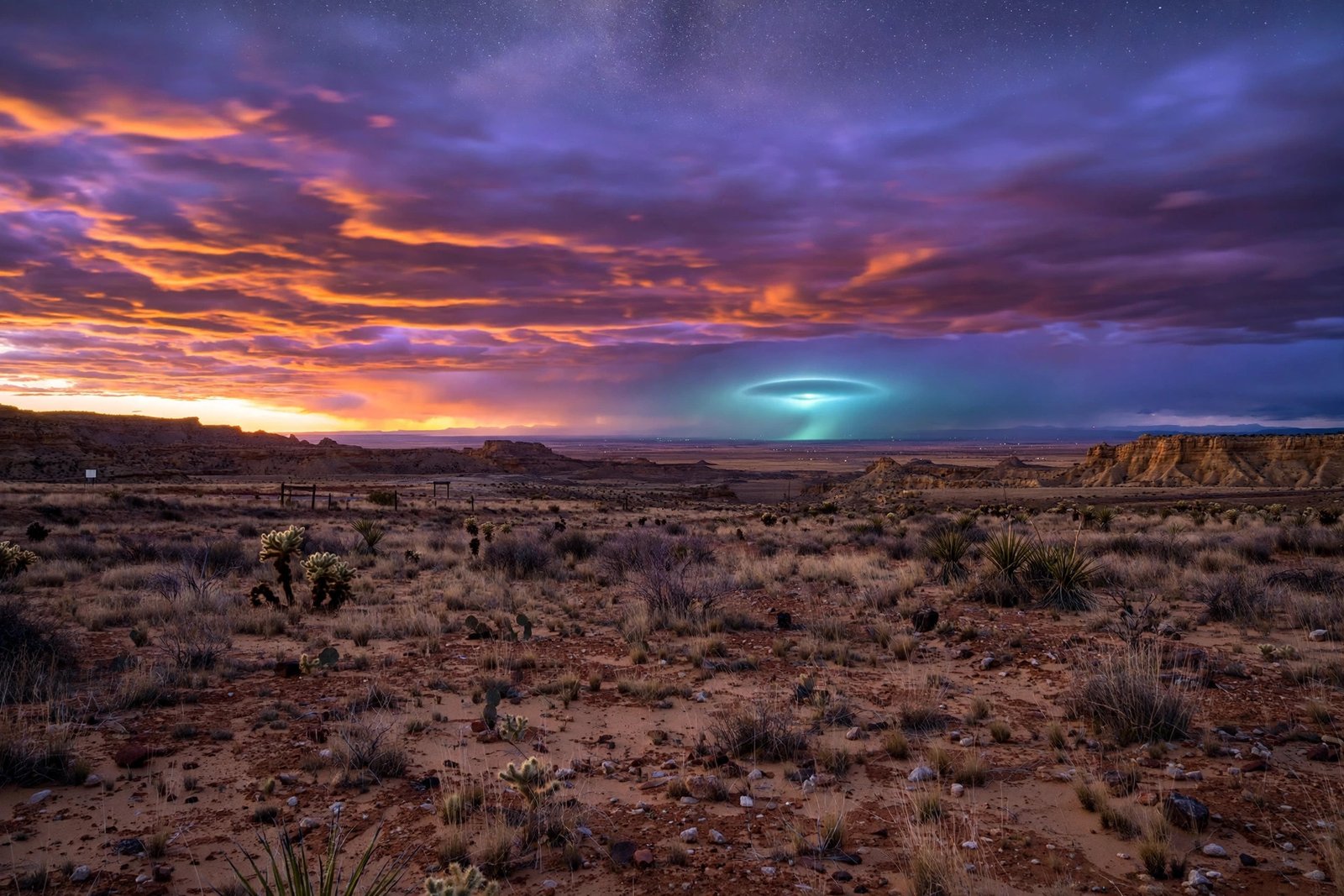
On the morning of July 8, 1947, readers of the Roswell Daily Record in New Mexico opened their newspaper to a headline that would echo for nearly eighty years: the United States Army had recovered a “flying disc” on a ranch near Roswell. Within a day, the story was retracted. Within a few decades, it had become the most famous UFO story in the world. And nearly half a century later, the U.S. Air Force offered an explanation that settled the official record — without ever quite settling the argument.
What really happened at Roswell in the summer of 1947? The answer depends on who you ask, but the paper trail is thinner — and stranger — than most people expect. Here is the story as the surviving records tell it, the official explanation that followed, and the questions that refuse to go away.
A Strange Discovery on a New Mexico Ranch
The story begins not in Roswell itself, but about 75 miles northwest of the town, on the Foster Ranch near Corona, New Mexico. In late June or early July of 1947, rancher W. W. “Mac” Brazel found a field scattered with debris. The material was unlike anything he had seen on a ranch before: sheets of thin, foil-like metal, lightweight sticks that looked like balsa wood, and rubber-like fragments, spread across a wide stretch of open ground. Some accounts describe the debris field as covering roughly three-quarters of a square mile.
Brazel gathered some of the material and, after a few days, brought it to the sheriff in Roswell. The sheriff, in turn, contacted the Roswell Army Air Field. On July 7, military personnel went out to the ranch and collected the rest of the wreckage. What happened next turned a rancher’s odd find into international news.
To understand why the Army took the debris so seriously, it helps to know what Roswell Army Air Field was in 1947. The base was home to the 509th Bomb Group, the only unit in the world at the time capable of delivering nuclear weapons. Anything strange falling from the sky near that base was going to get attention fast. And the summer of 1947 was already a strange one for the skies over America. Just two weeks earlier, on June 24, pilot Kenneth Arnold had reported seeing nine shiny objects flying in formation near Mount Rainier in Washington — a sighting that gave the world the phrase “flying saucer.” Newspapers across the country were full of saucer stories. The country was, in a word, primed.
“Flying Disc”: The Press Release That Shocked the World
On July 8, 1947, the Roswell Army Air Field’s public information officer, First Lieutenant Walter Haut, issued a press release at the direction of base commander Colonel William H. Blanchard. It was short, and it was extraordinary. The release announced that the 509th Bomb Group had recovered a “flying disc” that had crashed on a ranch near Roswell, and that the disc had been flown to higher headquarters for examination.
The story ran on the front page of the Roswell Daily Record that same afternoon, under the headline “RAAF Captures Flying Saucer on Ranch in Roswell Region.” Wire services picked it up within hours, and the news spread around the world. For a few hours, the United States Army appeared to have confirmed the existence of a flying saucer.
It remains the only time the U.S. military has ever formally announced the recovery of a “flying disc.” That single fact is a large part of why the story has never died. If the whole thing had been a weather balloon, as the Army soon claimed, why did the base announce a flying disc in the first place?
The Retraction: Just a Weather Balloon?
The retraction came fast. By that same evening, Brigadier General Roger Ramey, commander of the Eighth Air Force at Fort Worth, Texas, had taken charge of the story. The debris, Ramey told reporters, was nothing more than a weather balloon and its radar target — a lightweight reflector device known as a rawin target, made of foil-covered balsa wood sticks. Photographs were released of officers posing with the crumpled foil and sticks. The newspapers dutifully printed the correction, and the story faded from the headlines within days.
Major Jesse Marcel, the 509th Bomb Group’s intelligence officer, had been one of the officers who first handled the debris at the ranch. In the photographs from Fort Worth, he appears holding the wreckage. For thirty years, Marcel said little about what he had seen. Then, in 1978, the retired officer gave an interview in which he said the weather balloon explanation had been a cover story, and that the material he recovered was not of this Earth. Two years later, the 1980 book The Roswell Incident turned Marcel’s claims into a national sensation, and Roswell became a permanent fixture of American folklore.
But here is where the story gets complicated. The Air Force would later admit that the weather balloon story was, in fact, a cover story — just not for a flying saucer. It was a cover for something else entirely, something that had been classified at the highest levels.
The Air Force’s Answer: Project Mogul
In July 1994, the U.S. Air Force released a report titled The Roswell Report: Fact versus Fiction in the New Mexico Desert. Its conclusion: the debris Brazel found was almost certainly wreckage from Project Mogul, a then-classified program that flew long trains of balloons carrying radar reflectors and acoustic sensors high into the atmosphere. The purpose was to listen for the sound of Soviet nuclear tests, carried thousands of miles through high-altitude sound channels. The Soviet Union would not test its first atomic device until 1949, but American planners wanted the listening system ready.
The Mogul balloons were launched from Alamogordo Army Air Field, less than 150 miles from Roswell. Their radar targets were made of balsa wood struts covered in metallic foil — exactly the kind of strange, lightweight material Brazel described. According to the Air Force report, a Mogul balloon train launched on June 4, 1947, designated in project records as Flight 4, went missing from tracking within about 17 miles of the Foster Ranch. The report concluded that this flight was the most likely source of the debris.
Because Mogul was top secret, the Army in 1947 could not explain what the material really was. So officers fell back on the nearest unclassified explanation: a weather balloon. As the Air Force later put it, the weather balloon story was “an attempt to deflect attention from the top secret Mogul project.” The cover story worked for decades — until it didn’t, because the very secrecy that protected Mogul also left room for a much bigger story to grow.
The Missing Records
In the early 1990s, New Mexico Congressman Steven Schiff asked the Government Accountability Office to find every government record about the 1947 Roswell crash. The GAO’s report, published on July 28, 1995, was both thorough and frustrating. Investigators found only two government documents from 1947 that mentioned the incident: an FBI teletype dated July 8, 1947, and the July 1947 history of the 509th Bomb Group. Both described the debris as balloon equipment with a radar reflector.
More strikingly, the GAO found that the Roswell Army Air Field’s administrative records from March 1945 through December 1949, and its outgoing messages from October 1946 through December 1949, had been destroyed — with no surviving record of who authorized the destruction or why. For believers, the missing records are evidence of a cover-up. For skeptics, they are an unfortunate but common gap in old military paperwork. What no one can dispute is that the gap exists, and that it means some questions about July 1947 cannot be settled from documents alone.
The Alien Bodies Question
A second Air Force report, The Roswell Report: Case Closed, published in 1997, took on the most sensational part of the legend: stories, which began surfacing decades after 1947, of small humanoid bodies recovered near the crash site. The report concluded that these accounts most likely came from a confusion of memories over time. In the 1950s, the Air Force ran high-altitude balloon programs in the same part of New Mexico that dropped anthropomorphic test dummies from the sky to study parachutes and ejection seats. The dummies, with their pale bodies and odd proportions, could plausibly have been remembered — or misremembered — years later as something else entirely, and folded into the Roswell story.
It is an explanation that satisfies almost no one completely. Believers point out that it requires accepting that multiple witnesses mixed up events separated by years. Skeptics point out that the body stories did not appear until the 1980s and 1990s, decades after the event, and that human memory is famously unreliable over that kind of span. What can be said with confidence is this: no official record released to date describes a recovered craft or bodies.
Why Roswell Still Matters
Nearly eighty years on, Roswell is far more than a historical footnote. The town has embraced its strange fame. The International UFO Museum and Research Center, on Main Street in downtown Roswell, draws visitors from around the world with exhibits on the 1947 incident, and the city’s official website proudly leans into the story. Roswell has become shorthand for the whole UFO question — a place name that instantly signals mystery, secrecy, and the possibility that the government knows more than it says.
That reputation is why the case still matters beyond the world of UFO enthusiasts. Roswell is a case study in how secrecy, even secrecy with a legitimate national security purpose, can backfire. The Army’s decision to announce a “flying disc” and then retract it within hours, followed by decades of silence about Project Mogul, created exactly the vacuum in which a legend grows. Had the full story been declassified sooner, the legend might have been smaller. Instead, the combination of a sensational press release, a flimsy cover story, and destroyed records produced the most durable mystery in American history.
So what really happened in New Mexico in July 1947? The official record says a classified balloon train crashed on a ranch, and a panicked public relations response turned it into a flying saucer. The legend says something else fell from the sky that summer, and the truth is still hidden. The documents we have support the first story. The mystery is that, for millions of people, the documents have never been quite enough.
Frequently Asked Questions
What was found at Roswell in 1947?
Rancher W. W. “Mac” Brazel found scattered debris on the Foster Ranch near Corona, New Mexico, in late June or early July 1947: foil-like metal, lightweight sticks, and rubber-like fragments. The Air Force’s 1994 report concluded the material was most likely wreckage from a classified Project Mogul balloon train.
Did the Army really announce it had recovered a flying disc?
Yes. On July 8, 1947, the Roswell Army Air Field issued a press release stating that the 509th Bomb Group had recovered a “flying disc.” The story ran on the front page of the Roswell Daily Record that day. Within hours, Eighth Air Force commander General Roger Ramey retracted the announcement, saying the debris was a weather balloon.
What was Project Mogul?
Project Mogul was a top-secret U.S. program that flew trains of high-altitude balloons carrying microphones and radar reflectors to detect the sound of Soviet nuclear tests. The balloons were launched from Alamogordo Army Air Field in New Mexico, and their foil-covered balsa radar targets matched the debris Brazel found.
Is there any proof of alien bodies at Roswell?
No official record released to date describes recovered bodies or a craft. The Air Force’s 1997 report attributed body stories to anthropomorphic test dummies dropped in 1950s balloon programs in the same region, possibly mixed into memories of 1947. Believers dispute this, but the body accounts surfaced decades after the event.
Related reading
- Area 51 Mystery Explained
- Bermuda Triangle Mystery Explained
- Mothman Legend: The Point Pleasant Mystery
Sources: U.S. Government Accountability Office, “Government Records: Results of a Search for Records Concerning the 1947 Crash Near Roswell, New Mexico”; Roswell incident; City of Roswell, New Mexico; International UFO Museum and Research Center; What Really Happened at Roswell in 1947?; Declassified: The Air Force File Behind the Roswell Incident.