
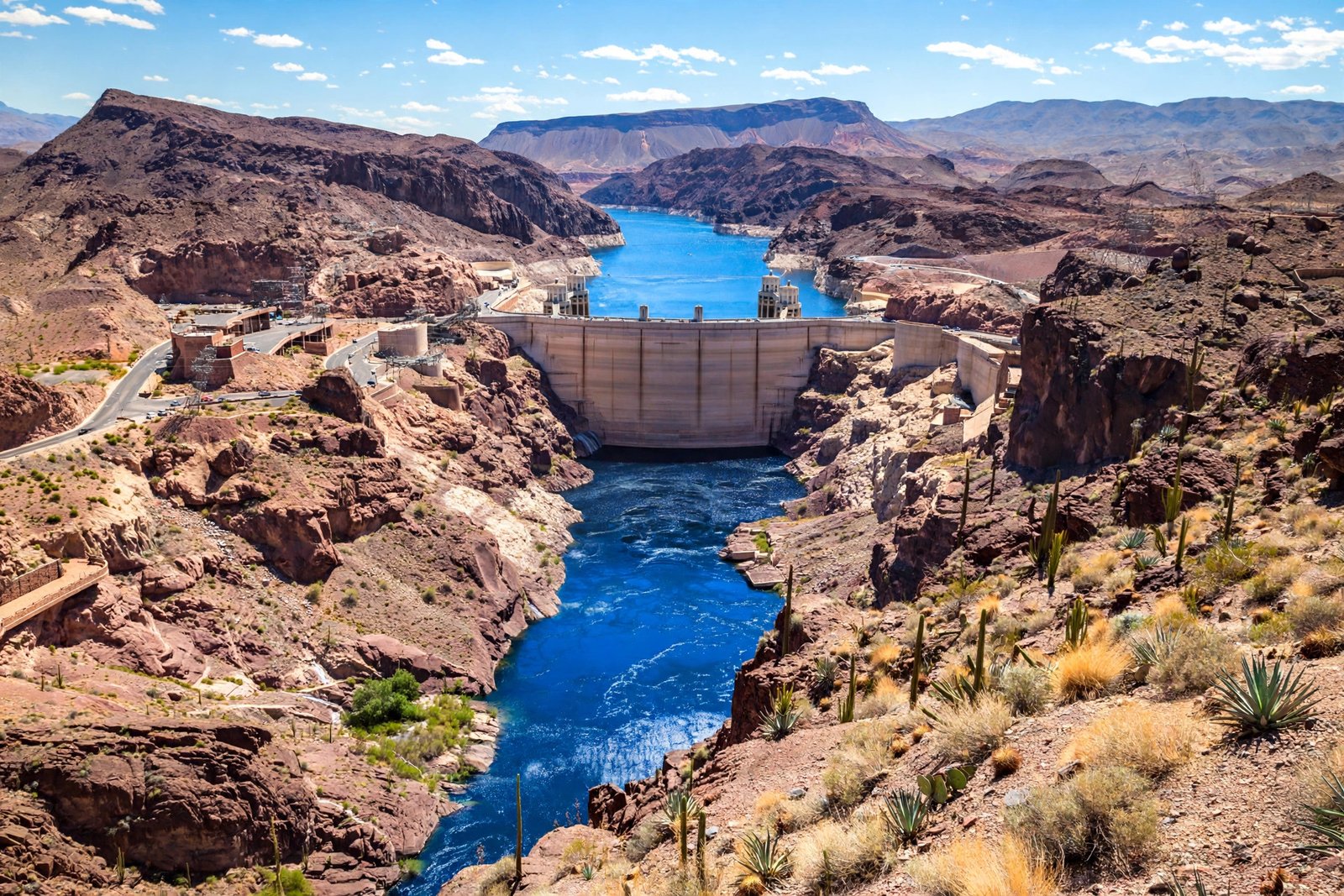
In the middle of the Great Depression, in a blazing desert canyon on the border between Nevada and Arizona, America built something that had never been built before. It was a wall of concrete 726 feet tall and 1,244 feet across, holding back the wild Colorado River, and it was finished two years ahead of schedule. It created the largest reservoir in the country, powered the growth of Las Vegas, watered the farms of the Southwest, and became one of the most visited landmarks in America. Its name is Hoover Dam, and nearly ninety years after it opened, it is still working.
Hoover Dam is more than an engineering marvel. It is a monument to a particular kind of American confidence, the belief that a nation in the depths of an economic crisis could still attempt something enormous and finish it. The dam’s story includes desperate workers, deadly heat, a river that had to be moved, and a concrete structure so large that engineers had to invent new ways to cool it as it hardened. It is, in every sense, a story about the power of the United States, and not just the electrical kind.
Here is how the dam was built, what it does, and why it still matters.
Taming the Colorado
The Colorado River had always been a problem. It flooded unpredictably, wrecking farms and settlements, and then ran low in dry years, leaving the same farms without water. As early as 1900, engineers had investigated Black Canyon and nearby Boulder Canyon for a dam that could control floods, provide irrigation water, and produce hydroelectric power. But a dam of the necessary size had never been attempted, and the river’s power made the idea seem almost reckless.
The politics took decades. In 1922, the Colorado River Compact divided the river’s waters between the states of the upper and lower basins, though apportionment within each basin was left to the states themselves. In 1928, Congress passed the Boulder Canyon Project Act, authorizing construction of the dam. President Calvin Coolidge signed the measure into law, authorizing $165 million for the project as well as the Imperial Dam and the All-American Canal.
The contract went to Six Companies, Inc., a joint venture of construction and engineering companies, which submitted a bid of $48,890,955 on March 11, 1931. The company began work in a place with almost no infrastructure: no town, no roads, no shade, and summer temperatures that regularly topped 120 degrees. The workers who came were desperate for jobs in the Depression, and they came by the thousands.
Moving a River
The first problem was the river itself. You cannot build a dam in a river that is still flowing through the construction site, so the engineers had to move the Colorado. Beginning in 1931, workers dug four diversion tunnels, each 56 feet in diameter, through the canyon walls, and by November 1932, the river had been diverted around the dam site. More than 1.5 million cubic yards of rock and earth had been removed from the riverbed and canyon walls to make it happen.
Then came the concrete. The first concrete flowed into forms on June 6, 1933, and at the peak of construction, on-site facilities supplied 5,000 cubic yards of concrete every day. The dam contains 3.25 million cubic yards of concrete, enough to build a highway from coast to coast, and it was poured in interlocking blocks rather than a single mass. The reason was heat: concrete generates heat as it cures, and a single solid pour of that size would have taken more than a century to cool. Engineers embedded cooling pipes in the blocks and circulated cold water through them, a technique that had never been used at this scale.
The human cost was real. Workers labored in brutal heat, on sheer canyon walls, in a place where a fall could be fatal. Around 100 workers died during construction, and the dam’s history includes the harsh conditions of the worker camp, the company town of Boulder City, and the strikes and protests that eventually improved conditions. The dam was built by people who needed the work, and their effort is part of the monument.
On May 29, 1935, workers poured the last of the concrete. The bulk of heavy construction was complete, and President Franklin D. Roosevelt dedicated the dam, then called Boulder Dam, during a ceremony on September 30, 1935, attended by thousands despite the blazing heat. Secretary of the Interior Harold Ickes formally accepted delivery of the dam and its power plant from Six Companies on March 1, 1936, more than two years ahead of schedule.
Power, Water, and a City
The dam’s power plant began generating electricity in 1936, with the first generator going into operation in October of that year. The final generator went into commercial operation in 1961, bringing the total to 17 main turbines. The plant has an installed capacity of 2,080 megawatts and generates about 4.2 billion kilowatt-hours of electricity each year, supplying power to public and private utilities in Nevada, Arizona, and California.
But electricity was only one of the dam’s jobs. Behind it, Lake Mead filled, named for Elwood Mead, commissioner of the U.S. Bureau of Reclamation. The reservoir can store 28.5 million acre-feet of water, nearly two years of the river’s average annual flow, making it America’s largest man-made reservoir. That water supplies drinking water to approximately 25 million people, irrigates farms across the Southwest, and controls the floods that once devastated the region.
The dam also made modern Las Vegas possible. The city, about 30 miles northwest of the dam, grew on the power and water the dam provided, and Boulder City, originally built to house dam workers, remains a living reminder of the construction era. The dam itself became a major tourist attraction, drawing nearly seven million visitors a year, and in 1994, the American Society of Civil Engineers named it one of America’s Seven Modern Civil Engineering Wonders. It is also a National Historic Landmark.
A Name With a History
The dam’s name carries its own story. Bills passed by Congress during construction referred to it as Hoover Dam, after President Herbert Hoover, who had strongly supported a high dam on the Colorado River. The Roosevelt administration, however, named it Boulder Dam, and that name stuck through the dedication ceremony. In 1947, Congress permanently restored the name Hoover Dam.
The naming dispute is a small footnote, but it reflects the politics of the era. Hoover had championed the project as Secretary of Commerce and as president, arguing that it should be self-supporting, financed entirely through the sale of hydroelectric power. That it is today, with power revenues repaying the construction cost, is a quiet vindication of his vision, whatever one thinks of his presidency.
The dam’s Art Deco design, by architect Gordon Kaufmann, also deserves mention. At a time when industrial structures were usually purely functional, Hoover Dam was given elegant towers, sculptures, and a terrazzo floor with a celestial map. The designers understood that the dam would be seen by millions, and they built it to be beautiful as well as strong. That choice is one reason it remains such a powerful symbol.
Challenges in a Changing West
Hoover Dam’s second century will not be as easy as its first. The Colorado River basin has faced prolonged drought, and Lake Mead’s levels have fallen dramatically from their historic highs, reducing the dam’s power output and raising difficult questions about water allocation among the seven basin states, Mexico, and the cities and farms that depend on the river.
Those challenges do not diminish the dam. They underline how central it remains. When Lake Mead drops, the entire Southwest notices, because the dam is still the linchpin of the region’s water and power system. The negotiations over the river’s future are among the most important water talks in American history, and they are happening precisely because the dam made the modern Southwest possible.
Engineers are also adapting the dam itself. The Hoover Dam Bypass, a bridge carrying U.S. Route 93 across the canyon downstream, opened in October 2010, removing through traffic from the dam’s crest and improving both security and safety. The dam’s turbines and generators have been maintained and upgraded over the decades, keeping a structure built in the 1930s in service for the twenty-first century.
Visiting the Dam
For visitors, Hoover Dam is one of the most rewarding stops in the American West. The dam offers guided tours of the power plant and the passageways inside the structure, and the views from the crest and from the bypass bridge are spectacular. The Mike O’Callaghan-Pat Tillman Memorial Bridge, as the bypass is formally known, offers a sweeping view of the dam and the canyon that is worth the walk alone.
A few tips for the trip:
- Go early. The dam draws nearly seven million visitors a year, and mornings are quieter and cooler, especially in summer.
- Take the power plant tour. Walking inside the dam gives a sense of its scale that no photograph can convey.
- Visit Boulder City. The town built for dam workers has a charming historic district and a museum devoted to the dam’s construction.
- Check Lake Mead’s level before you go. The bathtub ring on the canyon walls tells the story of the drought in a way no statistic can.
- Combine the trip with Las Vegas or the Grand Canyon. The dam sits between two of America’s great destinations, and it is the reason one of them exists.
Standing on the crest, with Lake Mead stretching behind you and the Colorado River far below, it is hard not to feel the ambition of the people who built it. They were working in the worst economy in American history, in one of the hottest places in the country, on a structure no one had ever attempted. And they finished early.
That is the power of the United States at its best: not just the electricity, though there is plenty of that, but the willingness to attempt something enormous and see it through. Hoover Dam is still standing, still generating, still holding back the river. It is a reminder that America can still build big things, and that the things it builds can last.
Frequently Asked Questions
When was Hoover Dam built? Construction began in 1931 and the last concrete was poured in 1935, two years ahead of schedule. President Franklin D. Roosevelt dedicated the dam on September 30, 1935, and the government formally accepted it on March 1, 1936. The first generator began operating in October 1936.
How tall is Hoover Dam? The dam is 726 feet tall and 1,244 feet long across the crest, with a base 660 feet thick tapering to 45 feet at the top. It contains 3.25 million cubic yards of concrete.
How much power does Hoover Dam generate? The power plant has an installed capacity of 2,080 megawatts and generates about 4.2 billion kilowatt-hours of electricity per year, supplying utilities in Nevada, Arizona, and California.
What is Lake Mead? Lake Mead is the reservoir created by Hoover Dam and the largest man-made reservoir in the United States, with a capacity of 28.5 million acre-feet. It supplies drinking water to approximately 25 million people.
Why is it called Hoover Dam? The dam was named for President Herbert Hoover, who championed the project. It was called Boulder Dam during the Roosevelt administration, but Congress permanently restored the name Hoover Dam in 1947.
Sources: U.S. Census Bureau: Hoover Dam history and Britannica: Hoover Dam.