
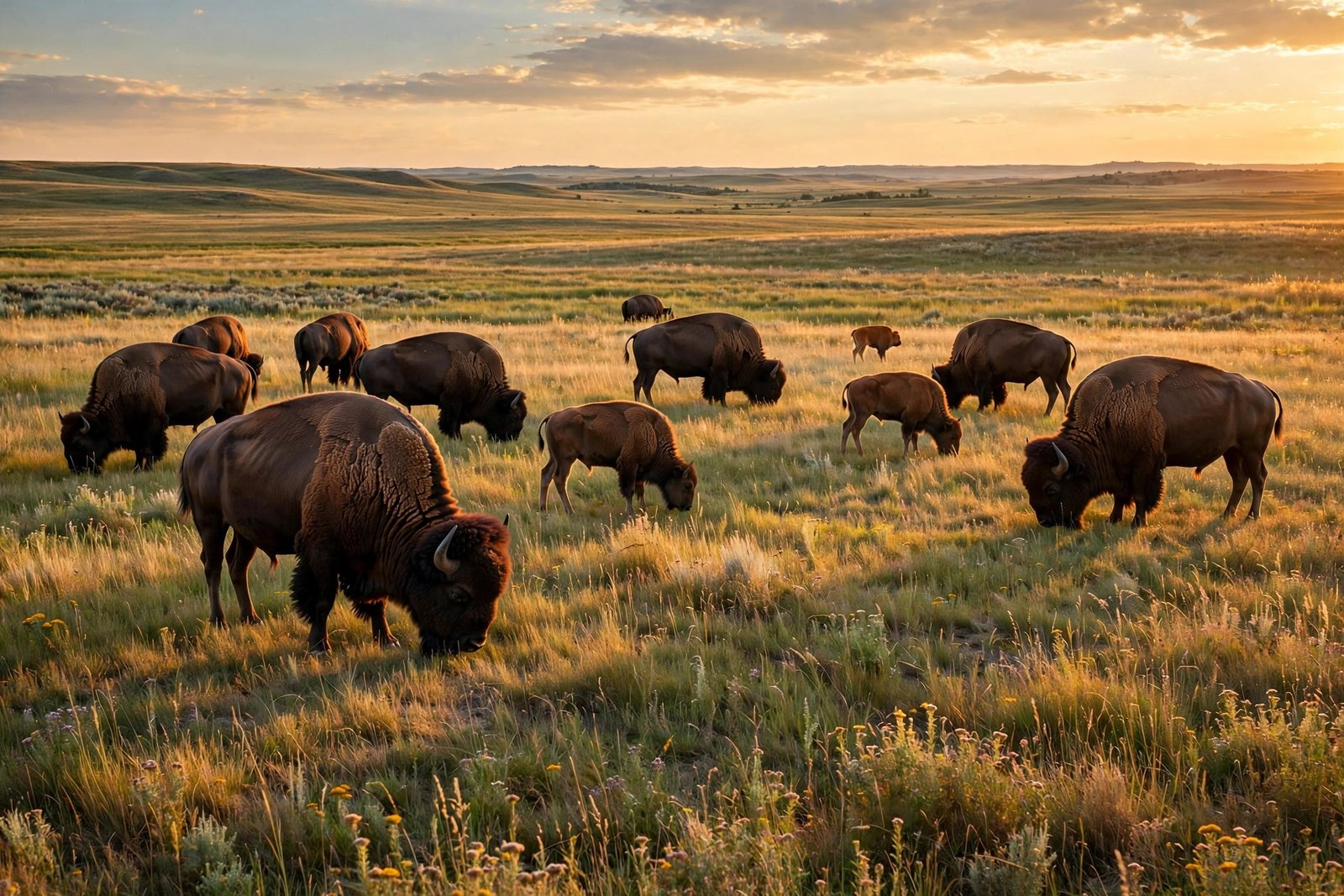
There was a time when the American bison seemed as endless as the prairie itself. Herds numbering in the tens of millions stretched across the Great Plains, and their movement shook the ground for miles. Within a single century, that abundance collapsed to the edge of extinction. Today, thanks to one of the greatest wildlife comebacks in history, bison are grazing the plains again, and their return is reshaping how Americans think about conservation.
The bison is the largest land animal in North America and the national mammal of the United States, a title it received in 2016. It is also a survivor. The story of how it came back from fewer than a thousand animals is a story of hunters turned protectors, of Native nations reclaiming a sacred relative, and of parks and ranches working toward the same goal.
The King of the Plains
An adult male bison can weigh up to two thousand pounds and stand six feet tall at the shoulder. Despite that bulk, bison can run at speeds approaching forty miles per hour and leap over fences that would stop a horse. Their massive heads and humped shoulders are built for pushing through snow to reach grass in winter, and their thick coats let them endure blizzards that kill less hardy animals.
Bison are grazers, and their grazing shapes the prairie itself. As they move, they crop grasses, spread seeds in their dung, and create wallows, shallow depressions in the soil that collect rainwater and become miniature wetlands. Prairie dogs, birds, and insects all benefit from the landscape bison create. Ecologists call bison a keystone species, meaning their presence holds an entire ecosystem together.
For Native peoples of the Plains, the bison was far more than food. It provided meat, hides for shelter and clothing, bones for tools, and sinew for thread. Bison hunts were communal events, and the animal featured in stories, ceremonies, and art. The relationship between Plains nations and the bison was one of the closest bonds between a people and an animal in North American history.
How the Herds Collapsed
The collapse of the bison was swift and deliberate. In the nineteenth century, commercial hunters killed bison by the millions for their hides and tongues, leaving the rest of the carcass to rot. Railroads made it easy to ship hides east, and the slaughter accelerated through the 1870s and 1880s.
The killing also served a darker purpose. Military and political leaders understood that destroying the bison herds would undermine the Plains nations that depended on them, forcing them onto reservations. The near-extermination of the bison was not only an ecological disaster. It was a weapon used against Native peoples, and its effects are still felt today.
By the late 1880s, the great herds were gone. Fewer than a thousand bison remained in North America, scattered in small private herds and in Yellowstone National Park, where a remnant population of wild bison survived under the protection of the U.S. Army, which then administered the park. The animal that had defined the Plains was nearly a memory.
The People Who Saved Them
The rescue began with a handful of determined people. Ranchers like Charles Goodnight in Texas and James McKay in Canada kept small herds alive on private land. In Yellowstone, park protectors guarded the last wild animals from poachers. And in 1905, conservationists including William Hornaday of the New York Zoological Society formed the American Bison Society, with President Theodore Roosevelt as its honorary president.
The Society’s plan was simple and radical: breed bison in captivity and return them to protected land. In 1913, bison raised at the Bronx Zoo were shipped by rail to the Wichita Mountains in Oklahoma, one of the first reintroductions of a large mammal in American history. Other herds followed in Montana, South Dakota, and elsewhere, and the wild population began a slow climb back.
Roosevelt’s role mattered. As a young man, he had hunted bison and watched the herds vanish, and as president he became the nation’s most famous conservationist, setting aside millions of acres of public land. The bison’s recovery became an early proof that conservation could work, and it helped build public support for the national parks and wildlife refuges that followed.
Native Nations Lead the Return
In recent decades, the most important chapter of the bison story has been written by Native nations themselves. Tribal herds have grown rapidly, and organizations like the InterTribal Buffalo Council, founded in 1992, now coordinate the return of bison to tribal lands across the country. For many tribal communities, bringing bison home is not only an ecological project. It is a cultural and spiritual restoration.
Yellowstone’s bison remain the most famous wild herd, and also the most controversial. Because some bison carry brucellosis, a disease that can affect cattle, animals that wander outside the park have long been hazed, captured, or slaughtered. In recent years, a program to transfer disease-free Yellowstone bison to tribal lands has offered a better path, sending live animals to start or grow tribal herds instead of killing them.
Commercial bison ranching has also grown, and most bison alive today live on private ranches rather than in the wild. That commercial population helped the species survive, but conservationists note that true ecological restoration means free-roaming herds on large landscapes, not only animals behind fences. The goal now is not just more bison, but bison living as wild animals again.
The Bison in American Culture
Long before it became the national mammal, the bison was already an American icon. The most famous image is the Buffalo nickel, minted from 1913 to 1938. Sculptor James Earle Fraser designed the coin with a Native American portrait on one side and a bison on the other, modeled on a bull named Black Diamond that lived at the Bronx Zoo. The coin is now a collector’s favorite, and its bison remains one of the most recognized animal images in American art.
Bison also appear on state flags, seals, and sports logos. Wyoming’s flag carries a bison, and the animal shows up in the seals of several states and in the names of countless schools, businesses, and teams, most famously the Buffalo Bills of the NFL. The bison became shorthand for the West itself: strength, endurance, and open country.
Bison meat has found its own modern audience as well. Leaner than beef and rich in protein, it is now sold in grocery stores and restaurants across the country, and demand from consumers has helped support the ranching herds that keep the species numerous. Conservationists sometimes note the irony: the animal once hunted to near extinction is now partly sustained by people who want to eat it. But as long as the herds grow and wild populations expand, most see that bargain as one worth making.
Where to See Bison Today
Visitors can see bison in many national parks and refuges. Yellowstone is the classic destination, where herds roam valleys that look much as they did two centuries ago. Badlands National Park, Theodore Roosevelt National Park, and the National Bison Range in Montana all offer reliable viewing, and many tribal lands welcome visitors to see their herds as well.
- Keep a safe distance. Bison are wild animals and can be dangerous, especially during mating season and when calves are present.
- Stay in your vehicle or at designated viewpoints when bison are near roads.
- Visit in the early morning or late evening, when herds are most active.
- Learn the history before you go. Knowing what the herds survived makes seeing them far more powerful.
The bison’s comeback is unfinished, but it is real. From fewer than a thousand animals to hundreds of thousands today, the species has traveled further back from the brink than almost any other large mammal. Its return is proof that extinction is not always the end of the story, and that when people decide to save something, even the largest animal on the continent can come home.
Frequently Asked Questions
How many bison are there today? North America’s bison population has grown from fewer than a thousand animals in the late 1880s to several hundred thousand today, most of them on private ranches, with significant wild and tribal herds as well.
Is the bison the national mammal of the United States? Yes. The American bison was designated the national mammal of the United States in 2016, joining the bald eagle as an official national symbol.
Why did bison nearly go extinct? Commercial hunting for hides in the nineteenth century wiped out the great herds, and the slaughter was encouraged by policies aimed at undermining Plains Native nations that depended on bison.
Where is the best place to see wild bison? Yellowstone National Park has the largest wild herd, and Badlands, Theodore Roosevelt National Park, and the National Bison Range in Montana are also excellent places to see free-roaming bison.
Are bison dangerous? Yes. Bison are wild animals that can run fast and charge when threatened. Visitors should keep a safe distance, stay near their vehicle when herds are close, and never approach calves.
Sources: National Park Service, Yellowstone Bison; U.S. Fish and Wildlife Service, American Bison; Smithsonian’s National Zoo, American Bison.