
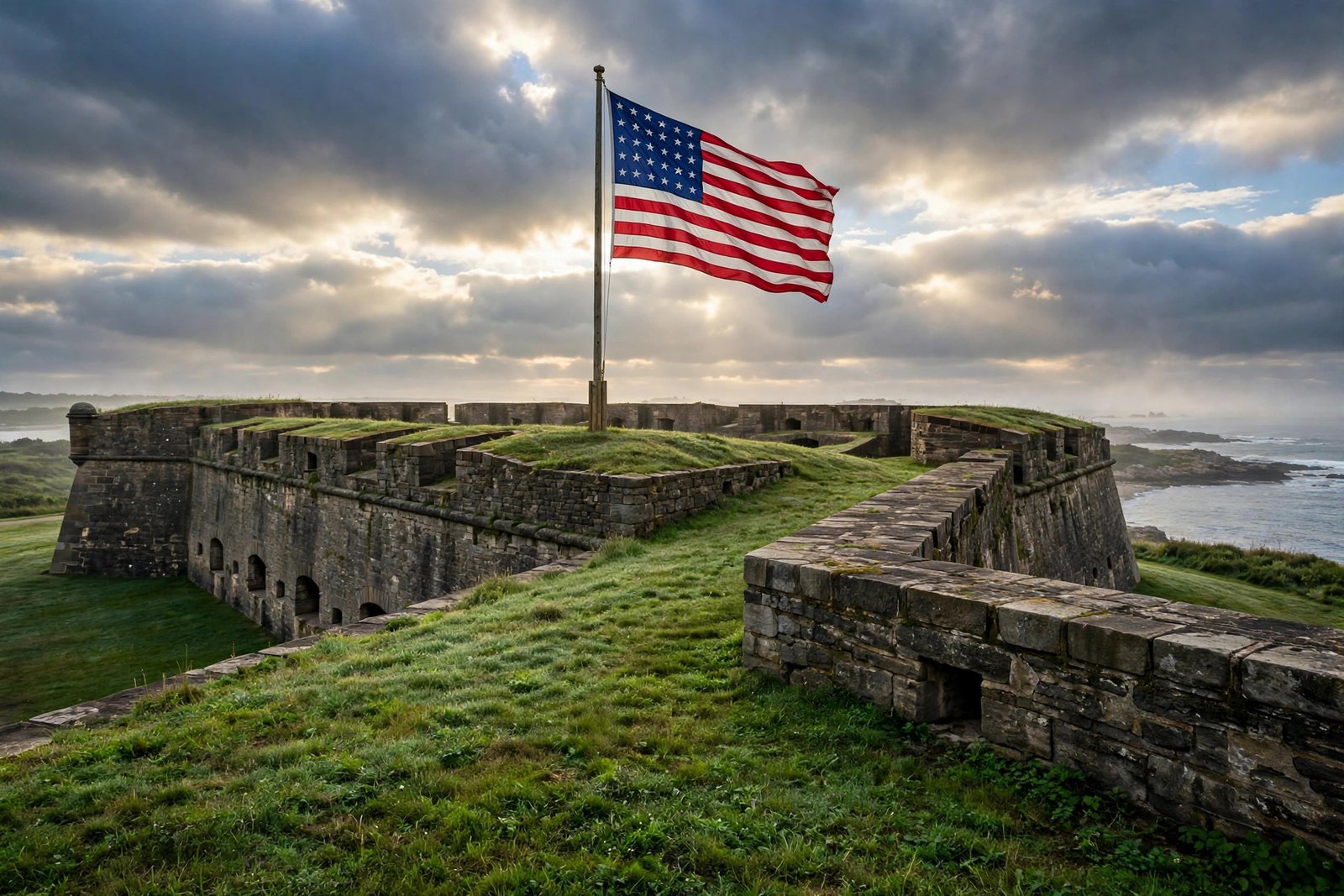
Ask most Americans to name the wars that shaped their country, and they will start with the Revolution and the Civil War. The War of 1812 rarely makes the list. Yet for two and a half years, from June 1812 to early 1815, the young United States fought the most powerful empire on earth for a second time, watched its capital city burn, and came out of the ordeal with a new sense of itself as a nation. It is often called America’s Second War of Independence, and the name fits. The war settled, once and for all, that the United States was here to stay.
The conflict is easy to forget because it ended in what looks like a draw. No territory changed hands, and the treaty that ended it did not even mention the issues that started it. But look closer, and the War of 1812 explains a surprising amount of American history: the national anthem, the rise of Andrew Jackson, the end of the Federalist Party, and the westward expansion that followed. Here is the full story, from the causes that pushed a reluctant young republic into war to the battles, the burning of Washington, the song born at Fort McHenry, and the peace that nobody quite won.
Why America Went to War: Impressment, Trade, and the Frontier
The roots of the War of 1812 lay in unfinished business from the Revolution and in a war an ocean away. Britain was locked in a long struggle against Napoleon’s France, and both sides tried to choke off each other’s trade. As a neutral nation, the United States wanted to trade with both. Britain, determined to starve France of supplies, seized American merchant ships bound for French ports and restricted American commerce. For a young country whose economy depended on seaborne trade, these restrictions were a direct blow to livelihoods along the Atlantic coast.
Worse still was impressment. The Royal Navy, desperate for sailors, stopped American ships at sea and seized men it claimed were British deserters, forcing them into service aboard British warships. Thousands of American sailors were taken this way, including many who were American citizens by birth. The practice outraged the American public, and it became the emotional heart of the case for war. The crisis came to a head in June 1807, when the British warship HMS Leopard fired on the American frigate USS Chesapeake off the coast of Virginia, killing three Americans and seizing four sailors. President Thomas Jefferson answered with the Embargo Act of 1807, which banned American trade with foreign nations, but the embargo hurt American merchants more than it hurt Britain, and it was eventually abandoned.
A third cause lay on the western frontier. As American settlers pushed into the Ohio Valley and the Great Lakes region, they met fierce resistance from Native American nations, led by the Shawnee chief Tecumseh and his brother Tenskwatawa, known as the Prophet. Tecumseh was building a confederation of tribes to resist American expansion, and American leaders believed, with good reason, that British agents in Canada were supplying and encouraging him. In November 1811, American forces under William Henry Harrison clashed with Tecumseh’s confederation at the Battle of Tippecanoe in Indiana Territory, destroying the settlement at Prophetstown. The battle deepened western anger at Britain and strengthened the hand of the “War Hawks,” the young congressmen, led by Henry Clay of Kentucky and John C. Calhoun of South Carolina, who were demanding war. When President James Madison finally asked Congress for a declaration of war, it passed by a narrow and bitterly divided vote on June 18, 1812.
A War That Started Badly: Canada, Detroit, and the Lakes
The American plan was simple: invade Canada, where British forces were thin, and force Britain to negotiate. The reality was a humiliation. In August 1812, just weeks after the declaration of war, the American garrison at Detroit surrendered to a smaller British force under General Isaac Brock and his Native allies, including Tecumseh’s warriors. It was a stunning blow. Later American invasions of Canada were repulsed again and again, and the small, inexperienced American army looked outmatched at every turn. The HISTORY overview of the War of 1812 describes a war that began with defeat after defeat on land, saved only by a string of surprising victories at sea.
Those naval victories mattered enormously for morale. The USS Constitution, a heavy frigate, defeated the British warships Guerriere and Java in single-ship duels, earning the nickname “Old Ironsides” because enemy cannonballs seemed to bounce off her thick oak hull. But the real turning point on land came on Lake Erie. On September 10, 1813, a small American squadron under Oliver Hazard Perry defeated a British fleet on the lake, giving the United States control of its waters. Perry’s famous report to Harrison read: “We have met the enemy and they are ours.” With the lake secured, Harrison pursued the retreating British into Canada and defeated them at the Battle of the Thames on October 5, 1813, where Tecumseh was killed. His death shattered the Native confederation in the Northwest and removed one of the war’s great obstacles to American expansion.
The Burning of Washington
The darkest days of the war came in the summer of 1814. With Napoleon defeated in Europe, Britain was finally free to send its battle-hardened veterans across the Atlantic. In August, some 4,500 British troops landed in Maryland and marched on the capital. At Bladensburg, on August 24, 1814, American militia broke and ran in what became known as the “Bladensburg Races.” President Madison and his cabinet fled the city, and First Lady Dolley Madison escaped the White House with what she could save, including the famous portrait of George Washington. That evening, British troops set fire to the Capitol, the White House, and other public buildings, leaving much of the young capital in ruins.
The burning of Washington was a national humiliation, and it might have broken the American will to fight. Instead, it hardened it. A violent thunderstorm swept through the city that night, dousing many of the fires and forcing the British to withdraw, and news of the attack outraged Americans who had doubted the war. The British pressed on to Baltimore, expecting another easy victory, but there the tide turned. General Robert Ross was killed by American sharpshooters as his forces advanced, and the attack stalled. The Royal Navy then turned its guns on Fort McHenry, the star-shaped fort guarding Baltimore harbor, and began a bombardment that would echo through American history.
Baltimore and the Birth of the Star-Spangled Banner
On the morning of September 13, 1814, British warships opened fire on Fort McHenry, and for twenty-five hours they poured rockets and shells into the fort. Watching from a British truce ship in the harbor was Francis Scott Key, a Maryland lawyer who had come to negotiate the release of an American prisoner, Dr. William Beanes. Because Key had learned details of the British attack plan, he and his companions were held aboard during the bombardment. Through the night, Key watched the rockets’ red glare and listened for the sound of the fort’s guns answering. If the fort fell, Baltimore would follow, and the war might be lost.
At dawn on September 14, Key looked through the smoke and saw the enormous American garrison flag, thirty feet by forty-two feet, sewn by the Baltimore flagmaker Mary Pickersgill, still flying over the fort. The sight moved him to write a poem, first titled “Defence of Fort M’Henry,” which was soon set to the tune of a popular British drinking song, “To Anacreon in Heaven.” The song spread quickly through the young republic, and in 1931, Congress adopted it as the national anthem, with President Herbert Hoover signing the measure into law. The history of Fort McHenry records how the fort’s defenders held through the bombardment, and how the flag that inspired Key became one of the most treasured objects in American history.
The same month brought another American victory in the north. On September 11, 1814, at the Battle of Plattsburgh on Lake Champlain, an American naval squadron defeated a British fleet, forcing an invading British army to retreat into Canada. Together, Plattsburgh and Baltimore proved that the United States could stand up to the full weight of the British military. By the autumn of 1814, both sides were exhausted, and both were ready to talk peace.
The Treaty of Ghent and the Battle of New Orleans
Peace talks had been going on for months in the Belgian city of Ghent, where an American delegation led by John Quincy Adams and Henry Clay met British commissioners. On December 24, 1814, the two sides signed the Treaty of Ghent. The terms were simple and, in a sense, empty: both sides agreed to return to the way things were before the war, a principle lawyers call status quo ante bellum. No territory changed hands. The treaty said nothing about impressment or trade restrictions, the issues that had started the war, because Britain had already ended those practices with the defeat of Napoleon. As the National Archives’ account of the Treaty of Ghent notes, Britain agreed to relinquish its claims to the Northwest Territory, and both countries pledged to work toward ending the slave trade. The treaty was ratified by the United States Senate in February 1815, and the war formally ended when the ratifications were exchanged.
But the war had one more battle to fight, and it became its most famous. News traveled slowly across the Atlantic in 1815, and the British forces in the Gulf of Mexico had not heard of the treaty. On January 8, 1815, a veteran British army under General Edward Pakenham attacked American positions outside New Orleans, where General Andrew Jackson had built a strong defensive line along the Rodriguez Canal. Jackson’s men waited behind earthworks as the British advanced across open ground. In about two hours of fighting, the British suffered more than 2,000 casualties, including Pakenham himself, while the Americans lost only 71 men. The HISTORY account of the Battle of New Orleans calls it the greatest American victory of the war, and it made Andrew Jackson a national hero and, eventually, a president.
The battle changed nothing in the treaty, because the treaty was already signed, but it changed everything in how Americans remembered the war. A conflict that had begun in humiliation and burned the capital ended, in the public mind, with a glorious triumph. The victory at New Orleans gave Americans a story of vindication to tell themselves, and that story shaped the politics of the next generation. Jackson rode his fame all the way to the White House, winning the presidency in 1828, and the war’s other veterans, including William Henry Harrison, later reached the presidency as well.
Why the War of 1812 Still Matters
The War of 1812 is sometimes called a forgotten war, but its consequences were anything but forgettable. First, it ended the threat to American independence for good. Britain never again challenged the sovereignty of the United States, and the two nations, after centuries of rivalry, began the long process of becoming allies. Second, it cleared the way for westward expansion. With Tecumseh dead and British support for Native resistance gone, the path was open for settlers to pour into the Old Northwest and the South, a movement that would define the next half century of American history.
Third, the war remade American politics. The Federalist Party, which had opposed the war and flirted with secession at the Hartford Convention in the winter of 1814–15, was destroyed by the timing of its protest. News of the convention arrived in Washington at almost the same moment as news of Jackson’s victory at New Orleans and the peace treaty, making the Federalists look unpatriotic just as the country was celebrating. The party never recovered, and the nation entered the so-called Era of Good Feelings, a period of one-party rule under the Democratic-Republicans. Finally, the war gave the young republic its symbols: the anthem written at Fort McHenry, the legend of Old Ironsides, and the hero of New Orleans.
The United States went to war over principles that the peace treaty never mentioned, yet by surviving a second war with the world’s greatest power, the young republic proved something no treaty could put into words: that American independence was permanent. The historian’s verdict is that neither side won, but the nation that emerged from the war was stronger, more confident, and more united than the one that had entered it. For a country that was barely thirty years old, that was victory enough.
Frequently Asked Questions
Why is the War of 1812 called the Second War of Independence?
Because the central issues were the same as in the Revolution: whether the United States was truly a sovereign nation. Britain’s seizure of American sailors through impressment, its restrictions on American trade, and its support for Native resistance on the frontier all treated the United States as if it were still a British dependency. The war settled that question for good.
Who won the War of 1812?
Neither side, in strict terms. The Treaty of Ghent, signed December 24, 1814, restored the prewar boundaries and settled none of the issues that caused the war. But the United States gained enormously in practice: its independence was secure, British support for Native resistance ended, and the victory at New Orleans gave the young nation a powerful sense of pride and unity.
How did the Star-Spangled Banner come from the War of 1812?
Francis Scott Key wrote the poem “Defence of Fort M’Henry” after watching British warships bombard Fort McHenry in Baltimore harbor on September 13–14, 1814. At dawn, he saw the huge American flag still flying over the fort, which meant it had not surrendered. The poem was set to music and became the national anthem in 1931.
Was the Battle of New Orleans fought after the war was over?
Almost, but not quite. The Treaty of Ghent was signed on December 24, 1814, two weeks before the battle on January 8, 1815. But the treaty only took effect when both countries ratified it, which did not happen until February 1815. Because news crossed the Atlantic slowly, the armies in Louisiana did not know peace had been agreed, so the battle was fought while the war was still technically in progress.