
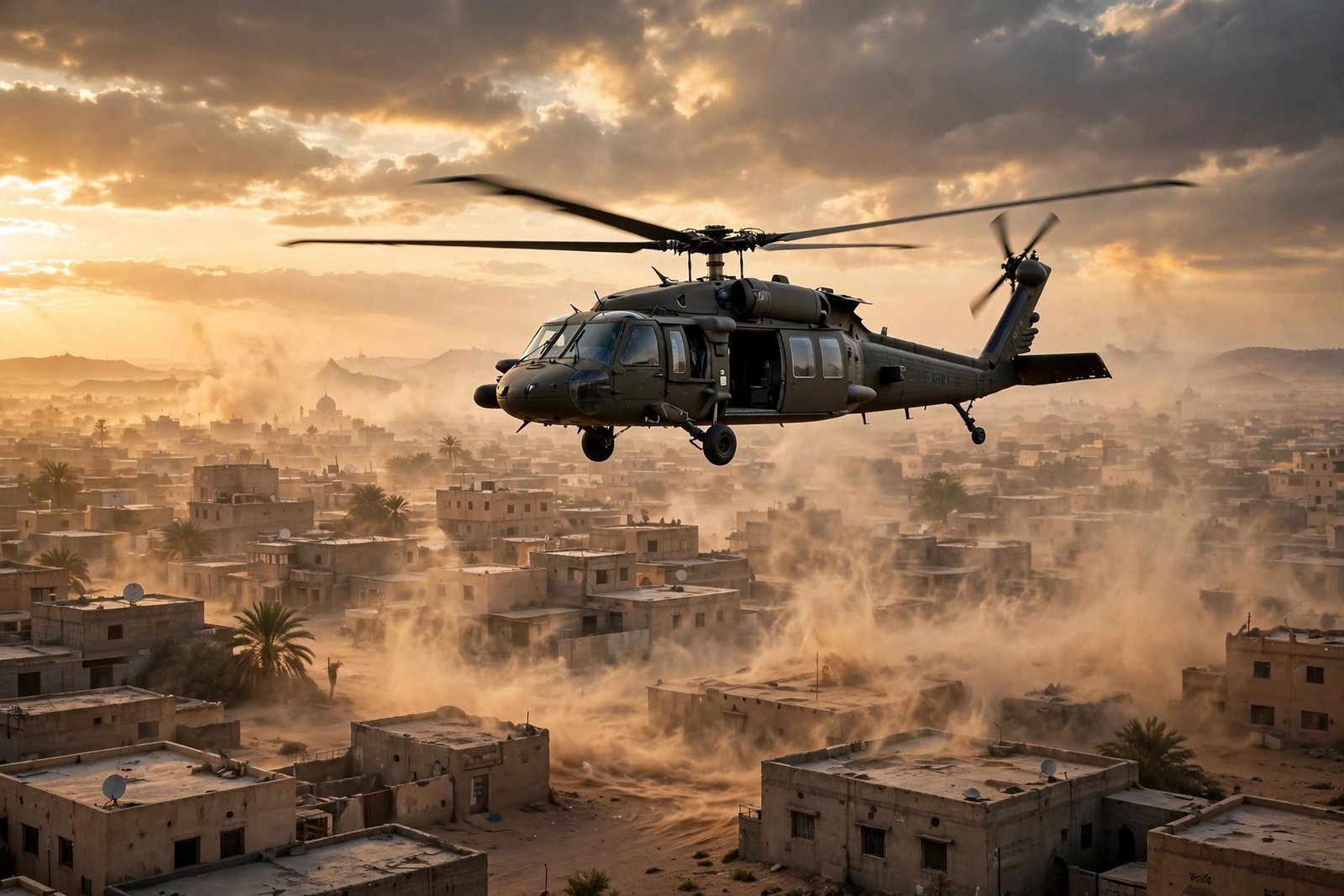
On the afternoon of October 3, 1993, American special operations soldiers lifted off from their base at Mogadishu airport expecting to be home within the hour. The mission was supposed to be a quick snatch-and-grab: fly into the Somali capital, capture two lieutenants of the warlord Mohamed Farrah Aidid, and fly out. Instead, the raid turned into the fiercest urban battle American troops had fought since the Vietnam War — a 15-hour fight through the streets of Mogadishu that left 18 American soldiers dead, 73 wounded, and a helicopter pilot in enemy hands. The world came to know it as “Black Hawk Down,” after the two U.S. Army Black Hawk helicopters shot out of the sky that day. More than three decades later, the Battle of Mogadishu remains one of the most studied engagements in modern American military history — a story of courage under fire, a rescue that almost failed, and lessons that reshaped how the United States fights in cities.
Why American Troops Were in Somalia
To understand the battle, you have to start with why American soldiers were in Somalia at all. By the early 1990s, Somalia was collapsing. The government had fallen in 1991, rival clans fought for control, and a devastating famine swept the land. In December 1992, the United States launched Operation Restore Hope, a humanitarian mission to protect food convoys and feed the starving. American troops, working under a United Nations mandate, helped stabilize the country enough for aid to flow. But the mission grew. In 1993, the United Nations force, known as UNOSOM II, moved from feeding people to disarming the militias — putting American troops on a collision course with Mohamed Farrah Aidid, the most powerful warlord in Mogadishu. Aidid’s fighters ambushed U.N. peacekeepers, killing 24 Pakistani soldiers in June 1993, and the United States answered by sending in an elite special operations unit with orders to capture Aidid and his top lieutenants. The Battle of Mogadishu grew directly out of that manhunt.
Task Force Ranger and the Plan
The force sent to catch Aidid was called Task Force Ranger, commanded by Maj. Gen. William F. Garrison. It was a hand-picked team of America’s best: operators from Delta Force, Rangers from B Company of the 3rd Battalion, 75th Ranger Regiment, Navy SEALs, Air Force special tactics airmen, and pilots of the 160th Special Operations Aviation Regiment — the Night Stalkers — flying MH-60 Black Hawks and small MH-6 and AH-6 Little Bird helicopters. The plan for October 3 was the seventh raid of its kind, and the previous six had gone smoothly. Intelligence placed two of Aidid’s lieutenants at a meeting in a building near the Olympic Hotel, in the Bakara Market district — the most dangerous neighborhood in Mogadishu. The concept was simple: Delta operators would fast-rope onto the building, Rangers would secure the streets, and the prisoners would be loaded onto a ground convoy for the trip back to the airport — about 30 minutes in all. Sixteen helicopters and around 160 American soldiers would take part. The men were so confident that many left their night-vision goggles and extra water behind.
The Raid Begins: October 3, 1993
The raid began at about 3:40 p.m. local time. The helicopters swept in low over the city, and Delta operators slid down ropes onto the target building while Rangers fanned out to block the streets. Within minutes, the assault force had its prisoners — both lieutenants were captured, along with about 20 other men. But the first sign of trouble came almost immediately. A young Ranger, Pfc. Todd Blackburn, fell from a helicopter rope while fast-roping and was badly injured on the street below. A rescue team was sent to get him, pulling men and helicopters away from the main effort. And all around the Rangers, the city was waking up. Aidid’s militia used burning tires and runners to spread the alarm, and within minutes thousands of armed Somalis were converging on the Bakara Market. The Rangers were used to missions that were over before the enemy could react. This time, the enemy reacted fast.
Super Six One Goes Down
At about 4:20 p.m., a rocket-propelled grenade — an RPG — struck one of the Black Hawks circling overhead. The helicopter, call sign Super Six One, was piloted by Chief Warrant Officer Cliff Wolcott, with Chief Warrant Officer Donovan Briley as his co-pilot. The RPG hit the tail rotor, and the helicopter spun out of control, crashing into a narrow street about 300 yards from the target building. Wolcott and Briley were killed instantly. Two crew members survived the crash but were badly hurt, and the wreckage became a magnet for Somali gunmen. A combat search-and-rescue team fought its way to the site and held a perimeter around the wreck through the evening. The crash changed everything. A raid meant to last 30 minutes had become a rescue mission, and the ground convoy carrying the prisoners was now fighting its way through ambushes toward a crash site it could not reach. The battle was no longer about the men they had captured. It was about getting their own people out alive.
Super Six Four and the Night of Fighting
While the fight raged at the first crash site, a second Black Hawk was hit. Super Six Four, piloted by Chief Warrant Officer Michael Durant, took an RPG to its tail and crashed several blocks away, in an even more hostile part of the city. Durant survived with a broken back and a broken leg, but his crew was badly wounded. As darkness fell, the battle spread. Somali fighters, armed with AK-47 rifles and RPGs, attacked from rooftops, alleyways, and windows. The Rangers and Delta operators were pinned down in small groups, fighting from behind wrecked vehicles and the walls of houses, running low on ammunition. Overhead, Little Bird gunships made strafing runs close above the rooftops. The Americans had expected a quick daylight raid. Instead, they fought a night battle in a maze of streets, cut off from help, with two crash sites to defend.
Gordon and Shughart: The Last Stand at the Second Crash Site
The most famous act of heroism of the battle took place at the second crash site. Two Delta Force snipers, Master Sergeant Gary Gordon and Sergeant First Class Randy Shughart, were circling overhead in a helicopter, watching the gunmen close in on Durant’s wreck. Twice they asked permission to be put on the ground to defend the crash site. Twice they were refused, because commanders knew the site was almost certainly a death sentence. The third time, they insisted — and permission was given. Gordon and Shughart were inserted by helicopter and fought their way to the wreck, where they found Durant alive. Armed with their rifles and sidearms, the two snipers held off wave after wave of attackers, dragging the wounded crewmen into the wreckage for cover. When their ammunition ran out, they kept fighting with the weapons of the fallen. Both men were killed at the site. Durant was the only survivor, taken prisoner by Aidid’s militia. Gordon and Shughart were posthumously awarded the Medal of Honor, the first soldiers to receive the nation’s highest award for valor since the Vietnam War. A detailed account of their actions is preserved in the Disabled American Veterans retelling of the battle, which calls the fighting the fiercest American combat since Vietnam.
The Rescue Convoy and the Long Night
By nightfall, the American force was in a desperate position. Dozens of soldiers were trapped at the two crash sites, others were pinned down around the target building, and the ground convoy that was supposed to carry everyone home was lost in the streets, taking casualties at every intersection. At the airport, a relief force was assembled — American soldiers from the 10th Mountain Division, joined by Malaysian and Pakistani armored troops under United Nations command. Armored personnel carriers were the only vehicles that could push through the streets, and the rescue convoy did not reach the first crash site until the early hours of the morning. The column that finally rolled back to the airport at dawn on October 4 carried the wounded and the dead. The Rangers who climbed aboard had been fighting for 15 hours, many out of ammunition and water. The battle was over — but the cost was only beginning to be counted.
The Cost: Casualties on Both Sides
When the fighting ended on the morning of October 4, 18 American soldiers had been killed and 73 wounded. It was the largest number of American combat deaths in a single battle since the Vietnam War. A 19th American was killed by a mortar attack on October 6. One Malaysian soldier was killed and seven wounded in the rescue convoy, and two Pakistani soldiers were wounded. Somali losses were far higher, though the exact number will never be known. Estimates vary widely, from a few hundred to more than 1,000 killed, and the dead included both militiamen and civilians caught in the crossfire. The International Committee of the Red Cross estimated that around 200 Somali civilians were killed. What is certain is that Mogadishu paid a terrible price alongside the Americans. Every American who died that day had a name, a family, and a hometown — and their names are read aloud every year at memorial ceremonies at Fort Benning, Georgia, where the fallen are honored. As the ThoughtCo history of the battle notes, the toll of 18 dead and 73 wounded made it the deadliest American engagement since Vietnam.
The Aftermath and America’s Withdrawal
The battle shocked the United States. Television images of dead American soldiers being dragged through the streets of Mogadishu horrified the public, and the political fallout was immediate. Within days, President Bill Clinton announced that American forces would leave Somalia by March 31, 1994. Michael Durant, the captured pilot, was released after 11 days in captivity. Aidid himself was never captured; he died in 1996 from wounds suffered in a clash with rival militiamen. The battle also changed American military thinking. For years afterward, U.S. commanders were reluctant to commit ground troops to cities and humanitarian missions, a caution critics later called the “Mogadishu line.” The Army studied the battle closely and drew hard lessons about armored support, communications, and the danger of underestimating an enemy fighting on its own streets. The air battle over Mogadishu is still analyzed by military aviators today, because the lessons about flying helicopters over hostile cities apply to every urban fight since.
Black Hawk Down: The Book and the Film
The battle might have faded from public memory if not for a journalist. Mark Bowden, a reporter for The Philadelphia Inquirer, spent years interviewing the soldiers who fought in Mogadishu and the families of those who died. His 1999 book, “Black Hawk Down: A Story of Modern War,” became a bestseller and brought the battle back into the national conversation. In 2001, director Ridley Scott turned the book into a film, “Black Hawk Down,” produced by Jerry Bruckheimer. The movie opened in limited release on December 28, 2001, and went into wide release on January 18, 2002. It was praised for its intense, realistic battle scenes and went on to win two Academy Awards, for film editing and sound. The film follows the raid hour by hour, from the fast-roping assault to the fall of the two helicopters and the long night at the crash sites, and it made Gordon and Shughart household names. Veterans have praised the film’s accuracy, though like any movie, it compresses events and leaves out the wider political story. For many Americans, the film remains the first and only way they have encountered the battle — which is why separating the Hollywood version from the real history still matters.
The Legacy of Mogadishu
More than 30 years after the battle, the legacy of Mogadishu is still being argued over and learned from. For the soldiers who fought there, the battle is a story of loyalty: men who refused to leave their comrades behind and fought through the night rather than abandon a crash site. For the Army, it is a case study in urban warfare, taught at staff colleges and used to train the next generation of Rangers and special operators. For the country, it is a caution about the limits of military power — a humanitarian mission that drifted into a manhunt, and a manhunt that ended in a street fight nobody had planned for. The men of Task Force Ranger did not choose the battle, but they fought it with a courage that still defines them. Every October, veterans gather to remember the 18 who did not come home. Their story, told first by Bowden and then by Ridley Scott, has become part of how America remembers the 1990s. The Veterans Breakfast Club’s account of the battle captures that spirit, describing the fight as part of a humanitarian mission that turned into the hardest day of the soldiers’ lives.
Frequently Asked Questions
How many American soldiers died in the Battle of Mogadishu?
Eighteen American soldiers were killed during the battle on October 3–4, 1993, and 73 were wounded. A 19th American was killed by a mortar attack on October 6. One Malaysian soldier was also killed and seven wounded in the rescue convoy, and two Pakistani soldiers were wounded.
Why is it called “Black Hawk Down”?
The name comes from the two U.S. Army UH-60 Black Hawk helicopters — call signs Super Six One and Super Six Four — that were shot down by rocket-propelled grenades during the battle. The phrase was the radio call used when a helicopter went down, and it became the title of Mark Bowden’s 1999 book and Ridley Scott’s 2001 film.
Who were Gary Gordon and Randy Shughart?
Master Sergeant Gary Gordon and Sergeant First Class Randy Shughart were Delta Force snipers who volunteered to be inserted on the ground to defend the second crash site, where pilot Michael Durant lay wounded. Both were killed holding off attackers, and both were posthumously awarded the Medal of Honor — the first awarded since the Vietnam War.
How long did the Battle of Mogadishu last?
The battle lasted about 15 hours, from the afternoon of October 3, 1993, until the morning of October 4, when a relief convoy of American, Malaysian, and Pakistani troops finally reached the trapped soldiers. The raid itself had been planned to last about 30 minutes.