
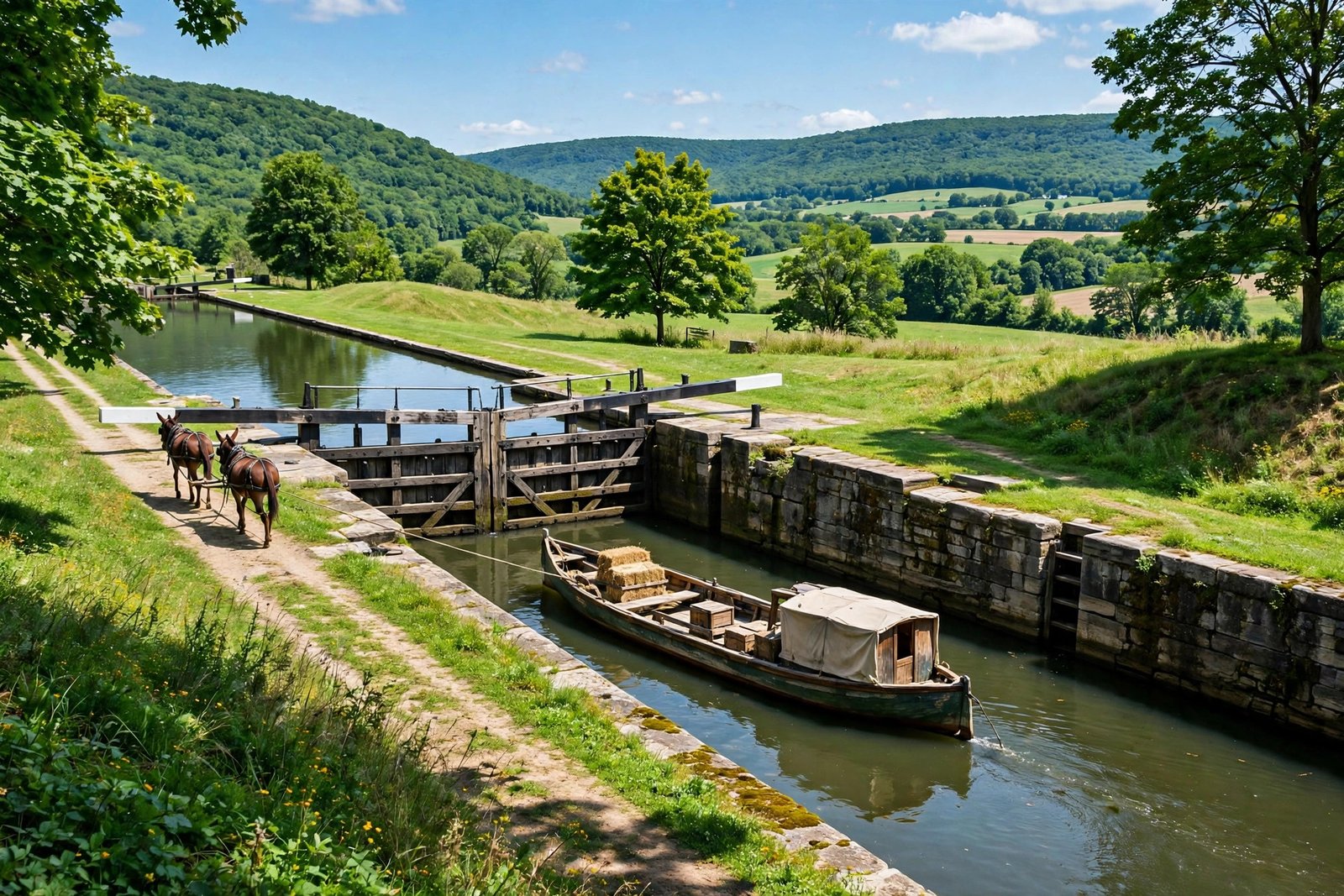
Before the Erie Canal, getting goods from the Atlantic coast to the American interior was slow, expensive, and often miserable. A farmer in Ohio could grow a fine crop of wheat and still struggle to sell it, because hauling it east over rough roads cost more than the grain was worth. Then, in 1825, a man-made waterway across New York State changed the equation entirely, and with it the future of the young United States.
The Erie Canal ran 363 miles from Albany on the Hudson River to Buffalo on Lake Erie. It was the longest artificial waterway in the Western Hemisphere at the time, and it was built almost entirely by hand. Its success turned New York City into the nation’s commercial capital, opened the Midwest to settlement, and proved that Americans could reshape their continent with ambition and shovels.
A Bold Idea That Many Called Impossible
The idea of connecting the Hudson River to the Great Lakes had been discussed for years, but most serious people considered it impractical. The route crossed hills, forests, swamps, and rivers. The elevation change between Lake Erie and the Hudson was more than 500 feet, which meant the canal would need dozens of locks to lift boats up and down. Critics joked that the project was Clinton’s Ditch, named after New York Governor DeWitt Clinton, its most passionate champion.
Clinton refused to be discouraged. He had studied earlier canals in Europe and in other American states, and he believed a canal would pay for itself many times over. In 1817, after years of lobbying, the New York legislature approved the project. The state would fund it, and the work would begin without any help from the federal government, which had declined to get involved.
What made the plan especially daring was that the United States had almost no experienced canal engineers. The chief engineers, Benjamin Wright and James Geddes, were surveyors and judges by training, not canal builders. They learned as they went, experimenting with lock designs, surveying routes through wilderness, and solving problems no American had faced before.
Digging a Canal by Hand
Construction began on July 4, 1817, in Rome, New York. The workforce was made up largely of Irish immigrants and local laborers, working with picks, shovels, wheelbarrows, and horse-drawn scrapers. There were no steam shovels and no dynamite. When workers hit solid rock, they drilled holes by hand and used black powder to break it apart.
The conditions were brutal. Laborers worked long days in mud, heat, and cold. Malaria and other fevers swept through camps in swampy stretches, and accidents were common. Yet the work pressed on, section by section, year after year. The canal was dug 40 feet wide at the surface and four feet deep, with a towpath alongside it where mules and horses pulled the boats.
One of the cleverest solutions was the development of a waterproof cement made from local limestone. American engineers discovered that a particular kind of limestone, when burned and ground, produced a hydraulic cement that hardened underwater. That discovery made the canal’s locks and aqueducts possible, and it later became a foundation of American construction.
The workforce also included many German and Welsh immigrants, and entire towns grew up around the construction camps. Taverns, stores, and boarding houses followed the diggers westward, and some of those rough settlements later became permanent communities along the canal route.
The Wedding of the Waters
The canal was completed ahead of schedule, and on October 26, 1825, Governor Clinton boarded a packet boat called the Seneca Chief in Buffalo for a celebratory journey to New York City. The trip took ten days, with cannon fire, bands, and cheering crowds greeting the boat at every town along the way.
When the Seneca Chief reached New York Harbor, Clinton performed a ceremony that became famous. He poured a keg of Lake Erie water into the Atlantic Ocean, an act newspapers called the Wedding of the Waters. It was a symbolic marriage of the Great Lakes and the sea, and it captured the public imagination across the country.
The celebration was not just theater. The canal immediately began carrying freight at a fraction of the old overland cost. A journey that had taken weeks by wagon could now be made in days by boat, and the price of moving goods collapsed. Farmers in the Midwest could finally sell their crops in eastern markets at a profit, and manufactured goods from the East flowed west in return.
How the Canal Transformed the Nation
The economic effects were enormous and fast. Tolls on the canal paid off the entire construction debt within a decade, an astonishing return on a public investment. New York City, sitting at the canal’s eastern end, pulled ahead of its rivals and became the busiest port in the country, a position it has never really surrendered.
Population followed the water. Settlers poured into western New York and then into Ohio, Michigan, Indiana, and Illinois, many of them traveling by canal boat for at least part of the journey. Towns like Rochester, Syracuse, and Buffalo grew from small settlements into major cities, and their mills, warehouses, and factories were built around canal traffic.
The canal also changed how Americans thought about their country. It was proof that a single state, acting on its own, could complete a project of continental scale. It inspired a wave of canal building across the nation, and it gave the young republic a new confidence that geography was not destiny. If a ditch could be dug across New York, what else might be possible?
Life on the canal had its own culture. Packet boats carried passengers in surprising comfort, with cabins, meals, and berths for overnight travel, while freight boats hauled grain, lumber, salt, and goods of every kind. Children led the mules along the towpath, lock tenders worked the gates at all hours, and canal towns developed a rough-and-tumble reputation that later showed up in songs and stories. The canal was not just a trade route. It was a moving community, and for thousands of ordinary Americans it was their first experience of long-distance travel.
The canal corridor also became part of a larger American story. Towns along the route, including Rochester, were centers of reform movements in the years before the Civil War, and the waterway itself was used by some freedom seekers traveling toward Canada. The canal that carried wheat and lumber also carried ideas, newspapers, and people with plans to change the country.
Not everyone benefited equally, and the canal’s story is not a simple tale of progress. The Haudenosaunee and other Native peoples had already been pushed from much of the land the canal crossed, and the boom it created accelerated settlement on territory they had long inhabited. The canal’s builders and boosters rarely reckoned with that cost, and any honest history of the waterway has to include it.
The Canal Today
The original canal was enlarged twice in the nineteenth century, and much of its route is now part of the modern New York State Canal System. Commercial traffic has long since moved to railroads and highways, but the canal corridor remains a living piece of history. Visitors can ride tour boats through old locks, walk or cycle the towpath trails, and visit canal museums in towns along the route.
The Erie Canalway National Heritage Corridor, managed in partnership with the National Park Service, preserves the canal’s story across its full length. It is a reminder that infrastructure is never just concrete and water. The choices a society makes about what to build, and for whom, shape its economy, its cities, and its people for generations.
Two centuries after the Wedding of the Waters, the Erie Canal still offers a useful lesson. Big projects succeed when they solve a real problem, when they are built to serve ordinary people like farmers and merchants, and when a leader is willing to be mocked for an idea that others call impossible. Clinton’s Ditch became America’s first great highway of water, and the nation that grew up along it was never the same.
Frequently Asked Questions
When was the Erie Canal built? Construction began on July 4, 1817, and the canal opened on October 26, 1825, when Governor DeWitt Clinton traveled from Buffalo to New York City aboard the Seneca Chief.
How long was the original Erie Canal? The original canal ran 363 miles from Albany to Buffalo. It was later enlarged, and its route is now part of the New York State Canal System.
Why was it called Clinton’s Ditch? Critics gave the project that mocking nickname because they thought Governor DeWitt Clinton’s plan to dig a canal across New York State was foolish and doomed to fail.
How did the canal change New York City? By connecting the Hudson River to the Great Lakes, the canal made New York the main gateway for trade between the Midwest and the Atlantic, helping it grow into the nation’s busiest port and largest city.
Can you still visit the Erie Canal today? Yes. Much of the route is preserved as the Erie Canalway National Heritage Corridor, with tour boats, towpath trails, museums, and historic locks open to visitors.
Sources: National Park Service, Erie Canalway National Heritage Corridor; Encyclopaedia Britannica, Erie Canal; History.com, Erie Canal history.