
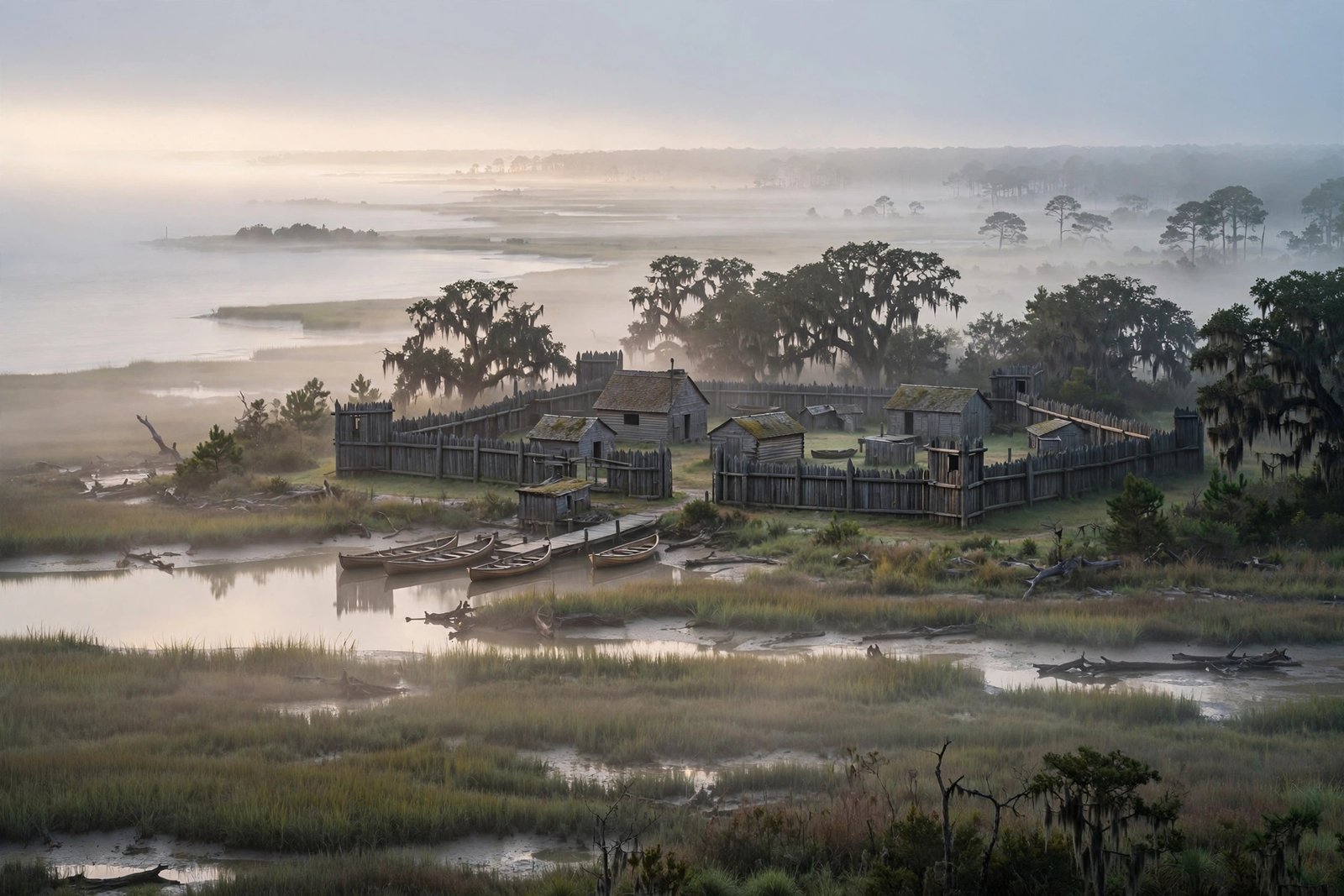
On August 18, 1590, Governor John White waded ashore on Roanoke Island, off the coast of what is now North Carolina, expecting to find his daughter, his son-in-law, his three-year-old granddaughter, and the rest of the colonists he had left there three years earlier. Instead, he found a deserted settlement, its fort dismantled, its houses gone, and a single word carved into a wooden post: CROATOAN. The more than 100 English men, women, and children who had lived there had vanished, and no one has ever found them.
The Lost Colony of Roanoke is America’s oldest mystery. It has inspired plays, novels, television shows, and four centuries of argument, and it remains unsolved in the strictest sense. But the latest research has narrowed the possibilities considerably, and the most likely answer is more interesting than any ghost story: the colonists probably did not die. They probably walked away, on purpose, and joined the people who already lived on that coast.
Here is what we know, what we used to believe, and what the newest evidence suggests really happened to the Lost Colony.
England’s First Attempt at America
The Roanoke venture was part of Sir Walter Raleigh’s effort to plant an English presence in North America and challenge Spanish dominance in the New World. The first colony was established at Roanoke Island in 1585 as a military outpost under Governor Ralph Lane. Poor relations with some local Native American tribes and a lack of supplies troubled Lane’s colony, and when a resupply mission was delayed, Lane abandoned the settlement and returned to England with Sir Francis Drake in 1586.
The second attempt was meant to be different. Instead of soldiers, it would be families, a permanent settlement rather than an outpost. A group of settlers under John White, an artist who had traveled to the region before, arrived on Roanoke Island in July 1587. Raleigh had intended them to establish a settlement called the “Cittie of Raleigh” on the Chesapeake Bay, but during a stop to check on the men left behind by the earlier expedition, the ship’s pilot, Simon Fernandes, forced White and his colonists to remain on Roanoke.
The colonists made the best of it. They repaired the abandoned fort and set about building a town. On August 13, 1587, Manteo, a friendly Croatoan man, was baptized and made Lord of Roanoke by order of Raleigh. On August 18, Eleanor Dare, White’s daughter, gave birth to a daughter she named Virginia, the first English child born in the Americas. Days later, John White sailed back to England to fetch supplies and reinforcements. It was the last time he would ever see his family.
Three Years of Silence
White’s return voyage was delayed far longer than anyone expected. England was at war with Spain, and the Spanish Armada of 1588 consumed every available ship and sailor. It was not until 1590, three years after he left, that White finally made it back to Roanoke Island.
What he found has haunted the American imagination ever since. The settlement was fortified but abandoned. The houses had been taken down, not burned or broken, as if the colonists had dismantled them deliberately. There were no mass graves, no signs of battle, and no bodies. The only clues were the word “CROATOAN” carved into a palisade post and the letters “CRO” carved into a nearby tree.
Crucially, neither carving was accompanied by a distress cross. Before leaving, White had agreed with the colonists that if they moved, they would carve their destination, and if they were in danger, they would add a cross. The absence of the cross mattered. White interpreted the carving to mean that the colonists had relocated to Croatoan Island, home of the friendly Croatoan people, in what is now Hatteras Island. Before he could follow that lead, rough seas and a lost anchor forced the mission to return to England. He never found them.
The Theories, Old and New
For centuries, the leading explanations for the colony’s disappearance were grim. The colonists, many assumed, had been massacred by hostile tribes or had starved on the island. Others suggested they had tried to sail back to England and been lost at sea. Still others wove the story into legends of ghosts, curses, and supernatural disappearances.
The evidence, however, has never supported the grim versions. No mass graves, signs of battle, or skeletal remains have ever been found on Roanoke Island itself. The orderly dismantling of the houses and the carved messages point to a planned relocation, not panic or violence. And there is no evidence of boats left behind or shipwreck debris to support the idea of a doomed voyage home.
The theory that has gained the most support in recent years is that the colonists split into groups and assimilated with neighboring Algonquian peoples, primarily the Croatoan on Hatteras Island and other groups further inland. This was not a wild guess. It was exactly what the carved message suggested, and it fits what we know about how English settlers and Native peoples interacted in the early colonial period, when survival often depended on local alliances.
What the Digging Has Found
Archaeology has added weight to the assimilation theory. Since 2015, researchers have found European artifacts at sites inland from Roanoke Island, in Bertie County, North Carolina, including pottery of a type made on the Surrey-Hampshire border in England. Such pottery, found at sites known as Site X and Site Y, is the kind of everyday object colonists would have carried with them, and its presence inland suggests that at least some of the colonists moved west and lived among Native communities there.
More recently, iron-working hammer scale announced on Hatteras Island in 2025 points to English metalworking activity in the very place the carved message indicated. Taken together, the finds suggest the colonists did not stay together as one group. They appear to have split, with some heading to Hatteras Island and others moving inland, exactly the kind of dispersal that would happen if a struggling settlement broke apart and its people sought shelter with different Native hosts.
There is also a human thread that supports the theory. Later English settlers in the region reported encounters with Native people who had European features, spoke some English words, and practiced customs that seemed to mix English and Native traditions. Those reports, recorded in the early 1600s, are not proof on their own, but they fit a story in which the Roanoke colonists lived, married, and raised families among their hosts, and their descendants were still there when the next English ships arrived.
Why the Mystery Endures
If the assimilation theory is right, why do we still call it a mystery? Partly because the evidence, while suggestive, is not conclusive. No document has ever surfaced in which a colonist explains what happened. No grave has been identified as belonging to a specific Roanoke settler. The colonists, as individuals, remain lost to history even if their general fate is increasingly clear.
There is also the matter of what was lost. The colony included Virginia Dare, the first English child born in the Americas, and her parents, Eleanor and Ananias Dare. John White never saw his daughter or granddaughter again, and his watercolor portraits of the region’s Native peoples remain among the most important visual records of early America. The personal tragedy at the heart of the story keeps it alive in a way that a solved puzzle would not.
And then there is the play. Since 1937, the outdoor drama “The Lost Colony” has been performed at Fort Raleigh National Historic Site on Roanoke Island, telling the story to generations of visitors. The mystery is part of the region’s identity now, and the Outer Banks would hardly be the same without it. A good mystery, it turns out, can be a kind of heritage all its own.
Visiting Roanoke Today
Modern visitors can walk the ground where the colony stood. Fort Raleigh National Historic Site preserves the location, and the island’s quiet, wooded landscape makes it easy to imagine the settlement as it was. The nearby town of Manteo, named for the Croatoan man who befriended the English, is a pleasant base for exploring the Outer Banks, and Hatteras Island, where the carved message pointed, is a short drive away.
For travelers interested in the mystery, a few stops are worth the trip:
- Fort Raleigh National Historic Site, where the colony’s fort once stood and where the outdoor drama is performed in summer.
- The Elizabethan Gardens, a beautiful memorial garden on Roanoke Island created as a tribute to the first colonists.
- Hatteras Island, the likely destination named by the CROATOAN carving, and home to the Cape Hatteras Lighthouse.
- The North Carolina History Center and local museums, which display artifacts from the ongoing archaeological work.
Standing on Roanoke Island at dusk, it is easy to understand why the story has lasted. The place is beautiful and a little lonely, and the questions it raises, about survival, about belonging, about what happens when two peoples meet on a new shore, are as alive now as they were in 1587.
Frequently Asked Questions
How many colonists disappeared at Roanoke? Estimates range from about 112 to 121 people, including men, women, and children. Sources differ because the exact roster of the 1587 expedition is not fully preserved.
What does CROATOAN mean? It was the name of the Native people and the island, now Hatteras Island, where the friendly Croatoan lived. Governor John White interpreted the carving as a message that the colonists had moved there.
Was Virginia Dare really the first English child born in America? Yes. Virginia Dare was born on Roanoke Island on August 18, 1587, to Eleanor and Ananias Dare, and she is recognized as the first child born to English parents in the Americas. Her fate, like that of every other colonist, has never been confirmed.
Did the colonists starve or get massacred? The evidence argues against both. No mass graves or signs of battle have been found on Roanoke Island, and the orderly dismantling of the settlement suggests a planned departure rather than a disaster.
What is the leading theory today? The best-supported theory is that the colonists split into groups and assimilated with neighboring Algonquian peoples, mainly the Croatoan on Hatteras Island and groups further inland, a conclusion supported by recent archaeological finds at inland sites and on Hatteras Island.
Sources: NCpedia: Lost Colony and Britannica: The Lost Colony of Roanoke.