
On a quiet Sunday morning in Hawaii, just before 8 a.m., the sky over Oahu filled with planes that did not belong there. Within less than two hours, the United States Pacific Fleet at Pearl Harbor was burning, more than 2,400 Americans were dead, and a country that had tried to stay out of the world’s war was suddenly, irreversibly, in it. The attack on Pearl Harbor on December 7, 1941, remains one of the most studied and most remembered days in American history — not only because of the destruction it caused, but because of what it set in motion. The next day, President Franklin D. Roosevelt stood before Congress and called December 7 “a date which will live in infamy,” and within days the United States was at war with Japan, Germany, and Italy. The road to that morning, the attack itself, and the long aftermath shaped the rest of the 20th century.
To understand Pearl Harbor, it helps to start with where it was and why it mattered. Pearl Harbor, on the island of Oahu in Hawaii, was the home of the U.S. Pacific Fleet, the naval force meant to deter aggression in the Pacific. Hawaii was then a U.S. territory, not yet a state, and Oahu was heavily fortified, with army bases, airfields, and gun emplacements ringing the island. The naval station at Pearl Harbor, established in the years after the United States annexed Hawaii in 1898, had grown into one of the most important American military installations in the Pacific. Its sheltered harbor, with a narrow entrance and deep anchorages, could hold dozens of warships, and its position in the central Pacific made it a natural hub for American power in the region.
By late 1941, relations between the United States and Japan had deteriorated badly. Japan, seeking resources and territory in Asia, had invaded China in 1937 and moved into French Indochina in 1940 and 1941. The United States responded with economic pressure, including an oil embargo, and with diplomatic demands that Japan withdraw from occupied territory. Negotiations continued through the fall of 1941, but neither side would accept the other’s terms. Japanese military leaders, convinced that war with the United States was coming, decided to strike first — not to conquer Hawaii, but to cripple the Pacific Fleet long enough for Japan to seize territory across Southeast Asia and the western Pacific without American naval interference. The plan was conceived by Admiral Isoroku Yamamoto, commander-in-chief of Japan’s Combined Fleet, and planned in detail by Captain Minoru Genda.
The Japanese Strike Force
The operation centered on the Kido Butai, Japan’s carrier striking force, commanded by Vice Admiral Chuichi Nagumo. On November 26, 1941, the force departed northern Japan under strict radio silence, sailing across the northern Pacific toward Hawaii. It consisted of six aircraft carriers — Akagi, Kaga, Soryu, Hiryu, Shokaku, and Zuikaku — escorted by battleships, cruisers, destroyers, and submarines. The force carried 353 aircraft for the attack, including torpedo planes, level bombers, dive-bombers, and fighters. The plan called for two waves of aircraft to hit Pearl Harbor’s battleships and airfields in quick succession, destroying American ships at anchor and American planes on the ground before they could mount a counterattack.
The Attack Begins
Just before 8 a.m. local time on Sunday, December 7, 1941, the first wave of Japanese aircraft struck. The first wave hit at approximately 7:55 a.m., with torpedo planes skimming low over the harbor to attack the battleships moored along Battleship Row, while bombers and fighters hit airfields across Oahu. A second wave followed beginning around 8:45 a.m. The entire attack lasted roughly an hour and fifteen minutes, according to the National WWII Museum’s fact sheet, though some accounts describe it as lasting under 90 minutes from first bomb to last. In that short span, the damage was staggering: 19 U.S. Navy ships were destroyed or damaged, including eight battleships, and 188 American aircraft were destroyed, with many more damaged.
The human cost was worse. The attack killed 2,403 Americans, according to the National WWII Museum, including 68 civilians, and wounded 1,178 more. The National Park Service, which preserves the Pearl Harbor National Memorial, puts the total death toll at 2,390, a slightly different figure that reflects ongoing research into the casualty records. The difference of a handful of names is a reminder that even the most documented events in history are still being refined by historians. What no account disputes is the scale of the loss, and that nearly half of those killed died aboard a single ship: the USS Arizona.
The USS Arizona and Battleship Row
The USS Arizona, a Pennsylvania-class battleship commissioned in 1916, was moored along Battleship Row on the morning of the attack. In the early minutes of the assault, the Arizona was struck multiple times. A bomb penetrated her armored deck and ignited the ammunition magazines in the forward section of the ship. The resulting explosion was catastrophic, and the ship sank within minutes, taking 1,177 sailors and Marines with her. The National Park Service notes that more than 900 of the Arizona’s crew remain entombed in the sunken battleship, which still rests on the harbor floor. The ship was never salvaged, and today it serves as both a war grave and a memorial.
Other ships along Battleship Row suffered terribly as well. The USS Oklahoma capsized after being struck by torpedoes, trapping hundreds of men inside; some were rescued in the hours after the attack when rescuers cut through the hull, but 429 crew members died. The USS West Virginia sank at her moorings and was later raised and repaired, returning to service in 1944. The USS California sank in the harbor and was also raised and rebuilt. The USS Nevada, moored just behind the Arizona, became the only battleship to get underway during the attack, making a run for the harbor entrance before being beached to avoid blocking the channel. The USS Utah, a former battleship then serving as a target ship, capsized at her berth. Each of these ships has its own story, and the National Park Service’s Battleship Row pages preserve them in detail for visitors and researchers.
Heroes of December 7
Amid the chaos, individual acts of courage became legend. Doris “Dorie” Miller, a mess attendant aboard the USS West Virginia, had no combat training, yet during the attack he carried wounded sailors to safety and then manned an anti-aircraft machine gun, firing at Japanese planes until ordered to abandon ship. He was later awarded the Navy Cross, the first ever given to a Black sailor, and his story became a symbol of courage under fire. On the USS Nevada, officers and crew got the ship moving under heavy fire, a feat of seamanship that earned lasting admiration. At the airfields, pilots who managed to get their planes airborne, including George Welch and Kenneth Taylor at Haleiwa Field, shot down several Japanese aircraft in the midst of the assault.
“A Date Which Will Live in Infamy”
The day after the attack, President Roosevelt addressed a joint session of Congress. His speech, one of the most famous in American history, opened with the words: “Yesterday, December 7, 1941 — a date which will live in infamy — the United States of America was suddenly and deliberately attacked by naval and air forces of the Empire of Japan.” He described the damage, noted that the attack had come while Japanese diplomats were still negotiating with Washington, and asked Congress to declare that a state of war had existed since the attack. Congress approved the declaration of war against Japan on December 8, 1941, with only one dissenting vote in the House. On December 11, Germany and Italy declared war on the United States, and the United States responded with declarations of war against both countries. America was now fully in World War II.
The attack transformed American public opinion overnight. Before December 7, a large share of Americans had opposed entering the war, and the country was deeply divided over how far to go in supporting Britain and other allies. After Pearl Harbor, that debate ended. Enlistment offices were flooded with volunteers, factories converted to wartime production, and the entire economy shifted to a war footing. The attack also had a darker domestic consequence: in February 1942, Roosevelt signed Executive Order 9066, which led to the forced removal and incarceration of more than 120,000 Japanese Americans, most of them U.S. citizens, in internment camps for the duration of the war. That policy, now widely regarded as a grave injustice, remains an essential part of the Pearl Harbor story and a cautionary chapter in American history.
The Road to Victory — and to Peace
Militarily, the attack did not achieve Japan’s strategic goal. Instead of crippling American power for years, it united the country and accelerated the buildup of American naval and industrial might. Just six months after Pearl Harbor, in June 1942, the U.S. Navy won a decisive victory at the Battle of Midway, sinking four Japanese aircraft carriers and turning the tide of the Pacific war. Over the next three years, American forces advanced island by island across the Pacific, in campaigns marked by extraordinary sacrifice on both sides. The war in the Pacific ended in September 1945, when Japan formally surrendered aboard the battleship USS Missouri in Tokyo Bay — a ship that today is moored at Pearl Harbor, just a short distance from the Arizona Memorial, in a deliberate pairing of the beginning and the end of the war for America.
Remembering Pearl Harbor Today
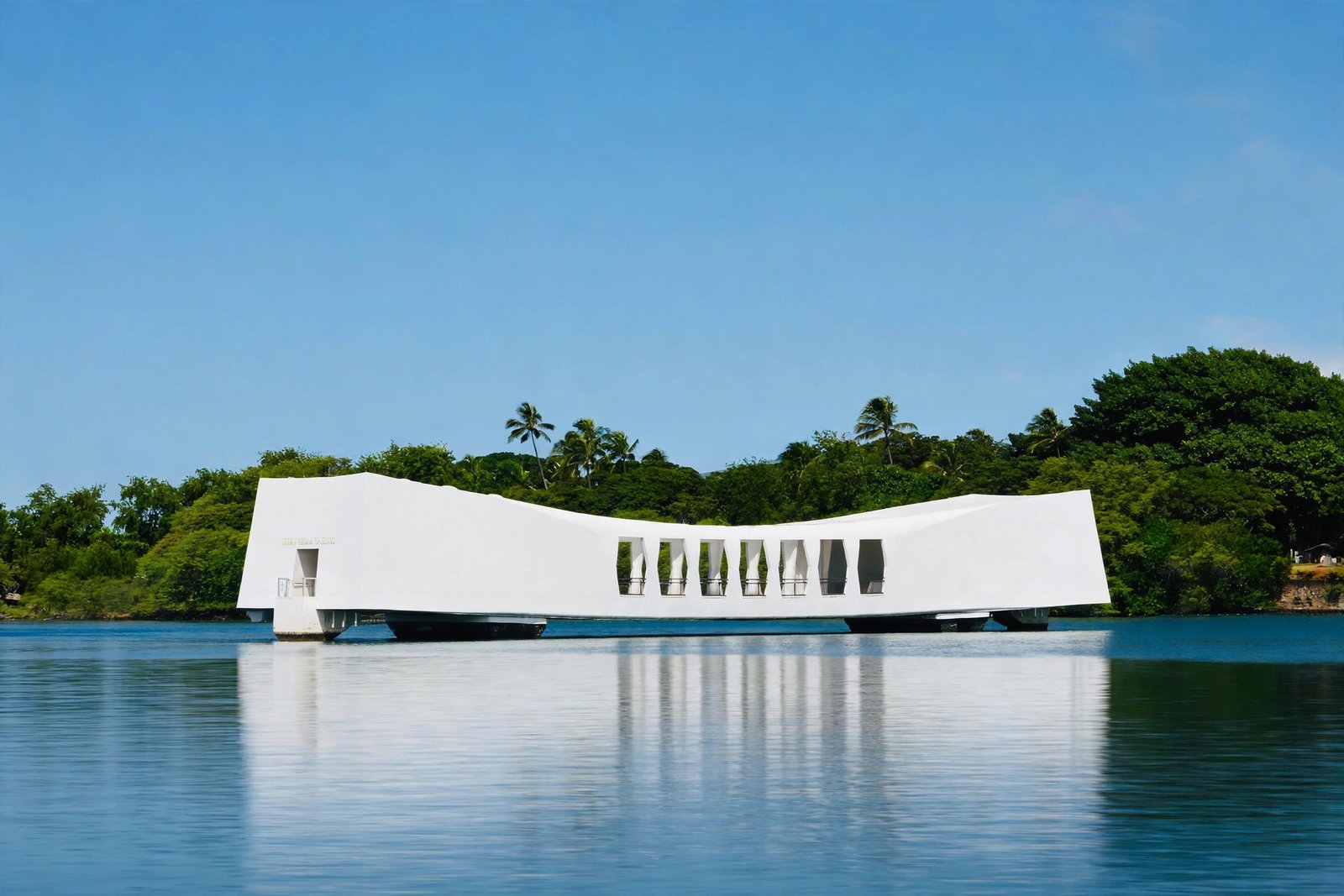
Today, Pearl Harbor is both an active military base and a place of remembrance. The Pearl Harbor National Memorial, administered by the National Park Service, includes the USS Arizona Memorial, the USS Utah Memorial, and the USS Oklahoma Memorial, along with a visitor center at Halawa Landing. The Arizona Memorial, a white structure spanning 184 feet across the sunken battleship, was authorized by President Dwight D. Eisenhower in 1958, completed in 1961, and dedicated in 1962. Its design, by architect Alfred Preis, includes an entry room, an assembly room for ceremonies and observation, and a shrine room where the names of the 1,177 Arizona dead are engraved on a marble wall. More than 1.8 million people visit the memorial each year, making it one of the most visited sites in Hawaii.
Each December 7, the nation marks National Pearl Harbor Remembrance Day, and ceremonies at Pearl Harbor draw survivors’ families, veterans, and visitors from around the world. The annual ceremony traditionally begins with a moment of silence at 7:55 a.m. Hawaii time, the moment the attack began. As the years pass, the number of living survivors dwindles — the youngest sailors of 1941 are now well over 100 years old — and the task of remembrance increasingly falls to museums, memorials, and the families who keep the stories alive. The National WWII Museum in New Orleans, designated by Congress as America’s National WWII Museum, maintains extensive Pearl Harbor collections, including articles, oral histories, and artifacts that trace the attack, the war that followed, and the long road to reconciliation with Japan.
Frequently Asked Questions
When did the attack on Pearl Harbor happen?
The surprise Japanese attack on Pearl Harbor took place on the morning of Sunday, December 7, 1941, beginning at approximately 7:55 a.m. local time in Hawaii. The attack lasted roughly 75 to 90 minutes and involved two waves of aircraft launched from six Japanese aircraft carriers.
How many Americans were killed at Pearl Harbor?
The attack killed 2,403 Americans, including 68 civilians, according to the National WWII Museum, and wounded 1,178 more. The National Park Service cites a total of 2,390 deaths. Nearly half of those killed — 1,177 sailors and Marines — died aboard the battleship USS Arizona.
What happened the day after Pearl Harbor?
On December 8, 1941, President Franklin D. Roosevelt addressed Congress, calling December 7 “a date which will live in infamy,” and Congress declared war on Japan. On December 11, Germany and Italy declared war on the United States, bringing America fully into World War II.
Can you visit Pearl Harbor today?
Yes. The Pearl Harbor National Memorial on Oahu, Hawaii, is open to visitors and includes the USS Arizona Memorial, the USS Utah Memorial, and the USS Oklahoma Memorial. The Arizona Memorial, dedicated in 1962, spans the sunken battleship, where more than 900 crew members remain entombed. The battleship USS Missouri, where Japan formally surrendered in 1945, is also moored nearby.
Learn more from the National WWII Museum’s overview of the Pearl Harbor attack, the Museum’s Pearl Harbor fact sheet, the National Park Service history of the USS Arizona, the Park Service guide to Battleship Row, and the Park Service account of the people of Pearl Harbor.