
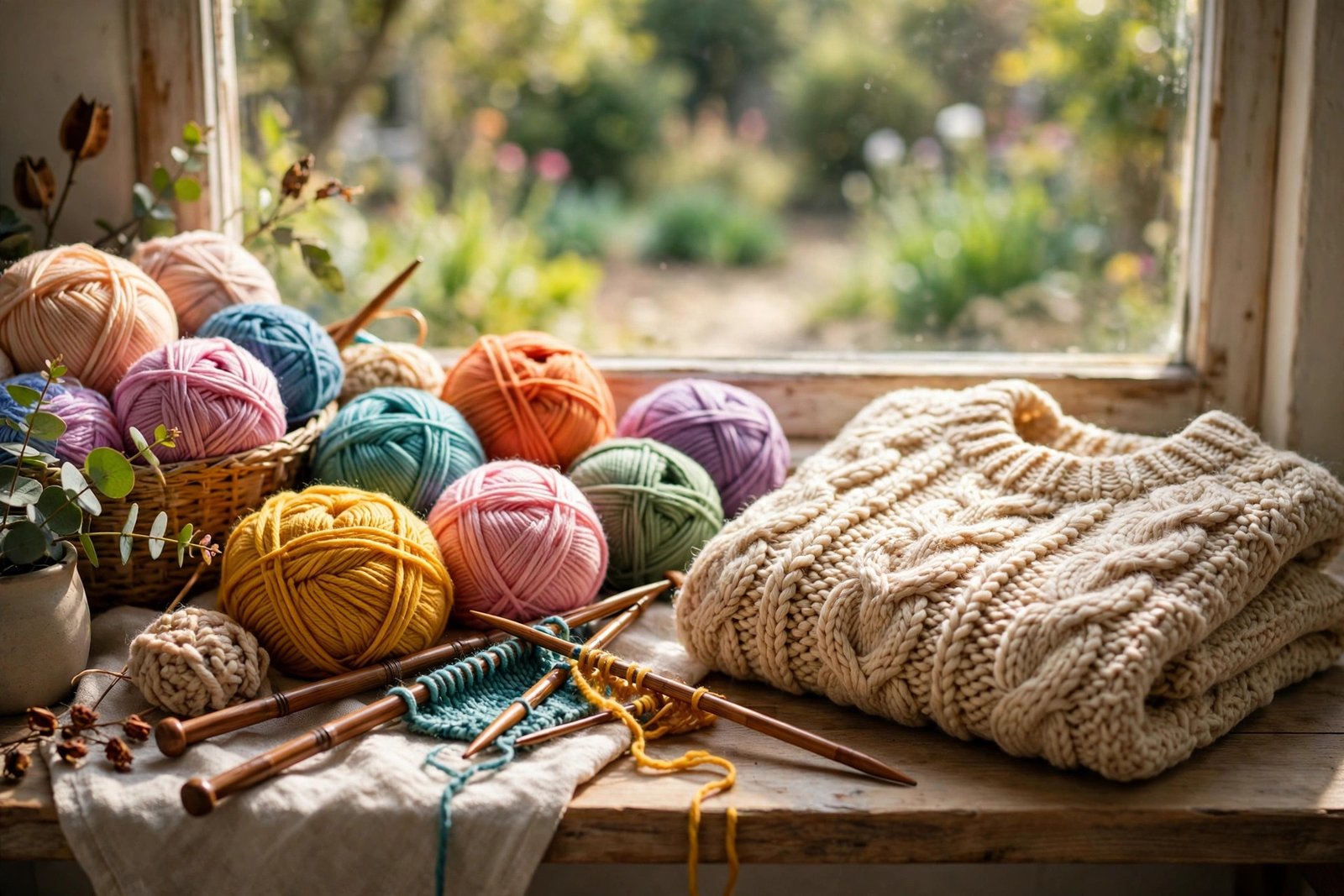
Picture a Friday night in America in 2026. A group of twenty-somethings gathers at a coffee shop, orders lattes, puts their phones face-down on the table, and pulls out yarn. Someone is halfway through a crocheted cardigan. Someone else is knitting a scarf that will not be finished until winter. Nobody is in a hurry. Nobody is filming it for content, or at least, nobody is filming it yet.
This scene has a name now: the grandma hobby boom. Knitting, crochet, embroidery, sewing, pottery, and sourdough baking, the hands-on pastimes once associated with grandmothers and their rocking chairs, have become some of the most popular social activities among Gen Z and younger millennials. It is one of the most unexpected cultural reversals of the decade, and it is happening in coffee shops, craft stores, and living rooms across the country.
What Counts as a Grandma Hobby
The label covers a loose family of slow, tactile crafts. Knitting and crochet lead the pack, followed closely by embroidery and cross-stitch. Sewing and mending have their own devoted crowd, as does pottery, where beginners shape lopsided mugs in studio classes and proudly drink from them anyway. Sourdough baking, which exploded during the pandemic and never quite went away, belongs in the same conversation, as do candle-making, quilting, and pressed-flower art.
What these hobbies share is not a technique but a tempo. They are slow. You cannot rush knitting. You cannot glaze pottery while answering emails. A sourdough starter does not care about your schedule. In a culture built on speed, that slowness is the feature, not the bug.
They also share a history. For generations, these were not hobbies at all. They were essential domestic skills. Women sewed clothes for their families, knitted sweaters to keep warm, and baked bread to put food on the table. The grandma hobby boom reframes those skills as something people choose for pleasure, not necessity, which changes how they feel entirely.
Why Young Americans Are Picking Up Yarn
The most common explanation is also the simplest: screen fatigue. Gen Z lives inside an endless loop of notifications, reels, messages, and algorithmic noise. Work, friendships, entertainment, and even dating happen online. When every minute of the day is mediated through a screen, the body starts craving something physical. Clay under your nails. Thread between your fingers. Batter in a bowl.
Crafts force a kind of presence that digital life rarely demands. A dropped stitch punishes distraction immediately. A pottery wheel wobbles if your hands wander. That demand for attention is, paradoxically, relaxing. People describe craft nights the way others describe meditation: the mind quiets because the hands are busy.
There is also a social story. Crafting has become a group activity again, and the group part matters as much as the craft. Close-knit clubs meet weekly at coffee shops, where everyone brings a current project and knits while they socialize. Workshops and social clubs are popping up in cities across the country, giving younger people a way to make friends that does not involve a bar or an app. The project gives the gathering a purpose, which makes it easier to show up, and easier to stay.
The Numbers Behind the Boom
This is not just a vibe. The market data tells the same story from several angles. Coverage of the Michaels Creativity Trend Report has noted that online searches for embroidery, knitting, and crochet jumped sharply over a six-month period, while yarn sales climbed alongside them. Youth research firm YPulse has reported that a large majority of crocheters are now between 18 and 34, a statistic that surprises people who still picture crochet as a retirement hobby.
Other surveys point the same way. A Mintel report on arts and crafts found that most American consumers now describe themselves as crafters. The Wall Street Journal has reported that the overwhelming majority of Gen Z identifies as crafters, discovering knitting and crochet through TikTok and Instagram. Three different datasets, three different angles, one conclusion: the youngest customers in the craft aisle are also the newest.
The retail landscape reflects it too. Major craft chains have struggled in recent years, but independent studios, thrift stores, and online marketplaces have picked up the slack. Young crafters are famously resourceful about supplies, unraveling old sweaters for yarn, cutting up thrifted quilts for fabric, and swapping materials at craft nights. That scrappiness is part of the culture, not a workaround for it.
How Gen Z Makes Old Hobbies Their Own
This is not a nostalgia trip, and the new generation of crafters is not trying to recreate their grandmothers’ living rooms. They are remixing the hobbies. Gen Z crocheters make plush toys, trendy bags, and oversized cardigans, and some turn their crafts into small businesses and side hustles on marketplaces like Etsy. Custom tools and bright, unconventional color palettes have replaced the beige-and-brown stereotype.
The social format has changed too. Traditional knitting circles were quiet, regular, and often private. The new version is louder and more public: granny-core meetups where friends combine several retro pastimes in one evening, mahjong alongside knitting, sourdough starters traded like baseball cards. Some young people throw crafting parties with DJs and food, where the craft is the excuse and the community is the point.
Even the learning path is different. Previous generations learned from a relative at the kitchen table or from a book. Today’s beginners learn from short-form video, stitch-along livestreams, and online pattern libraries. A teenager can watch a dozen creators demonstrate the same stitch, pick the explanation that clicks, and be crocheting within an hour. The gatekeepers are gone, and the hobby is more accessible than it has ever been.
Mahjong, Board Games, and the Wider Retro Wave
Knitting is the headline, but it is part of a wider retro wave. Mahjong, the tile-based game with roots going back about two centuries, is having a major moment, with interest in mahjong clubs surging and young people driving much of the growth. Board games of all kinds are seeing a resurgence as the video game monoculture breaks apart. Video games are still huge, but many young people find they prefer playing games in real life with friends.
The pattern is consistent. Activities that demand presence, patience, and other people are winning back time from activities that demand only a screen. It is not a rejection of technology. Most of these hobbyists found their hobbies through technology. It is a rebalancing, a decision that some of life should happen at human speed.
How to Start Your First Grandma Hobby
If the boom has you curious, the barrier to entry is wonderfully low. Here is a practical way in.
- Pick one craft, not five. Crochet is the most beginner-friendly entry point, because mistakes are easy to undo and supplies cost very little.
- Buy a beginner kit or a single skein of yarn and one hook. You do not need a full craft room to start.
- Learn from video, not just diagrams. A short tutorial that shows hand movements beats a printed chart for most beginners.
- Join a group early. A weekly craft night, a library workshop, or a coffee shop meetup will keep you going past the first frustrating week.
- Expect ugly first projects. Everyone’s first scarf is lopsided. The second one is better, and the tenth one is something you will actually wear.
- Thrift your supplies. Charity shops and estate sales are full of cheap, high-quality fabric and yarn, and using them is part of the culture.
The most important advice is the simplest: choose the craft that makes you want to sit down and do it. If knitting bores you but pottery excites you, follow the excitement. The hobby that sticks is the one you actually enjoy, not the one that photographs best.
What the Boom Says About America Right Now
It is tempting to treat the grandma hobby boom as a cute trend story and move on. But it says something real about the moment. A generation raised on instant everything is voluntarily choosing the slowest possible pastimes. A generation accused of living online is building its social life around tables, yarn, and clay.
There is a quiet optimism in that. It suggests that the appetite for making things with your hands never went away. It was just waiting for someone to give it a good reason to come back. The reason turned out to be simple: people wanted something real to hold onto, and they found it in the crafts their grandmothers never thought of as hobbies at all.
For more on the trend, see Upworthy’s look at the old-school hobbies Gen Z is reviving, how young crafters are choosing crafting over consumerism, and the grandma hobby moment in Charlotte.
Frequently Asked Questions
What is the grandma hobby boom? It is the surge of interest among Gen Z and younger millennials in slow, hands-on crafts like knitting, crochet, embroidery, sewing, pottery, and sourdough baking, often enjoyed as social activities.
Why are young people taking up these hobbies? The most common reasons are screen fatigue, a desire for tactile and offline activities, the social appeal of craft nights, and the satisfaction of making something with your hands.
Is crochet or knitting easier for beginners? Most beginners find crochet easier to start, because mistakes are simpler to fix and the basic stitches come together faster. Knitting rewards patience with a smoother, stretchier fabric.
Do I need expensive supplies to start? No. A single skein of yarn and one hook or pair of needles is enough to begin, and thrift stores are a popular source of cheap, high-quality materials.
Where can I find a craft group near me? Check local coffee shops, libraries, and craft studios for weekly meetups, and search social media for stitch-and-chat groups in your city. Many groups welcome complete beginners.