
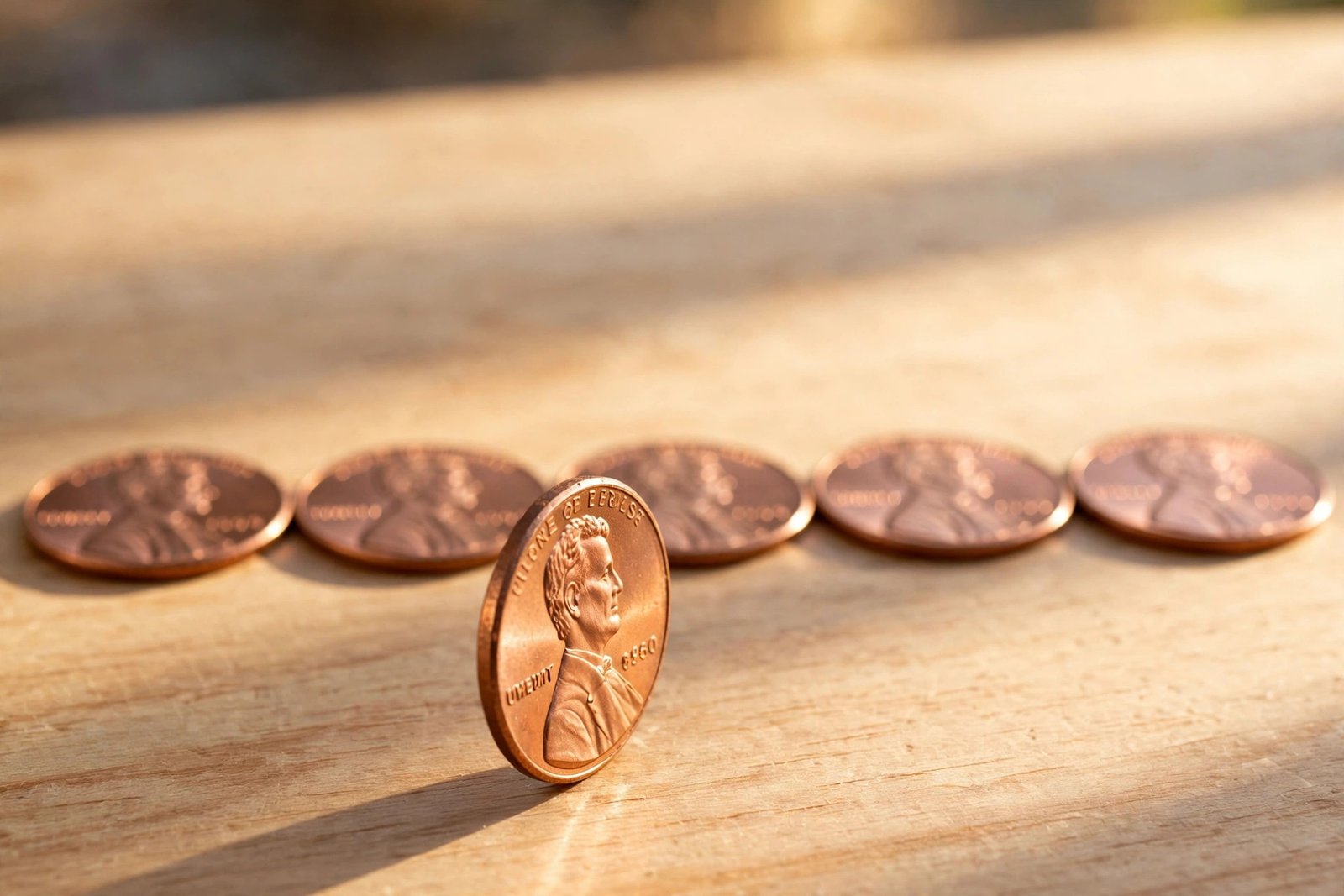
For 232 years, the penny was the smallest workhorse of American money — buying candy, paying exact change, and rattling around in junk drawers. Then, on November 12, 2025, the United States Mint struck its last penny for circulation, closing a chapter that began in 1793. The coin is still legal tender, and the roughly 114 billion pennies already out there are spendable, but no new pennies for everyday spending will ever be made again. The reason is simple arithmetic: it had come to cost nearly four cents to make a coin worth one cent.
A Coin That Cost More Than It Was Worth
The penny’s problem was not popularity. Americans used pennies every day, and the Mint produced billions of them each year. The problem was the price tag on making them. According to the U.S. Mint, the cost of producing a penny rose from 1.42 cents to 3.69 cents over the decade leading up to the decision, and in fiscal year 2024 the penny accounted for 57 percent of the Mint’s total circulating coin production of 5.61 billion coins. The Mint produced and shipped about 3.2 billion pennies that year alone. Every one of them lost money the moment it left the press.
The math only got worse with time. A modern penny is mostly zinc, with a thin copper coating — 2.5 percent copper and 97.5 percent zinc, according to the Mint — and the prices of both metals climbed through the 2010s and 2020s. The Mint’s own figures show that the cost of making and distributing a penny exceeded its one-cent face value for two decades. In fiscal year 2024, the Mint lost about $85.3 million on pennies alone.
That is the kind of loss that is easy to miss in a federal budget, but hard to defend once someone points it out. Taxpayers were, in effect, paying several cents to put a one-cent coin into circulation, and then paying again in the handling costs that pennies impose on banks, retailers, and armored carriers. The Federal Reserve’s St. Louis branch put it plainly in its own explainer: the rising cost of production was one of the central economic arguments for ending the coin, alongside the penny’s shrinking purchasing power and the steady shift toward noncash payments. You can read that analysis from the Federal Reserve Bank of St. Louis.
The penny was also losing its job. A century ago, a penny bought something real. Today, very few single items cost a cent, and most prices are set in dollars, not pennies. The coin survived mostly as a tool for making exact change — a job that matters less every year as more Americans pay by card, phone, or online.
How the Decision Unfolded
The end of the penny did not happen in a single day. It was the result of a chain of decisions that stretched across most of 2025. In February 2025, President Donald Trump directed the Treasury Department to stop producing new pennies, calling the practice wasteful in a social media post and instructing his Treasury Secretary to end production. His message was blunt: the United States had minted pennies for far too long that literally cost more than two cents each, and the waste should be cut out of the budget, even a penny at a time.
In May 2025, the Treasury Department confirmed that the Mint had placed its final order for penny blanks — the round metal discs that are stamped into finished coins. Without new blanks, no new pennies could be struck. The Treasury estimated at the time that ending penny production would save about $56 million a year in material costs.
The legal basis for the move rested with the Secretary of the Treasury. Under federal law, the Secretary may mint one-cent coins in amounts deemed necessary to meet the needs of the United States, and may suspend production upon determining that new coins are no longer needed. Lawmakers in Congress have also debated bills, including the Common Cents Act, that would write the end of circulating penny production into law permanently.
The Last Penny: November 12, 2025
The final day of penny production was a ceremonial one. On Wednesday, November 12, 2025, the U.S. Mint in Philadelphia produced its last penny for circulation, in a ceremony attended by Treasury officials. U.S. Treasurer Brandon Beach pressed the final penny, and the Associated Press reported his words at the moment: “God bless America, and we’re going to save the taxpayers $56 million.” It was a fittingly small and practical send-off for a coin that had circulated since 1793 — 232 years of American history, ended with a press and a promise of savings.
A handful of the final pennies were set aside as keepsakes. Specially marked examples of the last 2025 cents, bearing an Omega privy mark, were later sold at auction in three-coin sets, with the proceeds going well beyond face value — a reminder that the penny’s second life, as a collector’s item, was only beginning. The Mint has confirmed that it will continue to produce numismatic, or collector, versions of the penny in limited quantities, even though circulating production has stopped.
The final year of production was a big one. The Mint shipped about 4.77 billion pennies in fiscal year 2025, up from about 3.2 billion the year before, as it filled orders ahead of the shutdown. The unit cost in that final year came in at 3.02 cents per penny, down from 3.69 cents in fiscal 2024, but still about three times the coin’s face value.
What Happens to the Pennies Already in Your Pocket
Here is the part that matters most for everyday life: nothing changes about the pennies you already have. The penny remains legal tender, and the U.S. Mint states this plainly in its official FAQ. You can still spend pennies at stores, deposit them at the bank, and receive them as change while supplies last. No one is coming to collect them, and no deadline has been set for their use.
What will change, slowly, is availability. The Treasury Department has said there are roughly 114 billion pennies in circulation, and the Federal Reserve will continue to recirculate those pennies for as long as possible. But with no new pennies entering the system, the supply will gradually thin out, as pennies get lost, damaged, or tucked away in jars and drawers. Over time, stores may find themselves short of pennies for making change, and some already have.
In fact, the transition has not been entirely smooth. After circulating production ended, the Federal Reserve stopped handling pennies at many of its terminals, which led to regional penny shortages in late 2025. Some businesses responded by rounding cash transactions to the nearest five cents, or by asking customers for exact change. The Federal Reserve later resumed handling pennies at its terminals, easing the shortages — but the episode showed how quickly a coin that seems abundant can become scarce once the supply line stops.
For most shoppers, the practical advice is simple: keep using pennies normally. Spend them, deposit them, or roll them up for the bank. If you have a jar of pennies at home, it is still money — a thousand pennies is still ten dollars, and banks will still accept rolled coins. There is no reason to hoard ordinary pennies in the hope they will become valuable. With 114 billion in existence, a standard penny from circulation is worth one cent. Only unusual pennies — rare dates, mint errors, or the specially marked final-strike coins — carry collector value.
Cash Rounding: What Shoppers Should Expect
The biggest everyday change from the penny’s retirement is cash rounding. When pennies run short, a cash purchase that totals, say, $10.03 cannot be settled exactly in coins, because the smallest coin available will be the nickel. The usual answer, adopted in other countries, is to round the final cash total to the nearest five cents. Under the standard rounding rule, totals ending in 1 or 2 cents round down, totals ending in 3 or 4 cents round up to the nearest five, totals ending in 6 or 7 round down, and totals ending in 8 or 9 round up.
Crucially, rounding applies only to cash. Card, phone, and online payments are still settled to the exact cent, because electronic payments have no physical coin problem. Prices on shelves do not need to change either — a store can still price an item at $3.99. Only the final cash total, after tax, is rounded. Over many transactions, the rounding evens out: sometimes you save two cents, sometimes you pay two cents more, and the average effect is close to zero. That is the theory, at least, and it is how other countries have handled the same change.
There is still no single federal rule in the United States telling every business exactly how to round, and practices vary from store to store. Some states have passed their own laws permitting rounding when pennies are unavailable. Shoppers who pay cash should watch the register total: a total of $7.02 may become $7.00, or $7.03 may become $7.05. If a store rounds in a way that seems unfair, ask the manager how the store handles it — the rounding should always be visible on the receipt.
What Canada Learned When It Dropped Its Penny
America is not the first country to retire its smallest coin. Canada eliminated its penny in 2012, and its experience is the closest preview of what the United States can expect. The Canadian government announced the change in its 2012 budget, stopped distributing pennies in February 2013, and told businesses to round cash transactions to the nearest five cents. Non-cash payments were untouched, and pennies remained usable indefinitely. You can read Canada’s official explanation in its archived budget document from the Government of Canada.
There is one difference worth noting. Canada’s phaseout was planned and announced well in advance, with a clear transition date and national rounding guidelines. The American phaseout has moved faster and with less uniform guidance, which is part of why some stores faced penny shortages in late 2025. The end result is likely the same, but the road there has been bumpier.
What About the Nickel?
If the penny cost more than it was worth, what about the nickel? It is a fair question, and the numbers are even more striking. In fiscal year 2024, a nickel cost about 13.78 cents to produce and distribute — nearly three times its five-cent face value. In fiscal 2025, that figure eased slightly to about 13.31 cents, but the nickel still loses money on every coin. The dime, by contrast, costs under seven cents, and the quarter about 15 cents, so both still turn a small profit for the Mint.
For now, the nickel is safe. No decision has been made to end nickel production, and the Treasury’s action covered only the penny. But the nickel’s cost is now the obvious next question, and the Common Cents Act would give the Treasury more flexibility to address coin costs, including a possible change to the nickel’s composition. If the Mint can make a cheaper nickel — using different metals, for example — the coin can survive. If not, the debate that ended the penny may one day return for its five-cent cousin.
What to Do With Your Pennies Now
The simplest advice is also the most boring: treat pennies like the money they still are. Spend them, save them, or deposit them. If you run a small business, talk to your bank early about penny supply, and decide on a rounding policy before a shortage forces the question. Post it clearly at the register so customers understand what is happening. If you pay mostly by card, you may barely notice the change at all.
Collectors have a different opportunity. The final-year 2025 pennies, especially those with the Omega privy mark from the last production run, are already attracting attention, and uncirculated rolls of 2025 cents may hold modest value over time. But this is a long game, not a windfall: the Mint produced billions of 2025 pennies. Keep a few crisp examples if you enjoy the history — just do not expect them to pay the mortgage.
Mostly, the penny’s ending is a reminder of how quietly big things change. A coin that survived the Civil War, the Great Depression, two world wars, and the arrival of the internet was finally undone by something far more ordinary: it simply cost too much to make. The penny will linger for years in drawers and jars, but the era of the new penny is over, and the cash register of the future will count in nickels.
Related Reading
- Why US Dollar Bills Are Green: History and Facts
- US Dollar World Reserve Currency Power
- Thanksgiving Turkey Prices 2026 USA
FAQ
Are pennies still legal tender in the United States?
Yes. The U.S. Mint confirms that pennies remain legal tender and may still be used for transactions. Only the production of new pennies for circulation has stopped. You can still spend the pennies you have, deposit them at a bank, and receive them as change while supplies last.
When was the last penny made?
The last penny for circulation was struck on November 12, 2025, at the U.S. Mint in Philadelphia, in a ceremony where U.S. Treasurer Brandon Beach pressed the final coin. The penny had circulated since 1793, a run of 232 years. The Mint continues to strike limited collector versions of the penny.
How much did it cost to make a penny?
In fiscal year 2024, it cost 3.69 cents to produce and distribute each one-cent coin, according to the U.S. Mint. In fiscal year 2025, the cost eased to 3.02 cents per penny, but that was still about three times the coin’s face value. The Treasury estimates that ending production will save about $56 million a year in material costs.
Will cash prices be rounded to the nearest nickel now?
When pennies are unavailable, many businesses round cash totals to the nearest five cents, while card and electronic payments are still settled to the exact cent. There is no single federal rounding rule yet, so practices vary by store and by state. The standard pattern rounds totals ending in 1, 2, 6, or 7 cents down and totals ending in 3, 4, 8, or 9 cents up.
Are my old pennies worth anything as collectibles?
Most ordinary pennies in circulation are worth exactly one cent, and with roughly 114 billion in existence, common dates will not become valuable. Rare dates, mint errors, and specially marked final-run 2025 pennies with the Omega privy mark can carry collector value, but those are the exception.