
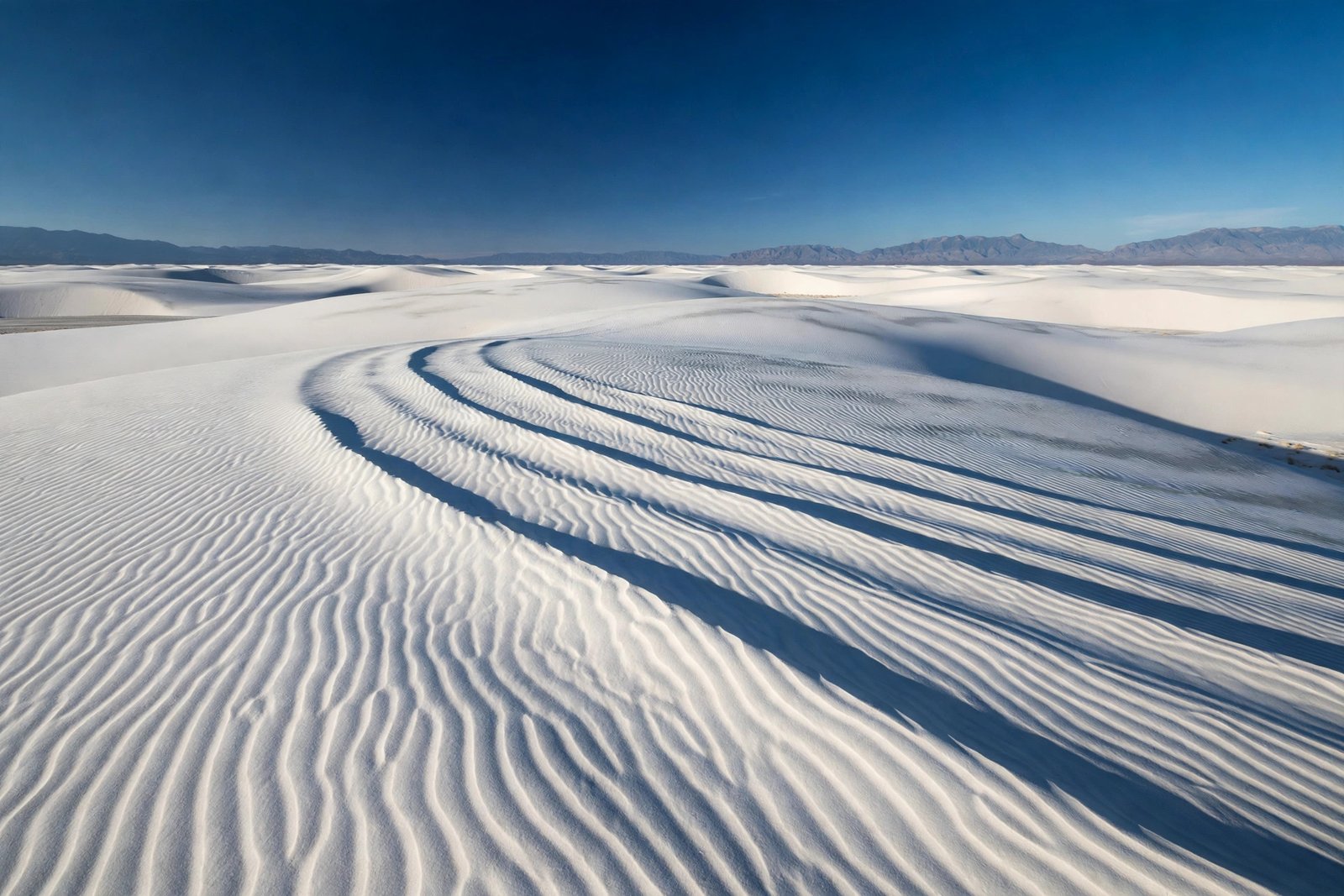
There is a place in southern New Mexico where the desert is white. Not pale, not dusty — white, like a beach of powdered sugar stretching to the horizon, rippling in waves under a huge blue sky. It looks like snow, but it is warm to the touch. It looks like a beach, but the nearest ocean is hundreds of miles away. This is White Sands National Park, home to the largest gypsum dune field on Earth, and one of the most quietly astonishing places in America.
The park sits in the Tularosa Basin, a broad desert valley between mountain ranges in southern New Mexico, near the town of Alamogordo. The dune field covers about 275 square miles, and the national park protects roughly 41 percent of it — about 145,762 acres of gleaming white sand. The rest lies inside the neighboring White Sands Missile Range. It feels less like a park than another planet, and it rewards visitors who walk out into the dunes.
White Sands became a national monument in 1933 and was redesignated as a national park on December 20, 2019, making it one of the newest national parks in the country. It draws visitors from around the world, yet it remains wonderfully uncrowded compared with the famous parks of Utah and Arizona. This guide covers what makes the dunes unique, how they formed, and how to plan a visit — sledding, hiking, sunsets, stargazing, and practical tips.
What Makes White Sands Different From Every Other Desert
Most deserts are made of quartz sand — tiny grains of rock ground down over millions of years, usually tan or brown. White Sands is made of something else entirely: gypsum, a soft mineral used to make plaster and drywall, and almost never found as sand. That is because gypsum dissolves in water; in most places, rain washes it away long before it can pile up into dunes. At White Sands, a rare combination of geology and climate let it pile up into the largest gypsum dune field on the planet.
The difference is visible the moment you arrive. The sand is brilliant white, almost luminous in the desert sun, and it reflects light instead of absorbing it — which is why the dunes feel cool under bare feet even on a hot afternoon, while ordinary desert sand can scorch your soles. The grains are soft and fine, more like flour than beach sand, and they cling to skin and shoes. Everything you bring home will have a little white dust on it.
How the Dunes Were Made
The story of White Sands begins with an ancient lake. Thousands of years ago, during the last ice age, much of the Tularosa Basin was covered by a shallow body of water known as Lake Otero. As the climate warmed and dried, the lake evaporated, leaving thick gypsum deposits on the dry lakebed. Wind did the rest, picking up the gypsum crystals and carrying them across the basin, where they piled into dunes against the Sacramento Mountains.
That process is still going on: the wind keeps grinding gypsum crystals into finer grains and pushing the dunes slowly across the basin. The dune field is not a static monument; it is a moving, growing landscape, fed by the dry lakebed at its western edge. The dunes have been forming for thousands of years, and as long as the basin stays dry and windy, they will keep growing.
From National Monument to National Park
People have lived in the Tularosa Basin for a very long time. According to the National Park Service’s own history of the area, people were drawn to the basin more than 10,000 years ago in search of food, water, and shelter. Spanish explorers and miners came later, chasing salt, gypsum, and other resources, and ranchers worked the basin’s grasslands into the early 20th century. After Pearl Harbor, the military saw the isolated basin as ideal for research and testing, and much of the surrounding land became the White Sands Missile Range.
The dunes were saved by a local businessman named Tom Charles, who spent years campaigning to protect them. His efforts paid off in 1933, when White Sands was established as a national monument. For 86 years it remained a monument — beloved, but without the profile and funding that national park status brings. That changed on December 20, 2019, when Congress redesignated it as White Sands National Park. Visitor numbers climbed after the change, but the park has kept its quiet, uncrowded character.
The military history is still part of the place. The park is entirely surrounded by the White Sands Missile Range and Holloman Air Force Base, where missile testing remains a regular occurrence. The nearby Trinity Site, where the first atomic bomb was tested in 1945, sits within the missile range and opens to the public only on rare occasions. The park’s 1930s adobe visitor center, part of a historic district, tells this layered story.
The Dunes Drive: Your First Stop
Almost everything you will do at White Sands happens along a single road. The Dunes Drive is an eight-mile scenic road — sixteen miles round trip — from the visitor center into the heart of the dune field. The first stretch is paved and lined with desert scrub, and then, almost suddenly, the pavement gives way to packed gypsum and the world turns white. The road ends in a loop where the tallest dunes rise on both sides.
Give yourself at least an hour for the drive, and longer if you plan to stop. There are pullouts and picnic areas along the way, and every stop offers a different view: wide interdune flats where the sand stretches flat and empty, and steep dune faces where the ridges curl like frozen waves. Drive to the end of the loop first, then work your way back, stopping wherever the light catches your eye.
Stop at the visitor center first. The rangers can tell you the day’s road hours, whether any missile testing closures are scheduled, and which trails are in the best condition. The visitor center also has exhibits on the dunes’ geology and history, drinking water, restrooms, and the gift shop — where you buy your sled.
One thing to know before you drive in: the park can close, sometimes with little notice, when the missile range is testing. Closures typically last up to a few hours and can shut U.S. Highway 70 as well as the park. Always check the park’s website or call ahead the morning of your visit.
Sledding the Dunes
Sledding is the signature White Sands experience, and it is exactly as fun as it sounds. You climb a steep dune face, sit on a plastic saucer, and slide down the soft white slope, gypsum spraying behind you. Kids love it. Adults love it just as much, usually after pretending they are only doing it for the kids. It is the single most popular activity in the park.
Here is what nobody tells you until you have already failed once: gypsum is not snow. It has friction. A flimsy inflatable tube or a rectangular sled will dig in and go nowhere. What works is a hard plastic saucer — the round, shallow kind — and wax. Wax the bottom of the saucer before every run, the way you would wax skis — the wax is what makes the difference between gliding and grinding to a halt halfway down.
Buy saucers and wax at the visitor center gift shop, which will even buy your saucer back when you leave. Pick your slope carefully: a steep dune face ending in flat, open sand, away from the road and plants. The best runs are in the late afternoon, when the sand is cooler and faster and the low sun makes the whole dune field glow.
Hiking: Two Trails Worth Your Time
White Sands has five official trails, but two of them tell the story of the park better than the rest. The first is the Dune Life Nature Trail, an easy one-mile loop that climbs two steep dunes and winds through an area rich in desert plant life. The signs explain how plants and animals survive in shifting sand. Go in the morning, when the night’s animal tracks are still fresh in the sand.
The second is the Alkali Flat Trail, and it is a different proposition entirely: a roughly five-mile round trip across open dunefield to the edge of the dry bed of ancient Lake Otero — the birthplace of the sand itself. There is no shade and no water on the trail, and it is marked only by red posts, which you follow from one to the next across a landscape where every dune looks like every other dune. It takes three to four hours and is strenuous — and the most rewarding hike here.
Hike Alkali Flat in the cooler months, or start at first light in summer. Carry far more water than you think you need — at least a gallon per person — and wear sun protection; the white sand reflects sunlight upward as well as down. If the wind picks up, turn back; blowing gypsum stings, and it is easy to lose the trail markers. Ask about ranger-led programs, including tours to Lake Lucero.
Sunset and Stargazing
If you do only one thing at White Sands, make it sunset. As the sun drops toward the San Andres Mountains, the dunes change color minute by minute — white to gold to pink to violet — and the long shadows stretch across the rippled sand in patterns that look painted. The park stays open until shortly after sunset, when the dunes are at their most beautiful.
Stay for the transition: the moment the sun disappears, the dunes go quiet, the wind drops, the heat lifts, and the white sand holds the last light of the day. Then the stars come out, and White Sands becomes one of the best stargazing spots in the American Southwest. Far from city lights, the white sand reflects just enough starlight to make the landscape feel faintly luminous. On a moonless night, the Milky Way arches over the dunes.
Best Times to Visit
White Sands is open year-round, and every season has its case to make. But the desert is honest about its extremes, and timing matters more here than at most parks. The best months for most visitors are October through April, when daytime temperatures are comfortable and the hiking is pleasant. Winter is the quiet season: crisp air, thin crowds, and low sun making the dunes glow all day. Spring brings wildflowers, though spring winds can be strong.
Summer is the hardest season and, for some visitors, the most rewarding. Midday temperatures regularly climb past 100 degrees, the sun is relentless, and there is no shade anywhere in the dune field. In summer, hike and sled early or late, spend midday at the visitor center, and return for sunset. The reward is the longest, most colorful evenings of the year.
Practical Tips Before You Go
A little preparation goes a long way. The entry fee is $25 per vehicle, good for seven days, and America the Beautiful passes are accepted. The park is open daily except December 25, with seasonal hours. Check the official park website for hours and missile testing closures before you drive out.
Water is the most important thing you will bring. There is no drinking water, food, or shade anywhere in the dune field beyond the visitor center, so carry at least a gallon of water per person. Sunscreen, a hat, and sunglasses are essential — the white sand reflects sunlight from below as well as above, and sunburn here is surprisingly fast. Wear shoes you do not mind filling with sand, and bring a change of clothes — the gypsum gets everywhere.
Getting there is straightforward. White Sands is about 15 miles southwest of Alamogordo, New Mexico, on U.S. Highway 70, roughly an hour and a half from Las Cruces and about three and a half hours from El Paso, Texas. Alamogordo has hotels and restaurants and makes a comfortable base. If you are flying in, El Paso International Airport is the closest major airport.
A few final rules, all simple. Stay off the dunes’ fragile plants — the vegetation holds the dunes in place. Sled only on the far side of dunes, away from the road and other visitors. Leave the sand where it is; collecting gypsum is not allowed. Watch the weather: summer thunderstorms can arrive fast, and winter mornings can be surprisingly cold. Check the forecast and the park’s closure page, then go enjoy one of the strangest and most beautiful places in America.
Frequently Asked Questions
Where is White Sands National Park?
White Sands is in southern New Mexico, in the Tularosa Basin about 15 miles southwest of Alamogordo on U.S. Highway 70 — roughly 90 minutes from Las Cruces and about three and a half hours from El Paso, Texas.
Why is the sand white?
The dunes are made of gypsum, not quartz. Gypsum is a soft white mineral that usually dissolves in water, but in the dry, closed Tularosa Basin it accumulated over thousands of years as an ancient lake evaporated and the wind piled the crystals into dunes — the largest gypsum dune field on Earth.
How much does it cost to visit?
Entry is $25 per vehicle for seven days, and America the Beautiful passes are accepted. Sleds are sold separately at the visitor center gift shop, which will also buy them back.
Can you sled at White Sands?
Yes — sledding is the park’s most popular activity. Bring a hard plastic saucer and wax, or buy both at the visitor center gift shop. Sled on steep dune faces that end in flat, open sand, away from the road and plants, and go in the late afternoon.
When is the best time to visit White Sands?
October through April is most comfortable, with winter the quietest season. Summer brings extreme heat, so hike and sled early or late in the day. Sunset and the hour after sunrise are the best times of day, and always check the park’s website for missile testing closures before you go.
Related reading
More of America’s most beautiful and surprising places:
- Great Sand Dunes National Park: Colorado’s Towering Desert
- Bisti Badlands: New Mexico’s Alien Landscape
- America’s 63 National Parks: The Complete Guide
Plan your trip with the National Park Service’s official White Sands page, the park’s history and culture guide, Lonely Planet’s White Sands guide, and the National Park Foundation’s park overview, and the Visit Las Cruces guide to the park.