
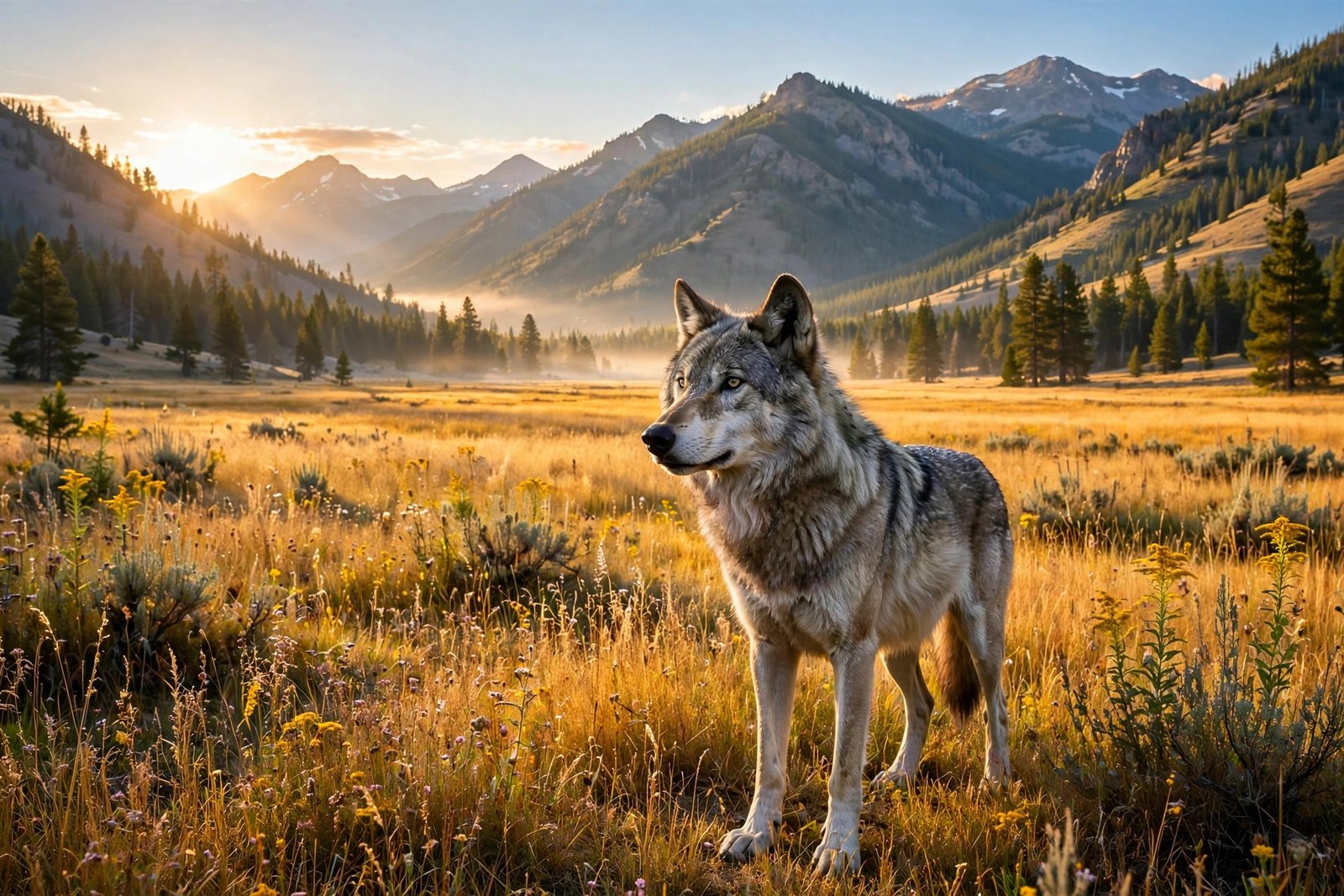
In January 1995, fourteen gray wolves stepped out of acclimation pens in Yellowstone National Park and into history. They were the first wolves to roam the park in nearly 70 years, brought south from Canada by the U.S. Fish and Wildlife Service in one of the most ambitious — and controversial — wildlife experiments ever attempted in America. Three decades later, the results are still unfolding, and they changed how scientists understand what a single species can do to an entire ecosystem.
The Yellowstone wolf story is often told as a simple fable: wolves returned, elk declined, trees grew back, rivers healed. The real story is more complicated and more interesting. Wolves did transform Yellowstone, but not by magic — by predation, by fear, by competition, and by setting off a chain of effects that researchers are still untangling. It is a story about what happens when you put a missing piece back into a landscape, and about how long it takes to understand what that piece actually does.
How Yellowstone lost its wolves
Wolves were deliberately exterminated from Yellowstone by 1926 as part of a federal predator-control program. The logic of the era was straightforward: predators killed livestock and reduced game populations for hunters, so predators had to go. Rangers, trappers and government hunters killed wolves by shooting, trapping and poisoning until none remained. For nearly 70 years, the park functioned without its apex predator.
Without wolves, the elk population grew large and stayed large. Elk browsed heavily on young willows, aspens and cottonwoods along streams, preventing those trees from maturing. Streambanks eroded without the root systems that held them. Beavers, which depend on willow for food and dam-building, declined — by 1995, there was just one beaver colony left in the park. Coyotes, freed from competition with wolves, grew numerous and suppressed smaller predators like foxes. The ecosystem was not dead, but it was out of balance in ways that were visible to anyone who knew what to look for.
The return: 1995 and 1996
The reintroduction was carefully planned and fiercely opposed. Ranchers worried about livestock losses outside the park. Some hunting groups worried about declining elk numbers. Conservationists argued that a national park should contain its native species, including its top predator. After years of environmental review and legal challenge, the plan went ahead.
In January 1995, fourteen wolves arrived in two shipments — eight on January 12 and six on January 19 — and were held in temporary pens to acclimate before release. A second round in January 1996 brought seventeen more. In total, 31 gray wolves were relocated to Yellowstone across those two winters, with additional releases in 1997 bringing the founding population higher. The wolves, captured in western Canada, adapted quickly. They hunted, they bred, and their numbers climbed, peaking in the early 2000s before settling toward an equilibrium of roughly 100 wolves inside the park.
Recent counts bear that out: as of 2024, the park was home to at least 108 wolves living in nine packs, and long-term studies put the typical population at around 80 to 120 animals. The population has fluctuated with prey, disease and winter severity, but it has never collapsed — and it has never exploded either. It found its level, as wild populations do.
What the wolves changed
The most direct effect was on elk. Wolves kill elk — an average of about 22 elk per wolf per year, according to long-term research, more than the 12 per wolf per year predicted before reintroduction. The northern Yellowstone elk herd declined substantially, though hunting, drought and other predators also played roles. Fewer elk meant less browsing pressure on streamside vegetation, and willows, aspens and cottonwoods began to recover in places where elk had eliminated them.
With the willows came the beavers. From a single colony in 1995, the park’s beaver population grew to nine colonies, with more likely. Beaver dams slow water, raise water tables, create wetlands and provide habitat for fish, amphibians and birds. Songbirds that depend on riparian vegetation, including yellow warblers, returned to recovering streamside thickets. The change in vegetation even affected the shape of some streams, as stabilized banks narrowed channels and reduced erosion — the famous claim that wolves “changed the rivers” of Yellowstone, which is true in a qualified sense: they helped set off a chain of effects that reached the rivers, even if they did not personally re-engineer them.
Researchers call this a trophic cascade: a change at the top of the food web rippling downward through herbivores, plants and beyond. Yellowstone is the most famous example in the world, and it has become a textbook case. But scientists are careful to add that the cascade is not the whole story. Elk behavior changed too — elk avoided risky streamside areas where wolves hunted, which gave plants breathing room even where elk numbers remained high. Drought, fire, hunting and bears all influenced the same landscape. The wolves mattered enormously, but they were not the only actors.
Competition, conflict and coexistence
The wolves’ return reshaped the park’s predator community as well. Coyote numbers fell as wolves reclaimed their place at the top, which released pressure on foxes, whose numbers rose. Grizzly bears, which scavenge wolf kills, benefited from a new food source. Ravens, eagles and magpies gather at wolf kills, part of a scavenger community that follows the packs.
Outside the park, the story is tenser. Wolves are protected inside Yellowstone, but they can be legally hunted in surrounding states once they cross the boundary, and that has created ongoing conflict between conservation goals and state policies. Ranchers in Montana, Wyoming and Idaho deal with livestock losses, and wildlife agencies manage a patchwork of protections that changes at invisible lines on a map. The debate over wolf management — how many wolves, where, and under what rules — remains one of the most heated in American conservation.
That tension is part of the Yellowstone lesson, too. Reintroduction does not end at the park boundary. Animals move, people disagree, and science has to share the table with livelihoods, politics and values. The wolves do not know about the boundary. The managers do, and they have to live with the consequences.
What Yellowstone teaches the world
Yellowstone’s wolves have become a global reference point for rewilding — the idea that restoring missing species can heal degraded ecosystems. Projects from Scotland to South America cite Yellowstone when they argue for bringing back predators. The lesson is real, but it comes with a caution that Yellowstone’s own researchers emphasize: reintroduction works best when it is paired with rigorous science, phased implementation, long-term monitoring and honest engagement with the people who live alongside the animals.
For visitors, the wolves have also become a symbol of wild Yellowstone itself. Dawn patrols in the Lamar Valley — the park’s famous “Valley of the Wolves” — now draw wildlife watchers from around the world, hoping for a glimpse of a pack on a distant ridge. Wolf-watching has become a genuine part of the local economy, a reminder that a living predator can be worth more to a community than a dead one.
Read more about the science behind the transformation here and a full account of the ecosystem changes here.
Thirty years on
Three decades after those first fourteen wolves stepped out of their pens, Yellowstone’s wolf population is stable, its ecosystem is different, and the experiment is still running. The willows are taller. The beavers are back. The elk are fewer and warier. The rivers run through a landscape that remembers what it was like to have a top predator — because, once again, it does.
The wolves did not fix Yellowstone on their own, and no honest account should claim they did. But they proved something important: that an ecosystem is not just a collection of species, but a web of relationships, and that restoring a single missing relationship can set off changes nobody fully predicted. That is why the story still matters, and why scientists are still watching the Lamar Valley at dawn.
Related reading
For more wildlife comebacks, read How the Bald Eagle Came Back From the Brink, The American Bison Comeback: Return of the Herds, and Cumberland Island: Georgia’s Hidden Gem of Wild Horses.
Frequently asked questions
When were wolves reintroduced to Yellowstone? The first wolves were released in January 1995, with a second group in January 1996 — 31 wolves in total across the first two winters.
Why were wolves removed from Yellowstone? They were systematically eliminated by 1926 under federal predator-control policies aimed at protecting livestock and increasing game populations for hunters.
How many wolves live in Yellowstone now? Around 100 wolves, typically in about nine packs, with counts fluctuating year to year. As of 2024, at least 108 wolves in nine packs were recorded.
How did wolves change Yellowstone’s ecosystem? By reducing elk numbers and changing elk behavior, wolves allowed willows and aspens to recover, which helped beavers, songbirds and streambanks — a trophic cascade.
Are wolves protected outside Yellowstone? No. Wolves are protected inside the park but can be legally hunted in surrounding states under state regulations, which remains a source of controversy.