
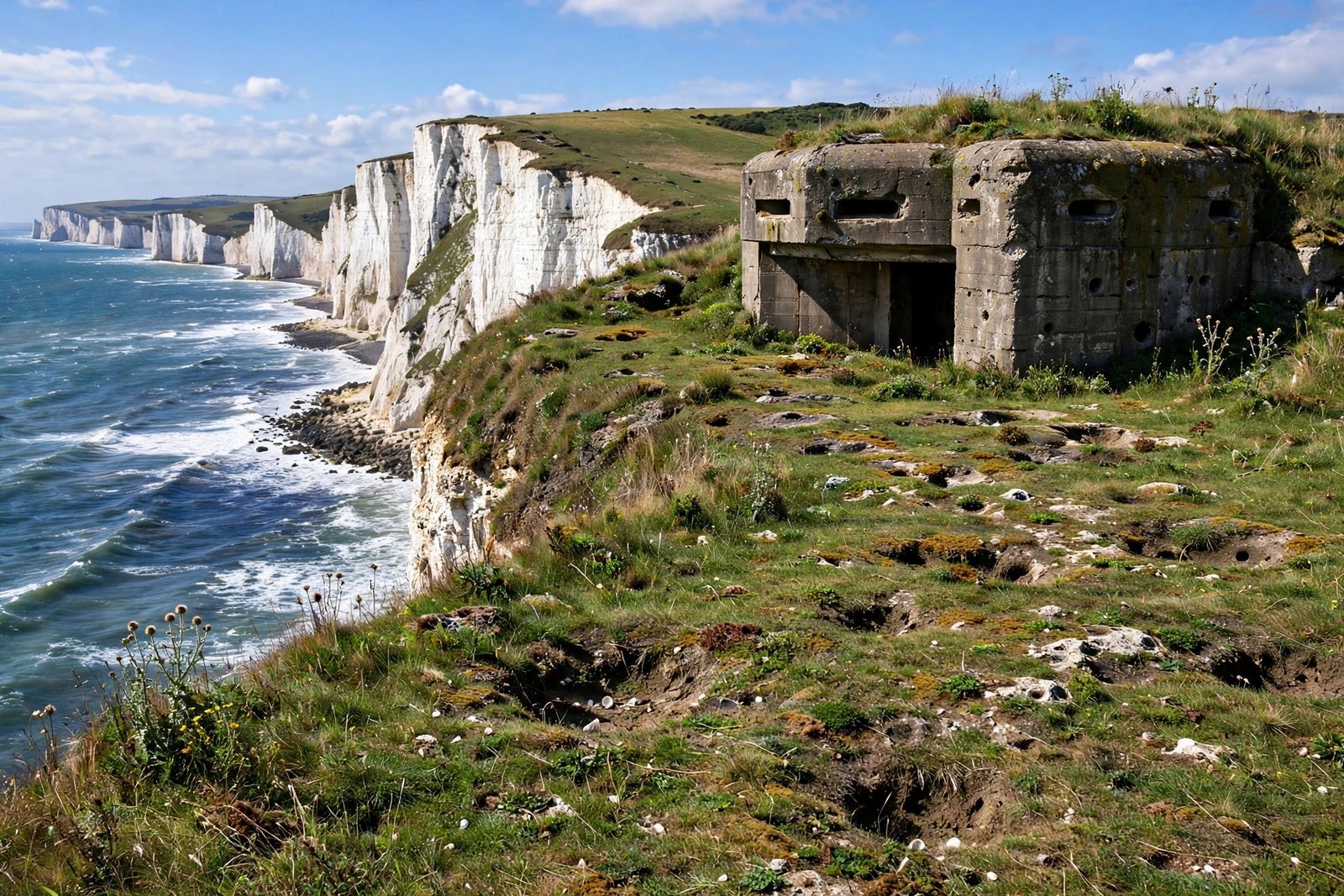
There are places in American history where the ground itself tells the story. Pointe du Hoc, on the Normandy coast of France, is one of them. Stand at the top of the cliff today and you can still see the craters left by Allied bombing, the concrete bunkers built into the earth, and the long drop to the English Channel below. On the morning of June 6, 1944, that cliff was not a memorial. It was a fortress, and a small force of American Rangers was ordered to take it before the rest of D-Day could succeed.
The men who climbed it did not have the luxury of hindsight. They knew only that German guns on that headland could fire on the beaches where tens of thousands of Allied troops were about to land. If those guns were not silenced, the landings at Omaha Beach and Utah Beach could be torn apart from the flank. That is why the mission at Pointe du Hoc was given to some of the toughest, most specially trained soldiers in the American Army, and that is why their story still stops visitors in their tracks more than eighty years later.
Why Pointe du Hoc Mattered So Much
To understand Pointe du Hoc, picture the Normandy coastline on a map. Utah Beach lies to the west and Omaha Beach lies to the east, and between them juts a rocky promontory that rises roughly one hundred feet above the sea. From that height, artillery could reach in both directions, threatening the landing beaches and the ships offshore that were carrying troops, tanks, and supplies. Allied planners could not simply hope the guns would miss. They had to be put out of action before the main landings got underway.
The Germans understood the value of the position too. As part of the Atlantic Wall, the coastal defenses built to repel an Allied invasion, they had fortified Pointe du Hoc with concrete gun casemates, bunkers, machine-gun positions, trenches, and barbed wire. Bombing raids in the months before D-Day had pounded the site and left the clifftop pockmarked with craters, but bombing alone could not guarantee the battery was destroyed. Guns could survive, be repaired, or be moved. Only ground troops standing on the position could be sure it was out of the fight.
That reasoning shaped one of the boldest assignments of D-Day. The task went to the 2nd Ranger Battalion, commanded by Lieutenant Colonel James Earl Rudder. Three of its companies, D, E, and F, would make the initial assault, landing at the base of the cliff and scaling it under fire. The rest of the battalion, along with the 5th Ranger Battalion, would follow as reinforcements once the Rangers on the cliff signaled success. It was a plan that depended on timing, seamanship, climbing skill, and sheer nerve, all in the first hours of the largest amphibious invasion in history.
Rudder and the Men Who Volunteered for the Climb
The Rangers trained in England and Scotland for the assault, working with British Commando instructors who knew cliff warfare. They practiced amphibious landings, rope climbing, demolitions, and small-unit tactics until the movements became second nature. They trained with the special equipment the mission required: rocket-fired grappling hooks that could carry ropes up the cliff face, rope ladders, extension ladders, and demolition charges for destroying guns and fortifications. Every man needed to know not only his own job but the job of the man next to him, because casualties were expected and the climb would leave no room for confusion.
That training mattered because the Ranger battalions were still a new kind of unit in the American Army. At the start of the war, the Army had no specialized commando force of this type. Ranger battalions were created to carry out missions that ordinary infantry units were not designed for: raids, assaults on fortified positions, and operations behind or ahead of the main force. The U.S. Army notes that the 2nd and 5th Ranger Battalions entered the war on June 6, 1944, in Normandy, and that it was during the bitter fighting on D-Day that the Rangers earned their motto, “Rangers, lead the way!” At Pointe du Hoc, they would live up to those words in the most literal way possible, going first, alone, up a cliff.
A Rough Crossing and a Late Landing
The assault force set out in the early hours of June 6, 1944, in landing craft heading for the Normandy coast. Almost immediately, things began to go wrong. The sea was rough, the wind was strong, and the current pushed the small craft off course. Some landing craft were swamped or lost, and with them went supplies and equipment the Rangers could not easily replace. Navigation in darkness and heavy seas, under the noise and confusion of a vast invasion fleet, was brutally difficult.
Instead of landing at the planned spot at the foot of the cliff, the Rangers came ashore some distance away and had to work their way back along the coast against the tide. The delay was costly. Every minute spent fighting the current was a minute in which German defenders could recover from the naval and air bombardment, man their positions, and prepare to fire down on the beach. By the time the Rangers reached the base of Pointe du Hoc, they were behind schedule, wet, cold, and already low on some of the gear they had counted on.
Scaling the Cliff Under Fire
Imagine the climb itself. The cliff at Pointe du Hoc rises about one hundred feet, steep and broken, with loose rock, wet rope, and mud. Some ropes were soaked by sea spray and grew heavy. Some grappling hooks failed to catch. German defenders cut ropes where they could and dropped grenades onto the climbers. The men climbing had no cover. They were exposed on a vertical wall, carrying weapons and equipment, moving hand over hand while bullets and fragments cracked around them.
The Guns Were Gone, Then Found Inland
When the Rangers reached the concrete gun casemates on the clifftop, the guns were not there. In place of artillery pieces, they found wooden poles arranged to look like guns under camouflage netting. The real guns had been moved inland, away from the battered clifftop positions, to a more sheltered location where they could still be brought into action. From the Allied point of view, this was both a relief and a new problem. The battery had not been destroyed, because the guns had not been in the casemates at all.
Rudder’s men did not stop at the cliff edge. Patrols pushed inland, searching hedgerows, orchards, and country lanes for the missing artillery. Before long, a small Ranger patrol discovered the guns hidden and unattended in a field inland from the cliff. Using thermite grenades, which burn at extremely high temperatures and can wreck a gun’s mechanism, the Rangers disabled the artillery pieces. The guns that had threatened Omaha and Utah beaches could no longer fire. By mid-morning on D-Day, the Rangers were able to report that their main objective had been achieved.
For more on how the U.S. Army itself tells this story, including the role of the 2nd Ranger Battalion and the origin of the Rangers’ motto, see the Army’s account of the Rangers of World War II at army.mil. A detailed retelling that draws on the National WWII Museum’s historians describes the discovery of the guns inland and the two-day fight that followed at The Public’s Radio.
Two Days of Holding On
Destroying the guns was only half the mission. The Rangers also had to hold Pointe du Hoc until they were relieved by forces advancing from Omaha Beach. That proved to be the hardest part of all. Cut off at the end of a narrow promontory, with limited ammunition, food, and water, and with no easy route for resupply, the Rangers dug in among the craters and ruined fortifications and waited for the counterattacks they knew would come.
The German response was fierce and repeated. Over the next two days, the Rangers fought off successive counterattacks as German troops tried to retake the position and cut them off from the sea. The fighting was close, confused, and exhausting. Men fought from trenches and shell holes, often at short range, with little sleep and dwindling supplies. Wounded Rangers had to be cared for with what was at hand. Ammunition had to be conserved. Every attack repelled bought time, but it also cost men the force could not replace.
Relief finally came on the morning of June 8, when troops from Omaha Beach, including elements of the 5th Ranger Battalion and infantry units, reached Pointe du Hoc. By that point, the cost had been devastating. According to historians at the National WWII Museum, only about 90 of the original 225 Rangers who had landed on D-Day were still able to bear arms when relief arrived. The rest had been killed, wounded, or otherwise put out of action. The numbers tell a stark story: a force that had gone in at company strength came out of two days of fighting reduced to a fraction of itself, having held the ground it was ordered to hold.
What the Rangers’ Experience Teaches Today
It is tempting to turn Pointe du Hoc into a simple story of heroism, and heroism is certainly part of it. But the fuller story offers lessons that reach beyond the battlefield. The first is about preparation. Rudder’s Rangers did not improvise their courage from nothing. They had trained for months for this exact kind of assault, and that training gave them habits that held when the plan broke down. In civilian life, preparation looks different, but the principle is the same: the work done quietly beforehand is what makes it possible to act well under pressure.
The third lesson is about adaptability. The guns were not where they were supposed to be. The reinforcements did not arrive when they were supposed to arrive. The Rangers succeeded not because everything went according to plan but because they kept solving the next problem in front of them: climb the cliff, clear the bunkers, find the guns, destroy them, hold the ground. That sequence, one hard problem at a time, is a useful way to think about any overwhelming task, military or otherwise.
Visiting Pointe du Hoc Today
Today, Pointe du Hoc is preserved as a memorial and a historic site, and it draws visitors from around the world. The ground still shows the scars of the battle: deep craters from Allied bombing, the remains of German bunkers and observation posts, and the cliff itself, still imposing even on a calm day. Standing at the base and looking up gives visitors a small sense of what the climb must have felt like, though nothing can fully reproduce the fear and noise of that morning.
Frequently Asked Questions
What was the mission at Pointe du Hoc on D-Day?
The mission was to capture the German artillery battery on the cliff between Omaha Beach and Utah Beach and destroy its guns, so the guns could not fire on the Allied landings or the ships offshore. Three companies of the 2nd Ranger Battalion, led by Lieutenant Colonel James Earl Rudder, made the initial assault by scaling the cliff, while other Ranger units were to follow as reinforcements.
How did the Rangers climb the cliff?
The Rangers used rocket-fired grappling hooks carrying ropes, along with rope ladders and extension ladders, to scale a cliff roughly one hundred feet high. They climbed under fire from German defenders above, who used small arms and grenades. Wet ropes, loose rock, and enemy fire made the climb slow and dangerous, but groups of Rangers reached the top and fought their way into the German positions.
Why were the guns not in the clifftop casemates?
Allied bombing had badly damaged the clifftop gun positions before D-Day, and the Germans had moved the artillery inland to a more sheltered location. When the Rangers reached the concrete casemates, they found dummy guns made of poles under camouflage netting. Ranger patrols then found the real guns hidden inland and disabled them with thermite grenades, completing the main objective.
How long did the Rangers hold Pointe du Hoc?
The Rangers held Pointe du Hoc for about two days, from the morning of June 6, 1944, until relief arrived on the morning of June 8. During that time they fought off repeated German counterattacks while short of ammunition, food, and water, and cut off from the forces fighting on Omaha Beach.
Why is Pointe du Hoc still important today?
Pointe du Hoc remains important as a memorial to courage, leadership, and sacrifice, and as a place where visitors can see the actual ground of D-Day. It also teaches practical lessons about preparation, adaptability, and the human cost of war. Presidential anniversary speeches there, including Ronald Reagan’s 1984 address to the surviving Rangers, have made it a symbol of American resolve and of gratitude to the generation that fought World War II.