
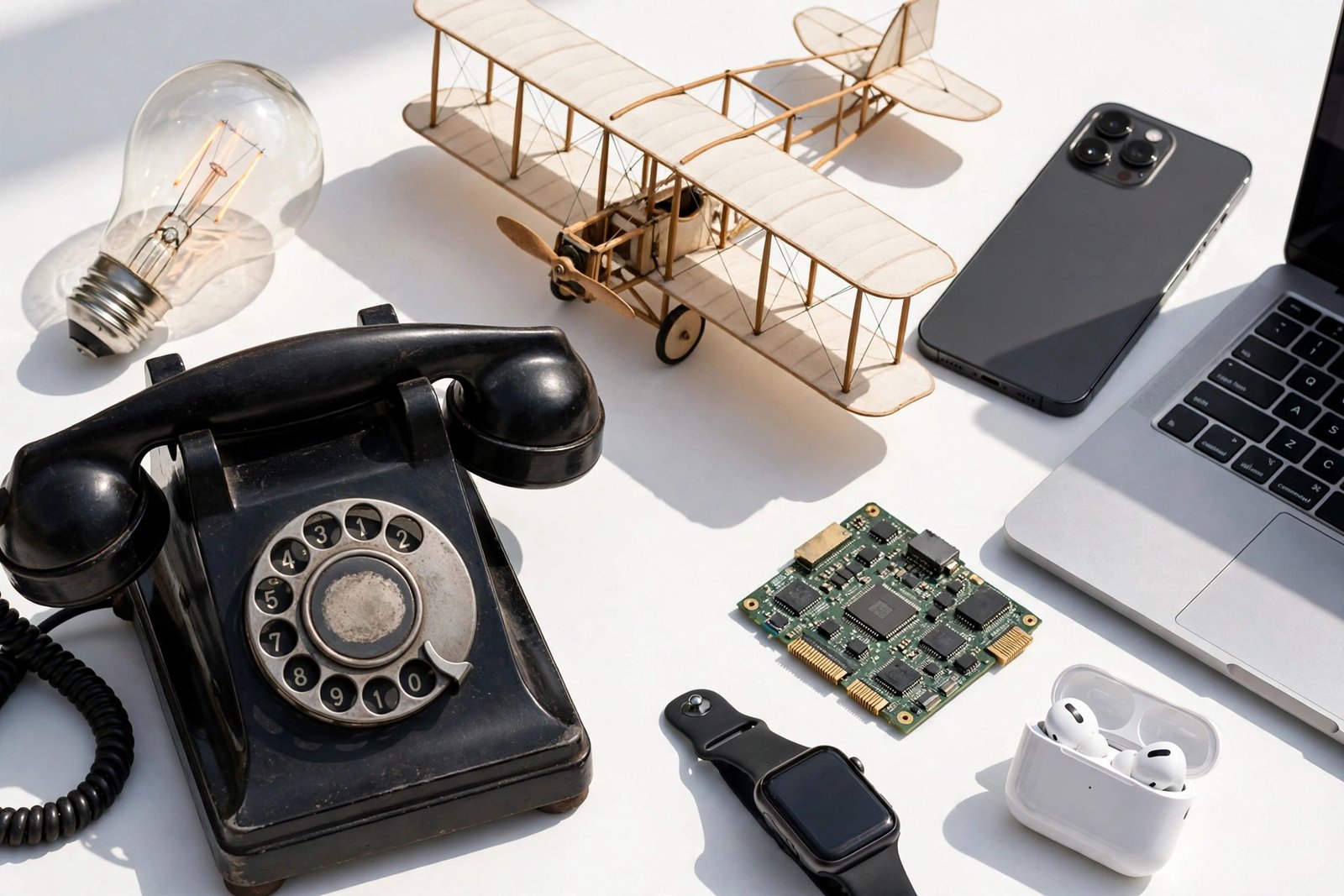
Some inventions change a single industry. A rare few change how everyone on Earth lives, works, and talks to one another. The United States, a young country by world standards, has produced a surprising share of that second kind. From the first voice carried over a wire to the first powered flight and the network that became the internet, American workshops, laboratories, and garages gave the world tools that reshaped daily life. This is the story of five of those inventions, the people behind them, and the honest truth that invention is rarely the work of one person alone.
What makes an invention “American” is not always simple. Ideas crossed oceans, rivals worked on the same problems at the same time, and credit was sometimes decided in courtrooms rather than workshops. The inventions below are American in the sense that they were developed, patented, or first made practical in the United States, even where earlier experimenters elsewhere paved the way. That messy, competitive history is part of what makes the story so interesting.
The Telephone: A Voice Across the Distance
Before the telephone, a message across a continent traveled at the speed of a horse, a train, or a ship. The telegraph, developed in the 1830s, could send coded dots and dashes almost instantly, but it could not carry a human voice. That changed in 1876, when Alexander Graham Bell received the first United States patent for the telephone. The U.S. Department of State’s survey of American innovations dates Bell’s telephone to 1876 and notes how it replaced letters and telegrams that could take days or weeks to arrive with conversations in real time.
Bell was not working in a vacuum. Other inventors, including Elisha Gray and Antonio Meucci, had designed devices that could transmit speech electrically, and historians still debate who deserves the most credit. What is not in dispute is that Bell’s patent and his company turned a laboratory curiosity into a working system. Within a few years, telephone exchanges connected neighbors, then cities, then whole countries. Businesses reorganized around the idea that a supplier or customer could be reached in seconds. Families separated by migration could hear one another’s voices for the first time.
The telephone’s legacy runs straight through the next century and into your pocket. Every mobile phone, every video call, and every voice message descends from the idea that sound itself could travel over a wire. When you call a loved one across the country today, you are using a descendant of Bell’s 1876 invention, refined by generations of engineers but built on the same breakthrough: the human voice, made electric.
The Light Bulb: Turning Night Into Day
Thomas Edison is the name most people attach to the light bulb, and the year most often cited is 1879. But the fuller story is more useful than the legend. Many inventors before Edison had made bulbs that glowed briefly before burning out. Edison’s achievement, as the State Department’s account puts it, was a commercially viable electric lighting system based on the incandescent bulb. In other words, he did not just make light; he made light that lasted, that could be manufactured, and that ordinary people and businesses could afford to use.
That distinction mattered enormously. A bulb that lasts a few minutes is a parlor trick. A bulb that lasts for hours, backed by generators, wiring, and power stations, is a revolution. Edison opened America’s first central power plant in New York in 1882, and electrification spread from there to streets, factories, stores, and homes. Night stopped being a hard limit on human activity. Shops stayed open after dark, factories ran evening shifts, and reading, studying, and socializing no longer ended at sunset.
It is worth being fair to Edison’s rivals and predecessors: electric light was a shared quest, and Edison built on the work of others, just as others later improved on his designs. But the system he commercialized is why his name stuck. The light bulb did more than brighten rooms. It created the electrical grid itself, the vast infrastructure that now powers nearly everything else on this list, from telephones to computers to the internet.
The Airplane: Twelve Seconds That Shrank the World
On the morning of December 17, 1903, on a windswept beach near Kitty Hawk, North Carolina, two bicycle mechanics from Ohio did what centuries of dreamers had failed to do. Orville Wright lay at the controls of a fragile wooden biplane called the Flyer while his brother Wilbur ran alongside. At 10:35 a.m., the machine lifted into a strong headwind and flew 120 feet in 12 seconds. It was, as the Smithsonian’s National Air and Space Museum records, the first powered, controlled flight of a heavier-than-air flying machine.
Twelve seconds does not sound like much, and the first flight covered less ground than a modern airliner spans with its wings. But the Wrights made three more flights that same morning, the longest covering 852 feet in 59 seconds with Wilbur at the controls. Control was the real breakthrough. Others had built gliders and powered craft that lurched into the air; the Wrights built a machine a pilot could actually steer, using a system of wing-warping and rudders they had tested for years with gliders at Kitty Hawk.
The world did not change overnight. Early airplanes were fragile, slow, and dangerous, and it took years before the public took the Wrights seriously. But the path from that beach to everything that followed is direct: airmail, passenger airlines, transoceanic travel measured in hours instead of weeks, and eventually spaceflight. The Smithsonian notes the poetic bookend: just 66 years separated the Wrights’ 12-second hop from the Apollo 11 Moon landing in 1969, and the Apollo astronauts carried a small piece of the Flyer with them. The airplane did not just give humans wings. It made the planet smaller and, in a real sense, made the modern connected world possible.
The Transistor: The Tiny Switch Inside Everything
If the airplane is the most dramatic invention on this list, the transistor is the most quietly important. Invented at Bell Labs in 1947, the transistor replaced bulky, power-hungry vacuum tubes with a small, fast, energy-efficient switch made from semiconductor material. The State Department’s survey calls it one of the twentieth century’s most groundbreaking inventions, and that is not an exaggeration. Without it, there would be no modern computers, no cellphones, and no internet as we know it.
Vacuum tubes were the size of small light bulbs, generated enormous heat, and failed often. Early computers built from them filled entire rooms and demanded constant maintenance. Transistors changed the arithmetic of electronics completely. They could be made smaller, cheaper, and more reliable, and they used far less power. Over the following decades, engineers learned to pack thousands, then millions, then billions of transistors onto a single silicon chip. That steady shrinking is what turned room-sized computers into laptops, then phones, then the tiny sensors and devices woven through modern life.
Most people will never see a transistor, and that is the point. It disappeared into everything. Every call you make, every photo you take, every search you run passes through transistors by the billions. It is the invisible foundation of the digital age, and it was born in an American industrial laboratory in the years just after the Second World War.
The Internet: A Network of Networks
The internet is the hardest invention on this list to credit to a single person or moment, because it was built in layers over decades. Its roots lie in ARPANET, a network developed in the late 1960s by the U.S. Department of Defense’s Advanced Research Projects Agency. The idea was to link computers so that researchers and institutions could share information and computing resources even if parts of the network failed.
The decisive step came in the 1970s, when Vinton Cerf and Robert Kahn developed TCP/IP, the Transmission Control Protocol and Internet Protocol. As the State Department’s account explains, TCP/IP provided the backbone for a web of interconnected networks, which is exactly what the word “internet” means. On January 1, 1983, ARPANET adopted TCP/IP as its standard, allowing different networks to talk to one another in a common language. From that technical foundation grew email, the World Wide Web, e-commerce, social media, streaming video, and the entire digital economy.
It is tempting to treat the internet as purely American, but its builders would be the first to say it became a global project, with crucial contributions from researchers in many countries. What began as an American defense research project became the shared infrastructure of the planet. No other invention on this list touches so many parts of life at once: how we learn, shop, work, bank, date, argue, create, and stay in touch with the people we love.
Why These Five Still Matter
Look at the pattern across these five inventions and something striking emerges. The telephone conquered distance for the voice. Electric light conquered darkness. The airplane conquered distance for the body. The transistor conquered size and cost for computing. The internet combined them all, conquering distance, darkness, and delay at once. Each one took something that had always limited human life and made it optional.
There is also a humbling lesson in this history. None of these breakthroughs arrived fully formed, and none belonged to a lone genius working in isolation. Bell had rivals, Edison had predecessors, the Wrights had competitors, the transistor grew out of team research at Bell Labs, and the internet was built by hundreds of contributors. Celebrating American invention honestly means celebrating that whole ecosystem: the tinkerers, the funders, the engineers who turned prototypes into products, and the ordinary users who found new uses the inventors never imagined.
The next world-changing invention may already be taking shape in a laboratory or garage somewhere in America today. If history is any guide, it will look modest at first, like a 12-second flight or a glowing filament that refuses to burn out. And a generation later, people will wonder how they ever lived without it.
Frequently Asked Questions
Who invented the telephone?
Alexander Graham Bell received the first U.S. patent for the telephone in 1876, though Elisha Gray and Antonio Meucci also developed devices that transmitted speech electrically, so historians treat the credit as shared and contested rather than belonging to one person alone.
Did Thomas Edison invent the light bulb?
Not from scratch. Earlier inventors made bulbs that glowed briefly, but Edison’s 1879 design was the first commercially practical incandescent bulb, backed by a power system that made electric lighting usable in homes and businesses.
How long was the Wright brothers’ first flight?
The first flight on December 17, 1903, lasted 12 seconds and covered 120 feet, according to the Smithsonian’s National Air and Space Museum. The brothers made three more flights that day, the longest covering 852 feet in 59 seconds.
What is TCP/IP and why does it matter?
TCP/IP, developed by Vinton Cerf and Robert Kahn in the 1970s, is the set of protocols that lets different computer networks communicate. Its adoption by ARPANET in 1983 created the foundation of the modern internet.
Why is the transistor so important?
The transistor, invented at Bell Labs in 1947, replaced bulky vacuum tubes with a tiny, efficient electronic switch. It made modern computers, phones, and the internet possible by allowing electronics to shrink dramatically in size and cost.
For further reading, see the U.S. Department of State’s survey of American innovations, the Smithsonian’s account of the Wright brothers at Kitty Hawk, the museum’s record of the 1903 Wright Flyer, and Smithsonian Magazine’s history of the original Flyer.
Related reading
If you enjoyed this article, you may also like: How the Interstate Highway System Built America Hoover Dam: The Concrete Giant That Built the West GPS: America’s Satellite Power Explained.