
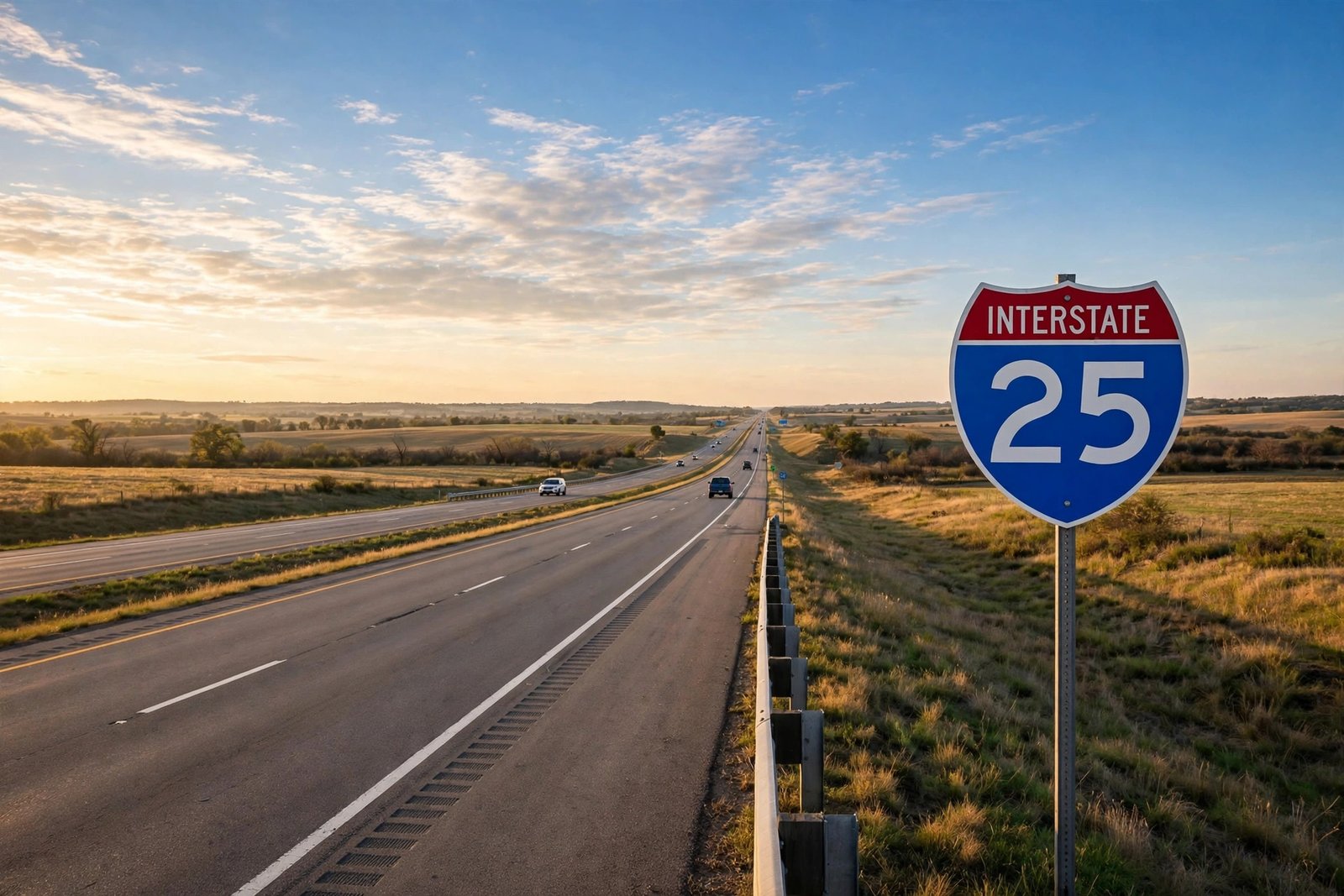
There is hardly an American road trip, commute, or delivery route that does not depend on it. The Interstate Highway System is the concrete backbone of modern American life, a network of controlled-access highways that links cities, carries freight, and makes it possible to drive from coast to coast without ever stopping at a traffic light. It is also one of the largest public works projects in the nation’s history, born from a young officer’s miserable cross-country journey, a president’s wartime observations, and a 1956 law that changed how America moves.
Understanding the Interstate System means understanding not just the roads but the ideas behind them: national defense, economic growth, and the belief that connecting a continent would make the country stronger. Seventy years after the system was authorized, its influence is so woven into daily life that it is easy to forget how recently it was built, and how bold the undertaking was.
A Young Officer’s Miserable Journey
The story begins in 1919, when a young Army officer named Dwight D. Eisenhower joined a transcontinental Army convoy traveling the Lincoln Highway from Washington to San Francisco. The convoy covered 3,251 miles in 61 days, an average pace that would seem absurd to any modern driver. Roads were unpaved or poorly maintained in long stretches, bridges failed, vehicles broke down, and the convoy slogged through mud and dust. For Eisenhower, the experience was a lesson in how weak America’s road network was, and how much that weakness would matter in a crisis.
Decades later, during World War II, Eisenhower saw the other side of the coin. In Germany, he observed the autobahn network, modern high-speed highways that allowed rapid military movement. The contrast with his 1919 experience stayed with him. When he became president, he carried both memories: the frustration of an army crawling across its own country, and the strategic value of roads built for speed and capacity.
Planning the System
The idea of a national highway network did not begin with Eisenhower. Planning roots go back to the Federal-Aid Highway Act of 1938, which called for a study of a national highway system, and the 1944 act calling for up to 40,000 miles of interstate highways. Those early plans sketched the shape of a system, but they did not solve the hardest problem: how to pay for it. Without a dedicated funding source, grand plans remained mostly on paper.
Eisenhower made the system a priority of his presidency, arguing that it served both civilian prosperity and national defense. The network would move goods and people efficiently in peacetime and move troops and supplies quickly in wartime. That dual purpose, reflected in the system’s formal name, the Dwight D. Eisenhower System of Interstate and Defense Highways, helped build the political coalition needed to fund it.
The 1956 Act
President Dwight D. Eisenhower signed the Federal-Aid Highway Act of 1956 on June 29, 1956, authorizing 41,000 miles of interstate highways. It was then the largest public works project in US history. The federal government paid 90 percent of project costs, an extraordinary commitment that reflected the project’s national scope, and the Highway Trust Fund was created as a dedicated funding source, giving the program the financial footing earlier plans had lacked.
The scale of the undertaking is hard to overstate. Building 41,000 miles of controlled-access highway meant acquiring land, designing interchanges, bridging rivers and mountains, and standardizing everything from lane widths to signage across dozens of states. Construction stretched across decades and employed generations of engineers, surveyors, and laborers. The system grew beyond its original authorization, and today it spans about 46,876 miles per figures cited by the Federal Highway Administration, connecting all 48 contiguous states.
What the Interstates Changed
The effects of the Interstate System reached into nearly every corner of American life. Freight movement became faster and more predictable, helping national supply chains and the growth of industries that depended on trucking. Suburbs expanded along interstate corridors, as commuters could live farther from city centers and still reach their jobs. Tourism boomed, with families able to drive long distances comfortably and reliably. Towns near interchanges grew, while some towns bypassed by the new highways struggled, a reminder that infrastructure reshapes communities as surely as it connects them.
The system also changed American culture. Roadside America, the motel, the fast-food restaurant, the rest stop, grew up along the interstates, creating a shared landscape that travelers from Maine to California would recognize. The open highway became a symbol of freedom and possibility in music, film, and advertising, even as the daily reality of interstate driving became, for most people, simply the way to work, to school, and to the store.
The Last Section and the Legacy
The final section of the original system is commonly dated to October 1992, when I-70 through Colorado was completed. That date marks the end of the original construction era, though the system has continued to evolve since, with improvements, widenings, and new segments keeping pace with population growth and changing travel patterns. The original vision, a connected nation, had been realized.
In 2026, the system marks its 70th anniversary, seven decades after Eisenhower signed the 1956 act. The anniversary is a chance to appreciate both the achievement and the ongoing responsibility it created. Highways age, traffic grows, and the needs of a country change. Maintaining and modernizing the system is now the work of a new generation, just as building it was the work of the last one. For the official history, the Federal Highway Administration’s history of the Eisenhower Interstate System is an excellent resource, and its detailed account of the system’s origins traces the planning story from the earliest studies onward.
The Interstate Highway System did not just pave America. It connected it, reshaped its economy, its cities, and its culture, and it remains, seventy years on, the network on which American daily life runs.
The Human Cost and the Debates
No honest account of the Interstate System can ignore its costs alongside its benefits. Building highways through cities often meant clearing neighborhoods, and the communities displaced by construction were frequently lower-income and minority neighborhoods with the least political power to resist. Some towns bypassed by the new highways lost the through-traffic their businesses depended on, and the growth of car-centered suburbs contributed to patterns of sprawl that later generations have had to reckon with. The system connected America, but it also divided some of its neighborhoods, and that legacy is part of the story.
These debates continue to shape highway policy today. Questions about whether to widen a highway or invest in other forms of transportation, how to repair aging bridges and interchanges, and how to reconnect neighborhoods split by past construction are all live issues in cities across the country. The Interstate System was built with a particular set of priorities, national mobility, defense, and economic growth, and later generations have added their own: equity, environmental health, and livable cities. The system endures not because those debates were settled in 1956, but because the network itself proved flexible enough to serve changing needs.
Driving the System Today
For most Americans, the Interstate System is not a historical monument but a daily tool. It carries commuters to work, trucks to warehouses, families to vacation destinations, and emergency vehicles to where they are needed. Its standardized signs, consistent design, and controlled access make long-distance driving safer and more predictable than the patchwork of roads that came before it. A driver can cross multiple states without ever learning a new set of local road rules, and that consistency is itself one of the system’s great achievements.
The system also remains a symbol. The idea of the open highway, of being able to drive from one end of the country to the other on a single network, is woven into American identity in a way few infrastructure projects ever achieve. Songs, films, and road-trip stories all draw on it, and every summer millions of families still load up a car and head out onto the interstates, retracing in comfort the kind of journey that took Eisenhower’s convoy two hard months to complete.
Frequently Asked Questions
When was the Interstate Highway System authorized?
President Dwight D. Eisenhower signed the Federal-Aid Highway Act of 1956 on June 29, 1956, authorizing 41,000 miles of interstate highways, then the largest public works project in US history.
How was the Interstate System funded?
The federal government paid 90 percent of project costs, and the Highway Trust Fund was created as a dedicated funding source for the program.
What inspired Eisenhower to support the system?
Two experiences shaped his support: his 1919 transcontinental Army convoy, which covered 3,251 miles in 61 days on the Lincoln Highway, and his World War II experience with Germany’s autobahn network.
How many miles does the system cover today?
The system today spans about 46,876 miles per Federal Highway Administration-cited figures, connecting all 48 contiguous states.
When was the original system completed?
The final section of the original system is commonly dated to October 1992, with the completion of I-70 through Colorado. The year 2026 marks the system’s 70th anniversary.