
Every fall, one of the most extraordinary journeys in the natural world begins quietly, in gardens and meadows across the eastern United States and Canada. Monarch butterflies, creatures light enough to rest on a fingertip, lift into the sky and begin a migration that can stretch up to 3,000 miles. Their destination is a cluster of mountain forests in central Mexico, a place most of them have never seen, reached by a generation that will never make the return trip. It is a feat of navigation, endurance, and biology that scientists are still working to fully understand.
The monarch migration has captivated people for generations, and for good reason. Few animals migrate so far relative to their size, and none does it quite like the monarch, whose journey spans multiple generations in a single year. To follow the migration is to follow a relay race written into the life cycle of a butterfly, with each generation handing the journey to the next.
The Fall Journey South
Per the US Fish and Wildlife Service, eastern monarchs migrate up to 3,000 miles from breeding grounds in the eastern United States and Canada to overwintering grounds in central Mexico. The fall migration typically starts in mid-August, as days shorten and temperatures begin to drop. Butterflies that emerge in late summer are different from their parents and grandparents: they belong to the migrating super generation, and their bodies and behavior are tuned for the long flight ahead.
The super generation lives up to eight or nine months, versus a few weeks for summer generations. That extraordinary lifespan is part of what makes the migration possible. Instead of mating and laying eggs right away, these butterflies delay mating until spring, conserving energy for the journey. They navigate by the sun, traveling roughly 50 miles a day and riding thermals, the rising columns of warm air that let them glide for long stretches without beating their wings. Gliding is the key to the whole enterprise: a butterfly that flapped every mile of the way could never make it, but a butterfly that rides the air can cover remarkable distances on modest energy.
A Forest Full of Butterflies
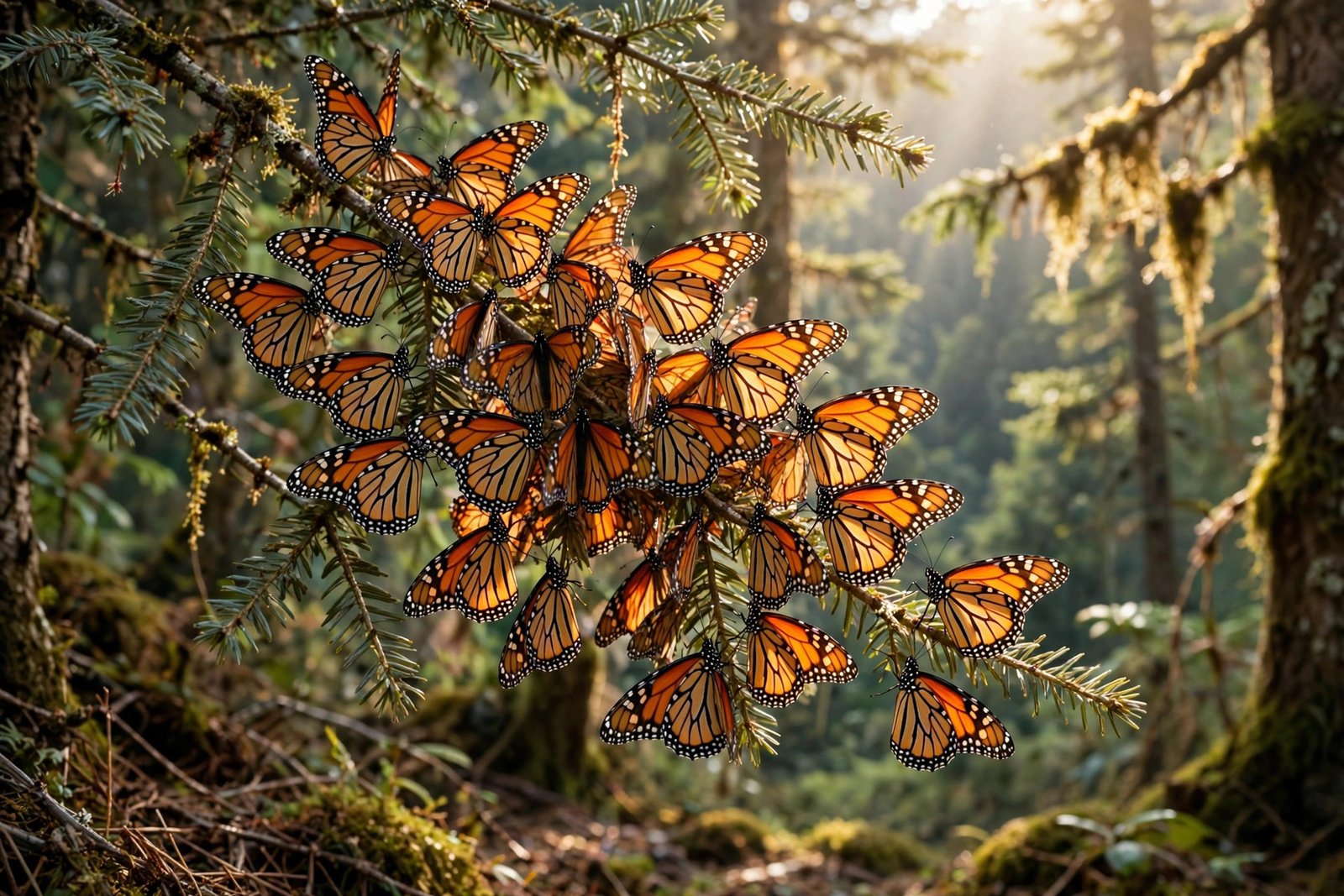
The destination of this journey is as remarkable as the flight itself. The monarchs cluster in oyamel fir forests in Mexico’s transvolcanic mountains, arriving from early November. There, in a handful of mountain sites, millions of butterflies drape the trees in living orange, clustering so thickly that branches bend under their weight. The forest canopy shelters them from wind and temperature swings, and the cool mountain air keeps their metabolism low, helping them survive the winter on stored fat.
Mexico established the Monarch Butterfly Biosphere Reserve in 1986, protecting 56,000 hectares of this critical habitat. The reserve is a recognition that the migration depends not just on the butterflies but on a specific place, and that losing that place would mean losing the migration. Conservationists, local communities, and researchers work within and around the reserve to protect the forest, monitor the colonies, and support livelihoods that do not depend on cutting the trees the butterflies need.
The Journey North Again
When winter loosens its grip, the migration reverses, but not in the way most people imagine. The butterflies begin the journey north in March, and this time the travelers mate along the way, laying eggs on milkweed as they travel. Their offspring continue northward, and the offspring of those offspring continue further still, so that by summer, monarchs have repopulated breeding grounds across the eastern United States and Canada. No single butterfly completes the round trip. The migration is a multi-generational relay, with the super generation’s descendants finishing what it started.
This relay is why milkweed matters so much. Monarch caterpillars feed only on milkweed, and the availability of milkweed along the migration route and in breeding areas determines whether each generation can thrive. Gardens, roadsides, and meadows planted with native milkweed are not just pretty additions to a landscape; they are waystations and nurseries for one of nature’s great migrations.
Threats Along the Way
The monarch migration faces serious threats. Deforestation and illegal logging in the overwintering forests reduce the shelter the butterflies depend on. Climate impacts and severe storms can strike colonies at their most vulnerable, when millions of butterflies are clustered in a small area. Habitat loss along the migration route and in breeding grounds, including the decline of milkweed, makes each leg of the journey harder. These pressures act together, which is why conservation efforts must address the whole migration, from Canadian breeding grounds to Mexican forests and everywhere in between.
Western monarchs face a related but distinct journey. They migrate a shorter distance to the California coast, overwintering in groves along the Pacific rather than flying to Mexico. Their story is a reminder that the monarch migration is not one single pattern but a set of regional strategies, each adapted to its landscape and each vulnerable to habitat loss in its own way.
Tracking the Migration Today
Researchers are finding new ways to follow the monarchs and learn from their journey. A recent project at Wichita Mountains Wildlife Refuge tagged 15 monarchs with solar-powered radio tags, allowing scientists to track individual butterflies over long distances. One tagged monarch traveled over 1,000 kilometers, about 621 miles, in 14 days to Monterrey, Mexico, a striking demonstration of how far and how fast a single butterfly can travel.
Tagging studies like this one, along with community science efforts in which volunteers report monarch sightings, help researchers map the migration in detail, identify critical stopover sites, and understand how weather and habitat shape the journey. For the public, these stories make the migration tangible: a butterfly tagged in Oklahoma can be followed, in data if not in person, all the way to Mexico. To learn more about this phenomenon, the US Fish and Wildlife Service account of the monarch migration is a wonderful starting point, and the Monarch Joint Venture migration guide explains the biology behind the journey in clear detail.
The monarch migration endures because the butterflies, the forests, and the people who protect them all play a part. Planting milkweed, supporting habitat conservation, and paying attention to the small orange travelers passing overhead in fall are all ways to keep a 3,000-mile journey alive for the generations, of butterflies and of people, yet to come.
Why the Migration Matters
The monarch migration matters for reasons that go beyond the beauty of the butterflies themselves. Monarchs are pollinators, moving between flowers as they feed and helping plants reproduce along the way. They are also an indicator species, meaning their fortunes reflect the health of the landscapes they travel through. When milkweed disappears from fields and roadsides, when forests shrink, or when weather patterns shift, monarch numbers respond, and those responses tell scientists something about the wider environment.
There is also a cultural dimension that is hard to measure but easy to feel. The migration crosses international borders, linking communities in Canada, the United States, and Mexico in a shared natural event. In Mexico, the arrival of the monarchs coincides with the Day of the Dead season, and local traditions have long associated the butterflies with returning souls, a connection that gives the migration a spiritual resonance for many people. In the United States and Canada, the fall passage of monarchs through gardens and schoolyards has introduced countless children to the idea of migration and to the wonder of the natural world.
How People Can Help Monarchs
Helping monarchs does not require a grand gesture. Planting native milkweed in a garden, yard, or community space gives caterpillars the food they need and gives migrating adults a place to rest and feed. Choosing native nectar plants that bloom at different times of the season extends that support across the months when monarchs are active. Avoiding pesticide use where monarchs feed and breed protects caterpillars and adults alike, since chemicals meant for other insects can harm butterflies too.
Community science is another way to contribute. Reporting monarch sightings to migration-tracking projects helps researchers follow the migration in real time and identify the places where monarchs stop, feed, and breed. Even simply paying attention, noticing the first monarch of spring or the last one of fall, connects a person to a cycle much larger than any single garden. The migration has survived because landscapes, forests, and people have sustained it together, and each of those threads matters for the journeys still to come.
Frequently Asked Questions
How far do monarch butterflies migrate?
Eastern monarchs migrate up to 3,000 miles from breeding grounds in the eastern United States and Canada to overwintering grounds in central Mexico, according to the US Fish and Wildlife Service.
What is the monarch super generation?
The super generation is the late-summer generation that migrates south. It lives up to eight or nine months, versus a few weeks for summer generations, delays mating until spring, navigates by the sun, and travels roughly 50 miles a day while riding thermals.
Where do monarchs spend the winter in Mexico?
They cluster in oyamel fir forests in Mexico’s transvolcanic mountains, arriving from early November. Mexico established the Monarch Butterfly Biosphere Reserve in 1986, covering 56,000 hectares, to protect this habitat.
When do monarchs start heading north again?
They begin the journey north in March. The returning butterflies mate and lay eggs along the way, and successive generations continue northward through the spring and summer.
Do all monarchs migrate to Mexico?
No. Western monarchs migrate a shorter distance to the California coast, overwintering in coastal groves rather than flying to Mexico.