
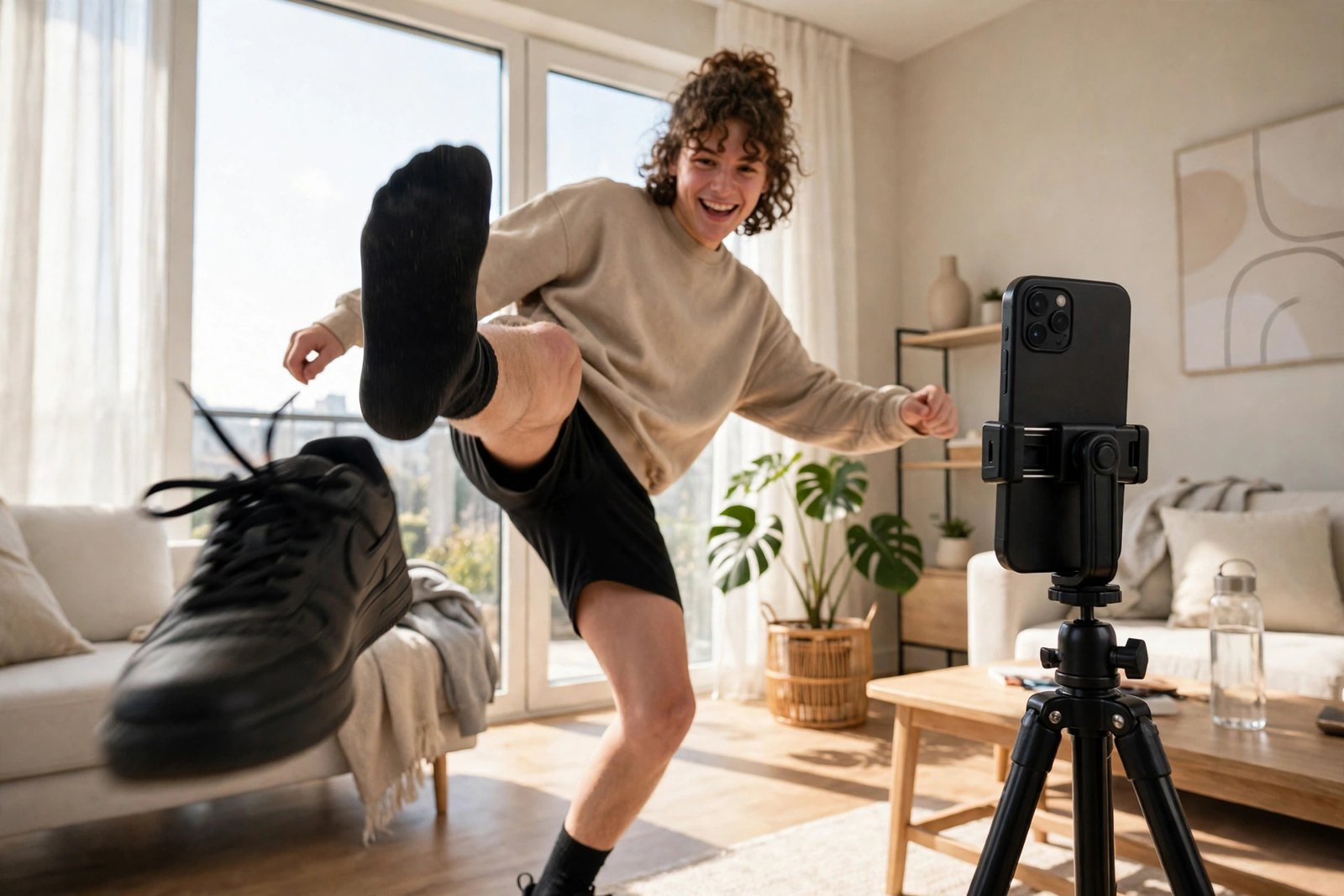
Every few weeks, TikTok finds a new transition, and every few weeks, millions of viewers learn a new way to watch someone change outfits. The latest format drawing attention is the Shoe Kick Transition, a deceptively simple idea: a creator balances a sneaker or boot in a karate-style kick, then kicks into the shoe to reveal a brand-new outfit. In a feed full of elaborate edits, the charm of this trend is its physicality. The transition is performed, not just edited, and the kick itself is the moment the video turns.
As described by trend trackers in October 2026, the Shoe Kick Transition is listed among current growth-stage TikTok trends, alongside the “But Where?” shrug and the “We Can’t All Be Matcha Girls” counter-wellness format. That grouping tells you something about where TikTok is right now: short, repeatable formats that anyone can try, built around a single gesture or attitude, are traveling fast. The Shoe Kick Transition fits that mold perfectly. It needs no special equipment, no elaborate setup, and no advanced editing skill, just a shoe, a camera, and a willingness to kick.
How the Format Works
The basic format is easy to describe and fun to watch. The creator starts in one outfit, often casual or deliberately plain, and sets up the shot so the camera captures the full body or at least the lower body and the shoe. Then comes the kick: the creator balances a sneaker or boot in a karate-style kick, holding the pose for a beat so viewers register what is happening. The kick drives into the shoe, and on the cut, the creator appears in a brand-new outfit, as if the kick itself caused the change.
The effect works because the motion hides the edit. Viewers’ eyes follow the moving foot, and the cut lands in the middle of that motion, so the outfit change feels like a consequence of the kick rather than a simple jump cut. It is the same principle behind many classic transition videos, where a hand swipe, a spin, or a jump masks the moment one clip becomes another. Here, the shoe is both the prop and the punchline, and the karate-style framing adds a playful, confident energy that suits the reveal.
Why This Transition Catches On
Transitions catch on when they balance novelty with repeatability, and the Shoe Kick Transition does both. The novelty is in the shoe itself: most outfit transitions rely on a hand movement or a spin, so a kick stands out in a feed. The repeatability is in the simplicity: anyone with a pair of sneakers and a phone can attempt it, and each attempt looks a little different depending on the shoe, the outfit, the setting, and the kicker’s style. That variation keeps the format fresh even as more people try it.
The format also invites a before-and-after story, which is one of the most durable structures on social video. The first outfit sets up an expectation, the kick delivers a surprise, and the second outfit pays it off. Viewers stay to see the reveal, and creators get a natural hook in the first second of the video: a shoe in the air is an unusual opening image, and unusual openings stop thumbs from scrolling. When a format gives creators a hook, a payoff, and room to personalize, it has the ingredients to spread.
How to Film a Shoe Kick Transition
Filming the transition is straightforward, but a few practical choices make the difference between a clean effect and a messy one. First, lock the camera down. A tripod, a stack of books, or a phone propped securely in place will keep the frame steady between the two clips, and a steady frame is what sells the illusion that only the outfit changed. If the camera moves between takes, the cut becomes obvious.
Second, mark your position. Stand in the same spot for both clips, and note where your feet land, so the before and after shots line up. Some creators put a small piece of tape on the floor as a marker, a simple trick that saves a lot of frustration. Third, film the kick in both clips: the first clip ends mid-kick, and the second clip begins with the follow-through in the new outfit, so the motion bridges the cut. Practice the kick a few times before recording, and keep it controlled. A big, wild kick is harder to match across clips than a sharp, deliberate one, and it is also easier to lose your balance mid-take.
Fourth, think about the shoe. The shoe is the star of the transition, so choose one that reads clearly on camera: a sneaker with a bold color or a boot with a distinctive shape will register better than a shoe that blends into the background. Finally, keep the lighting consistent between clips. Film both takes in the same light, ideally without moving lamps or changing position relative to a window, so the two halves of the video feel like one continuous moment.
Reading the Trend Cycle
For creators deciding whether to try a trend, timing matters, and trend trackers offer a useful rule of thumb. Guidance cited by trackers says sounds in the 1,000 to 20,000 video range sit in a growth window, a stage where a format is gaining momentum but has not yet become so common that new versions blend together. Creators are advised to check TikTok Creative Center with the region filter set to United States, so they are reading the trend landscape for the audience they actually want to reach rather than a global average that may not reflect their viewers.
That kind of check is part of a broader habit worth building: before jumping on a format, look at how it is actually being used, what variations are working, and whether your version can add something of its own. The creators who stand out in a trend cycle are rarely the ones who copy a format exactly. They are the ones who bring a personal twist to it, whether that is an unexpected shoe choice, a surprising second outfit, a funny setting, or a kick with real style.
Not Just Another Costume Trend
It is worth noting what the Shoe Kick Transition is not. The trend is distinct from October’s costume trends, including the Ramalama Costume Walk and the Pumpkin Head Illusion, which are built around costumes and seasonal dressing up. The Shoe Kick Transition is a transition format first and foremost: it works in any season, with any wardrobe, and its appeal does not depend on Halloween or any holiday. That distinction matters for creators planning content, because a transition format has a longer shelf life than a seasonal costume trend, and it can be reused with new outfits long after the initial wave passes.
At the same time, the format sits comfortably alongside the other growth-stage trends of the moment. The “But Where?” shrug trades on a gesture of comic confusion, and the “We Can’t All Be Matcha Girls” format pushes back against wellness culture with humor. All three are short, attitude-driven, and easy to personalize, which may be why they are traveling together. TikTok’s trend cycle rewards formats that let personality show through a simple structure, and the Shoe Kick Transition is a textbook example. You can find current trend listings and analysis through resources like this current TikTok trends tracker, and a roundup of TikTok trends for October 2026 places the format in context with the month’s other rising formats.
Making Your Version Stand Out
With any repeatable format, the versions that travel furthest usually add one personal twist. For the Shoe Kick Transition, that twist can come from the shoe itself, an unexpected pair that nobody else is using, or from the second outfit, a reveal that surprises because it contrasts sharply with the first look. It can come from the setting, a kitchen, a rooftop, a park path, anywhere the kick feels a little unexpected, or from the performance, a confident pose held just a beat longer than viewers expect before the cut lands.
Sound choice matters too. A track that matches the energy of the kick, punchy and upbeat rather than slow or sleepy, helps the reveal land with impact. And as with any trend, the best time to post your version is while the format still feels fresh to your audience, which is why keeping an eye on trend trackers and on TikTok Creative Center, with the region filter set to United States, is a practical habit for creators who want to ride a wave rather than chase one after it has passed.
Frequently Asked Questions
What is the Shoe Kick Transition?
It is a TikTok format in which creators balance a sneaker or boot in a karate-style kick, then kick into the shoe to reveal a brand-new outfit. The kick masks the edit between the before and after clips.
What do I need to film it?
Just a phone, a shoe, and two outfits. A stable camera position, a marked spot on the floor, consistent lighting, and a practiced, controlled kick will make the transition look clean.
How do I know if a TikTok trend is still growing?
Trend guidance cited by trackers says sounds in the 1,000 to 20,000 video range sit in a growth window. Creators should check TikTok Creative Center with the region filter set to United States to read the trend landscape for their audience.
Is the Shoe Kick Transition a Halloween trend?
No. It is distinct from October’s costume trends such as the Ramalama Costume Walk and the Pumpkin Head Illusion. It is a transition format that works in any season with any wardrobe.
What other trends are growing alongside it?
As reported by trend trackers in October 2026, it is listed among current growth-stage trends alongside the “But Where?” shrug and the “We Can’t All Be Matcha Girls” counter-wellness format.