
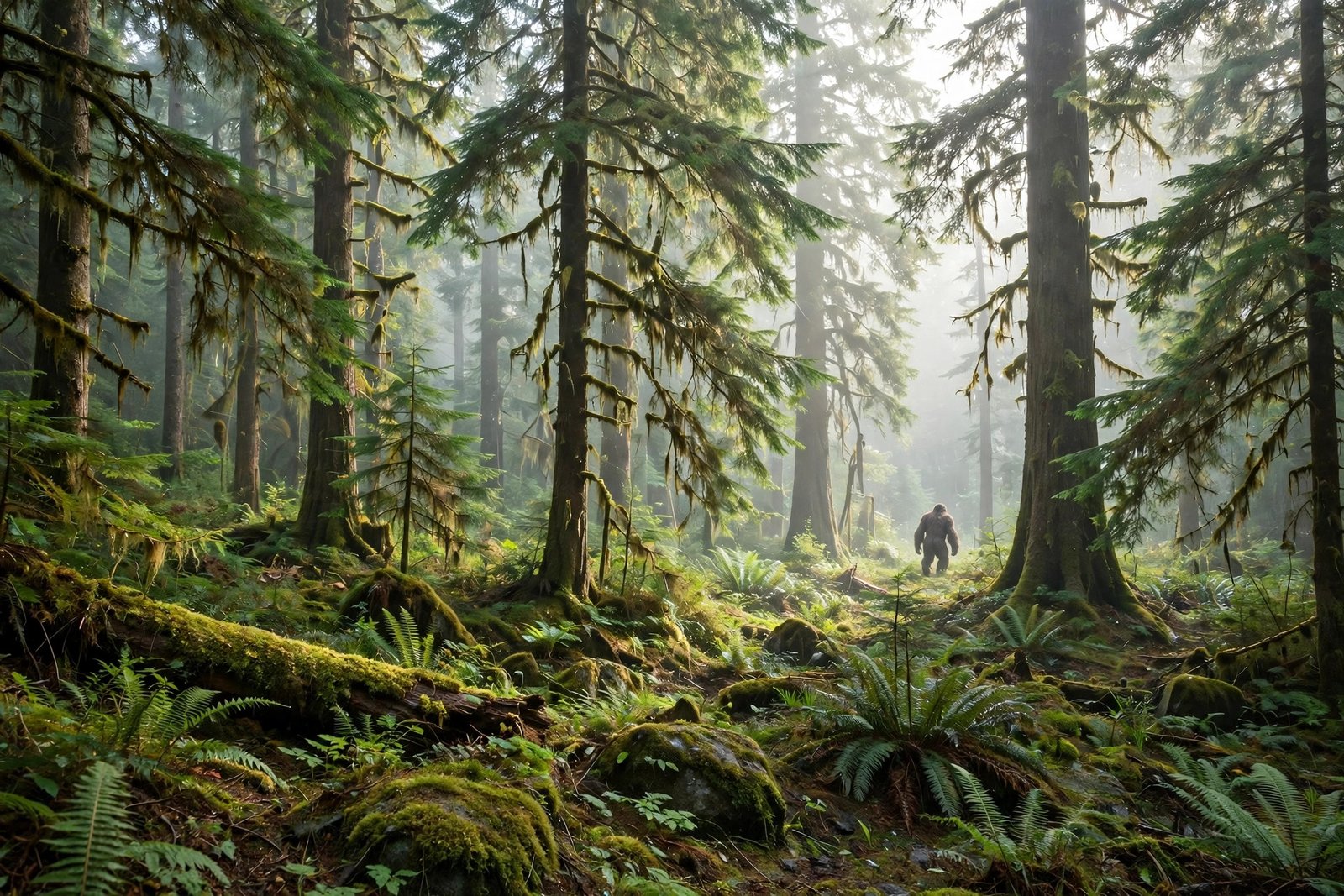
There is a stretch of forest in the Pacific Northwest where the trees grow so tall and so close together that daylight arrives filtered and green, and a hiker can walk for hours without meeting another person. It is in places like this — the damp valleys of Washington, the Cascade foothills of Oregon, the redwood country of Northern California, and the coastal rainforests of British Columbia — that America’s most durable legend was born. The creature at its center goes by many names, but the one most people know is Bigfoot. According to the stories told about it, it is a tall, hair-covered, upright-walking being that keeps to the deep woods, leaves enormous footprints, and vanishes before anyone can get a clear look. No scientist has ever produced a body, a skeleton, or verified DNA that proves such a creature exists, and that absence of proof is itself part of the story. Yet the legend has survived for generations, growing from Indigenous oral traditions and frontier tales into films, festivals, television shows, and a small but persistent field of amateur investigation.
Older Than the Name Bigfoot
Long before anyone said the word Bigfoot, Indigenous peoples of the Pacific Northwest told stories of large, hairy, wild beings living in the forests. These traditions belong to many different nations and communities, and they do not all describe the same creature. Some accounts describe a being that steals food or startles hunters; others describe a shy forest dweller that avoids people altogether. The Coast Salish peoples of British Columbia and Washington told stories of a being whose name was later anglicized as Sasquatch, a term popularized in the 1920s by Canadian teacher and journalist J. W. Burns, who collected stories from the Chehalis First Nation and published them for a wider audience. Burns spelled the name Sasquatch, drawing on the Coast Salish word Sasq’ets, and that spelling stuck.
The Footprints That Gave Bigfoot Its Name
The modern Bigfoot era is usually dated to 1958, when large, humanlike footprints were reported near a road-construction site at Bluff Creek in Northern California. Construction worker Jerry Crew found the tracks, made a plaster cast of one, and showed it to a local newspaper, the Humboldt Times. The paper ran the story, and in its coverage the creature that supposedly made the tracks was dubbed Bigfoot. The name caught on immediately, and within a few years it had replaced Sasquatch in popular American usage, even though the two words are often used interchangeably today.
Later, the story behind those 1958 tracks grew more complicated. Ray Wallace, a road-construction contractor in the Bluff Creek area, was reported after his death to have faked some of the famous footprints with carved wooden feet, and his family displayed the alleged props. Enthusiasts dispute how much of the Bluff Creek evidence Wallace can account for, and the argument continues, but the episode established a pattern that would repeat for decades: a striking piece of evidence, public excitement, and then a hoax claim that muddies the water. For readers, the lesson is a useful one. A footprint cast, however impressive it looks in a photograph, is not the same as proof of an animal, especially when the same region has a documented history of pranks.
By the early 1960s, the legend had its first full-time champions. Roger Patterson, a rodeo rider from Yakima, Washington, became fascinated by the reports after reading about them in magazines, and in 1966 he self-published a book asking whether abominable snowmen of America really existed. Patterson was not a scientist, but he was a tireless promoter, and he spent years talking to witnesses, collecting footprint casts, and planning a documentary film about the creature. That film project is what took him back to Bluff Creek in the autumn of 1967 — and into history.
The Patterson-Gimlin Film: Fifty-Nine Seconds That Changed Everything
According to Patterson and his companion, Robert Bob Gimlin, the two men were riding on horseback along Bluff Creek on the afternoon of October 20, 1967, when they came upon a large, hair-covered figure walking across a sandbar beside the creek. Patterson, who had a 16mm camera, filmed the figure as it walked away from them, glanced back over its shoulder at one point, and disappeared into the trees. The resulting footage, known ever since as the Patterson-Gimlin film, runs for about 59.5 seconds at 16 frames per second and contains roughly 954 frames. The most reproduced image from it, frame 352, shows the figure mid-stride, turning to look toward the camera.
Nothing else in Bigfoot lore has been studied as closely. Supporters point to details they say a costume could not easily fake in 1967: the way the figure’s muscles appear to move beneath its hair, the length and proportions of its arms and legs, and the depth of the footprints the men said they cast at the site afterward. Anatomist Grover Krantz, one of the few credentialed academics to take the subject seriously, argued that the figure’s gait and proportions did not match a person in a suit. Other analysts, including special-effects artists, have studied cleaned-up versions of the film and reached similar conclusions about how difficult the footage would have been to fake with the materials of the era.
Skeptics tell a very different story, and their version is at least as well documented. Costume maker Philip Morris has claimed that he sold Patterson an ape suit used in the film, and a Yakima man named Bob Heironimus has claimed that he was the person inside the suit. Gimlin has always denied any hoax, and Patterson maintained until his death from cancer in 1972 that the creature on the film was real. The claims and counterclaims have never been resolved to everyone’s satisfaction, because the original film itself is short, grainy, and shot from a moving horse — exactly the kind of evidence that invites argument rather than settling it. What is not in dispute is the film’s cultural impact. After 1967, Bigfoot was no longer a regional logging-camp tale. It was a national celebrity.
Ape Canyon and the Reports That Kept Coming
The Patterson-Gimlin film was not the only famous case from the region, and the other stories help explain why the legend keeps renewing itself. One of the oldest is the Ape Canyon incident of 1924, in which a group of gold prospectors on the slopes of Mount St. Helens in Washington claimed that ape-like beings threw rocks at their cabin through the night. The U.S. Forest Service investigated at the time and treated the story as a probable hoax, yet the canyon kept its name, and the tale is still retold on hiking guides and local tours today. Whether or not anything happened at Ape Canyon, the story shows how a single dramatic night can brand a landscape for a century.
What Science Says — and Why Skeptics Are Not Convinced
The scientific consensus is blunt: there is no confirmed physical evidence for Bigfoot. No body has ever been recovered, no skeleton has been found in a museum collection, and no DNA sample attributed to Bigfoot has survived verification. Hair samples submitted as Bigfoot evidence have, when tested, turned out to belong to known animals, including bears, deer, and other mammals. A widely reported example involved hair samples examined by the FBI in the 1970s, which were identified as deer hair. More recent genetic studies of supposed Bigfoot, Yeti, and related samples have reached the same conclusion: the samples match known species.
Ecologists raise a second objection that is harder to wave away. A breeding population of large primates — animals described in reports as standing seven feet tall or more — would need food, territory, and mates, and would leave traces: bones, droppings, nests, and eventually roadkill. North America’s forests are vast, but they are also crisscrossed by roads, trails, logging operations, and trail cameras, and no such population has ever been documented by any of those means. That is a serious problem for the idea of a hidden ape living in Washington and Oregon, however remote some valleys may feel to a hiker.
The most common scientific explanations for sightings are more ordinary, but they are also more consistent with what we know about human perception. Black bears can stand and walk briefly on their hind legs, and in poor light, at a distance, a bear’s silhouette can look startlingly humanlike. A 2023 study found a strong correlation between black bear populations and reported Bigfoot sightings across North America, suggesting that many reports track bear habitat rather than an unknown animal. Add in shadows, fog, fatigue, and the power of suggestion — once you have heard the legend, an odd shape in the trees is easier to read as Bigfoot — and researchers say most reports can be explained without inventing a new species. None of this proves that every witness is lying or mistaken, but it does explain why scientists treat Bigfoot as folklore until something better than a blurry film or a footprint cast turns up.
Bigfoot in Law, Tourism, and Popular Culture
Perhaps the strangest chapter in the Bigfoot story is a legal one. On April 1, 1969 — April Fool’s Day, which did not help its credibility — Skamania County, Washington, passed Ordinance No. 69-01, making the premeditated, willful, and wanton slaying of a Sasquatch a felony punishable by a fine of up to 10,000 dollars and up to five years in jail. County officials insisted the ordinance was serious, explaining that publicity around reported sightings was drawing armed visitors into the forests and creating a safety risk. In 1984 the county amended the law, reducing the offense to a gross misdemeanor and declaring the whole county a Sasquatch Refuge, with Sasquatch designated an endangered species of the county. Whatcom County later declared itself a Sasquatch protection and refuge area as well. These laws do not prove that Bigfoot exists — they prove that the legend was already powerful enough, by 1969, to worry local officials.
How to Explore Bigfoot Country Responsibly
If you want to explore the legend for yourself, the Pacific Northwest makes it easy, and you do not need to believe in Bigfoot to enjoy the trip. The landscapes at the heart of the stories — Olympic National Park, the Gifford Pinchot National Forest, Mount Hood National Forest, and the redwood parks of Northern California — are spectacular by any measure, with old-growth trees, waterfalls, and trails that range from easy boardwalks to multi-day backcountry routes. Plan your hike the way you would any other: check trail conditions, carry water and rain gear, tell someone your route, and stay on marked trails. The forests are real, and their hazards — steep ground, fast rivers, and changing weather — are real too.
For more on the most famous piece of Bigfoot evidence, see the background on the Patterson-Gimlin film and a detailed case review of the 1967 Bluff Creek footage. The Skamania County ordinance is explained in Mental Floss’s account of the county where killing Bigfoot is illegal, and a broader overview of Pacific Northwest reports and skeptical explanations appears in this survey of Pacific Northwest sightings.
Frequently Asked Questions
Is Bigfoot real?
There is no confirmed scientific evidence that Bigfoot exists. No body, skeleton, or verified DNA sample has ever been produced, and most scientists regard Bigfoot as folklore, misidentification, and hoax, rather than a real animal. The sightings and stories described in this article are claims reported by witnesses, not established facts.
What is the Patterson-Gimlin film?
It is a short 16mm film shot on October 20, 1967, near Bluff Creek in Northern California by Roger Patterson and Robert Gimlin, which they said shows a large, hair-covered, bipedal figure. The film runs about 59.5 seconds and remains the most famous and most debated piece of Bigfoot evidence. Its authenticity is disputed, with hoax claims from a costume maker and an alleged suit wearer, and denials from Gimlin.
Where are most Bigfoot sightings reported?
Reports cluster in the Pacific Northwest, especially Washington, Oregon, Northern California, and British Columbia, with concentrations around forested areas such as the Olympic Peninsula, the Gifford Pinchot National Forest, and the Cascade Range. Enthusiast databases such as the BFRO collect these reports, but clustering alone does not prove an animal lives there.
Why do scientists doubt Bigfoot?
Scientists cite the absence of a body, bones, or verified DNA, the fact that hair samples have matched known animals, and the ecological problem of a large breeding population leaving no confirmed trace despite roads, trails, and trail cameras across its supposed range. Many sightings are also consistent with misidentified black bears, which can stand upright briefly.
Is it really illegal to kill Bigfoot anywhere?
Skamania County, Washington, passed an ordinance in 1969 making the willful slaying of a Sasquatch a felony, later amended in 1984 to a gross misdemeanor with the county declared a Sasquatch Refuge. The ordinance was motivated by safety concerns about armed visitors, not by scientific proof that the creature exists.
Related reading
If you enjoyed this article, you may also like: The Mothman Legend of Point Pleasant The Jersey Devil of the Pine Barrens Skinwalker Ranch: Utah’s Mystery.