
Flip a light switch in New York, charge a phone in Phoenix, or run a factory in Ohio, and the same quiet miracle happens: electricity made somewhere else arrives at exactly the right moment, at exactly the right voltage, without you having to think about it at all. Behind that ordinary moment sits one of the largest machines ever built in the United States — the power grid. It is not a single wire or a single company. It is a continent-spanning network of power plants, towering transmission lines, substations, control rooms, and millions of miles of smaller wires, all working together in real time. Understanding how electricity travels across America is really understanding how modern life stays powered, from hospital operating rooms and data centers to kitchen lights and electric cars.
What the Power Grid Actually Is
The U.S. Energy Information Administration describes the grid as the complex system of substations, transformers, and power lines that connects electricity producers and consumers. Most local grids are interconnected with each other, forming larger and more reliable networks so there is always enough electricity to meet demand. In the United States, that means thousands of miles of high-voltage power lines and millions of miles of lower-voltage lines, all tied together.
Think of the grid in three stages. First comes generation, where power plants make electricity. Then comes transmission, where that electricity travels long distances at very high voltage. Finally comes distribution, where the voltage is stepped back down and power is delivered to homes, shops, schools, and factories. Each stage has its own equipment and its own vulnerabilities, and a failure in any one stage can ripple outward. That is why grid operators plan for redundancy — extra paths, backup plants, and spare capacity — wherever they can.
Step One: Where Electricity Is Made
Every journey on the grid starts at a power plant. The United States has thousands of generating plants, and they make electricity in different ways. Some burn natural gas or coal to make steam, which spins a turbine. Nuclear plants use the heat from fission to do the same job without burning fuel. Hydropower plants, like the Hoover Dam, use falling water to spin turbines. Wind turbines catch the wind, and solar panels turn sunlight directly into electricity. The mix changes by region and season: the Pacific Northwest leans heavily on hydropower, the Southwest has abundant sunshine, the Great Plains are rich in wind, and the Southeast and Midwest still rely on a large share of gas, coal, and nuclear power.
What matters for the grid is not just how much power a plant can make, but when it can make it and how quickly it can change its output. Some plants run almost constantly, providing a steady base of power day and night. Others can ramp up quickly when demand spikes in the late afternoon, when millions of Americans come home, turn on air conditioning, cook dinner, and charge devices at the same time.
Step Two: Stepping Up the Voltage for the Long Haul
Electricity loses energy as heat when it travels through a wire, and the longer the journey, the greater the loss. The solution is both elegant and old: raise the voltage. At a power plant, a step-up transformer boosts the electricity to extremely high voltage before it enters the transmission system, and at those voltages far less energy is wasted on the way. The Energy Information Administration notes that high-voltage transmission lines carry electricity over long distances, and that higher voltage makes long-distance transmission more efficient and less expensive.
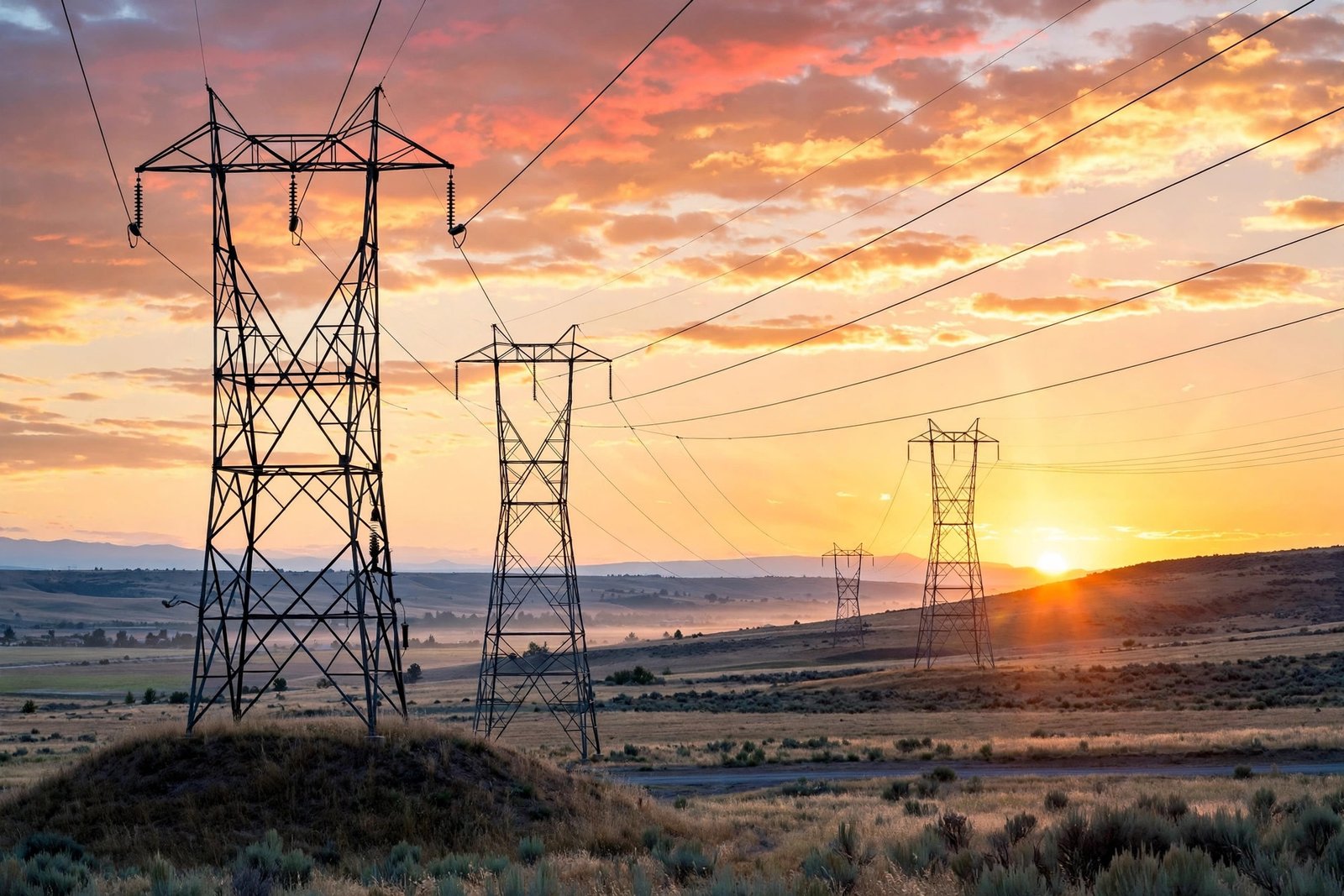
Those are the lines most Americans picture when they think of the grid: tall steel lattice towers marching across farmland, desert, and mountains, carrying thick cables high above the ground. Transmission voltages can range from about 69,000 volts to 765,000 volts, and the lines can run overhead or, less commonly, underground. Roughly five percent of electricity is lost in transmission and distribution in the United States — a figure that sounds small until you remember the enormous scale of the system.
Step Three: Substations, Distribution, and Your Street
High-voltage electricity is efficient for travel, but it is far too powerful to bring directly into a home. That is where substations come in: fenced yards full of transformers, switches, and circuit breakers whose main job is to step voltage down in stages. Transmission lines arrive at very high voltage, transformers reduce it to a medium voltage, and distribution lines carry it onward toward neighborhoods. Along the way, smaller transformers — the gray cylinders on utility poles, or the green boxes on the ground in newer neighborhoods — step the voltage down again, to the level that is safe for a house.
Distribution is the part of the grid most of us actually see: wooden poles, wires strung between them, transformers, and the meter on the side of a house. It is also, by mileage, by far the largest part of the system. Millions of miles of distribution lines crisscross the country, and they are the most exposed to weather. A falling tree branch, an ice storm, a car hitting a pole, or a squirrel getting into the wrong place can cut power to a street, even while the big transmission system keeps humming along. That is why most outages Americans experience are distribution outages, not failures of the big grid itself.
Three Grids, Not One
Here is the fact that surprises most Americans: the continental United States does not have one power grid. It has three. The U.S. electric system in the Lower 48 states is made up of three main interconnections, which operate largely independently of each other, with only limited transfers of power between them. All three run at the same standard frequency, about 60 hertz, but they are not synchronized with each other, and power cannot simply flow freely from one to another.
The Eastern Interconnection is the largest. It covers the area east of the Rocky Mountains and a portion of northern Texas, and it includes 36 balancing authorities — 31 in the United States and five in Canada. The Western Interconnection covers the area from the Rockies westward, including California, Oregon, Washington, Arizona, Nevada, Utah, and Idaho, with 37 balancing authorities — 34 in the United States, two in Canada, and one in Mexico.
The third grid is the Texas Interconnection, run by the Electric Reliability Council of Texas, known as ERCOT. It covers most, but not all, of Texas, and it consists of a single balancing authority. Texas built its grid to stand largely apart, and it remains mostly separate from the other two by design. The links between the interconnections are narrow: the Department of Energy has noted that converter stations along the seam between the Western and Eastern interconnections allow about 1,320 megawatts to flow between them — a small amount compared with the size of the two networks. Alaska and Hawaii sit outside all three interconnections entirely.
Who Keeps the Lights On?
If the grid is a machine, the people who run it are its nervous system. Day-to-day operation within regions is managed by entities called balancing authorities, whose job is to keep supply and demand in balance at every moment. They watch demand rise and fall, dispatch power plants up and down, and keep the system frequency steady. In parts of the country, that job is done by regional transmission organizations or independent system operators — groups like PJM in the mid-Atlantic and Midwest, MISO in the central United States, CAISO in California, NYISO in New York, ISO New England, SPP in the Plains, and ERCOT in Texas. In other regions, individual utilities perform the balancing role themselves.
Above the balancing authorities sits the North American Electric Reliability Corporation, known as NERC. It is the nonprofit regulatory authority charged with reducing risks to the reliability and security of the bulk power system across North America. NERC develops and enforces mandatory reliability standards, monitors the grid, assesses whether there will be enough power to meet demand in the years ahead, and investigates major disturbances to learn what went wrong. When the grid fails on a large scale, the consequences are measured in lives, not just inconvenience.
Reliability: Why Outages Happen and How the Grid Fights Back
No grid is perfect, and the American grid faces a growing list of stresses. Extreme weather is the biggest one. Hurricanes can knock down transmission towers and flood substations. Ice storms can snap lines under the weight of frozen rain. Heat waves push demand to its peak at the same time they make power plants and lines less efficient. Wildfires can force utilities to shut off power preemptively to prevent their equipment from starting new fires.
The grid defends itself in layers. First, it is built with redundancy: if one line fails, power can often take another path. Second, operators keep reserve capacity on standby, so a sudden loss of generation can be replaced quickly. Third, protective equipment like circuit breakers can isolate a fault in milliseconds, stopping a local problem from spreading. Fourth, utilities invest in hardening — stronger poles, underground lines in vulnerable areas, vegetation management to keep trees away from wires, and flood protection for substations.
Modernization: The Smart Grid and What Comes Next
The grid Americans use today was largely built in the twentieth century, for a world of big central power plants and one-way power flow. The grid of the future has to do more. The Department of Energy describes grid modernization as making the grid smarter and more resilient through cutting-edge technologies, equipment, and controls that communicate and work together to deliver electricity more reliably and efficiently. Modernizing the grid, the department says, can greatly reduce the frequency and duration of power outages, reduce storm impacts, and restore service faster when outages occur.
The tools of that modernization are already arriving. Advanced sensors called phasor measurement units let operators assess grid stability in real time. Advanced digital meters give consumers better information and automatically report outages. Relays can sense and recover from faults in a substation automatically. Automated feeder switches can reroute power around problems without waiting for a crew. Batteries can store excess energy and make it available later to meet demand.
Transmission is the other great frontier. New high-voltage lines could connect windy and sunny regions to the cities that need their power — but building them in America is slow, tangled in permitting, cost allocation, and local opposition. The Department of Energy’s Interconnections Seam Study explored the benefits of strengthening the links between the western and eastern grids, and whether those links get built will shape the American grid for decades.
Why the Grid Matters to American Power
The power grid is infrastructure, but it is also a statement about what kind of country the United States wants to be. A reliable grid underpins everything else: the factories that make things, the hospitals that save lives, the schools that teach children, the data centers that run the internet, and the military bases that defend the nation. When the grid works, it is invisible, and that invisibility is its own kind of success.
For ordinary Americans, the most practical takeaway is simple: the light switch is the end of a very long and very human chain. Someone built the plant, someone strung the wire, someone watches the control room at three in the morning, and someone climbs the pole in the rain to fix what broke. The next time the lights come on without a second thought, that is the grid doing its job — quietly, constantly, and across an entire continent.
Frequently Asked Questions
How many power grids does the United States have?
The Lower 48 states run on three main interconnections: the Eastern Interconnection, the Western Interconnection, and the Texas Interconnection run by ERCOT. They operate largely independently, with only limited power transfers between them. Alaska and Hawaii are outside all three.
Why is electricity transmitted at such high voltage?
Higher voltage means less energy is lost as heat over long distances, which makes transmission more efficient and less expensive. Step-up transformers at power plants raise the voltage for the journey, and step-down transformers at substations lower it again before it reaches homes and businesses.
What is a balancing authority?
A balancing authority is the entity responsible for keeping electricity supply and demand in balance within its area, moment by moment. In some regions that role is filled by a regional transmission organization or independent system operator; in others, it is filled by a utility.
What causes most power outages in the United States?
Most outages Americans experience are caused by problems on the local distribution system — storm damage, falling trees, ice, vehicle accidents, or equipment failure on neighborhood lines — rather than failures of the big high-voltage transmission system.
What is the smart grid?
The smart grid is the modernization of the traditional grid with two-way communication, sensors, automated controls, and digital meters.