
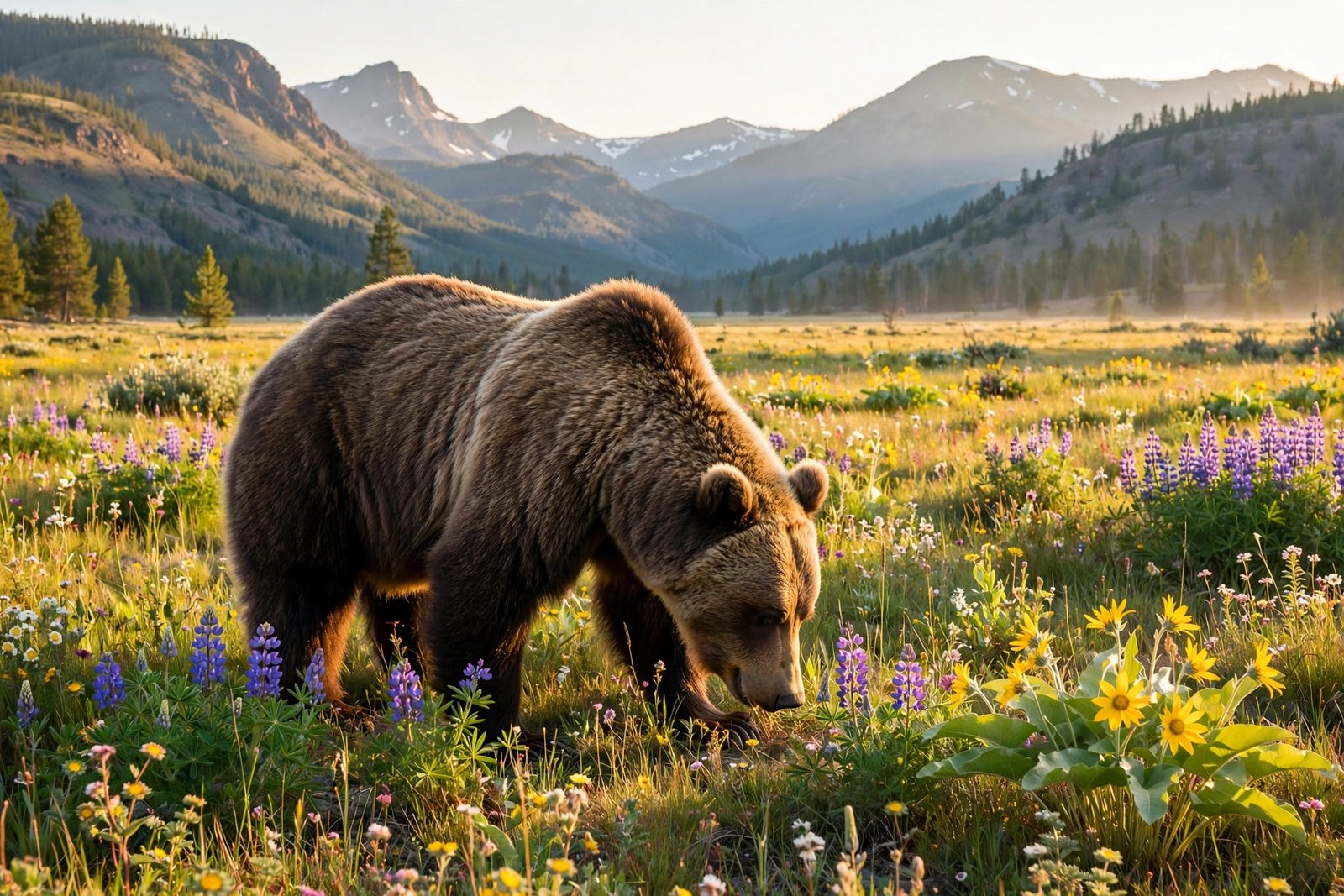
There is a moment every Yellowstone visitor dreams about. You round a bend in Lamar Valley at first light, and there, far across the sagebrush, a huge brown shape is moving slowly through the grass. A spotting scope reveals the hump on its shoulders, the dish-shaped face, the long claws. It is a grizzly bear, the most famous animal in America’s first national park, and for a few minutes the whole valley seems to hold its breath.
This guide covers what makes Yellowstone’s grizzlies special, how many of them live in the region, where visitors are most likely to spot them, how the bears live through the seasons, and, most importantly, how to stay safe in bear country. The numbers here come from the National Park Service, the U.S. Geological Survey, and the U.S. Fish and Wildlife Service, and where a figure is an estimate, this guide says so. Bears do not follow schedules, and no visit guarantees a sighting, but knowing where to look and how to behave will give you the best chance of a safe and memorable encounter.
Meet the Grizzly Bear
The grizzly bear is the North American subspecies of the brown bear, known to scientists as Ursus arctos horribilis. Grizzlies are distinguished from Yellowstone’s other bear, the American black bear, by a few reliable features: a prominent muscular hump over the shoulders, a dish-shaped face, long straight claws, and, often, grizzled fur with lighter tips that gives the animal its name.
Grizzlies are omnivores, and Yellowstone’s bears eat an impressively varied diet. In spring they graze on grasses and sedges, dig for roots and bulbs, and prey on newborn elk and bison calves. In summer they feed on insects and on spawning trout in some streams. In autumn, during the period of intense feeding known as hyperphagia, they gorge on whitebark pine nuts, berries, and carcasses, building the fat reserves they will need to survive the winter. A grizzly may eat for most of its waking hours in the fall, and the weight it gains then is what carries it through months of hibernation.
That seasonal rhythm shapes everything about a Yellowstone visit. Bears emerge from their dens in spring, hungry and often visible in the open valleys where new grass and newborn prey are found. In summer they spread out and become harder to spot, spending time in forested areas and at higher elevations. In autumn they return to the valleys to feed intensively before denning. Understanding this cycle is the key to both finding bears and staying out of their way.
How Many Grizzly Bears Live in Yellowstone?
The honest answer is that nobody counts every bear. What scientists do is estimate the population of the Greater Yellowstone Ecosystem, a vast region of roughly 22,500 square miles that includes Yellowstone and Grand Teton National Parks, surrounding national forests, and private land across Wyoming, Montana, and Idaho. The National Park Service’s bear management page explains that the population has grown from 136 bears in 1975 to about 1,050 in 2024, using an integrated population model. Other recent figures put the estimate at about 1,030 bears in 2024, and the small difference reflects the fact that these are statistical estimates, not headcounts.
Inside Yellowstone National Park itself, roughly 150 to 200 grizzly bears spend at least some of their time, according to the Park Service. The rest of the population lives across the wider ecosystem, moving freely between the park, the national forests, and neighboring lands. Black bears, by contrast, are common throughout the park but are not counted precisely, because they are harder to survey in dense forest. If a guide or a website gives you a single exact number for Yellowstone’s grizzlies without a date or a source, treat it with caution. The number that matters is the trend, and the trend is a remarkable recovery.
The science behind those estimates comes from the Interagency Grizzly Bear Study Team, a group formed by the Department of the Interior in 1973 and led by the U.S. Geological Survey. The team has radio-collared bears since 1975, tracking reproduction, cub survival, causes of death, and the size of the occupied range. That long-running research is one of the largest bodies of scientific information on any bear species in the world, and it is what allows managers to say with confidence that the population has grown and spread.
Where to See Grizzly Bears in Yellowstone
Yellowstone’s two great wildlife valleys are the best places to start. Lamar Valley, in the northeast corner of the park, is often called America’s Serengeti, and the National Park Service’s Tower-Roosevelt guide describes it as an excellent place to view wildlife, with bison and elk attracting predators including wolves and grizzly bears. Grizzlies are sometimes seen in Lamar Valley and on the north slopes of Mount Washburn, particularly in the spring when elk are calving. The valley is wide and open, which means bears can often be spotted from the road with binoculars or a spotting scope, and pullouts along the Northeast Entrance Road give visitors safe places to stop.
Hayden Valley, between Canyon and Fishing Bridge, is the other classic bear-watching destination. The Park Service’s Canyon guide notes that grizzly bears may be seen in Hayden Valley in the spring and early summer, preying on newborn bison and elk calves. The valley is a broad, marshy plain along the Yellowstone River, and in the early morning it often holds mist, bison herds, and, with luck, a bear working the riverbank. Fishing Bridge and Pelican Valley, just to the east, are also prime bear habitat, where bears visit streams in spring and early summer to eat spawning trout.
A few practical tips make all the difference. Go early. Bears are most active in the cool hours of dawn and dusk, and the valleys are quietest then. Bring binoculars or a spotting scope, because most bear sightings are at a distance of several hundred yards. Look for the cluster of parked cars and people with scopes, known locally as a “bear jam,” but park only in designated pullouts and never block the road. And be patient: a grizzly may feed in one meadow for an hour, then vanish into the trees for the rest of the day.
A Year in the Life of a Yellowstone Grizzly
Spring is the season of hunger. Grizzlies emerge from their winter dens between March and May, depending on the weather and on whether they are males, females with cubs, or solitary females. Mothers with cubs are usually the last to emerge. The bears are lean after months without food, and they head for the valleys, where the first green grass is appearing and elk and bison are giving birth. This is the best season for visitors to see bears, and also the season when the Park Service closes certain bear management areas to protect both bears and people.
Summer is the season of spreading out. As the valleys dry and the snow melts at higher elevations, bears move up into the mountains, following food sources that change week by week. Visitors see fewer bears in summer, not because the bears have left, but because they are dispersed across a huge landscape. Early mornings and late evenings remain the best times, and the cooler northern range around Lamar Valley and Tower Junction often holds bears longer than the hotter interior.
Autumn is the season of urgency. From late August through October, grizzlies enter hyperphagia, feeding almost constantly to build fat for hibernation. Whitebark pine nuts are a prized food, and bears travel to high-elevation pine stands to feed. They also scavenge carcasses, and they move to lower elevations as the weather cools. By November or December, most bears have entered their dens, dug into hillsides or under fallen trees, where they will sleep until spring. Females give birth to tiny cubs in the dark of the den in midwinter, emerging with them months later.
Bear Safety: The Rules That Keep Everyone Safe
All of Yellowstone is bear country, from the deepest backcountry to the boardwalks around Old Faithful, and the safety rules are not suggestions. They are park regulations, and breaking them can put you and the bear in danger. The most important number to remember is 100 yards. Park regulations require visitors to stay at least 100 yards, about 91 meters, from bears and wolves, and at least 25 yards from all other wildlife. Approaching on foot within those distances is prohibited. Think of 100 yards as the length of a football field, and use binoculars or a telephoto lens instead of your feet to get a closer look.
Carry bear spray and know how to use it. Bear spray is a canister of capsaicin-based deterrent, and the Park Service calls it proven to be highly successful at stopping aggressive behavior in bears. It is sold at gift shops, outdoor stores, service stations, and bookstores in and near the park, and it can also be rented in some gateway towns. Carry it where you can reach it instantly, in a holster on your hip or chest strap, not buried in your backpack. Learn how to remove the safety clip and how to aim slightly downward, creating a cloud the bear must pass through. The Park Service’s backcountry safety page walks through the full list of precautions, from staying alert for fresh tracks and scat to avoiding carcasses, which bears will guard fiercely.
Hike in groups, make noise, and stay on the trail. The Park Service recommends hiking in groups of three or more, because most bear encounters that lead to injury involve people hiking alone or in pairs. Talk, clap, or call out periodically, especially where visibility is limited by brush, streams, or blind corners, so you do not surprise a bear at close range. Stay on maintained trails, since research in Yellowstone has shown that people are more likely to be attacked by a bear when hiking off-trail. Hike during daylight hours and avoid dawn, dusk, and night, when grizzlies are most active.
Food storage matters as much as trail behavior. Never feed any wildlife, and store all food, garbage, and scented items in bear-proof containers or in your vehicle, never in a tent. If a bear gets into your food or campsite, remove the attractant and notify a ranger. If you find a fresh carcass, leave the area immediately by the same route you came in, and report it to the nearest ranger station. And if a bear approaches your car, honk your horn and drive away. A bear that learns to associate cars and people with food is a bear whose life is at risk.
The Conservation Comeback Story
The recovery of Yellowstone’s grizzly bears is one of the great conservation stories in America, and it was far from inevitable. When the grizzly was listed as threatened under the Endangered Species Act in 1975, the Greater Yellowstone population had fallen to about 136 bears. Habitat loss, unregulated killing, and conflicts with people had pushed the species to the edge in the lower 48 states, where grizzlies had once roamed across much of the West. For decades, the bear’s future in Yellowstone was genuinely uncertain.
What changed was a sustained, science-led effort. The Interagency Grizzly Bear Study Team began monitoring the population in the 1970s, and the Park Service and its partners changed how bears were managed: securing garbage and food storage in campgrounds, closing areas seasonally to protect feeding bears, educating visitors, and reducing the conflicts that had killed so many bears. The population grew, slowly at first and then steadily, and its range expanded outward from the park’s core into surrounding forests and valleys. By 2024, the estimate stood at about 1,050 bears in the Greater Yellowstone Ecosystem, and scientists consider the population recovered and possibly at capacity in many parts of the ecosystem.
The comeback is not finished, and it is not guaranteed. Grizzlies still die on highways, in conflicts with livestock, and in encounters with people, and their habitat faces pressure from development outside the park. But the trajectory is real. A visitor who watches a grizzly sow and her cubs feeding in Lamar Valley is watching the result of fifty years of research, management, and public patience. That is worth remembering the next time you reach for your camera: the bear is not there for the photograph, and the distance, the quiet, and the bear spray are the price of it.
Frequently Asked Questions
How many grizzly bears are in Yellowstone?
About 150 to 200 grizzly bears spend at least some of their time inside Yellowstone National Park, according to the National Park Service. The wider Greater Yellowstone Ecosystem holds an estimated 1,030 to 1,050 bears as of 2024, a figure that comes from a statistical population model rather than a headcount, so different sources may give slightly different numbers.
Where is the best place to see a grizzly bear in Yellowstone?
Lamar Valley and Hayden Valley are the two most reliable places. Lamar Valley is best in spring, when elk are calving, and Hayden Valley is good in spring and early summer, when bears prey on newborn bison and elk calves. Go at dawn or dusk, bring binoculars or a spotting scope, and use roadside pullouts.
How far away should I stay from a grizzly bear?
Stay at least 100 yards, about 91 meters, from bears and wolves at all times. Approaching on foot within that distance is prohibited in Yellowstone. Stay in or near your car when watching bears from the road, use binoculars or a telephoto lens, and back away if a bear moves toward you.
Do I need bear spray in Yellowstone?
Yes. All of Yellowstone is bear country, and the Park Service recommends that everyone carry bear spray and know how to use it. Carry it in a holster where you can reach it instantly, not in your backpack. Bear spray is sold in the park and can be rented in some gateway towns.
Are Yellowstone’s grizzly bears still endangered?
Grizzly bears in the Greater Yellowstone Ecosystem are listed as threatened, not endangered, under the Endangered Species Act. They were listed in 1975, when the population had fallen to about 136 bears, and the population has since grown to more than 1,000. Attempts to delist the population in 2007 and 2017 were overturned in court, and the bears remain protected.
When is the best time of year to see grizzly bears?
Spring is generally the best season, because bears emerge hungry from their dens and feed in the open valleys. Autumn is also good, as bears feed intensively before hibernation. Summer sightings are possible but less reliable, since bears spread out across the park. Dawn and dusk are the best times of day in any season.