
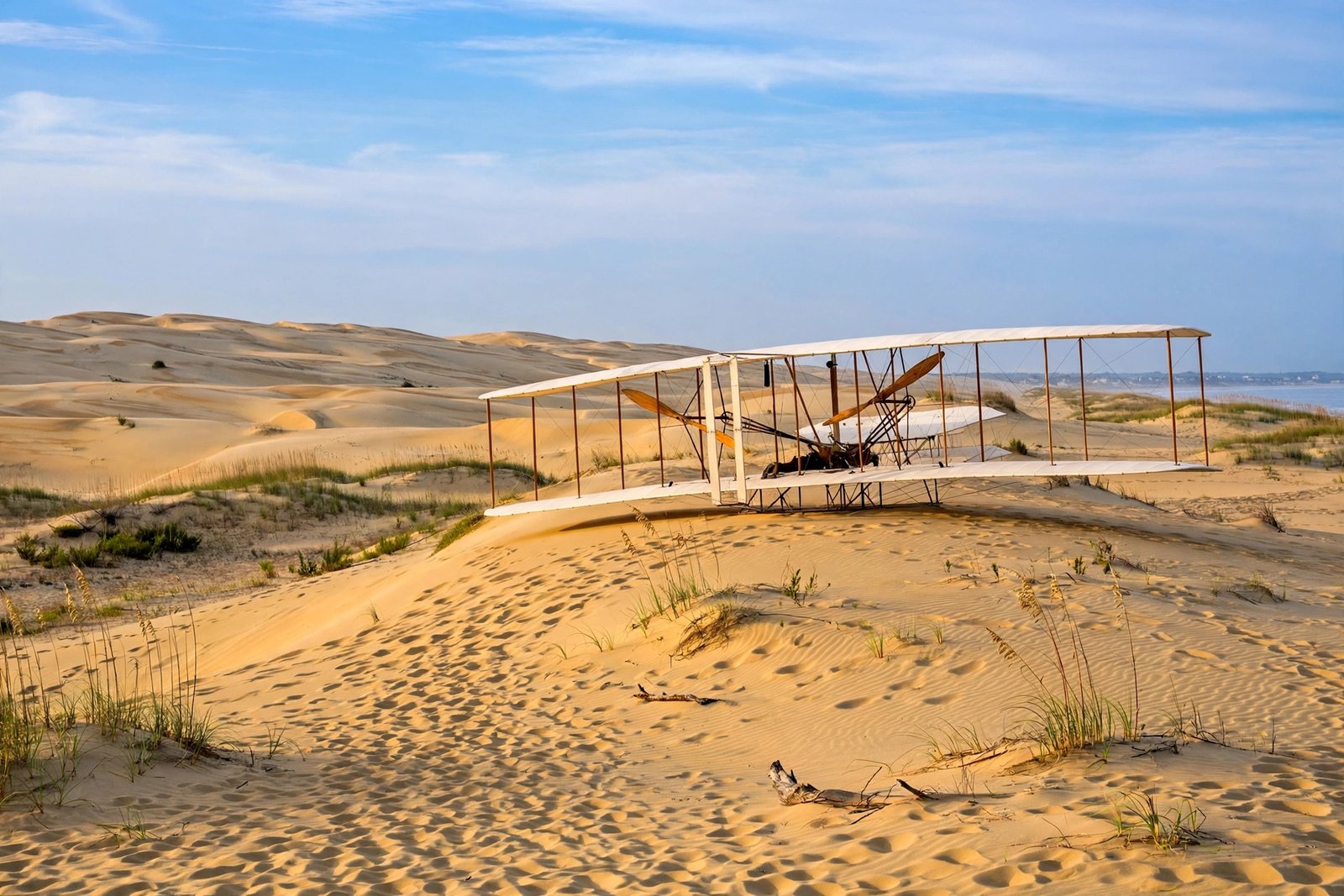
On a cold December morning in 1903, on a lonely stretch of sand on the North Carolina coast, two brothers from Ohio did something no human being had ever done before. At 10:35 a.m. on December 17, 1903, Orville Wright lay flat on the lower wing of a fragile wood-and-fabric machine, the engine sputtered to life, and the Wright Flyer lifted off the ground. Twelve seconds later, after traveling just 120 feet, it touched back down on the sand. It was the first powered, sustained, controlled flight of a heavier-than-air aircraft in history, and in those twelve seconds the world changed forever.
What makes the story so remarkable is who made it happen. Orville and Wilbur Wright were not wealthy men, university professors, or government scientists. They were bicycle makers from Dayton, Ohio, two brothers who ran a small repair shop and funded their experiments from the profits of their business. Through careful study and patient testing, they solved a problem that had defeated far better-funded inventors. It was the payoff for four years of disciplined work, and it opened the aerial age.
Two Bicycle Makers From Dayton, Ohio
Wilbur Wright was born on April 16, 1867, near Millville, Indiana, and his younger brother Orville was born on August 19, 1871, in Dayton, Ohio. The family moved around the Midwest as their father, Milton Wright, a bishop, traveled for his work, finally settling in Dayton in 1884. Neither brother graduated from high school, and neither went to college. Wilbur had hoped to attend Yale, but a serious injury in a winter sports accident in the winter of 1885–86 left him with damaged teeth and lingering health problems, and he spent the next few years caring for his mother, who was ill with tuberculosis. Orville learned the printing trade and persuaded Wilbur to join him in a print shop.
In 1892, the brothers opened a bicycle shop in Dayton, and a few years later they began building bicycles of their own design. The bicycle business gave the Wrights hands-on experience with lightweight machines built from wood, wire, and metal tubing, ideal preparation for building flying machines. The profits from the print shop and the bicycle shop paid for their aeronautical experiments from 1899 to 1905. Their interest in flight became serious in 1896, when the German glider pioneer Otto Lilienthal was killed in a glider crash. When the local library ran out of material on flight, Wilbur wrote to the Smithsonian Institution on May 30, 1899, asking for suggestions for further reading. That letter was the start of a research program that would last four years.
Why Kitty Hawk? The Search for Wind and Sand
The Wrights knew Dayton was the wrong place to test a flying machine. They needed wide-open space, steady wind, soft ground for landing, and privacy. They wrote to the U.S. Weather Bureau in Washington, D.C., asking for a list of places with steady winds, and among the promising locations was Kitty Hawk, North Carolina, a small fishing village on a thin strip of beach on the mid-Atlantic coast. They wanted steady winds, isolation, changes in elevation, and soft sand for landing, and Kitty Hawk offered all of it. Orville would later describe Kitty Hawk as being like the Sahara Desert, or what he imagined the Sahara to be. William Tate of the local weather station wrote back with enthusiasm, promising to help. The brothers made their first trip to Kitty Hawk in September 1900, and they would return again and again over the next three years.
Three Gliders and a Wind Tunnel: Learning to Fly Before Flying
Before flying with an engine, the Wrights knew they had to learn to control a flying machine, so they started with gliders. Their 1900 glider used a wire-braced biplane structure and a wing-warping system they had first tested with a kite in 1899. By twisting the wingtips in opposite directions, the pilot could bank and control the aircraft. The 1900 glider produced less lift than the brothers had predicted, but the control system worked. Their 1901 glider was worse, producing only about a third of the lift their calculations predicted, and it developed control problems. Instead of giving up, the brothers questioned the accepted science itself, suspecting the published aerodynamic data, including Lilienthal’s figures and a long-accepted value known as Smeaton’s coefficient, was wrong.
To find out, they first rigged a bicycle with measuring instruments, and then they built a small wind tunnel in their Dayton bicycle shop in the fall of 1901. Inside it, they tested dozens of wing shapes with instruments of their own design. Their tests showed that the accepted value for Smeaton’s coefficient, 0.005, was wrong. The correct value was about 0.0033. They also found the most efficient wing shape for their aircraft. Armed with good data, the brothers built a third glider in 1902, with thinner wings and a movable rudder. During September and October 1902, they made between 700 and 1,000 glides at Kitty Hawk, and they had created the first fully controllable aircraft, with control over pitch, roll, and yaw.
Building the Wright Flyer: A 12-Horsepower Gamble
In the spring and summer of 1903, back in Dayton, the brothers built their first powered airplane. It was essentially a larger, sturdier version of their 1902 glider, with one fundamentally new part: a propulsion system. No existing engine was light enough and powerful enough, so the Wrights designed their own. Their bicycle shop mechanic, Charlie Taylor, did virtually all the machine work to build it. The result was a four-cylinder gasoline engine that produced 12 horsepower, with an aluminum crankcase, the first time the lightweight metal had been used in airplane construction. Most original were the propellers: instead of copying a ship’s propeller, they treated the propeller as a rotary wing, turning an airfoil on its side to generate thrust. The two propellers were mounted behind the wings and driven by the engine through a chain-and-sprocket transmission system borrowed from bicycle design. By the fall of 1903, the Flyer was ready, but making it work at Kitty Hawk took weeks. Too big to assemble in Dayton, it took weeks to put together in North Carolina while the brothers fixed transmission problems. Orville had to return to Dayton to make new propeller shafts and did not get back to Kitty Hawk until December 11, with harsh winter weather closing in.
December 14: The Coin Toss and the False Start
On December 14, 1903, the Wrights were finally ready for a trial. They decided by a toss of a coin who would fly first, and Wilbur won. The Flyer sat on a 60-foot wooden launching rail on a small wheeled dolly. Wilbur’s attempt went wrong almost at once. About forty feet down the rail, the Flyer lurched upward, stalled, and smashed into the sand after only about three and a half seconds in the air. The forward elevator was slightly damaged, but the brothers were not discouraged: the engine had power, and the controls responded. Repairs took three days, and by the morning of December 17, everything was ready again, with Orville’s turn to fly.
December 17, 1903: Twelve Seconds That Changed the World
The morning of December 17, 1903, was freezing, and a strong wind was blowing at about 27 miles per hour. John T. Daniels, one of five local men helping that day, manned the brothers’ camera. At 10:35 a.m., the engine started, Orville lay prone on the lower wing with his hips in the cradle that operated the wing-warping mechanism, and Wilbur ran alongside. The Flyer darted up and down over the sand and came to rest with a thud 120 feet from takeoff. The flight had lasted only 12 seconds and reached a top speed of about 6.8 miles per hour, but it was a true flight. For the first time in history, a human being had flown a powered, controllable, heavier-than-air machine.
Four Flights in One Morning
The Wrights made four flights in total on December 17, 1903, taking turns as pilot, and each one was a little better than the last. After Orville’s first flight of 120 feet in 12 seconds, the brothers flew again, with the second and third flights covering roughly 175 and 200 feet. Then Wilbur took the controls for the fourth and final flight of the day. This time he steadied the airplane and flew 852 feet in 59 seconds, proving beyond doubt that the Flyer was capable of sustained, controlled flight. Minutes after that final landing, a strong gust of wind caught the Flyer on the ground and tumbled it across the sand, badly damaging it. The world’s first airplane would never fly again. The brothers crated the wreckage and shipped it back to Dayton. In 1948, exactly 45 years to the day after the first flight, it was donated to the Smithsonian, and today the original Wright Flyer hangs in the National Air and Space Museum in Washington, D.C.
What Happened After Kitty Hawk
Kitty Hawk was a beginning, not an ending. The 1903 Flyer was a proof of concept. It could fly in a straight line, but it was not yet a practical machine. The brothers returned to Dayton and spent 1904 and 1905 building better airplanes. Their Flyer III of 1905 could turn, bank, circle, and stay in the air for long stretches. On October 5, 1905, Wilbur flew it for 39 minutes over a closed course, covering about 24.5 miles. Then came a long wait. The brothers spent the next two and a half years seeking patent protection and customers, and they did not fly at all during that time. In 1908, Wilbur traveled to France to demonstrate the airplane in public, and Orville demonstrated it for the U.S. Army at Fort Myer, Virginia. The demonstrations were a triumph, and the Wrights became international celebrities almost overnight. Within a few years, airplanes were used in war, mail delivery, and the first scheduled commercial passenger flight, on January 1, 1914, between St. Petersburg and Tampa, Florida. Wilbur died in 1912 of typhoid fever, at only 45. Orville lived until 1948, long enough to see the airplane reach the jet age.
The Wright Flyer Today and the Memorial at Kill Devil Hills
Today, the place where the Wrights flew is preserved as the Wright Brothers National Memorial at Kill Devil Hills, North Carolina. Congress authorized the memorial in 1927, and a 60-foot granite monument was built atop Kill Devil Hill and dedicated in 1932. On December 17, 2003, more than 30,000 people gathered there to mark the 100th anniversary of the first flight. In 1969, Apollo 11 astronaut Neil Armstrong, like the Wright brothers a native of Ohio, carried a piece of wood from the Wright Flyer’s propeller and a piece of fabric from its wing to the Moon in his personal kit. Decades later, a piece of the Flyer’s wing fabric flew aboard NASA’s Ingenuity helicopter on the first powered flight on Mars, on April 19, 2021. From a sand dune in North Carolina to the surface of the Moon and the skies of Mars, the journey began with twelve seconds on December 17, 1903.
Why the First Flight Still Matters
The Wright brothers’ story endures because it is about more than an airplane. It is about two ordinary Americans who taught themselves a new science, questioned the accepted wisdom of their day, tested their ideas with their own hands, and kept going through failure after failure. They had no government funding and no university laboratory, only a bicycle shop, a wind tunnel they built themselves, and the steady winds of Kitty Hawk. If the brothers had given up after the failed glider of 1901 or Wilbur’s crash on December 14, the aerial age might have started somewhere else, years later. Instead, on a freezing morning on the Outer Banks, two brothers from Dayton proved that human beings could fly.
Frequently Asked Questions
When was the Wright brothers’ first flight?
The first powered flight took place on December 17, 1903, at 10:35 a.m., at Kill Devil Hills near Kitty Hawk, North Carolina. Orville Wright was the pilot.
How long did the first flight last?
The first flight lasted 12 seconds and covered 120 feet. The brothers made four flights that day, and the longest, piloted by Wilbur, lasted 59 seconds and covered 852 feet.
Why did the Wright brothers choose Kitty Hawk?
They needed steady winds, wide-open space, soft sand for landings, and privacy. After writing to the U.S. Weather Bureau, they picked Kitty Hawk on North Carolina’s Outer Banks. They had tested gliders there since 1900.
What kind of airplane was the Wright Flyer?
The Wright Flyer, also called Flyer I, was a wood-and-fabric canard biplane with a 12-horsepower four-cylinder gasoline engine driving two pusher propellers through a chain-and-sprocket system. It took off from a 60-foot wooden launching rail.
Where is the original Wright Flyer now?
The original 1903 Wright Flyer is on display at the Smithsonian’s National Air and Space Museum in Washington, D.C. It was formally donated to the Smithsonian on December 17, 1948, exactly 45 years after the first flight.
Can I visit the site of the first flight?
Yes. The Wright Brothers National Memorial at Kill Devil Hills, North Carolina, preserves the field where the flights took place, with markers for the takeoff and landing points and a 60-foot monument atop Kill Devil Hill.
Related reading
- American inventions that changed the world
- NASA’s Artemis Moon program and American power in space
- How GPS, America’s satellite system, powers the modern world
Sources: This article draws on the Smithsonian National Air and Space Museum (The Wright Brothers Made History at Kitty Hawk), NASA (120 Years Ago: The First Powered Flight at Kitty Hawk), the Smithsonian Institution’s record of the 1903 Wright Flyer, Encyclopaedia Britannica’s Wright brothers biography, the National Park Service’s history of commemorating the Wright brothers at Kitty Hawk, and Smithsonian Magazine (Who Were the Wright Brothers?).