
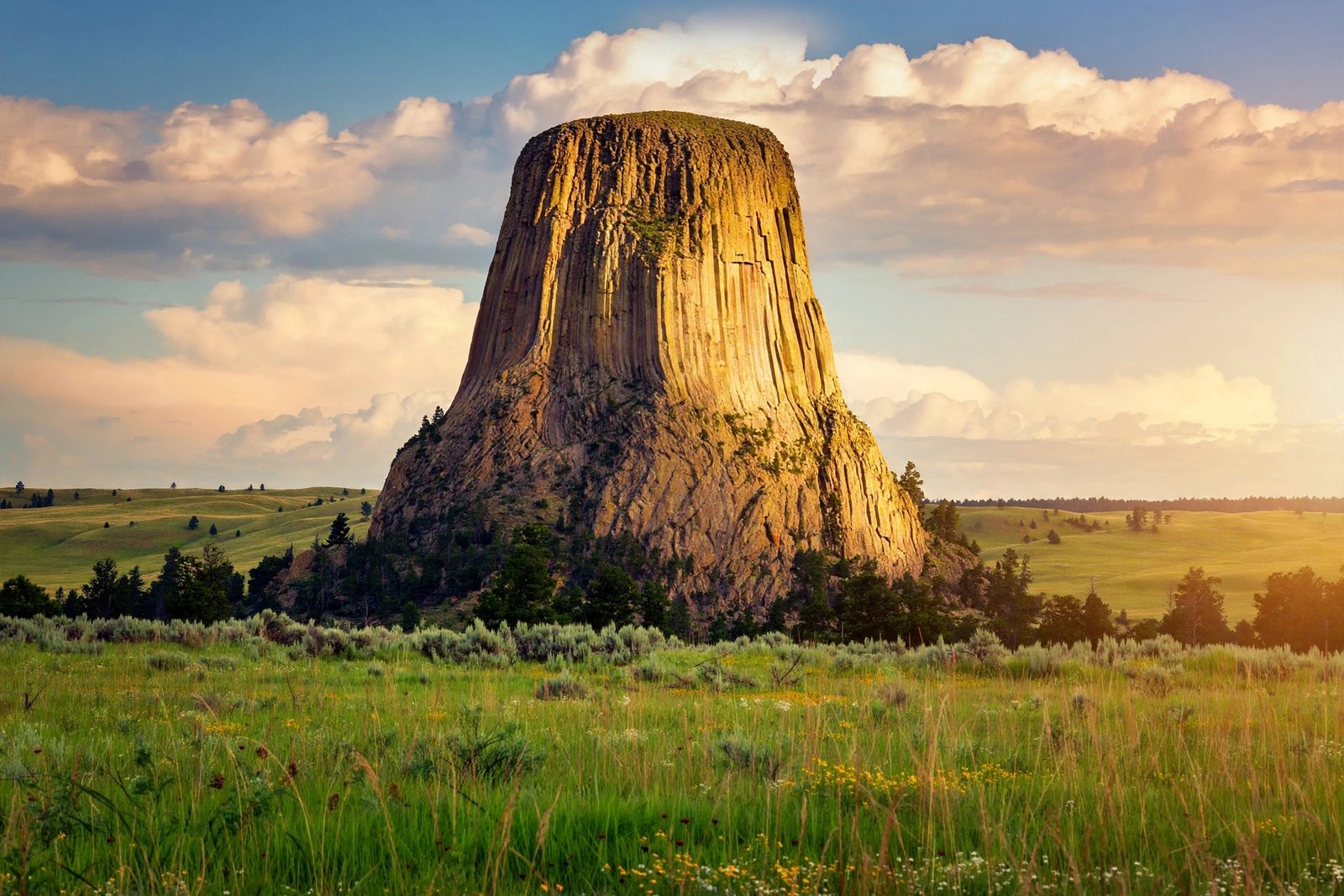
There are places in America that stop you in your tracks the first time you see them, and Devils Tower in northeastern Wyoming is one of them. Rising out of rolling prairie and pine-covered hills, this enormous stone column looks almost too straight, too tall, and too strange to be natural. It is not a mountain in the usual sense, and it is not a volcano. It is a single mass of cooled igneous rock, grooved from top to bottom with tall, hexagonal columns, standing alone against a wide Wyoming sky. For many visitors, the first sight of it is the moment a road trip becomes a memory.
Devils Tower also has a remarkable claim to fame. On September 24, 1906, President Theodore Roosevelt proclaimed it America’s first national monument, using the brand-new Antiquities Act of 1906. That decision set a pattern that would eventually protect hundreds of historic and natural places across the country.
Yet Devils Tower is more than a scenic stop. To more than 20 Native American tribes, it is a sacred place known as Bear Lodge, a site of prayer, ceremony, and stories that long predate the monument designation. To geologists, it is one of the finest examples of columnar jointing in the world. To climbers, it is a world-famous crack-climbing destination. And to anyone who loves the American West, it is a reminder that some of the country’s most extraordinary places are not in the famous national parks, but tucked away in quiet corners like Crook County, Wyoming, near the towns of Hulett and Sundance, above the Belle Fourche River.
America’s First National Monument
The story of how Devils Tower became a protected place begins in the late 1800s, when settlers, ranchers, and visitors began to worry that this unusual landmark might be damaged or carved up for private use. Wyoming Senator Francis E. Warren and Wyoming Representative Frank W. Mondell were among the early voices calling for its protection, and their efforts stretched over more than a decade. The problem was that there was no simple legal tool for a president to protect a natural landmark on public land.
That changed in 1906, when Congress passed the Antiquities Act. The new law gave the president authority to declare historic landmarks, historic and prehistoric structures, and other objects of historic or scientific interest on federal land to be national monuments. President Theodore Roosevelt, already known as a passionate conservationist, used that authority almost immediately. On September 24, 1906, he proclaimed Devils Tower the nation’s first national monument.
The original monument covered only a modest area around the tower itself, and its boundaries have been adjusted since then, but the core idea has never changed: this is a place set aside for the public, protected because of its geology, its beauty, and its cultural importance. Roosevelt would go on to designate 18 national monuments during his presidency, but Devils Tower was the first, and that fact alone makes it a landmark in the history of American conservation.
How Devils Tower Was Formed
Devils Tower looks like it was built, but it was born underground. Geologists explain that about 50 million years ago, molten rock pushed upward from deep within the Earth, forcing its way into older layers of sedimentary rock but never breaking through to the surface. The mass of magma cooled slowly underground, and as it cooled, it contracted and cracked into long, mostly hexagonal columns. That process is called columnar jointing, and the National Park Service describes Devils Tower as featuring the world’s largest example of it.
The rock itself is phonolite porphyry, a rare igneous rock that contains visible crystals of feldspar. It is not granite, though it can look similar at a distance. The columns are the tower’s most striking feature. Some are only a few inches across, while others reach several feet in diameter, and they run vertically for hundreds of feet, giving the tower its fluted, almost pleated appearance. Stand close to the base and look up, and the columns seem to go on forever.
Over millions of years, the softer sedimentary rock that once surrounded the cooled magma eroded away, carried off by wind, water, and time. The hard igneous core remained, gradually exposed as the landscape around it wore down. That is why the tower stands alone today, with no mountain range around it. It is the tough heart of an ancient intrusion, revealed after the softer earth around it was stripped away.
The result is a formation that rises 867 feet from its base to its summit, stands 1,267 feet above the Belle Fourche River, and reaches 5,117 feet above sea level at its flat summit, which is roughly the size of a football field.
Bear Lodge: A Sacred Place
Long before it had an English name, this place had names in the languages of the Plains tribes. The Lakota call it Mato Tipila, which means Bear Lodge. Other tribes know it by names that translate as Bear’s Tipi, Bear’s House, Tree Rock, or Bear Rock. Today, the National Park Service notes that it is a sacred place to more than 20 Native American tribes, including the Lakota, Cheyenne, Arapaho, Kiowa, and Crow peoples.
One of the best-known stories told about the tower explains its grooves as the claw marks of a giant bear. In versions told by several tribes, a group of young girls was chased by a great bear. They climbed onto a low rock and prayed for help, and the rock rose toward the sky, carrying them out of reach. The bear clawed at the sides of the rising stone, leaving the deep vertical marks that visitors see today. The story is told in different forms by different peoples, but the image of the bear and the rising rock is shared across the Plains.
The name Devils Tower itself came much later, and it came from a misunderstanding. In 1875, Colonel Richard Irving Dodge led a geological expedition into the Black Hills region, and he recorded a name he understood to mean Bad God’s Tower. He shortened and changed it to Devil’s Tower, and the new name stuck, even though it had no spiritual meaning for the tribes who revered the place. The official name today is written without an apostrophe: Devils Tower.
That history matters for visitors. Prayer cloths and bundles are sometimes tied to trees near the tower, and ceremonies take place here, especially in June. Visitors are asked to respect those offerings, to keep noise down near ceremonial areas, and to remember that this is not only a scenic viewpoint. It is a living sacred place, and respectful behavior is part of visiting well.
Climbing History: From a Wooden Ladder to a World Classic
Devils Tower has attracted climbers since long before modern climbing gear existed. The first documented ascent took place in 1893, when local ranchers William Rogers and Willard Ripley reached the summit using a wooden ladder they built by driving stakes into cracks in the rock. Parts of that ladder remained visible on the tower for decades, a reminder of how determined those early climbers were.
Modern rock climbing arrived in the 1930s. The Durrance Route, first climbed in 1938 by Jack Durrance, remains one of the most famous routes on the tower, and it is still a classic introduction to the kind of climbing Devils Tower is known for: long cracks between the columns, where climbers jam hands and feet into the gaps and work their way steadily upward. Today, the tower has more than 200 established climbing routes, and it is regarded as one of the premier traditional crack-climbing destinations in North America.
Climbing here is not a casual activity. The summit is reached only by technical rock climbing, and a climb typically takes many hours. Climbers must register before they climb, and they are expected to check for route closures, including seasonal closures that protect nesting falcons in spring and early summer. The Park Service provides current climbing information and closure updates, and climbers are expected to follow them.
Perhaps the most important climbing tradition at Devils Tower is the voluntary June climbing closure. Each June, climbers are asked to stay off the tower out of respect for Native American ceremonies that take place during that month. The closure is voluntary rather than legally enforced, but it is strongly supported by the National Park Service, by climbing organizations, and by much of the climbing community. It is a compromise worked out in the park’s climbing management plan, and it reflects the idea that access and respect can coexist when visitors choose to honor both.
Visiting Devils Tower: What to Do and When to Go
For most visitors, the best introduction to Devils Tower is the Tower Trail, a paved 1.3-mile loop that circles the base of the formation. The trail is rated easy, takes about 45 minutes to an hour at a leisurely pace, and offers constantly changing views as you walk around the tower. Interpretive signs along the way explain the geology, the wildlife, and the cultural history, and the boulder field at the base gives a close look at fallen columns.
The monument is open 24 hours a day, every day of the year, although the visitor center keeps regular daytime hours. The grounds around the tower are accessible at all hours, which means early morning and evening visits can be especially rewarding. Sunrise and sunset light bring out the color and texture of the columns, and the prairie sky at dusk is wide and quiet in a way that is hard to find in busier parks.
Beyond the Tower Trail, the park offers longer hikes, including the Red Beds Trail, which runs about three miles through the red sandstone hills around the monument, and the Joyner Ridge Trail, a short loop across the valley that offers one of the best wide views of the tower for photographs. Wildlife watchers should keep an eye out for prairie dogs, deer, and birds of prey, and the Park Service asks visitors to stay at least 25 yards from wildlife.
Summer is the busiest season, and parking can fill up quickly, especially in June, July, and August. Arriving early in the morning is the simplest way to avoid the crowds and the heat. Spring and fall bring cooler temperatures, fewer visitors, and beautiful light, while winter offers a stark, quiet version of the monument, with snow on the prairie and far fewer people. Whatever season you choose, check the official park website before you go for current conditions, closures, and entrance information.
For photographers, the tower changes dramatically with the light, so walk the full loop and cross to Joyner Ridge for the classic wide shot. The formation that seemed simple from a distance reveals new shapes from every angle.
Why Devils Tower Still Matters
Devils Tower matters for several reasons, and they add up to more than a good photograph. It matters as the first place protected under the Antiquities Act, the beginning of a conservation idea that now shapes how America treats its most important landscapes. It matters as a geological wonder, a place where anyone can see, up close, how the Earth builds and then reveals its hidden structures. And it matters as a sacred place, where stories, ceremonies, and prayers continue in the present day, not only in the past.
It also matters because it is accessible. A family can walk the Tower Trail in under an hour, and a traveler driving between the Black Hills and Yellowstone can stop for an afternoon and see something unforgettable.
That combination is what makes Devils Tower a true hidden gem. It is recognized around the world, thanks in part to its appearance in Steven Spielberg’s film Close Encounters of the Third Kind, yet it remains quieter and more personal than the great national parks. There is a tower, a trail, a prairie, and a sky.
If you are planning a trip through Wyoming, South Dakota, or Montana, put Devils Tower on the list and give it more than a quick drive-by. Walk the loop, read the signs, look for the prayer cloths, and take time to think about the bear story and the long history of the place. The tower has stood here for millions of years. A slow visit is the least we can offer in return.
Frequently Asked Questions
Where is Devils Tower located? Devils Tower National Monument is in Crook County, in northeastern Wyoming, near the towns of Hulett and Sundance, above the Belle Fourche River. It sits on the northwest flank of the Black Hills region, within driving distance of Rapid City, South Dakota, and the Black Hills.
Why is Devils Tower famous? It was proclaimed America’s first national monument on September 24, 1906, by President Theodore Roosevelt, under the Antiquities Act of 1906. It is also famous for its columnar jointing, its sacred significance to more than 20 Native American tribes, its world-class crack climbing, and its appearance in the film Close Encounters of the Third Kind.
Can you climb Devils Tower? Yes, but only by technical rock climbing. The summit is reached on established climbing routes, and climbers must register before climbing and check for seasonal route closures. There is no hiking trail to the top. Visitors are asked to respect the voluntary June climbing closure, which honors Native American ceremonies.
How long does the Tower Trail take? The paved Tower Trail is a 1.3-mile loop around the base of the tower. Most visitors take about 45 minutes to an hour to walk it at a leisurely pace, stopping to read signs and take photographs along the way.
What is the best time to visit Devils Tower? Late spring through early fall offers the most reliable weather and full visitor services, but summer is also the busiest season. Arriving early in the morning helps with parking and crowds. Spring and fall are quieter and cooler, and the monument is open year-round, 24 hours a day.
Related reading
Keep exploring America’s remarkable places with these stories from Famus News: America’s 63 National Parks Guide, Great Basin National Park, Nevada Hidden Gem, and Pictured Rocks, Michigan Hidden Gem.
Sources: National Park Service: Devils Tower Basic Information; National Park Service: Devils Tower National Monument; National Park Service: Early Conservationists; National Park Service: Climbing Information; National Park Service: Geodiversity Atlas, Devils Tower; WyoHistory.org: Devils Tower.