
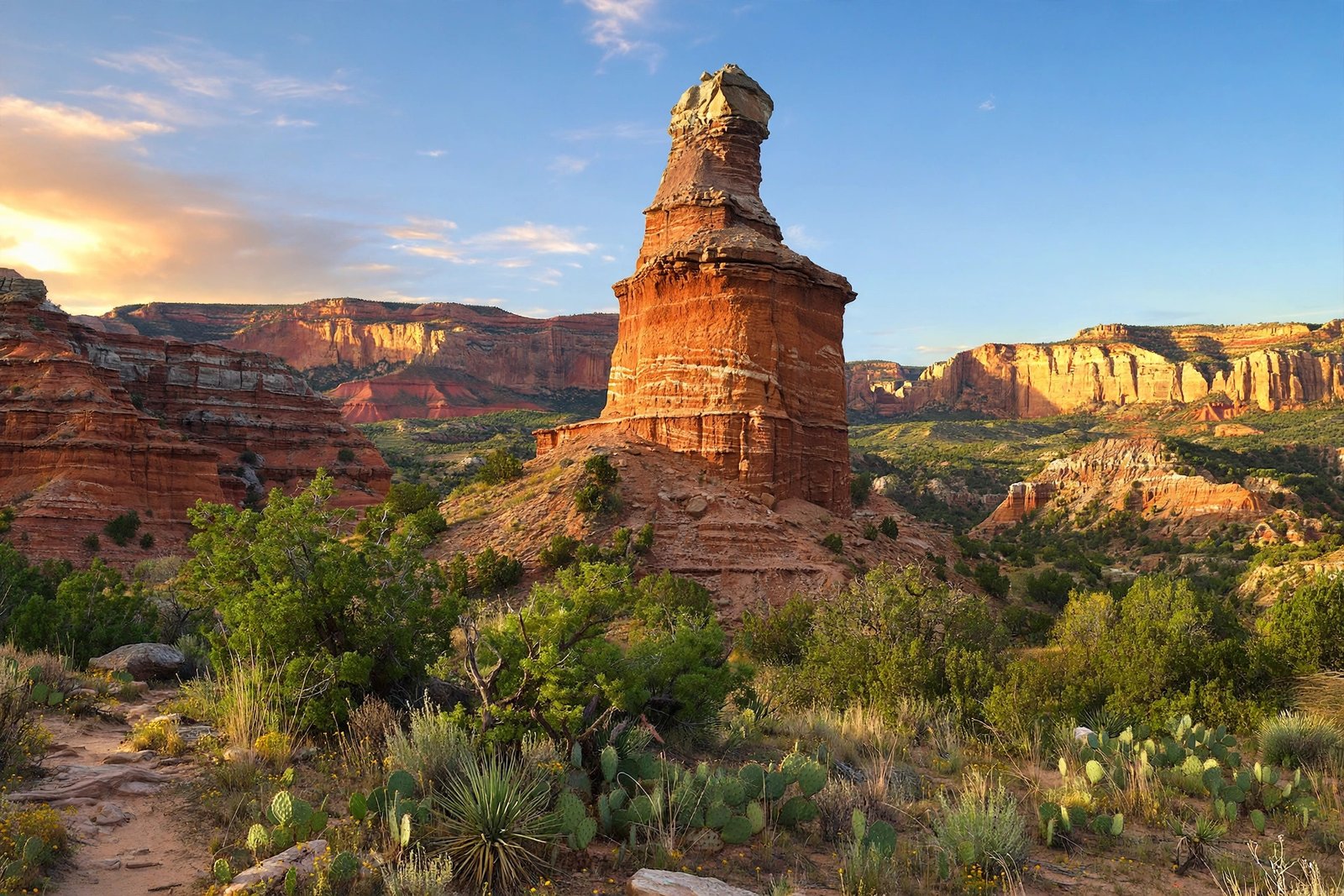
Drive south from Amarillo, Texas, and the flat Panhandle plains suddenly fall away. The ground opens into a vast red-rock gorge striped in orange, pink, and cream, with towering hoodoos and mesas stretching to the horizon. This is Palo Duro Canyon, and for travelers who think Texas is all flat ranchland and big cities, it feels like stumbling onto a secret. The canyon is the second-largest in the United States, behind only the Grand Canyon, yet it remains far less crowded than its famous Arizona cousin. That combination of scale and solitude is exactly what makes it one of the great hidden gems of the American West.
Palo Duro Canyon State Park protects the most spectacular stretch of the gorge, about 25 miles southeast of Amarillo and just east of the small town of Canyon. Inside the park you can hike to a 310-foot rock tower called the Lighthouse, drive a scenic road down to the canyon floor, camp beneath some of the darkest skies in Texas, and watch a Broadway-style outdoor musical performed against a cliff face at sunset. This guide covers everything you need to plan a visit, from the canyon’s geology and best trails to the seasons, the show, and the practical details that make the difference between a great trip and a miserable one.
Where Is Palo Duro Canyon — and Why Is It Called the Grand Canyon of Texas?
Palo Duro Canyon lies in the Texas Panhandle, carved into the eastern edge of the Llano Estacado, the high plains plateau that covers much of West Texas. The canyon system stretches roughly 120 miles long, up to about 20 miles wide in places, and reaches depths of around 800 feet. Those dimensions are why Texas Parks and Wildlife describes it as the second-largest canyon system in the United States, and why locals have long nicknamed it the Grand Canyon of Texas. It is much shallower than the Grand Canyon, but the colors, the hoodoos, and the sheer sense of space are just as striking.
The canyon was cut by the Prairie Dog Town Fork of the Red River, which still winds along the canyon floor today. The state park itself covers nearly 30,000 acres, and it opened in 1934 after the Civilian Conservation Corps built roads, cabins, and trails during the Great Depression. Many of those CCC structures are still in use, and they give the park a historic, hand-built character that newer parks lack. The park entrance sits on the canyon rim, and the paved park road descends steeply to the floor, where most of the trails, campgrounds, and the amphitheater are located.
Getting there is straightforward. The park is roughly a half-hour drive from Amarillo, which has the nearest airport, hotels, and restaurants. From Interstate 40, take the exit for Canyon and follow the signs south. There is no public transportation to the park, so a car is essential, and visitors should fill up on fuel and water in Canyon or Amarillo before heading in.
How the Canyon Was Carved
The striped walls of Palo Duro Canyon are a layer cake of rock laid down over some 250 million years. The deep red clay comes from the Quartermaster Formation, while bright white streaks of gypsum and pale yellow caliche add contrast to the cliff faces. Each band of color marks a different ancient environment — shallow seas, river floodplains, and wind-blown deserts — stacked one on top of another and then sliced open by the river.
The canyon’s most famous formations are its hoodoos, tall narrow towers of rock with a harder caprock protecting softer sediment beneath. Differential erosion did the sculpting: the hard caprock resisted wind and rain while the softer rock around it weathered away, leaving towers standing alone on the canyon floor. The Lighthouse, the park’s signature formation, is the finest example, but look closely on any hike and you will spot dozens of smaller hoodoos, balanced rocks, and castle-like battlements.
The landscape is still changing. Flash floods after heavy rain can reshape washes and close trails, and the clay soil turns slick and treacherous when wet. That is why the park sometimes closes trails in wet weather, and why rangers ask visitors to check the current park alert before arriving.
The Lighthouse: The Canyon’s Most Famous Rock
If you do only one hike in Palo Duro Canyon, make it the Lighthouse Trail. The trail leads about 2.8 miles each way across the canyon floor to the base of the Lighthouse, a 310-foot rock tower that has become the symbol of the entire canyon. The route is rated moderate and is mostly flat, winding through sunflower fields and sandy washes past massive red cliffs, before a short steep scramble at the very end. Allow roughly two and a half to four hours for the round trip of about 5.6 to 6 miles.
The catch is the sun. The Lighthouse Trail has almost no shade, and the canyon floor can run 10 to 15 degrees hotter than the rim, with summer temperatures frequently topping 110 degrees Fahrenheit. Texas Parks and Wildlife warns that most heat-related injuries at the park happen on this trail. Start before 8 a.m. in summer, carry far more water than you think you need, wear a hat and sunscreen, and turn back if the heat builds. During extreme heat advisories the park may close this and other trails between 11 a.m. and 5 p.m. for visitor safety.
The reward for an early start is worth it. In the soft morning light the Lighthouse glows orange and pink, and the trail is quiet enough that you may spot mule deer, roadrunners, and wild turkeys. Bring a camera, but also take time to simply stand at the base of the tower and look up — photographs rarely capture how tall it feels in person.
Best Hikes in Palo Duro Canyon State Park
The park has more than 30 miles of trails for hiking, mountain biking, and horseback riding, so there is something for every energy level. The Lighthouse Trail is the classic, but several others deserve a place on your list.
The Rock Garden Trail is the canyon’s toughest popular hike, climbing roughly 600 feet from the canyon floor to the rim over about 5 miles round trip. It winds through massive boulders and switchbacks and rewards the effort with sweeping views from the top. The Capitol Peak Trail, about 5.5 miles, is a favorite with mountain bikers and offers mesa views, while the GSL Trail — named for Givens, Spicer, and Lowry — runs about 5.7 miles of technical multi-use terrain along the canyon rim.
For an easier outing, the Paseo Del Rio Trail is a flat, family-friendly riverside walk of about a mile, and the Pioneer Nature Trail is a short loop of roughly 0.4 miles near the visitor center. The CCC Trail, about 1.4 miles each way, descends through several geologic layers past historic bridges built by the Civilian Conservation Corps. Whatever trail you choose, download the latest trail map from the park’s website before you go, and remember that trail conditions can change quickly after rain.
The TEXAS Outdoor Musical
On summer evenings, the canyon floor transforms into a theater. The TEXAS Outdoor Musical is staged in the Pioneer Amphitheatre, an open-air venue carved into a natural basin at the base of the canyon, and it tells the story of the Texas Panhandle’s settlers in the 1800s through song, dance, and fireworks lighting up the canyon walls. The show has run every summer since 1966, and the 2026 season marked its 60th year, produced by the Texas Panhandle Heritage Foundation.
Performances typically run Tuesday through Sunday from early June through early August, with gates opening in the early evening and the show starting around sunset. The 2026 season ran June 11 through August 1. Tickets are sold by the production rather than the park, and prices vary by section, so check the official show website for the current season’s dates and prices before planning your trip. An optional chuckwagon-style barbecue dinner is available before the show, and reservations are strongly recommended, especially on weekends and around the Fourth of July.
Even if musical theater is not usually your thing, the setting makes this one special. Watching fireworks burst above a 600-foot cliff while the canyon walls glow in the stage lights is an experience you will not find anywhere else in America. Bring a light jacket, as temperatures drop quickly after sunset on the canyon floor.
Camping, Cabins, and the Scenic Drive
Palo Duro Canyon State Park is one of the best places in Texas to spend a night outdoors. The park has campgrounds on the canyon floor with sites for tents and RVs, plus historic CCC cabins that sleep several people and book up far in advance. Camping lets you experience the canyon at its quietest — sunrise over the rim, stars undimmed by city lights, and coyotes calling in the dark. Campsites and cabins should always be reserved ahead through the Texas State Parks reservation system, especially on spring and fall weekends and during the musical season.
If you only have a few hours, the scenic drive is the way to see the canyon. The paved park road drops from the rim past the visitor center to the canyon floor, then loops along the river with overlooks, picnic areas, and trailheads. Stop at the overlooks on the way down — the first glimpse of the canyon from the rim is the one you will remember. The visitor center is worth a stop too, with exhibits on the canyon’s geology, wildlife, and CCC history, and rangers who can advise on trail conditions for the day.
Best Time to Visit Palo Duro Canyon
Spring and fall are the sweet spots. From March through May and September through November, daytime temperatures are comfortable for hiking, wildflowers bloom in spring, and the cottonwood trees along the river turn gold in autumn. These are also the busiest weekends, so reserve a day pass in advance.
Summer brings the TEXAS musical and long evenings, but also brutal heat. July averages a high around 92 degrees Fahrenheit, and the canyon floor runs hotter still. If you visit in summer, hike at sunrise, rest in the shade during the middle of the day, and save your energy for the evening show. Winter is the quiet season: cold mornings, empty trails, and crisp clear light on the red rock, with occasional dustings of snow that make the canyon look almost unreal.
Whatever the season, reserve a day pass online before you go. The park often reaches capacity on weekends and holidays, and a reserved pass guarantees entry when the park is full. Day passes open about a month ahead.
Practical Visitor Tips
A little planning goes a long way at Palo Duro Canyon. The day-use fee is $8 per person for ages 13 and older, and children 12 and under enter free. A Texas State Parks Pass, at $70 a year, covers entry and is worth it if you plan to visit several Texas state parks. Note that Texas state parks do not accept federal passes such as the America the Beautiful Pass, so bring your state pass or pay the day fee.
Water is the most important thing you will pack. There is no drinking water on the trails, so carry at least a liter per person per hour of hiking in warm weather, and more on the Lighthouse Trail. Cell service is spotty inside the canyon, so download maps and your day pass before descending. Watch for wildlife — rattlesnakes are present in warm months, so stay on trails and watch where you put your hands and feet. And leave no trace: pack out everything you bring in, and stay on marked trails to protect the fragile desert soil.
Finally, give yourself more time than you think you need. Most visitors plan a quick stop and end up wishing they had a full day. Arrive early, hike in the morning, rest through the heat of the day, and stay for sunset, when the canyon walls burn orange and red. That is when Palo Duro Canyon earns its nickname — and when you will understand why Texans call it their Grand Canyon.
Frequently Asked Questions
Is Palo Duro Canyon really the second-largest canyon in the US? Yes, that is how it is usually described. At roughly 120 miles long, up to about 20 miles wide, and around 800 feet deep, it is the second-largest canyon system in the United States after the Grand Canyon, though it is much shallower than its Arizona counterpart.
How long is the Lighthouse Trail? About 5.6 to 6 miles round trip, mostly flat, with a short steep scramble at the end. Most people take two and a half to four hours. The trail has almost no shade, so start early in the morning, especially in summer.
How much does it cost to enter Palo Duro Canyon State Park? The day-use fee is $8 per person for ages 13 and older, and children 12 and under enter free. A Texas State Parks Pass costs $70 a year and covers entry. Reserve a day pass online in advance, as the park often fills up on weekends.
When is the TEXAS Outdoor Musical performed? The show runs on summer evenings, typically Tuesday through Sunday from early June through early August, in the Pioneer Amphitheatre on the canyon floor. The 2026 season ran June 11 through August 1. Check the show’s official website for the next season’s dates and ticket prices.
Related Reading
Keep exploring America’s hidden natural wonders: Devils Tower, Wyoming’s Hidden Gem, Pictured Rocks, Michigan’s Hidden Gem, and Great Sand Dunes National Park, Colorado Guide.